Huating Temple: A Buddhist Temple in Kunming
Site at a Glance
- Rating
- 4.9
- Popularity
- Very Low
- Country
- China
- Primary era
- Medieval
- Eras represented
- Medieval
- Civilizations
- Yuan
- Site type
- Religious
- Remains
- Monastery
On this page13 sections
History
Huating Temple is a Chinese Buddhist temple in Xishan District, Kunming, China, founded in 1320 during the Yuan dynasty and completed in 1334. Associated with the Weiyang school, a branch of Chan Buddhism, it developed from a religious foundation connected with the history of Yunnan and has remained an active focus of Buddhist tradition through repeated rebuilding.
Origins and Yuan Dynasty Foundation
The site was associated with the Dali Kingdom, a medieval kingdom centered in present-day Yunnan before the region entered the Yuan imperial system. It was reportedly the residence of Gao Zhisheng, Marquis of Shanchan. The temple itself was established by the Buddhist monk Xuantong Yuanfeng and was originally called Yuanjue Temple.
In 1339, Xuantong Yuanfeng returned from Jiangnan with a set of the Chinese Buddhist canon, a collection of scriptures and authoritative religious texts. The arrival of these texts strengthened the temple’s role as a place of Buddhist learning during the Yuan period.
Ming Recognition and Renovation
In 1441, Emperor Yingzong of the Ming dynasty bestowed the name Huating Temple, which has continued in use. Twelve years later, the Jingtai Emperor sent the eunuch Li Yi to oversee renovation and redecoration. These imperial interventions connected the temple with the religious and administrative institutions of the Ming court.
Warfare, Reconstruction, and Buddhist Revival
Warfare following the fall of the Ming dynasty devastated the temple. Wang Jiwen, governor-general of Yunnan and Guizhou, rebuilt it in 1687 during the Qing dynasty. Part of the complex was badly damaged during the Hui Uprising in 1857 and received limited repairs in 1883.
A further phase of renewal began in 1920, when Tang Jiyao invited the monk Hsu Yun to propagate Buddhism at Huating Temple. Hsu Yun supervised reconstruction in 1923, and the temple also received the alternative name Jingguo Yunqi Chansi.
The Buddhist Texts Library deteriorated through neglect in 1969 and was demolished in 1970. Huating Temple had already been designated a Kunming municipal cultural-protection unit in 1961. In 1983, the State Council included it in the national list of key Buddhist temples in Han Chinese areas.
Remains
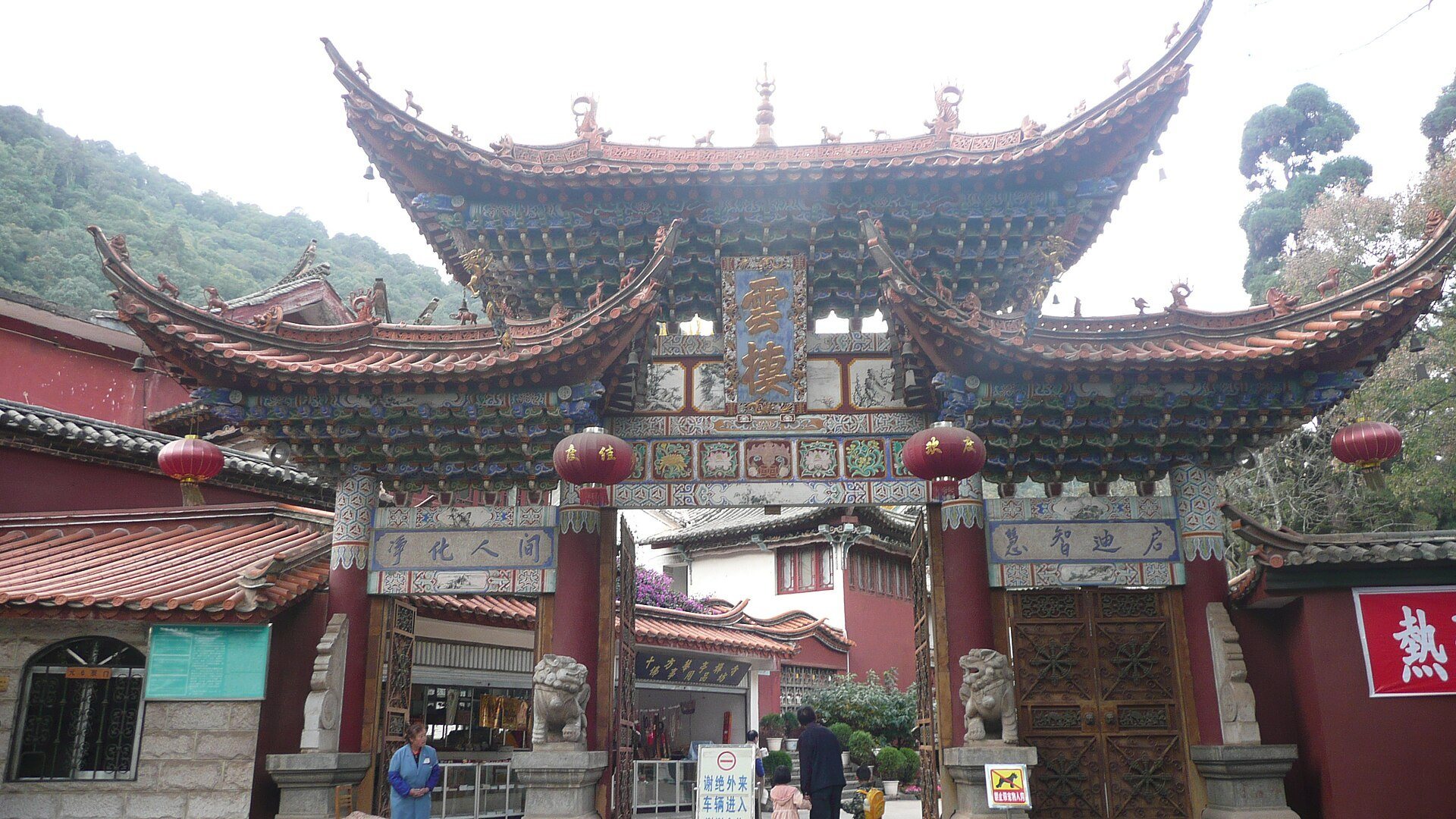
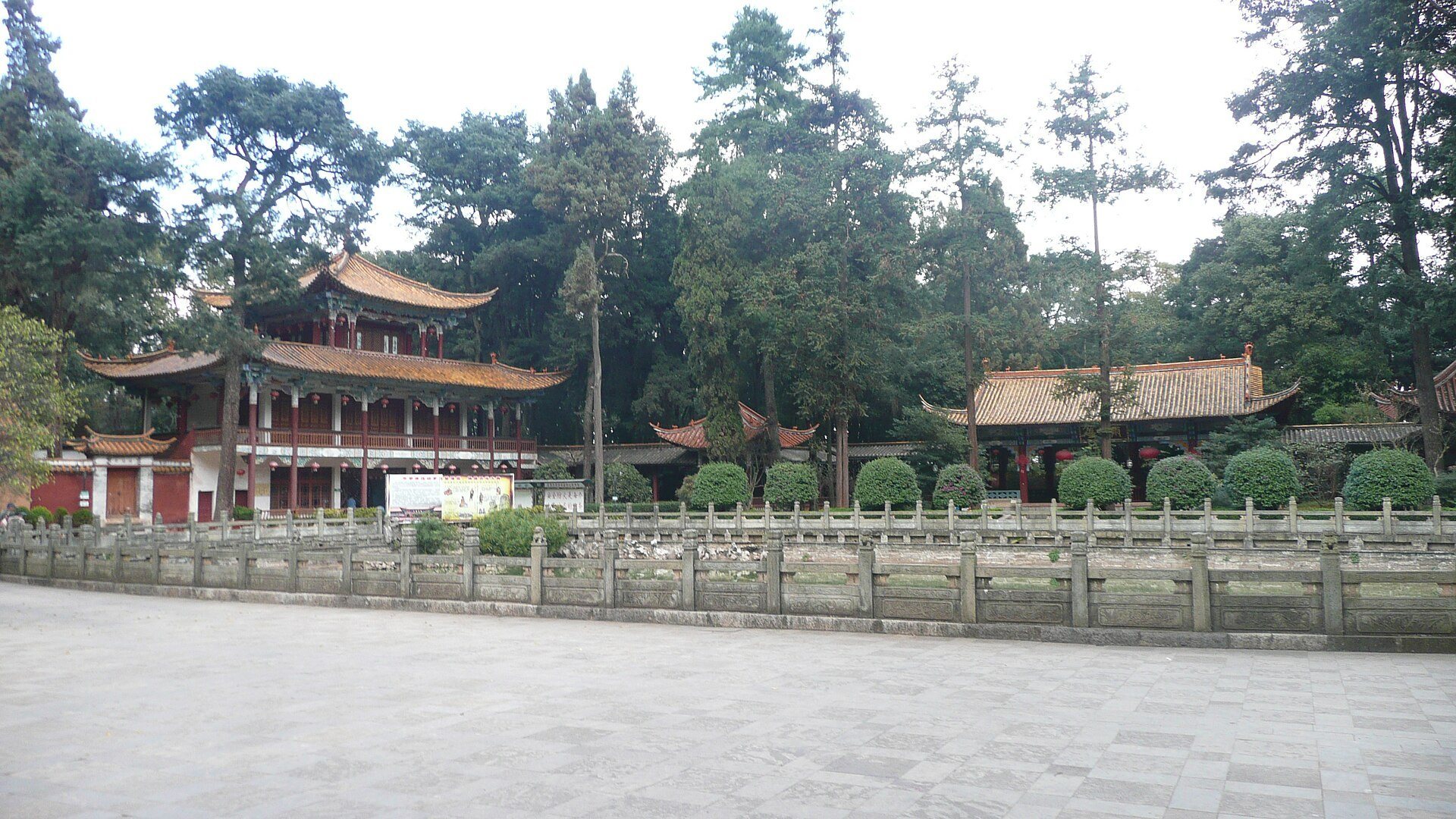
Huating Temple stands in the Xishan mountains of Kunming. A traditional ceremonial gateway, or paifang, marks the approach, while a pool lies before the principal buildings. The complex is organized along a central axis, with more than ten halls and rooms arranged on both sides. Its layout includes a mountain gate, the Tianwang Hall, the Mahavira Hall, the Guanyin Hall, and the Buddhist Texts Library, together with subsidiary spaces for monastic life.
Entrance and Guardian Figures
Mountain Gate and Tianwang Hall
The Tianwang Hall is devoted to the Four Heavenly Kings. Its central shrine contains Maitreya Buddha and Weituo, while the Four Heavenly Kings occupy positions on the left and right sides. The figures known as Heng and Ha stand beside the hall. A couplet by the Qing calligrapher Qian Feng hangs at the Maitreya shrine.
Stone and Vajra Sculptures
Stone sculptures of a green lion and a white elephant stand near the Tianwang Hall. Two seated Vajra figures are placed outside it. The figure on the left has an angry expression, an open mouth, and holds a pestle used for subduing demons. The figure on the right has a wrathful expression, a closed mouth, and holds a similar pestle. Identified as a Secret-Trace Vajra, it forms part of a paired seated arrangement described as distinctive among Buddhist temples.
Principal Halls and Buddhist Images
Mahavira Hall
The Mahavira Hall, the principal Buddha hall, enshrines Shakyamuni, Amitabha, and the Medicine Buddha. Ananda and Kassapa stand on either side of Shakyamuni. Behind him are statues of Guanyin and the Twenty-four Devas. The side walls contain 500 niches with small Arhat statues, representing Buddhist holy figures regarded as having attained spiritual liberation.
Guanyin Hall and Three Buddhas
The Guanyin Hall forms part of the central sequence of buildings. The temple also contains three full-body statues, each about five metres high, representing the Buddhas of the Three Times, associated with the past, present, and future.
Monastic Buildings and Central Axis
Rooms on either side of the main axis include the Patriarch Hall, Abbot’s Hall, monastic dining hall, monastic reception hall, and meditation hall. These buildings accompany the principal worship halls and express the complex’s organization around both religious ceremony and monastic life.
Buddhist Texts Library
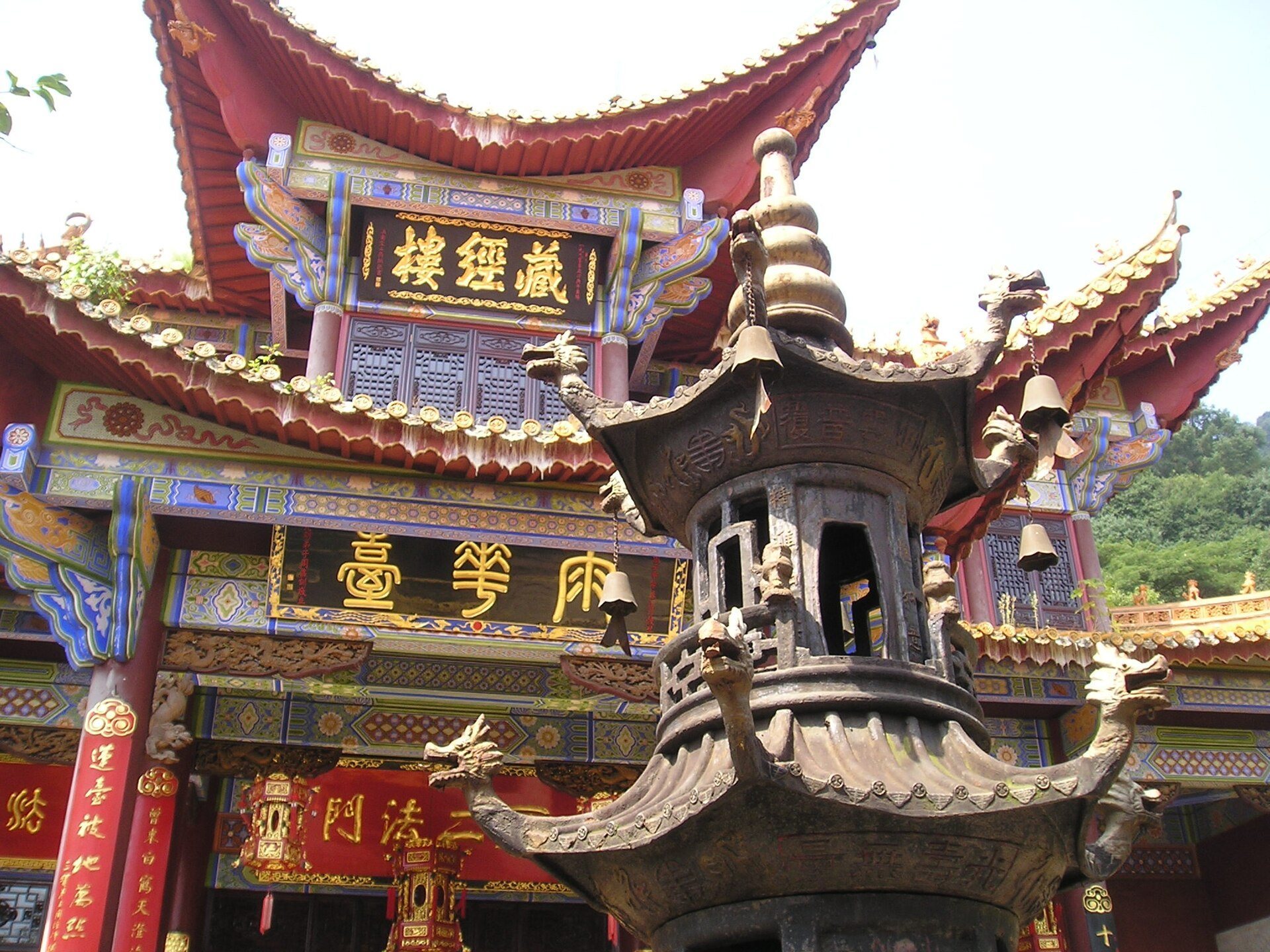
The Buddhist Texts Library formerly stood on the central axis as part of the principal sequence of buildings. After becoming dilapidated, it was demolished in 1970. Its earlier position remains part of the documented historical layout of the temple complex.