Kapaleeshwarar Temple: A Shaiva Temple in Mylapore, Chennai
Site at a Glance
- Rating
- 4.8
- Popularity
- High
- Country
- India
- Primary era
- Early Modern
- External website
- Open
- Eras represented
- Medieval, Early Modern, Modern
- Civilizations
- British, Chola
- Site type
- Religious
- Remains
- Temple
On this page14 sections
History
Kapaleeshwarar Temple is a Hindu Shaiva temple in Mylapore, Chennai, India, dedicated to Shiva as Kapaleeshwarar and Parvati as Karpagambal. Its history is associated with the Pallava period and with a seventh-century coastal temple, while the present complex was constructed after the relocation of Mylapore during the Vijayanagara period in the South Indian imperial era from the fourteenth to seventeenth centuries. Built in the Dravidian tradition of temple architecture, it is a Paadal Petra Sthalam, a Shiva temple praised in the canonical Tamil Shaiva hymns known as the Tevaram.
Pallava origins and the coastal temple
The earliest history of the shrine is generally connected with the Pallavas, a South Indian dynasty that supported the development of early Dravidian temple architecture. The original temple is generally thought to have stood near the seashore in the seventh century. Hymns by the Nayanar saint Thirugnana Sambandar and by the devotional poet Arunagirinathar specifically place the temple beside the sea.
The original coastal temple is generally thought to have been destroyed after the Portuguese took control of the area and built a fort. Mylapore later developed farther inland, and a new temple was constructed during the Vijayanagara period. Some material from the earlier temple may have been reused, although the precise chronology of the present complex remains uncertain. Inscriptions within the temple date from the twelfth century.
Names, legends, and devotional associations
The presiding deity was formerly known as Punnai Vananathar. The name Kapaleeshwarar became established after a change associated with the fifteenth century. The goddess is Karpagambal, a form of Parvati whose name refers to a wish-fulfilling tree. The temple is traditionally identified as the incarnation site of Vayilar Nayanar, a Shaiva saint, and is also linked with legends involving Brahma, Murugan, the Four Vedas, Shukra, Rama, Parvati, and Sambandar.
According to temple tradition, Parvati performed penance here in the form of a peahen after receiving a curse. This story is associated with the name Mylapore, or Mylai, which derives from the Tamil word for peacock. Another legend says that Brahma, the Hindu creator deity, installed a lingam, the aniconic form in which Shiva is worshipped, as penance after Shiva removed one of his heads.
A regional tradition recounts that Poompavai, the daughter of the Shaiva devotee Sivanesa Chettiar, died after a snakebite. Sambandar is said to have restored her to life by singing a Tevaram hymn before Kapaleeshwarar. A small shrine in the present temple commemorates Poompavai, and the story is also represented in sculptures within the complex.
The temple has been praised in Sambandar’s sixth Poompavai hymn, in Arunagirinathar’s Tirumayilai Tirupugal, and in other Tamil religious and literary works. The wider Tirumayilai literary corpus contains more than thirty works, including compositions devoted to the temple and its deities. The shrine is one of the seven sacred Shiva temples traditionally associated with Mylapore. The Ekambareshwarar and Valluvar Temple is traditionally regarded as an additional eighth temple.
Worship and annual celebrations
The temple follows the Kamika Agama, a Shaiva religious text concerned with temple ritual and worship. Priests from the Shaiva community conduct six daily services, including sacred bathing, decoration, food offerings, lamps, Vedic recitation, and music played on the nadasvaram and tavil. Additional observances include Rahu Abhishekam, a sacred bathing rite, as well as Somavaram, Sukravaram, Pradosham, new-moon worship, Kiruthigai, full-moon worship, and Sathurthi. On Fridays, Karpagambal is decorated with a garland made of gold coins.
The principal annual celebration is the Panguni festival, also called Panguni Peruvila or the spring Brahmotsavam. Its nine days include flag hoisting, a chariot festival, the Aṟupatimūvar procession for the sixty-three Nayanar saints, and the ceremonial marriage of Kapaleeshwarar and Karpagambal. The processions use the streets surrounding the temple and draw large crowds. The temple is administered and maintained by the Hindu Religious and Charitable Endowments Department of the Government of Tamil Nadu.
Remains
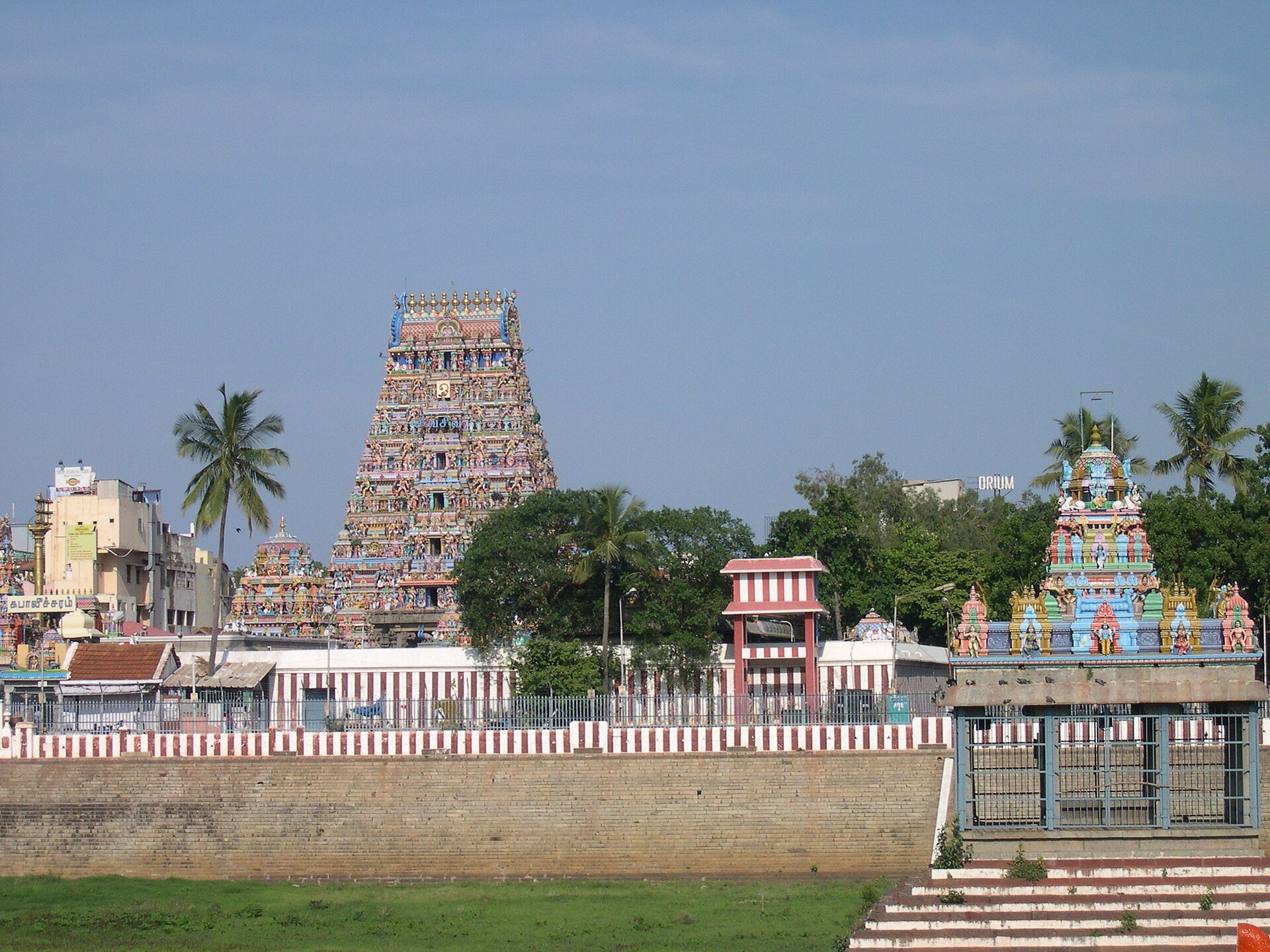
The present temple is a Dravidian-style complex enclosed by processional streets on all four sides and set at an elevation of approximately 54 metres. It contains principal shrines for Kapaleeshwarar and Karpagambal, subsidiary shrines, halls, gateway towers, ritual objects, and a large sacred tank to the west. The complex combines surviving architectural features with later additions and spaces used for worship and processions.
Temple buildings and gateways
Principal shrines and halls
The principal image of Kapaleeshwarar is a lingam housed in the main shrine. A separate principal shrine is dedicated to Karpagambal, while numerous subsidiary shrines and halls occupy the wider complex. The Navaratri mandapa, a pillared hall used during the Navaratri observance, contains plaster sculptures showing the story of Poompavai’s death and revival. A small shrine to Poompavai stands within the temple.
Gateway towers
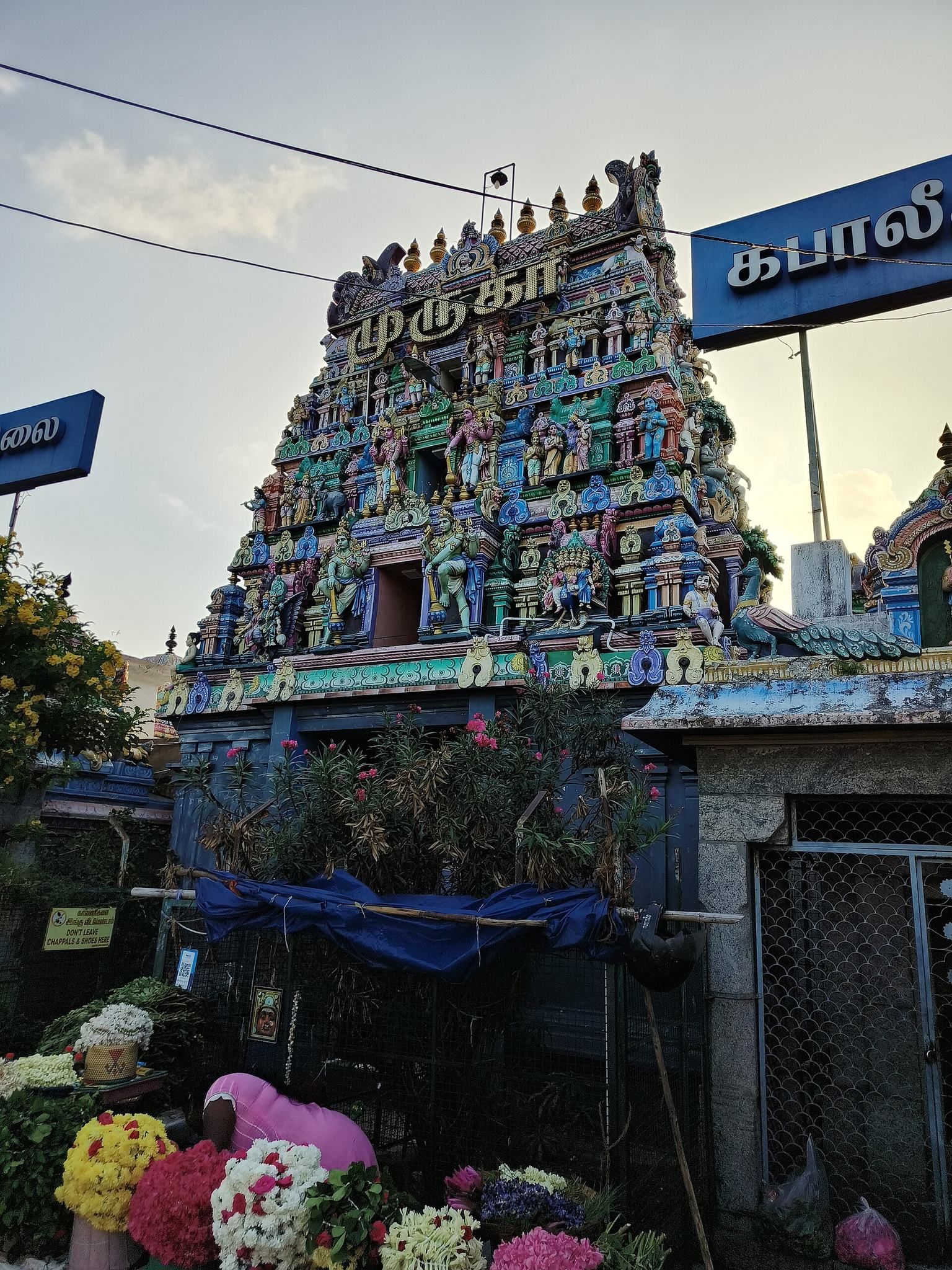
Two entrances are marked by monumental gateway towers, or gopurams. The eastern gopuram is approximately 40 metres high, while the smaller western gopuram faces the sacred tank. A major gateway tower measuring approximately 120 feet, or 36.6 metres, was built in 1906 and is covered with stucco figures.
Sacred tank and ritual landscape
Kapaleeshwarar Tank
The Kapaleeshwarar Tank, also called the Mylapore Tank, lies west of the temple. It measures approximately 190 metres by 143 metres and has a stated storage capacity of about 119,000 cubic metres. A sixteen-pillared mandapa with a granite roof stands at the centre of the tank. During the annual three-day float festival, images of Kapaleeshwarar and other deities are taken around the water while Vedic hymns are recited.
Sacred waters and tree
The temple’s sacred landscape includes the punnai tree and named ritual waters known as Kapali Tirtha, Kadava Tirtha, Veda Tirtha, Vali Tirtha, Ganga Tirtha, Velli Tirtha, and Rama Tirtha. A tirtha is a sacred body of water or ritual water associated with a Hindu holy place.
Processional objects and festival features
Vehicles and chariot
The temple’s vahana collection includes Adhikaranandi, a bull associated with the deity, as well as an elephant, bandicoot, peacock, goat, and parrot. A vahana is a deity’s symbolic vehicle or mount, used in ritual processions. A golden chariot was added later. Images of Kapaleeshwarar and Karpagambal are placed on these vehicles or on a chariot during temple celebrations.
The Panguni Brahmotsavam uses different vahanas in clockwise processions around the temple and its tank. Important events include Adhikaranandi on the third day, the Rishabha Vahana at midnight on the fifth day, the approximately 13-metre chariot on the seventh morning, and the Aṟupatimūvar procession on the eighth day. The chariot is decorated with flowers and sculptural figures. Kapaleeshwarar is represented seated on a throne and holding a bow, with Karpagambal beside him, while Brahma is represented as the chariot driver.
Peacock tradition
A male peacock and a peahen are kept in a cage inside the temple as symbols of the tradition that Karpagambal worshipped Kapaleeshwarar in the form of a peahen.