Shrum Mound: An Adena Burial Mound in Columbus, Ohio
Site at a Glance
- Rating
- 4.6
- Popularity
- Low
- Country
- United States
- Primary era
- Classical
- External website
- Open
- Eras represented
- Iron Age, Classical
- Civilizations
- Unclassified
- Site type
- Burial
- Remains
- Burial Mound
On this page7 sections
History
Adena origins
Shrum Mound is a Native American burial mound in Columbus, Ohio, built by people of the Adena culture roughly 2,000 years ago. The Adena were an early settled culture of the upper and middle Ohio Valley who combined hunting and gathering with farming and trade and constructed substantial earthworks and burial mounds. The cultural period is placed broadly between about 800 BC and AD 100 in some interpretations and between roughly 500 BC and AD 200 in others, so the mound’s exact construction date remains uncertain.
The mound takes its name from the Shrum family, whose farmland originally included the site. In 1928, educator Minnie R. Shrum deeded the property to the Ohio Historical Society, now called the Ohio History Connection. The following year, Jessie Campbell Coons named Campbell Memorial Park in memory of her father, James E. Campbell, and the society erected a memorial marker at the mound. Campbell had served as governor of Ohio from 1890 to 1892 and later led the Ohio Archaeological and Historical Society, the predecessor of the Ohio Historical Society, as its president from 1913 to 1924.
Preservation and historical designation
Shrum Mound has not been archaeologically excavated, leaving its precise contents unknown. In January 2026, archaeologist Neil Thompson said that it likely still holds numerous interments and described the mound as sacred ground. This understanding has shaped efforts to protect it, including requests that people stop using the mound as a sledding hill.
The site was added to the National Register of Historic Places on November 10, 1970, under the official listing name “Campbell Mound.” The National Register is the United States’ official list of historically significant districts, sites, buildings, structures, and objects. The listing identifies information potential as the applicable criterion, meaning that future investigation may yield important archaeological information. It places the site’s area of significance in prehistory and gives an estimated period of significance of approximately 499 BC to AD 499.
In 2015, the Ohio History Connection removed about 18 trees that had grown on the mound. The work addressed the risk that a severe storm could topple the trees and damage the burial site. In 2026, a large dredging project was undertaken in the adjacent quarry lake because the water body had limited remaining capacity after decades of use for municipal water-treatment byproducts.
Remains
Mound and surrounding landscape
Burial mound
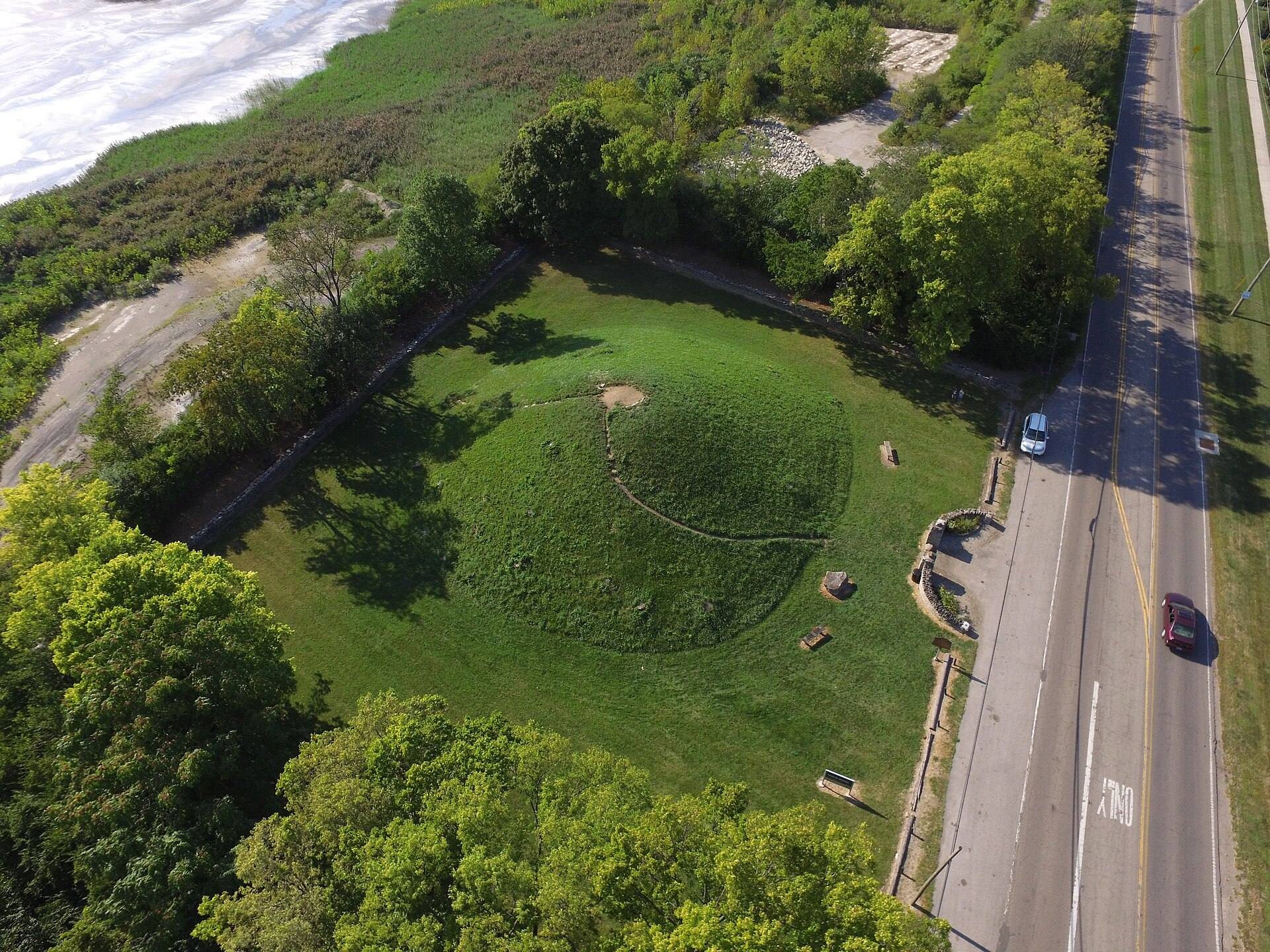
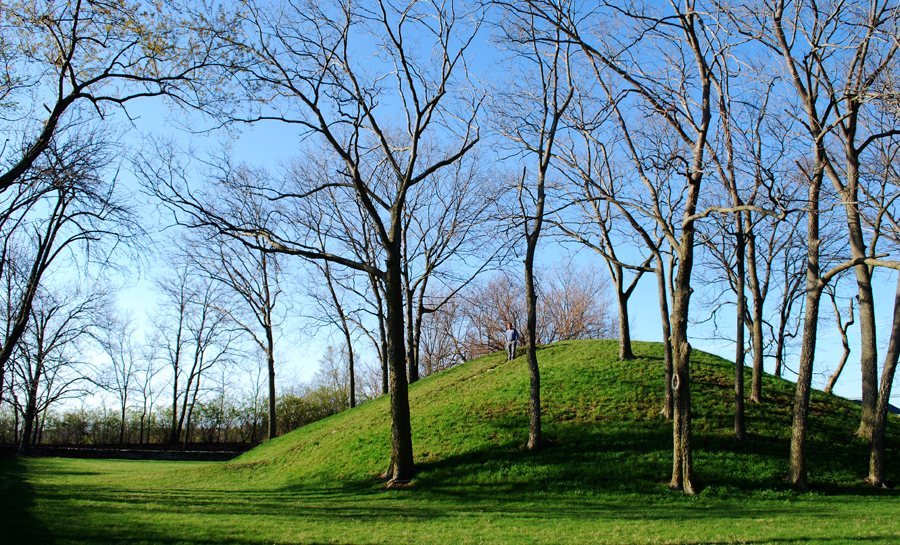
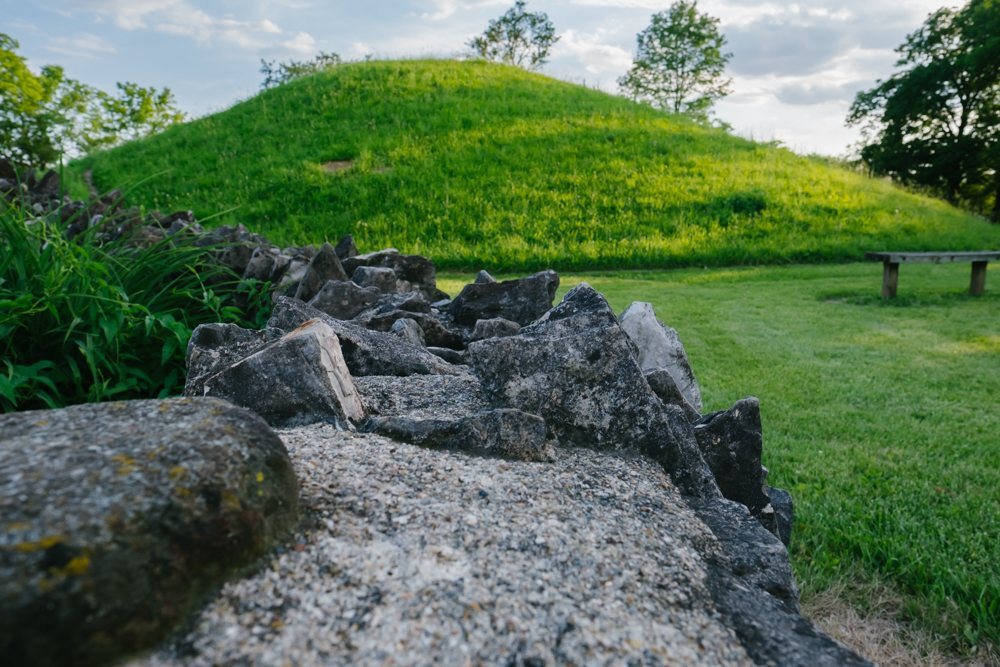
Shrum Mound is a conical earthwork set on a high bluff on the west side of the Scioto River. It rises approximately 20 feet, or 6 meters, above the surrounding ground and measures about 100 feet, or 30 meters, across. The site occupies approximately 1 acre, or 0.40 hectares. Its unexcavated interior is associated with the burial practices of the Adena culture, while its present form preserves the basic profile of the prehistoric earthwork.
Historical photographs from 1929 to 1963 show formal steps rising to the summit. More recent descriptions identify two unpaved paths, including a gentler approach from the park entrance and a steeper, more direct route on the western side. The surviving mound and its setting continue to form the principal physical evidence of the site.
Quarry lake
An active quarry lake, locally known as McKinley Avenue Quarry, borders the mound. The Columbus Division of Water operated the quarry, where limestone extraction began in the late nineteenth century and continued into the early twentieth century. After the quarry was exhausted, it filled with water.
Beginning in the 1970s, the flooded quarry received residual byproducts from municipal water treatment. Its limited remaining capacity led to the large dredging project carried out in 2026. The lake therefore represents a later industrial and municipal use of the landscape beside the prehistoric burial mound.