Julien Dubuque’s Mines: A Meskwaki and Colonial Lead-Mining Complex
Site at a Glance
- Rating
- 4.7
- Popularity
- Low
- Country
- United States
- Primary era
- Medieval
- External website
- Open
- Eras represented
- Bronze Age, Iron Age, Classical, Medieval, Early Modern, Modern
- Civilizations
- Spanish
- Site type
- Economic
- Remains
- Mine
On this page8 sections
History
Julien Dubuque’s Mines is an archaeological and historic complex at 1810 Monument Dr in Dubuque, Iowa, United States, associated with Meskwaki lead mining and Julien Dubuque’s late-eighteenth-century trading enterprise. The complex developed through Indigenous occupation, mining, trade, agriculture, and later European settlement in the area now known as the Mines of Spain.
Indigenous occupation and mining
The area contains evidence of human occupation from the Late Archaic period, approximately 2050–450 BCE, through the Woodland period, approximately 450 BCE–1250 CE, and the Oneota period, approximately 950 CE to European contact. Archaeological evidence includes projectile points, pottery, burial mounds, cultivated plants, bison remains, scapula hoes, and manos and metates, which were stones used for grinding. Copper from the Lake Superior region and galena, a lead-bearing mineral, indicate connections with regional exchange networks and the use of lead in mortuary practices.
The Meskwaki, an Indigenous people of the Great Lakes and upper Mississippi region, may have reached the area as early as the 1760s and were established there by the 1780s. They practiced horticulture, hunting, fishing, and gathering, and lived in semi-permanent palisaded villages near navigable waterways. Their lead mining formed part of a wider trading economy that also included furs and exchanged goods. Meskwaki miners worked surface deposits and smelted the ore in two kinds of temporary furnaces before taking the lead to nearby traders or transporting it to St. Louis.
Dubuque’s enterprise
In 1788, Julien Dubuque reached an agreement with the Meskwaki to mine lead. The governor of New Spain then authorized him to work Spanish-owned land, designating the roughly 1,380-acre tract as the Mines of Spain. Dubuque, a French explorer, miner, and trader operating under Spanish colonial authority, is believed to have been the first European to settle in what is now Iowa.
Dubuque established a trading post near the Meskwaki settlement known as the Village of Kettle Chief along Catfish Creek. The post supported lead and fur trading as well as agriculture. Its products moved to St. Louis, Prairie du Chien, Green Bay, and Michilimackinac, and Dubuque also traded with the Sauk and possibly other groups. Mining was first carried out by the Meskwaki and later by European settlers, continuing at the site until 1914.
Monument and historic recognition
Dubuque died on March 24, 1810, and was buried according to Meskwaki customs. In 1897, leaders of the City of Dubuque commissioned a monument because they regarded him as the community’s founder. Its construction belonged to a local booster movement during a period of economic decline. Human remains were found while the monument’s footings were excavated, but they were not identified, so the location remained the supposed burial place of Dubuque, his wife Potosa, and her father Peosta, a Meskwaki chief.
The archaeological remains were listed on the National Register of Historic Places on November 21, 1988, as four historic districts: the Dubuque Trading Post–Village of Kettle Chief Archaeological District, the Mines of Spain Area Rural Community Archaeological District, the Mines of Spain Lead Mining Community Archaeological District, and the Mines of Spain Prehistoric District. The Julien Dubuque Monument was listed individually on the same date. Together, these resources became the Julien Dubuque’s Mines National Historic Landmark District on November 4, 1993.
Remains
Archaeological landscape
The archaeological complex includes prehistoric settlement areas, the Meskwaki mining village, Dubuque’s trading-post area, lead-mining areas, and later mining-related areas. These remains are distributed among the four archaeological districts associated with Julien Dubuque’s Mines. The trading post stood near the Meskwaki village beside Catfish Creek, while the wider area included cultivated land and the physical traces of mining and processing.
Trading post and mining remains
Dubuque’s trading post contained his residence, houses for Euro-American workers and employees of mixed origin, a grain mill, a cellar for storing furs, one or two barns, a blacksmith shop, and several other storage facilities. The surrounding land was farmed. The Meskwaki mining village and the later mining areas form part of the same archaeological complex, linking settlement, processing, trade, and agricultural activity across the site.
Julien Dubuque Monument
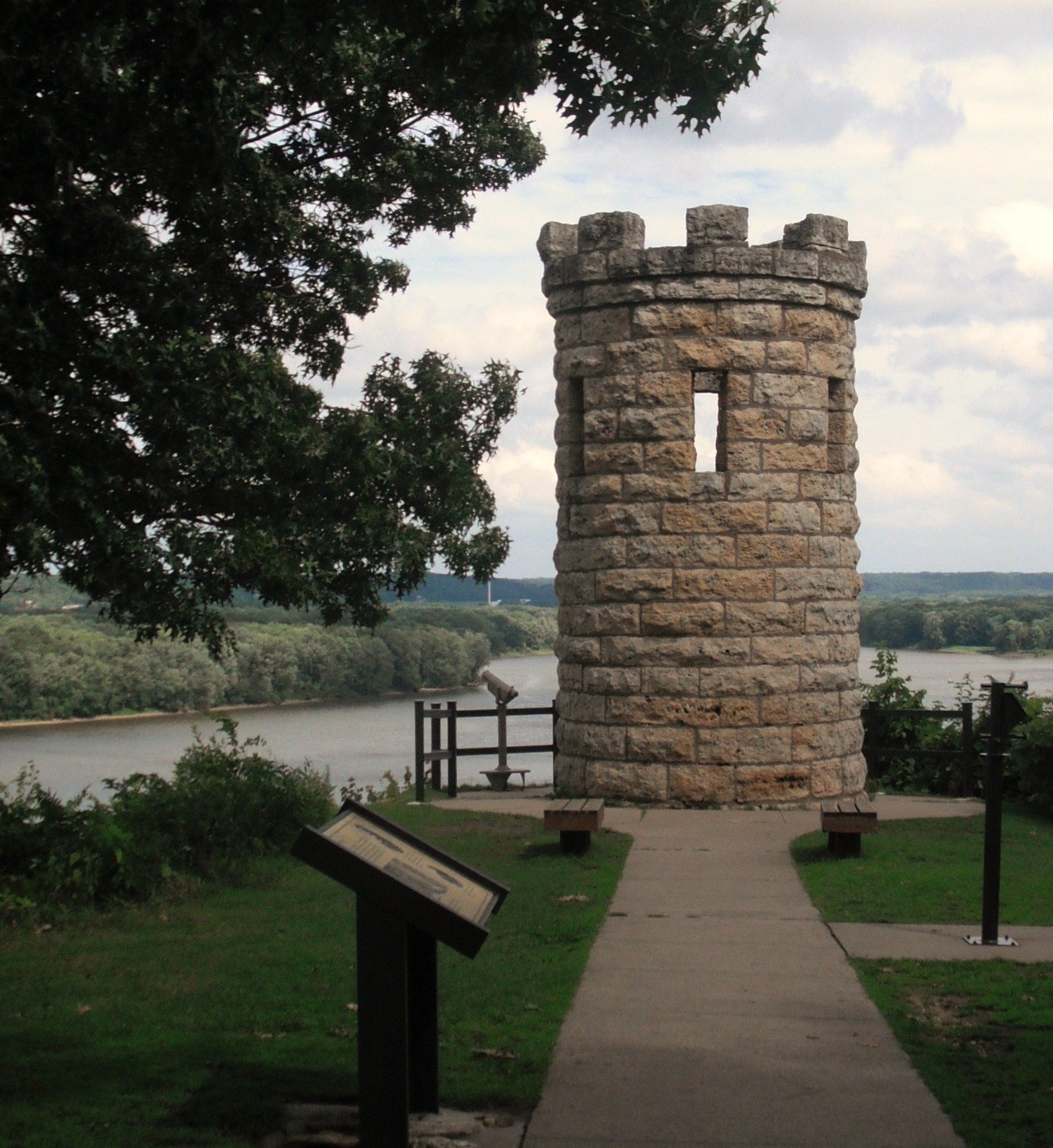
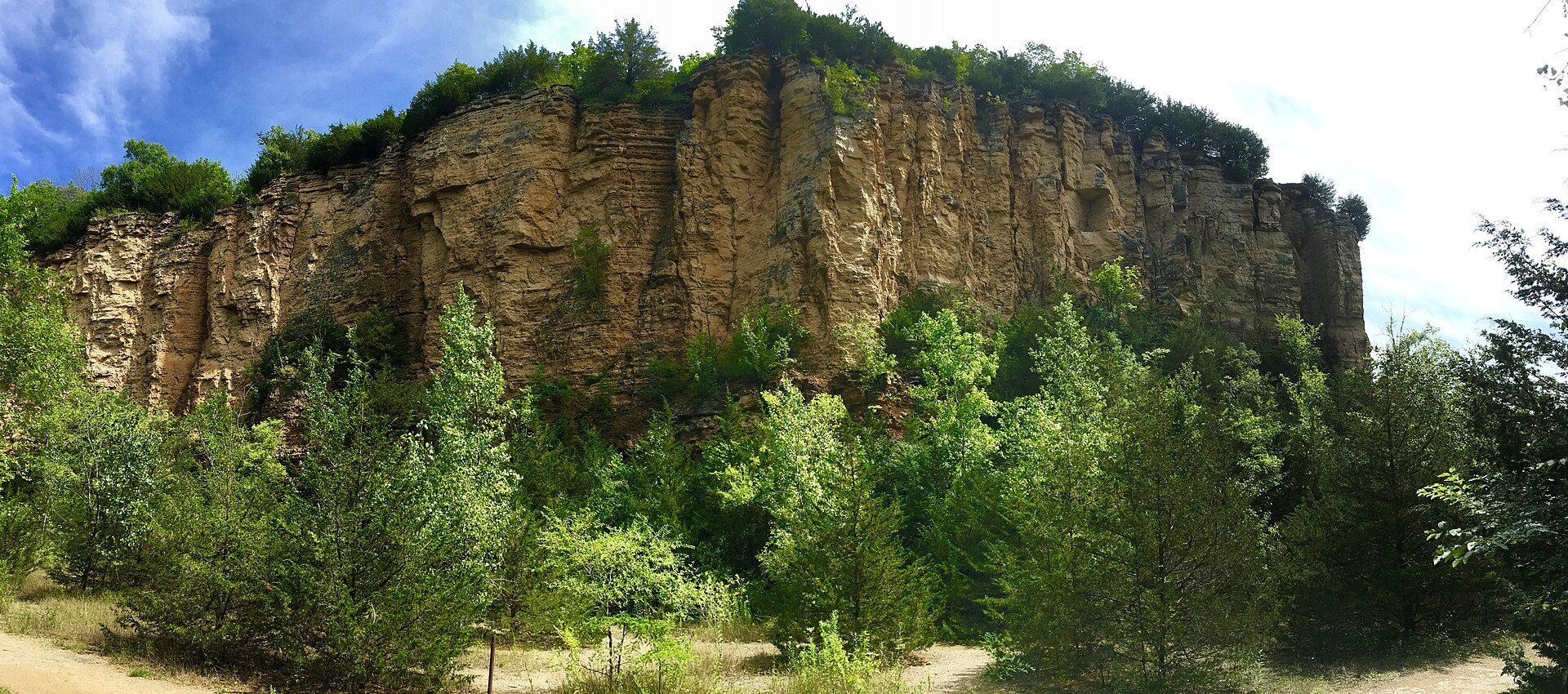
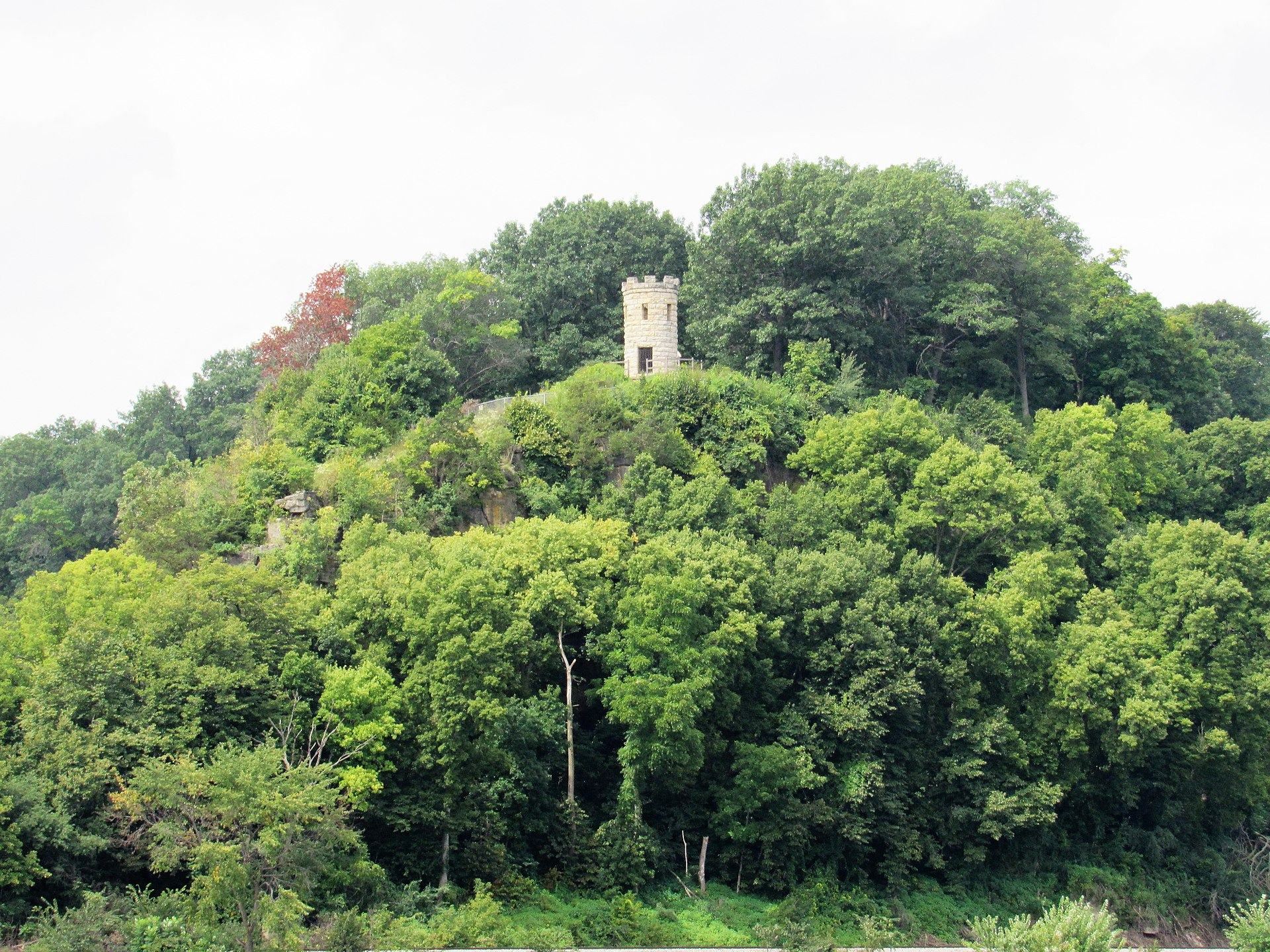
The Julien Dubuque Monument is a cylindrical, roofless limestone tower built in 1897 from stone quarried locally. It is approximately 25 feet, or 7.6 meters, high and 12 feet, or 3.7 meters, wide, with walls 18 inches, or 46 centimeters, thick. Narrow windows and a grilled entrance punctuate its ashlar masonry, which uses regularly shaped blocks laid in orderly courses.
Designed by Alexander Simplot and Carter Bros., the monument is classified as Late Gothic Revival. Its medieval-inspired form is capped by crenellations, the alternating raised sections and openings traditionally associated with fortified walls. A bronze plaque bears the inscription, “Julien Dubuque. Miner of the Mines of Spain. Founder of Our City. Died March 24, 1810.” The tower stands on the edge of a bluff above the mouth of Catfish Creek at the Mississippi River. Roads, footpaths, benches, and interpretive signs were added around it during the twentieth century.