Xumishan Grottoes: A Buddhist Cave-Temple Complex in China
Site at a Glance
- Rating
- 4.2
- Popularity
- Very Low
- Country
- China
- Primary era
- Medieval
- Eras represented
- Classical, Medieval, Early Modern
- Civilizations
- Ming, Qing, Tang
- Site type
- Religious
- Remains
- Sanctuary
On this page12 sections
History
The Xumishan Grottoes are a Buddhist cave-temple complex on Mount Xumi in Guyuan, Ningxia, China, begun by the Northern Wei in the fifth or early sixth century and expanded through successive Chinese dynasties. Their sculpture and painting reflect the movement of Buddhist ideas and artistic forms along the Silk Road, the overland network linking China with Central Asia, South Asia, and regions farther west. The precise reason for their foundation is uncertain, although one interpretation connects it with Northern Wei encouragement of Buddhism and meditation.
Foundations and early expansion
The caves developed near an important Silk Road city during the late Northern Wei, a dynasty that ruled much of northern China from the fifth to the sixth century. Large-scale work continued under the Western Wei and Northern Zhou. The Northern Wei caves include worship chambers for devotional images and smaller meditation caves associated with monks and nuns. These early works established the religious and artistic traditions that later phases developed across Mount Xumi.
Under the Northern Zhou, the grottoes acquired new groups of worship and meditation caves, including chambers carved on two levels of the cliff later associated with Yuanguang Temple. Fighting between the Tang dynasty and the Tibetan Empire, a powerful Tibetan state that expanded across the Tibetan Plateau and nearby regions between the seventh and ninth centuries, temporarily halted some carving. Several images were left unfinished. The suppression of Buddhism under Emperor Wu also appears to have interrupted work on Cave 51.
Sui and Tang development
The Sui dynasty continued the centre-pillar cave tradition, and the Tang dynasty brought the largest phase of expansion. A centre-pillar cave has a substantial rock pillar within its chamber, commonly carved with niches or images. Tang work included large-image caves, Buddha-hall caves arranged as enclosed spaces for Buddhist images, worship caves, and a parinirvana cave depicting the Buddha’s final death and entry into nirvana.
Large-scale carving continued during the Tang period, when Jingyun Temple was built in the surrounding area. Work on the sculptures was also affected by the An Lushan Rebellion, a major eighth-century revolt that weakened the Tang dynasty. The Tang caves preserve several artistic phases, including work dated approximately to 680–692, 682–712, and 712–779. Their imagery became less rigid over time, while the principal forms of the earlier niches and cave plans continued in use.
Song, Western Xia, and later religious activity
The grottoes were periodically repaired and redecorated during the Song and Western Xia periods. Several temples were established nearby, and Tibetan Buddhism, a form of Buddhism with distinctive ritual, artistic, and institutional traditions rooted in Tibet and the Himalayan cultural sphere, reached the Guyuan region. This later religious activity added new layers to a complex already shaped by Northern Wei, Western Wei, Northern Zhou, Sui, and Tang patronage.
In 1443, monks associated with the former Jingyun Temple rebuilt it. The Zhengtong-era emperor Yingzong, Zhu Qizhen, then renamed the temple Yuanguang Temple. Xiangguo Temple was also built in the vicinity. During the Ming period, a three-storey pavilion was constructed near Yuanguang Temple, while some Tibetan Buddhist burial and meditation caves were excavated during the Ming and Qing periods.
Qing repairs and religious transformation
The Qing dynasty saw extensive repairs to the grottoes, and a commemorative inscription was erected to record this work. After the Qing, Buddhism declined in the Guyuan region. Some Buddhist caves were converted for Daoist use. Daoism is a Chinese religious tradition distinct from Buddhism, and the Jade Emperor Pavilion built during this later phase was dedicated to the Jade Emperor, a major heavenly ruler in popular Chinese religious traditions. The altered caves became locally known as the Zisun Palace.
The surrounding Buddhist and Daoist temples were later destroyed. The Haiyuan earthquake of the 1920s severely damaged the grottoes and destroyed the associated buildings above ground, leaving ruins around the surviving caves. The site’s remote location limited archaeological attention for many years. Public documentation began in 1956, followed by a preliminary investigation in 1961 and a comprehensive survey by Ningxia cultural authorities in 1962.
Modern investigation and conservation
During the Cultural Revolution, many Buddhist statues were smashed, and Cave 5, the largest cave, was used as a shooting target. The Xumishan cultural relics management institution was established in 1982, the same year the grottoes became a National-Level Cultural Relic Protected Site. Surveys, repairs, and reinforcement continued from the 1980s onward. A joint archaeological survey and mapping project by Peking University and Ningxia cultural authorities took place in 1986. It assigned numbers to 132 caves, while other estimates place the total at approximately 150 or 151.
Emergency reinforcement and repairs in 1984 addressed important caves and damaged areas. Protective cave eaves and rain shelters were built from the remains of structures that had once stood before the entrances. Cracks found in the shelters in 2007 threatened the grottoes directly. An acrylic chemical treatment was applied to selected stone carvings in 2002 to slow weathering, but the treatment was not continued because of its high cost. Night patrols were introduced as looting of Buddhist images became a serious danger.
Wind, sand, rainwater erosion, earthquakes, natural weathering, vandalism, looting, and inadequate conservation have continued to damage the site. In 2007, the Xumishan Grottoes were included in the World Monuments Watch list of the 100 most endangered architectural and cultural sites. Conservation work in 2009 reinforced the exposed roots of old trees without damaging them, paved former mountain paths and patrol routes with stone, and placed electrical cables underground. A master plan for the Xumishan scenic area was completed in 2014. In 2015, Ningxia representatives proposed adding the grottoes to the Silk Roads extension of the World Cultural Heritage List; the proposed inscription was not established as completed.
Remains
Setting and overall layout
The grottoes are cut into red sandstone on the southern and eastern sides of hillocks shaped by weathering and erosion in the Liupan Mountains. They lie at approximately 1,700 to 1,850 metres above sea level and extend for more than 1,500 metres. The complex contains more than 130 caves distributed across roughly one to one and a half kilometres. The 1986 numbering arranged them from south to north in eight zones: Dafo Tower, caves 1–5; Zisun Palace, caves 6–39; Yuanguang Temple, caves 40–50; Xiangguo Temple, caves 51–103; Taohua Cave, caves 104–108; Songshuwa, caves 109–118; Three Caves, caves 119–125; and Heishigou, caves 126–132.
Another subdivision groups the site into five scenic areas named Dafo Tower, Zisun Palace, Yuanguang Temple, Xiangguo Temple, and Taohua Cave. Approximately 350 Buddhist sculptures, inscriptions, and paintings form the principal surviving artistic material, with sculptures reported in about 70 caves. Around 20 caves are described as completely intact, while many others are weathered, damaged, unfinished, or partly destroyed. Protective structures and rain shelters now form part of the physical setting, together with paved paths, underground utilities, and reinforcement around exposed tree roots. The shelters themselves later developed cracks that endangered the caves.
Northern Wei and Western Wei caves
Thirteen Northern Wei caves are concentrated in the southern and central parts of the Zisun Palace zone. Four are centre-pillar caves and nine are meditation caves intended for monks and nuns. The worship chambers are generally small or medium-sized and square in plan, with a window above the entrance and images carved on all four sides of the central pillar. A common arrangement shows one Buddha with two bodhisattvas, while other images portray Maitreya, the Buddhist future Buddha, with crossed legs, figures riding elephants or horses, and one Buddha accompanied by two disciples.
Northern Wei Buddhas commonly have high cranial protuberances, refined faces, long necks, narrow shoulders, and robes marked by dense parallel incisions. Bodhisattvas wear high coiffures, narrow necks, upper garments, skirts, and scarves crossed over the abdomen. Disciples wear monastic robes and stand with clasped hands. Caves 14 and 24 are comparatively well preserved. The centre pillars of Caves 22 and 28 have collapsed, while Cave 28 also contains numerous Buddhist images from the Western Wei period.
Western Wei caves occur mainly around the Dafo Tower and Zisun Palace zones, although their chronology is not always certain. The earlier group, stylistically close to Northern Wei work, includes 19 caves. Caves 17, 32, and 33 are centre-pillar caves. The pillars of Caves 17 and 33 were destroyed, while Cave 32 remains comparatively well preserved. Buddha-hall caves 2, 8, 18, 19, 20, 34, and 35 have been heavily weathered, making their original appearance difficult to distinguish.
Six later Western Wei caves mainly contain canopy-shaped niches with images arranged as one Buddha and two bodhisattvas. Their figures are broader, their bodhisattvas wear floral crowns and skirts, and the carving is comparatively coarse and simplified. Caves 36 and 37 are centre-pillar caves from this later group. The pillar in Cave 36 was destroyed, and the pillar in Cave 37 was left unfinished.
Northern Zhou and Sui caves
Northern Zhou caves are concentrated on the cliff face of the Yuanguang Temple zone. Caves 47 and 48 occupy the upper level, while the other caves lie below. Worship caves form the core of this group, surrounded by meditation caves. Caves 45, 46, 47, 48, and 51 are centre-pillar caves whose carved details imitate timber construction. These include beams, corner posts, lotus bases, bracket blocks, sloping rafters, and pillar shafts.
The Northern Zhou pillars are undivided and carry one niche on each side. Most niches have canopy shapes, while others have pointed gables or rounded arches. Canopy folds, lotus petals, jewels, bead necklaces, and hanging tassels decorate the niches, with some tassels held by the mouths of dragons, phoenixes, or elephants. The sculpture includes single scenes of one Buddha with two bodhisattvas, as well as groups of three Buddhas and seven Buddhas. The Buddhas are more robust and round-faced than Northern Wei and Western Wei figures, while the bodhisattvas have more graceful forms. Caves 47 and 48 retain carved outlines of their niches, and Cave 48 also contains numerous Tibetan Buddhist wall paintings and images.
Two identified Sui centre-pillar caves, Caves 67 and 70, are associated with surrounding meditation caves. Their square main chambers imitate timber construction in simplified form and have inverted-truncated-pyramid ceilings. Each contains one niche on the north wall and three niches on both the east and west walls. The pillars have high bases, undivided shafts, and niches on all four sides. Canopy-shaped, pointed-arched, and round-arched niches appear together, with relatively simple canopy decoration. The sculptures continue Northern Zhou conventions while giving the bodies more realistic modelling.
Tang-period caves and the Dafo Tower
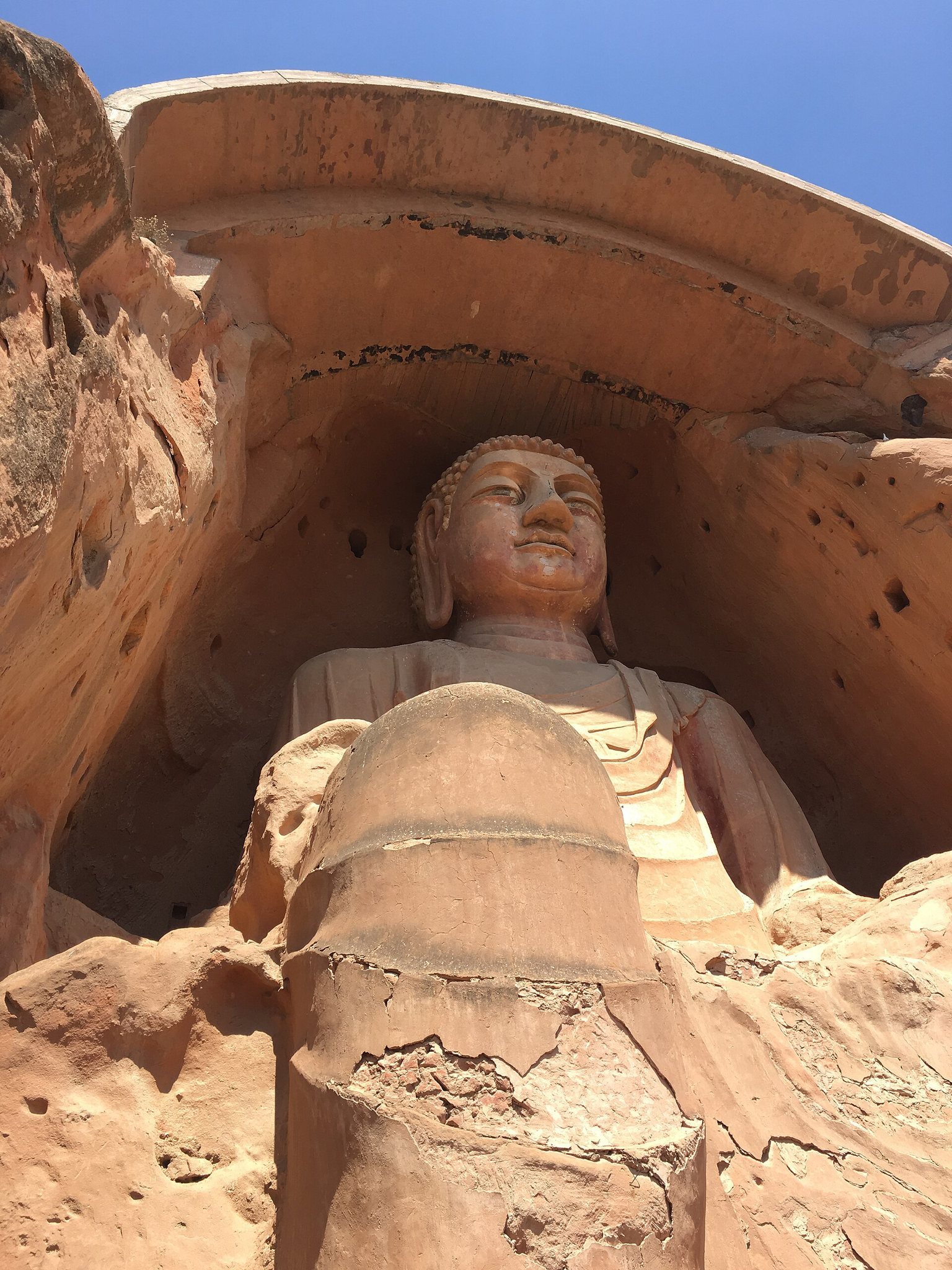
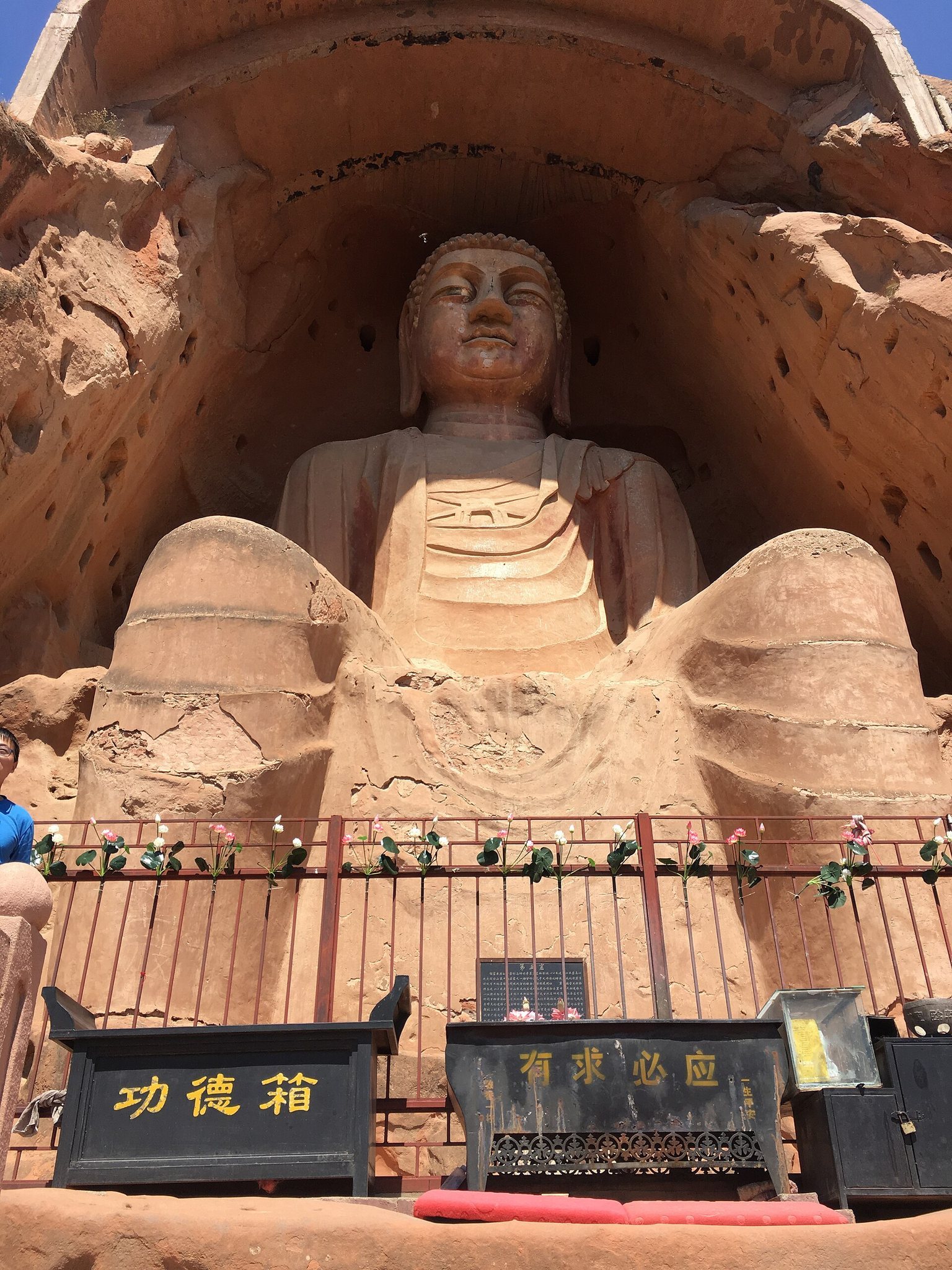
Tang caves are the most numerous group at Xumishan. Principal examples include Caves 1, 5, 52–54, 62, 64, 69, 71–72, 75–80, 82–83, and 86–90, together with Cave 105. Cave 5 is the largest, measuring 20.6 metres high, and is also called the Dafo Tower. The complex’s most prominent image is a seated representation of the future Buddha, approximately 65 feet high. A large fence protects it, while erosion and inappropriate conservation, including the reported application of cement in 1982, have affected its condition.
The earliest Tang phase, dated approximately to 680–692, includes the large-image Caves 1 and 5 and Buddha-hall Caves 77, 78, and 79. These halls have square chambers, inverted-truncated-pyramid or flat ceilings, Buddhist platforms along three walls, and predominantly triad compositions. Their figures are full-bodied and powerful but somewhat rigid. A second phase, dated approximately to 682–712, includes Caves 52–54, 69, 71–72, 75–76, 80, and 82–89. It contains Buddha-hall caves and Cave 75, a parinirvana cave portraying the death of Shakyamuni, the historical Buddha whose life and teachings form the foundation of Buddhism. The figures in this phase are less rigid than those of the earlier Tang group.
A third Tang phase extends approximately from 712 to 779 and includes Caves 62, 64, and 105. It contains both centre-pillar and Buddha-hall caves. Apart from Cave 62, whose sculptural content differs substantially, the niches generally continue earlier forms. Across the Tang group, statues, wall paintings, inscriptions, and inscribed stelae preserve evidence of the complex’s changing religious and artistic programs.
Ming and Qing cave groups
Ming and Qing caves are concentrated mainly in the Songshuwa area. They consist chiefly of Tibetan Buddhist burial caves and meditation caves. These chambers represent a later use of the carved landscape, adding funerary and contemplative functions to the earlier worship spaces.