Bernstein Castle: A Medieval Defensive Stronghold in Austria

Site at a Glance
- Rating
- 4.4
- Popularity
- Low
- Country
- Austria
- Primary era
- Medieval
- External website
- Open
- Eras represented
- Medieval, Early Modern
- Civilizations
- Hungarian
- Site type
- Military
- Remains
- Castle
On this page14 sections
History
Bernstein Castle is a medieval defensive stronghold in Bernstein, Austria, whose origins are placed either around AD 860 or in 1199. Its surviving architecture combines Gothic and Baroque elements, and the castle remains an important protected monument in Burgenland. It developed through successive periods of Hungarian rule, military conflict, rebuilding, and adaptation to later residential and hospitality uses.
Early origins and Hungarian rule
In AD 860, the surrounding region belonged to the Archbishopric of Salzburg, an ecclesiastical principality whose archbishop held both religious and territorial authority. Erimbert, an official or feudal dependent of the archbishopric, granted land on the Pinka River to Jacobus, who founded the village of Rettenbach. Rettenbach subsequently developed alongside Bernstein as a settlement associated with the castle.
The old Slavic name of nearby Grodnau means “the village belonging to the castle.” This name is regarded as evidence that a fortification may have existed near the site of the later castle. Another proposed date for the fortress begins in 1199, when it belonged to the Kingdom of Hungary. It later came into the possession of Frederick II, Duke of Austria, although the length and timing of his ownership remain uncertain.
King Béla IV of Hungary captured the fortress in 1236 and granted it to Count Henry II of Güssing in 1260. In 1336, the lords of Güssing and Bernstein were defeated by Charles Robert of Anjou, a medieval king of Hungary. Bernstein Castle and its associated lordship were then incorporated into the Hungarian crown lands.
The Kanizsay period and sixteenth-century sieges
The castle was granted or pledged to the Kanizsay family in 1388. The family began rebuilding the deteriorated fortress in 1389, and it became their property in 1392. Around 1482, Bernstein briefly belonged to Matthias Corvinus, the fifteenth-century king of Hungary. In 1487, Frederick III, the Habsburg emperor of the Holy Roman Empire, granted it as a pledge to Hans von Königsberg.
Ottoman forces commanded by Suleiman the Magnificent, the sultan who led the Ottoman Empire during its sixteenth-century expansion into Central Europe, besieged Bernstein unsuccessfully in 1529 and again in 1532. These attacks prompted the construction of a ring of bastions around the castle. The enlarged defenses transformed it into a refuge fortress for the inhabitants of the lordship. The Italian builder Francesco de Pozzo is associated with this work.
Seventeenth-century damage and rebuilding
In 1604, a combined army of Hungarians, Ottomans, and Tatars led by Stephen Bocskay besieged Bernstein for several weeks but failed to capture it. Bocskay was a Transylvanian prince whose military movement brought together these forces during a period of conflict in the region.
An explosion in the gunpowder magazine damaged the castle in 1617. Ludwig Königsberg subsequently ordered the Gothic interior to be rebuilt in the Baroque style. During this transformation, the keep, the principal fortified tower of a medieval castle, and the other towers were removed.
Batthyány, Almásy, and later use
In 1644, Ehrenreich Christoph Königsberg transferred the castle and its lordship to Count Ádám Batthyány. Gustav Batthyány sold the property to his administrator, Edward O’Egan, in 1864. O’Egan’s heirs sold it to Eduard von Almásy in 1892.
The present owners descend from Maria della Pace Kuefstein, who was adopted by János Almásy, the last Almásy lord of the castle, in 1955. She and later owners added “Almásy” to their surnames, continuing the family tradition. Since 1953, part of the castle has been used as a hotel and restaurant, while the complex remains associated with the Almásy family and retains protected-monument status.
The White Lady legend
A local legend tells of the White Lady of Bernstein, an apparition said to have appeared from 1859 onward to warn the Almásy family of approaching misfortune. One version, attributed to the fifteenth-century lord Lorentz von Ujlak, identifies the figure as his wife, Giovanna de’ Frescobaldi. According to the story, he discovered her with an Italian lover, who was supposedly killed and thrown into the castle well.
Alleged witnesses described the White Lady with a sorrowful expression, including on the castle stairs. An alleged photograph of the apparition was considered authentic and unaltered. The White Lady remains a legend associated with the castle rather than an established historical event.
Remains
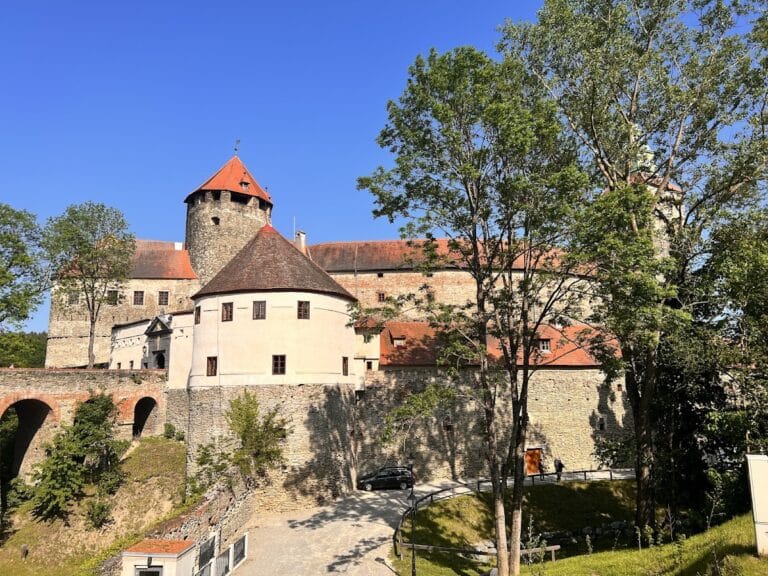
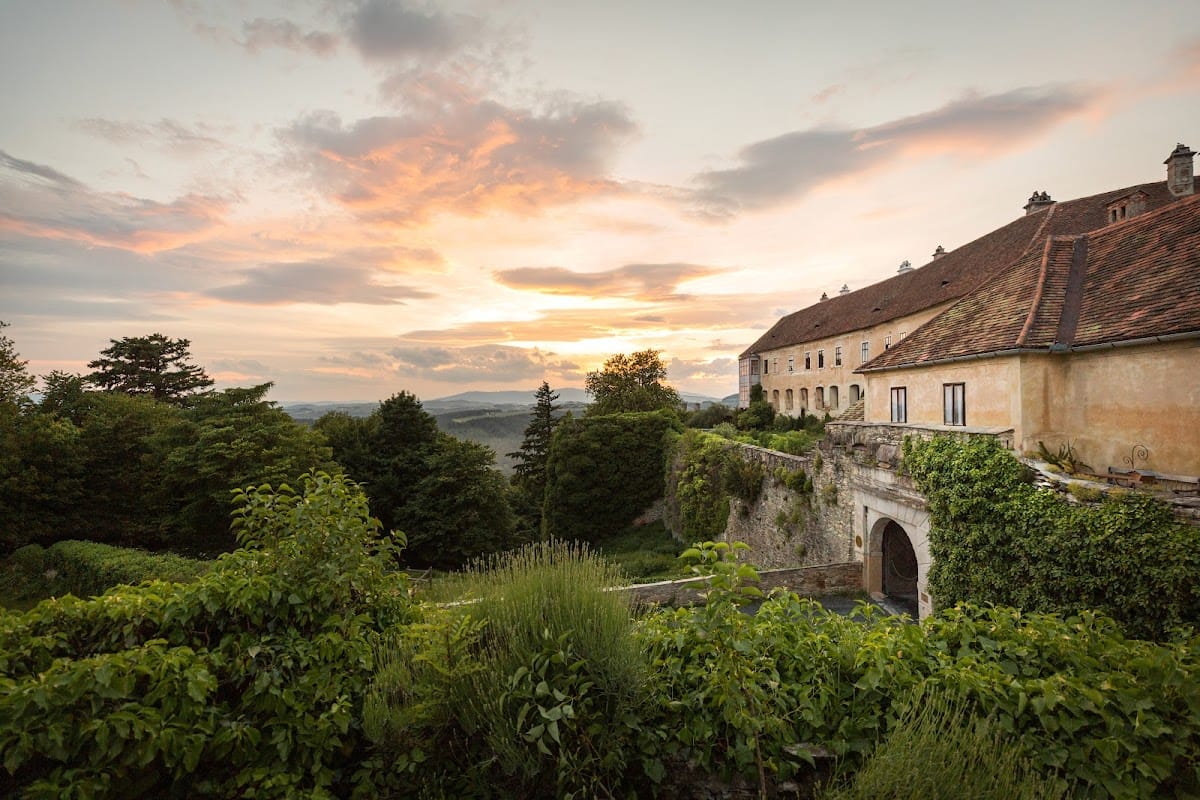
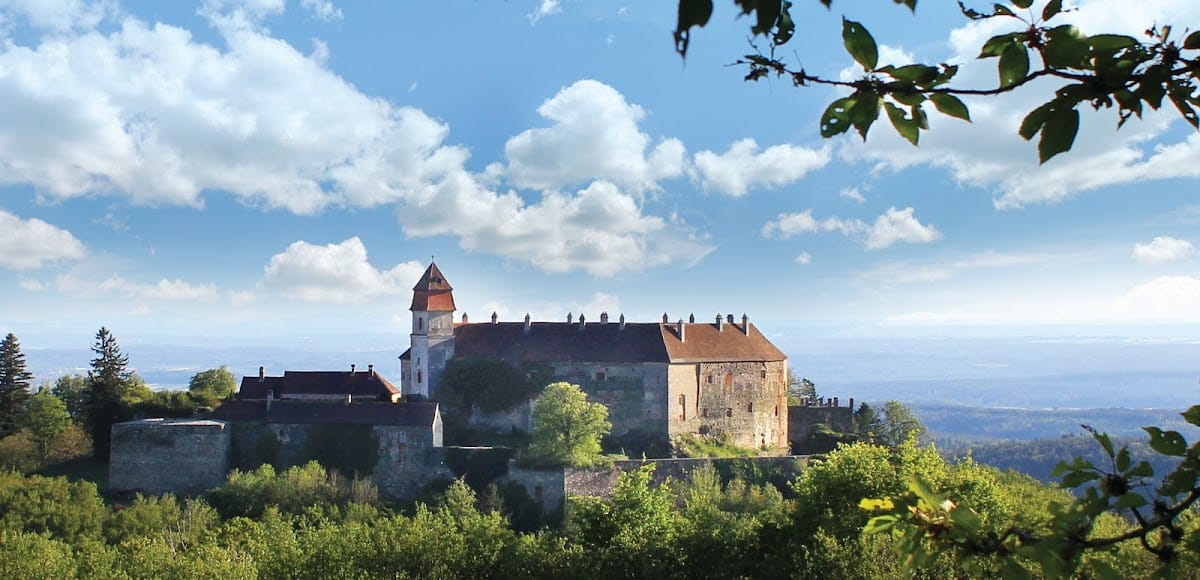
Bernstein Castle is a rock castle set on a 615-metre-high hill above the Tauchental. The extensive defensive complex preserves major portions of its Gothic and Baroque fabric. Its fortifications and surviving interior spaces reflect both its medieval origins and the changes made after sixteenth- and seventeenth-century military events.
Defensive complex
Bastion ring
The ring of bastions surrounds the castle as a projecting defensive system designed to let defenders use firearms along the faces of the enclosing walls. Built after the failed Ottoman sieges of 1529 and 1532, the bastions formed the principal structure of the castle’s conversion into a refuge fortress. Their construction is associated with Francesco de Pozzo.
Gates and courtyard
The complex includes an inner gate and an outer courtyard, which form part of the surviving arrangement of the fortified site. Together with the surrounding bastion system, these spaces preserve the castle’s defensive organization after its conversion into a refuge fortress.
Interior spaces
Knights’ hall
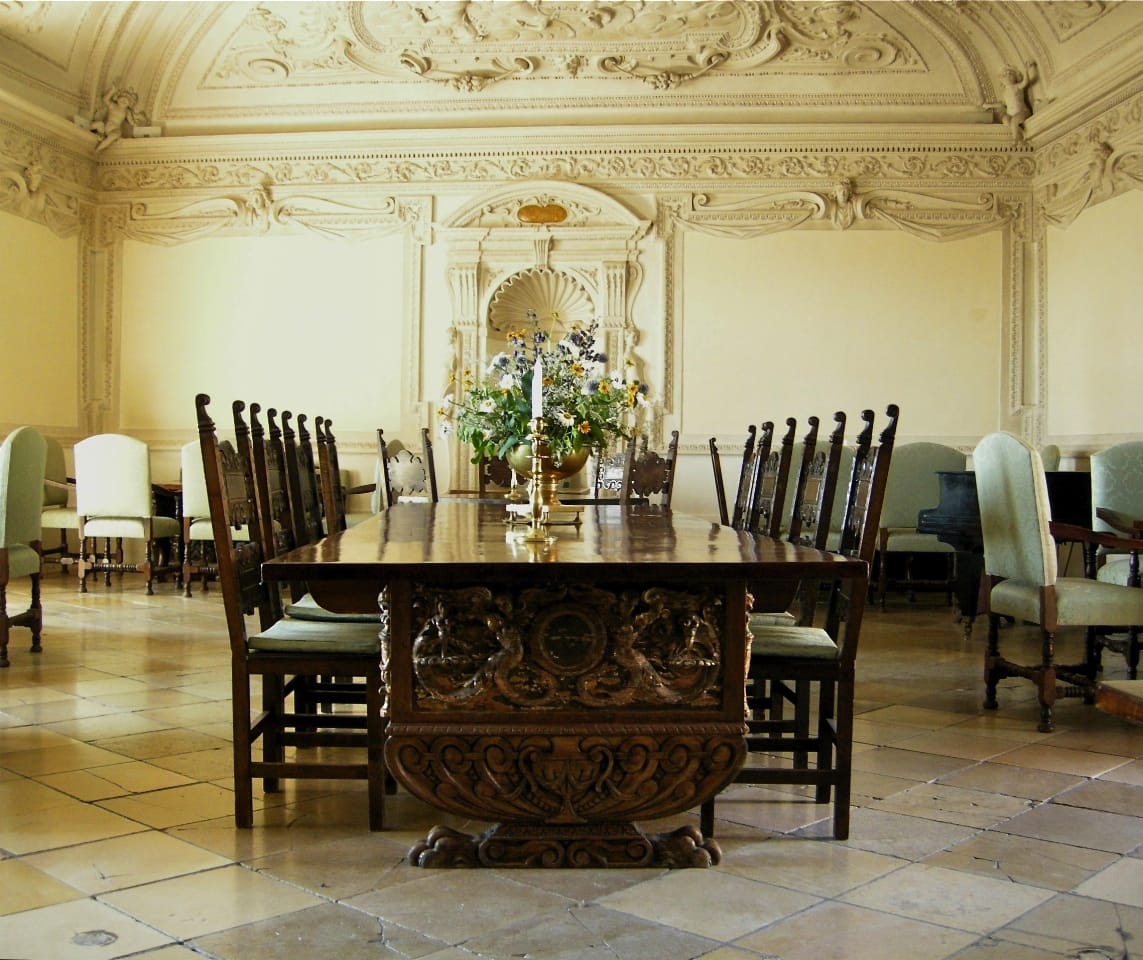
The knights’ hall dates from the first half of the seventeenth century, during the period of rebuilding that followed the 1617 gunpowder-magazine explosion. Its notable surviving feature is an elaborate stucco ceiling, reflecting the Baroque remodelling of the castle’s Gothic interior.
Alchemist’s kitchen
An alchemist’s kitchen forms part of the castle’s interior spaces. It survives within the complex alongside the other rooms shaped by the castle’s changing domestic and defensive functions.
Torture chamber
The castle also contains a sixteenth-century torture chamber. Museum exhibits are housed within the room, preserving its association with the judicial and punitive functions connected with the fortress during the period of its strengthened defenses.
Part of the complex has been adapted for hotel and restaurant use, while the surviving bastions, gates, courtyard, hall, kitchen, and torture chamber retain the architectural evidence of Bernstein’s medieval, military, and Baroque phases.