Heliodorus Pillar: A Garuda Standard at Besnagar
Site at a Glance
- Rating
- 4.2
- Popularity
- Low
- Country
- India
- Primary era
- Classical
- Eras represented
- Classical
- Civilizations
- Indo-Greek
- Site type
- Religious
- Remains
- Temple
On this page12 sections
History
Heliodorus Pillar is a stone religious monument at Besnagar, near Vidisha in present-day Madhya Pradesh, India, erected around 113 BCE in the late Shunga-period world. Heliodorus, a Greek ambassador from Taxila serving the Indo-Greek king Antialcidas, dedicated it to Vāsudeva, an early deity associated with the Vrishni heroes and later connected with Vishnu. The pillar formed part of a Vāsudeva temple complex near the meeting of the Betwa and Halali rivers, in a fertile region crossed by routes linking the Ganges valley, the Deccan, and southern India.
Foundation and Temple Development
The pillar stood at Besnagar during the reign of Antialcidas, whose rule is generally placed around 115 to 80 BCE. Its inscription identifies Heliodorus as the son of Dion of Taxila and states that Antialcidas sent him to the Indian ruler Kasiputra Bhagabhadra in the king’s fourteenth regnal year. Bhagabhadra is described as “the Savior,” but his identity remains uncertain. He was once identified with the fifth Shunga ruler, although he may instead have been a local king because the Shunga dynasty may have ended before the pillar was erected.
The pillar belonged to a longer sequence of Vāsudeva shrines. An earlier elliptical shrine probably dates from the fourth or third century BCE. It had brick foundations and a wooden upper structure, and a flood around 200 BCE destroyed it. After the ground was raised with fresh soil, a second shrine facing east was built with a Garuda standard. Flooding destroyed that building during the second century BCE. A further Vāsudeva temple was rebuilt in the late second century BCE, incorporating eight stone pillars arranged along a north-south line. The Heliodorus Pillar is the surviving member of that group.
Vāsudeva Worship and the Inscriptions
Heliodorus described himself as a Bhagavata, meaning a devotee or follower of Vāsudeva, and dedicated the monument as a Garuda standard to the “God of Gods” and Supreme Deity. Vāsudeva worship later became associated with Narayana and Vishnu, contributing to the development of Vaishnava religion, the broader tradition centered on Vishnu and his related forms. The pillar therefore provides early written and archaeological evidence for a religious tradition that later acquired a much wider theological framework.
The dedication has often been read as evidence that a foreign envoy adopted Vāsudeva worship. Another interpretation understands it as a diplomatic act in which Heliodorus honored a deity belonging to the court and country he visited, in keeping with Greek practices of respecting foreign gods. The inscription supports both the importance of the dedication and the international setting in which it was made, while Heliodorus’s personal religious position remains open to interpretation.
A second, shorter inscription gives three practices associated with reaching heaven or immortality. They are rendered in different translations as self-restraint, generosity, and attentiveness, or as restraint, renunciation, and rectitude. Both texts use Shunga-period Brahmi script, an ancient Indian writing system, and Monumental Prakrit, a formal inscriptional language related to the vernaculars of northern India, with some Sanskritized spellings.
Rediscovery and Archaeological Investigation
Alexander Cunningham found the pillar in 1877 near the ancient city of Besnagar. It was then coated in ritually applied vermilion and worshipped locally, with the name Khamba Baba or Kham Baba. Animal sacrifice was associated with the local practice, and a priest lived on a neighboring mound. Cunningham also examined a fan-palm capital near the standing pillar, a makara capital found nearby, and a kalpadruma, or wishing-tree, capital discovered about 1 kilometre away. Later study showed that the fan-palm capital did not belong to the pillar, while the pillar itself probably carried a Garuda emblem.
During 1909 and 1910, a team led by H. H. Lake removed the vermilion and exposed the Brahmi inscriptions. John Marshall identified the longer text as referring to Heliodorus and Vāsudeva. The shorter text was later recognized as a verse from the Mahabharata. Excavations directed by D. R. Bhandarkar between 1913 and 1915 revealed extensive brick foundations and other structures aligned with the cardinal directions, although the work ended when the local priest asserted rights over the house and compound built by his ancestors.
Excavations led by Khare from 1963 to 1965 exposed temple foundations beneath the later priest’s house. They also revealed secondary foundations added as flood deposits raised the ground level and established that the pillar formed part of a larger temple complex. Repeated flooding had deposited substantial layers of silt over roughly two thousand years, helping explain the raised platforms and changing levels found across the site.
The pillar’s date provides a relatively precise point within the reign of Antialcidas and makes it an important marker for the development of late Shunga-period art. Its decorative forms and inscriptional style have also helped date elements of the nearby Sanchi complex, including the reliefs of Stupa 2 to the last quarter of the second century BCE. Other Besnagar inscriptions mention a Garuda pillar installed by another Bhagavata at a temple of Bhagavat, indicating an established Bhagavata tradition in the region during the late second and first centuries BCE.
Remains
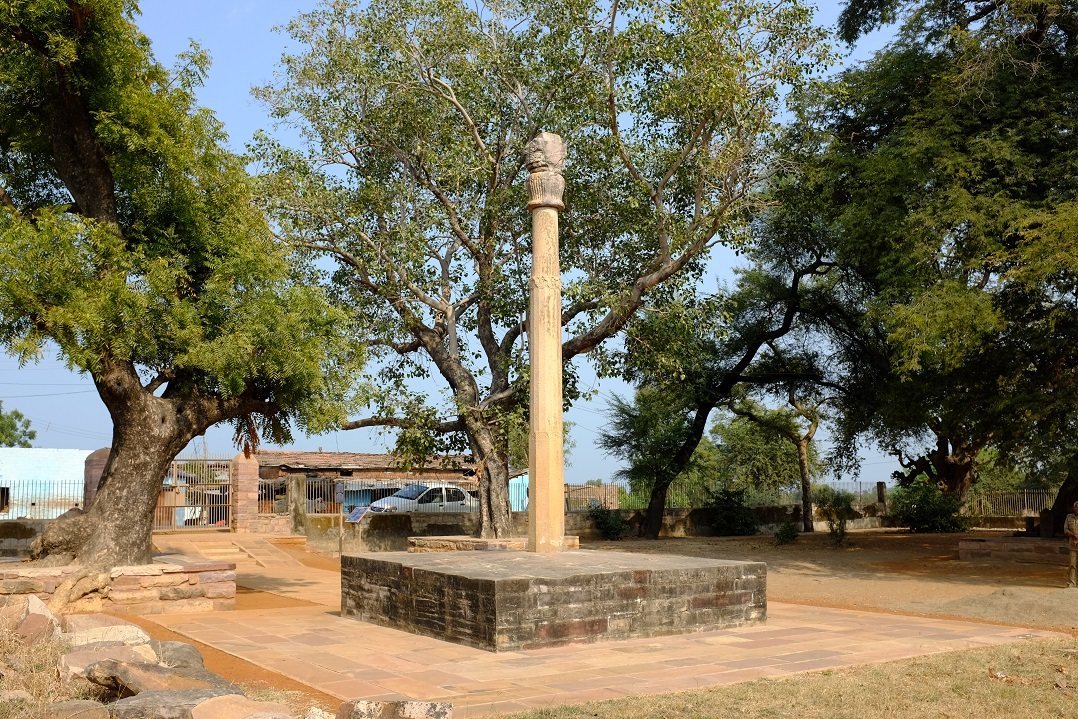
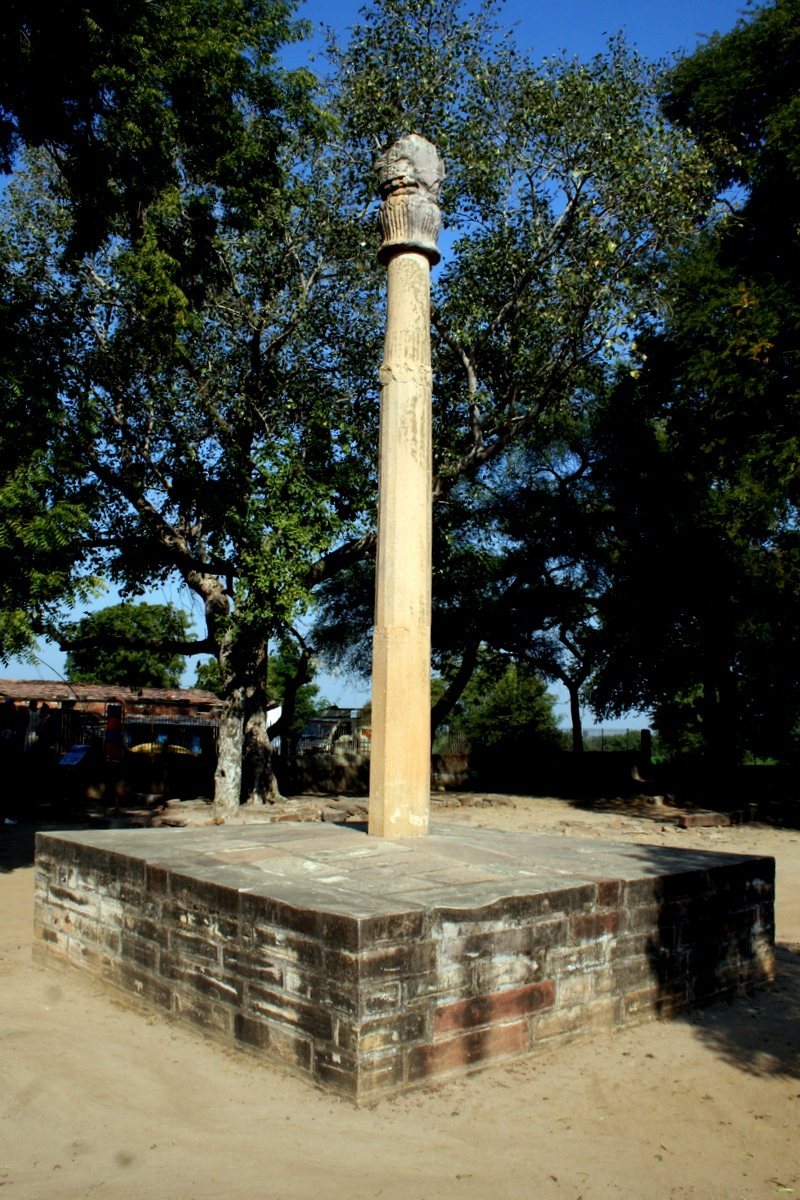
The surviving monument consists of a stone pillar on a square platform measuring about 12 feet on each side. The platform rises approximately 3 feet above the ground, while the pillar rises about 17.7 feet above it. The pillar once belonged to a temple arranged around brick foundations, wooden supports, and symbolic stone standards. Flood deposits altered the ground level and led to later construction over earlier remains.
The Pillar and Its Decoration
Shaft and Capital
The shaft rests on two basal placement stones secured by a layer of stone and metal. Above them are successive sections with different cross-sections: an untrimmed lower portion, an octagonal section, a sixteen-sided section, a thirty-two-sided section, and a short rounded upper section. The octagonal portion is about 4 feet 10 inches high, the sixteen-sided portion measures 6 feet 2 inches, the thirty-two-sided portion is about 11.5 inches high, and the rounded section rises approximately 2 feet 2 inches. A bell capital is about 1 foot 6 inches deep and 1 foot 8 inches wide, with an ornate square abacus measuring roughly 1 foot 7 inches on each side.
The original ground level lay about 4.5 centimetres above the junction between the untrimmed and trimmed parts of the shaft. Much of the pillar extends below the present platform and stands above the remains of an older pillar that may have been damaged by flooding. Unlike the ancient Ashokan pillars, the Heliodorus Pillar is neither tapered nor highly polished, and its diameter is approximately half that of those monuments. The Brahmi inscription is carved on the octagonal surface immediately below the lower decorative band.
Decorative Bands and Garuda Standard
Two ornamental bands mark transitions in the shaft. The lower band consists of half-rosettes. Above it is a festoon containing flowers, leaves, hanging vines, and small pigeon-like birds. Earlier interpretations identified the birds as geese or swans, but closer examination rejected that reading. The pillar’s inscription identifies it as a Garuda standard, so the rounded upper section was intended to support an emblem of Garuda, the divine bird associated with Vāsudeva and, in later Vaishnava tradition, with Vishnu.
A fragment now held at the Gujari Mahal Museum in Gwalior may belong to this emblem. It includes bird feet grasping a naga and a tail fragment resting on part of a stone railing. The proposed connection remains uncertain. The pillar’s form also carried a religious meaning: a stambha, or sacred pillar, was understood as a link between earth, the atmosphere, and heaven, expressing the cosmic axis and the totality of the deity.
Temple Foundations and Associated Standards
Shrines and Structural Foundations
The excavated temple core covers approximately 30 by 30 metres and has thick foundations for its walls. The complex included an elliptical shrine, a garbhagriha or sanctum, a pradakshinapatha or circumambulatory passage, an antarala or vestibule beside the sanctum, and a mandapa or assembly hall. Fired brick formed the foundations and floors. Post-holes and iron nails show that wooden pillars supported an upper structure probably made from wood, mud, and other perishable materials. The arrangement closely resembles the ancient temple complex at Nagari near Chittorgarh.
The Heliodorus Pillar was one of eight stone pillars aligned north to south in the late second-century-BCE temple. Excavation suggests that symbolic pillars stood in a line, with the Heliodorus Pillar at or near the northern end. These pillars were aniconic, meaning that they represented religious figures through symbols rather than human images. Images of associated deities may have stood in adjoining shrines.
Capitals and Religious Symbols
Several capitals connect the wider complex with the religious figures and symbols of the Bhagavata tradition. A fan-palm capital found beside the pillar is associated with Saṃkarṣaṇa-Balarama. A makara capital, a second-century-BCE work now in the Gwalior Museum, is associated with Pradyumna. A nearby kalpadruma capital, representing a wishing tree and now in the Indian Museum in Kolkata, is probably associated with Lakshmi. A possible statue of Lakshmi was also found at Besnagar.
Together, the Garuda, fan-palm, makara, and banyan-tree capitals suggest a complex containing symbols associated with several Vrishni heroes and Bhagavata deities, including Vāsudeva, Saṃkarṣaṇa, and Pradyumna. Another banyan-tree capital bears the eight treasures of Lakshmi. These remains place the Heliodorus Pillar within a broader sacred setting rather than treating it as an isolated monument.
Wider Besnagar Remains
Broken wall sections, pillar fragments, capitals, and statues have been found in mounds along the river within about 1 kilometre of the pillar. The discoveries include sculptures of the Sapta-Matrikas, or Seven Mothers, probably dating to the fifth or sixth century CE. Their presence indicates that religious activity continued in the wider Besnagar area long after the construction of the Heliodorus Pillar and its associated temple.