Bamburgh Castle: A Norman Fortress on the Northumberland Coast


Site at a Glance
- Rating
- 4.7
- Popularity
- High
- Country
- United Kingdom
- Primary era
- Medieval
- External website
- Open
- Eras represented
- Medieval
- Civilizations
- English, Norman
- Site type
- Military
- Remains
- Castle
On this page15 sections
History
Bamburgh Castle is a historic fortress in England, United Kingdom, beside the village of Bamburgh in Northumberland. The present castle incorporates the core of a Norman castle built after the destruction of an earlier fort in 993, while the site itself had served as a stronghold for centuries before the Norman conquest. Its history reaches from the Brittonic kingdom of the north through Anglo-Saxon Bernicia, medieval royal government, civil war, and Victorian restoration.
Brittonic and Anglo-Saxon stronghold
The site originally held a Celtic Brittonic fort called Din Guarie. It may have been the capital of Bernicia, an early Anglo-Saxon kingdom in northern Britain, from the kingdom’s foundation around AD 420 until 547. In that year, Ida of Bernicia captured the citadel and made it his seat. Brittonic and Anglo-Saxon forces changed control of the stronghold three times before it returned to Anglo-Saxon hands in 590.
Around 600, Ida’s successor Æthelfrith transferred the stronghold to his wife Bebba. The early name Bebbanburh was derived from her name. The fort was destroyed by Vikings in 993, after which the Normans built a new castle on the site. This Norman construction formed the core of the building that survives today.
Royal castle and medieval conflict
In 1095, William II unsuccessfully besieged Bamburgh during a revolt supported by its owner, Robert de Mowbray, Earl of Northumbria. Robert was captured, but his wife continued the defence. She surrendered only after the king threatened to blind her husband. Following the revolt, Bamburgh became the property of the reigning English monarch.
Henry II probably built the castle’s keep, the principal fortified tower, and it was complete by 1164. After the Siege of Acre in 1191, Richard I appointed Sir John Forster as the castle’s first governor, rewarding his service. David II, king of Scotland, was held prisoner at Bamburgh after the Scottish defeat at the Battle of Neville’s Cross in 1346. During the civil wars at the end of King John’s reign, Philip of Oldcoates controlled the castle.
Bamburgh was drawn into the Wars of the Roses, the fifteenth-century conflicts between the rival houses of York and Lancaster. In 1464, Richard Neville, 16th Earl of Warwick, besieged it for nine months on behalf of the Yorkists. Extensive artillery bombardment led to its capture by gunfire, an event that made Bamburgh the first castle in Britain taken in that manner.
Forster ownership and restoration
The Forster family of Northumberland continued to supply the Crown with successive governors. After the sixteenth-century Dissolution of the Monasteries, when the Crown suppressed and confiscated England’s monastic institutions, the Crown granted ownership, or possibly a lease, of the church and castle to Sir John Forster. The family retained the property until William Forster, who died in 1700, was declared bankrupt after his death. An Act of Parliament enabled his estates, including Bamburgh, to be sold to Lord Crewe, Bishop of Durham, in 1704 to settle the debts.
Lord Crewe placed the castle under a board of trustees chaired by Thomas Sharp, Archdeacon of Northumberland. After Thomas Sharp’s death, his son John Sharp led the board, refurbished the keep and court rooms, and established a hospital within the castle. Financial difficulties caused deterioration during the seventeenth century, while successive owners restored the property during the eighteenth and nineteenth centuries. Dr Sharpe made the castle habitable after Lord Crewe’s death.
William Armstrong, a major Victorian industrialist and founder of Armstrong Whitworth, bought Bamburgh Castle in 1894 and completed its restoration. C. J. Ferguson directed extensive restoration and reconstruction between 1894 and 1904, work described as being of high quality. The castle remains in the ownership of the Armstrong family and is open to the public. It became a Grade I listed building, the highest category of listed-building protection in England, on 4 January 1952.
War, archaeology, and later history
During the Second World War, pillboxes, small fortified concrete defensive structures, were installed in the surrounding sand dunes to protect the castle and the area from a possible German invasion. In 1944, a Royal Navy corvette was named HMS Bamborough Castle after the site.
Archaeological excavations began in the 1960s under Brian Hope-Taylor, producing the gold plaque known as the Bamburgh Beast and the Bamburgh Sword. Since 1996, the Bamburgh Research Project has investigated the archaeology and history of the castle and the surrounding area, including the early medieval burial ground at Bowl Hole. The site was formerly a township in Bambrough parish, became a separate civil parish in 1866, and was merged with Bamburgh on 1 April 1955.
Remains
Castle buildings and geological setting
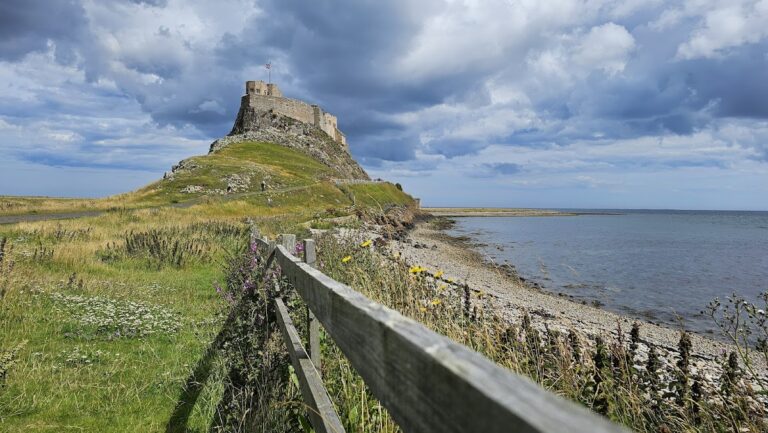
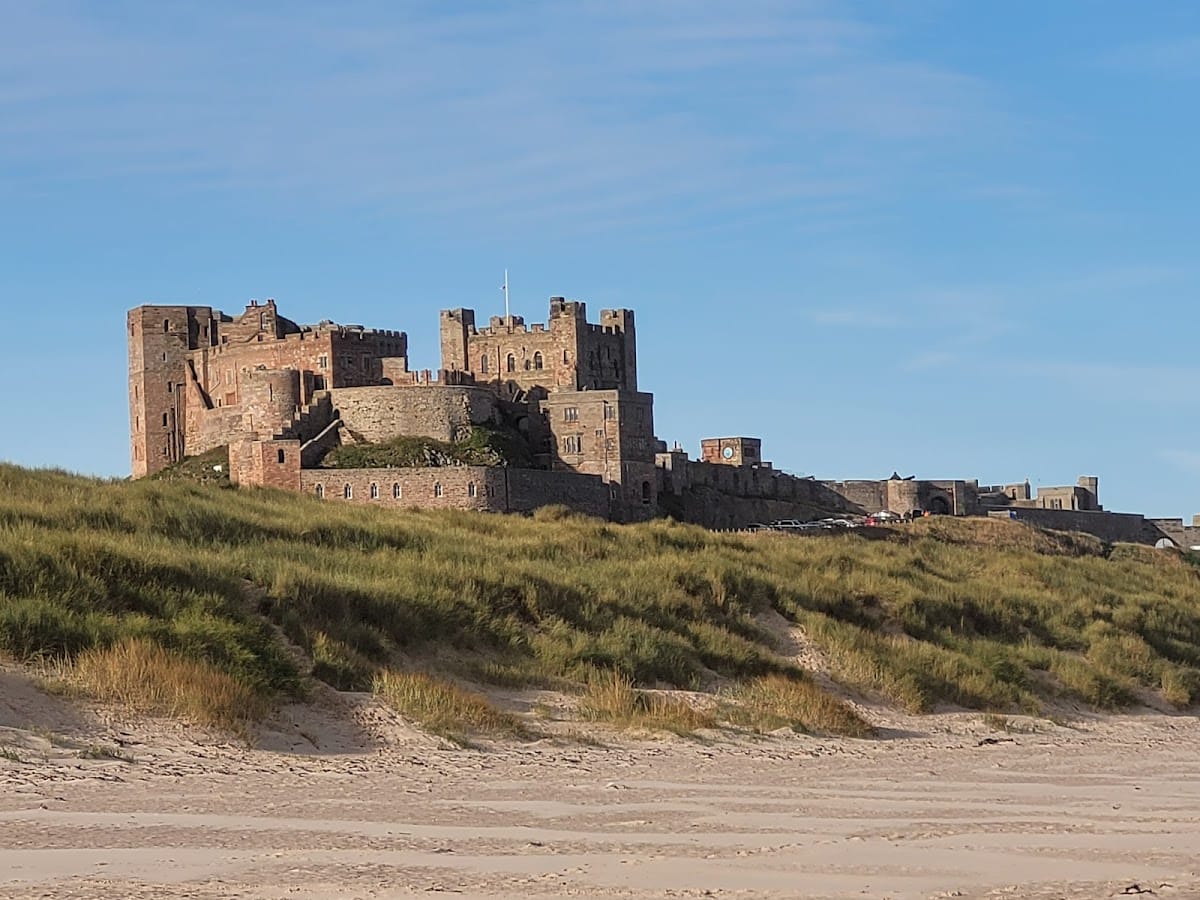
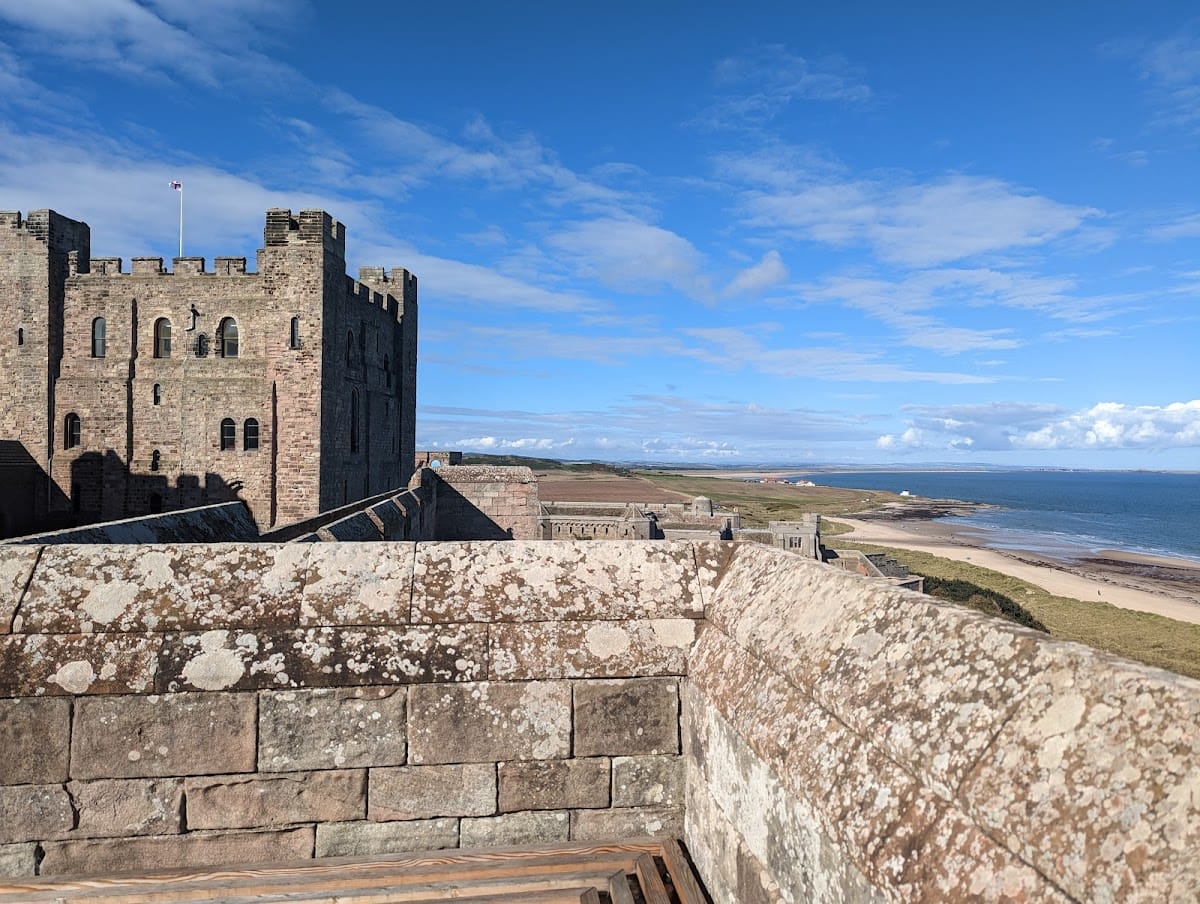
Bamburgh Castle occupies the summit of a black volcanic dolerite crag that forms part of the Whin Sill, a major geological intrusion in northern England. The present complex contains the core of the Norman castle raised after the Viking destruction of the earlier fort. Its buildings are divided into apartments and were reconstructed and restored between 1894 and 1904 with squared sandstone and finely dressed ashlar masonry laid in regular courses.
The keep
The keep is probably a twelfth-century structure built under Henry II and completed by 1164. It was later refurbished by John Sharp. As the principal fortified tower, it forms one of the central surviving elements of the castle and belongs to the medieval phase that followed the Norman rebuilding.
Courts and hospital
The castle’s court rooms were refurbished under John Sharp’s direction, and a hospital was established within the site. These changes belong to the period when Lord Crewe’s trustees adapted the castle for renewed occupation and institutional use.
Burial ground and archaeological finds
Bowl Hole
The Bowl Hole is an early medieval burial ground in the sand dunes south of the castle. A storm first exposed evidence of the burial ground in 1817. Excavations carried out between 1998 and 2007 uncovered the remains of 120 individuals dating from the seventh and eighth centuries. Analysis led by Professor Charlotte Roberts of Durham University identified people with origins in Ireland, Scotland, Scandinavia, the Mediterranean, and North Africa. In 2016, the human remains were moved to the crypt of St Aidan’s Church in Bamburgh.
Bamburgh Beast and Bamburgh Sword
The 1960s excavations produced the Bamburgh Beast, a gold plaque, and the Bamburgh Sword. These finds provide material evidence associated with the early archaeological investigation of the fortress.
Museum and wartime defenses
Armstrong and Aviation Artefacts Museum
The castle’s laundry rooms house the Armstrong and Aviation Artefacts Museum. Its displays concern William Armstrong and Armstrong Whitworth, the manufacturing company he founded, and include engines, artillery, weaponry, and aviation artefacts from the two world wars.
Sand-dune pillboxes
Second World War pillboxes were established in the sand dunes surrounding the castle as defensive installations. Their presence reflects the site’s continued military relevance during the wartime defense of the coast.