Maragheh Observatory: An Ilkhanid Center of Astronomy in Iran
Site at a Glance
- Rating
- 4.3
- Popularity
- Low
- Country
- Iran
- Primary era
- Medieval
- Eras represented
- Medieval
- Civilizations
- Ilkhanate
- Site type
- Civic
On this page15 sections
History
Maragheh Observatory is the surviving archaeological site of a thirteenth-century Ilkhanid astronomical institution at Maragheh in East Azerbaijan Province, Iran. Built under the patronage of Hulagu and directed by Nasir al-Din al-Tusi, it was established in 1259 and became a major center for astronomy, mathematics, education, and the preparation of astronomical tables.
Foundation under Hulagu
The observatory was founded after al-Tusi argued that new astronomical tables were needed. Hulagu, founder and first ruler of the Ilkhanate, the Mongol dynasty that governed much of Iran and neighboring regions, authorized the project. Construction began in 1259 and continued for approximately three to five years. A local tradition places its beginning in 657 of the Islamic calendar.
The institution was supported by a waqf, a legally established religious endowment whose income was assigned to charitable, educational, or religious purposes. Al-Tusi administered this endowment, giving Hulagu a pioneering role in financing an observatory through such a foundation. The precise reasons for Hulagu’s decision are uncertain. His interest may have involved astrology, al-Tusi’s appeals to his superstitions, or the mathematical and astronomical interests of Hulagu’s brother Mongke.
Al-Tusi had encountered Hulagu after the Mongol conquest of Alamut in 1256. Al-Tusi and other scholars had been sheltering at the fortress, which had been controlled by the Nizaris, a branch of Shia Islam. The circumstances of al-Tusi’s relationship with the Nizaris, including whether he was detained or assisted the Mongol attack, remain disputed. Hulagu later appointed him vizier and placed him in charge of religious endowments, providing the financial basis for the observatory.
Scientific and educational work
Al-Tusi became the observatory’s principal astronomer and first director. He supervised the installation of instruments, recruited scholars and staff, organized the library, and managed the endowment. His work there included the Tusi-couple, a geometric model in which two circular motions combine to create linear motion, and revisions of Euclid’s Elements and Ptolemy’s Almagest. The Ptolemaic system was the geocentric model associated with the ancient astronomer Claudius Ptolemy.
The observatory attracted students and scholars from across the Islamic world and as far as China. More than one hundred astronomers were associated with it during its active existence. Recovered student texts include introductions to mathematical astronomy and astronomical tables. Teaching extended beyond observation and calculation, with the institution also associated with philosophy, medicine, and other fields.
Mu’ayyid al-Din al-‘Urdi, an astronomer and engineer from Damascus, directed the construction of the buildings and the manufacture of instruments. Other associated scholars included Muhyi al-Din al-Maghribi, Qutb al-Din al-Shirazi, Najm al-Din Qazvini, Fakhr al-Din Maraghi, and Fao Munji, Hulagu’s Chinese astronomer. Fao Munji’s experience contributed to improvements in the Ptolemaic system used by al-Tusi.
After twelve years of work by al-Tusi and his colleagues, the astronomical handbook known as the Zij-i Ilkhani, or Ilkhanic Tables, was compiled. It contained numerical tables for calculating the positions and movements of celestial bodies. The work was published during the reign of Hulagu’s son Abaqa and took its name from the observatory’s patron. Local tradition dates its completion to 1276. The tables remained influential in several regions, including China, and were translated and published in Europe in 1356.
The observatory also served as a library and a place of practical training. Bar-Hebraeus, a Christian scholar and religious figure, lived near it late in his life so that he could use its library, and left a description of the institution. The library was said to contain approximately 400,000 books, supporting the observatory’s broad intellectual role.
Later Ilkhanid period and decline
Maragheh Observatory survived under seven rulers, including Abaqa and Uljaytu, and remained active for more than fifty years. After al-Tusi’s death, his son Sadr al-Din succeeded him as director. During Uljaytu’s reign, another son, Asil al-Din, held the same office.
Decline began in the late thirteenth century. The observatory lost important patronage after Hulagu died in 1265 and Abaqa died in 1282, and it became inactive by the beginning of the fourteenth century. Earthquakes, inadequate funding, and prolonged regional conflict contributed to the ruin of the complex. The contents of its library were stolen or destroyed.
Shah Abbas the Great arranged repairs in the early seventeenth century, but he died before restoration could begin. The observatory’s design later influenced institutions including the Ulugh Beg Observatory in Samarkand, the Taqi al-Din Observatory in Constantinople, the Jantar Mantar observatories in Jaipur, and the Gaocheng Astronomical Observatory in China.
Excavation and protection
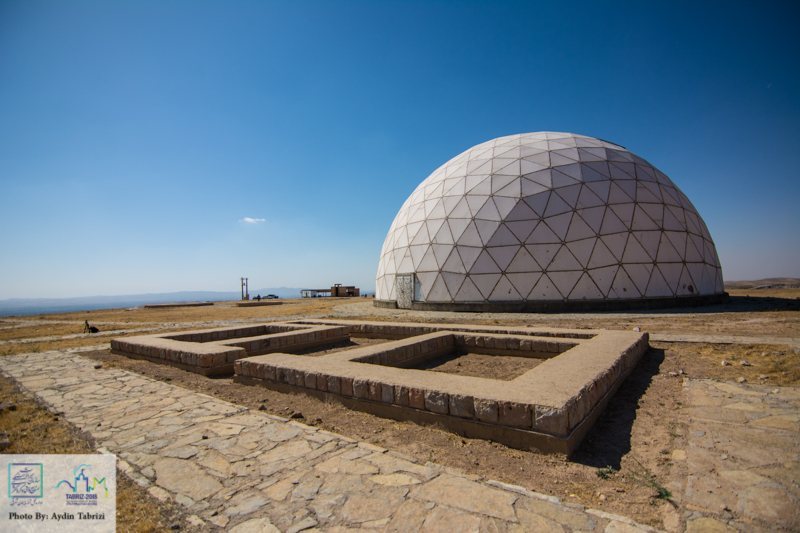
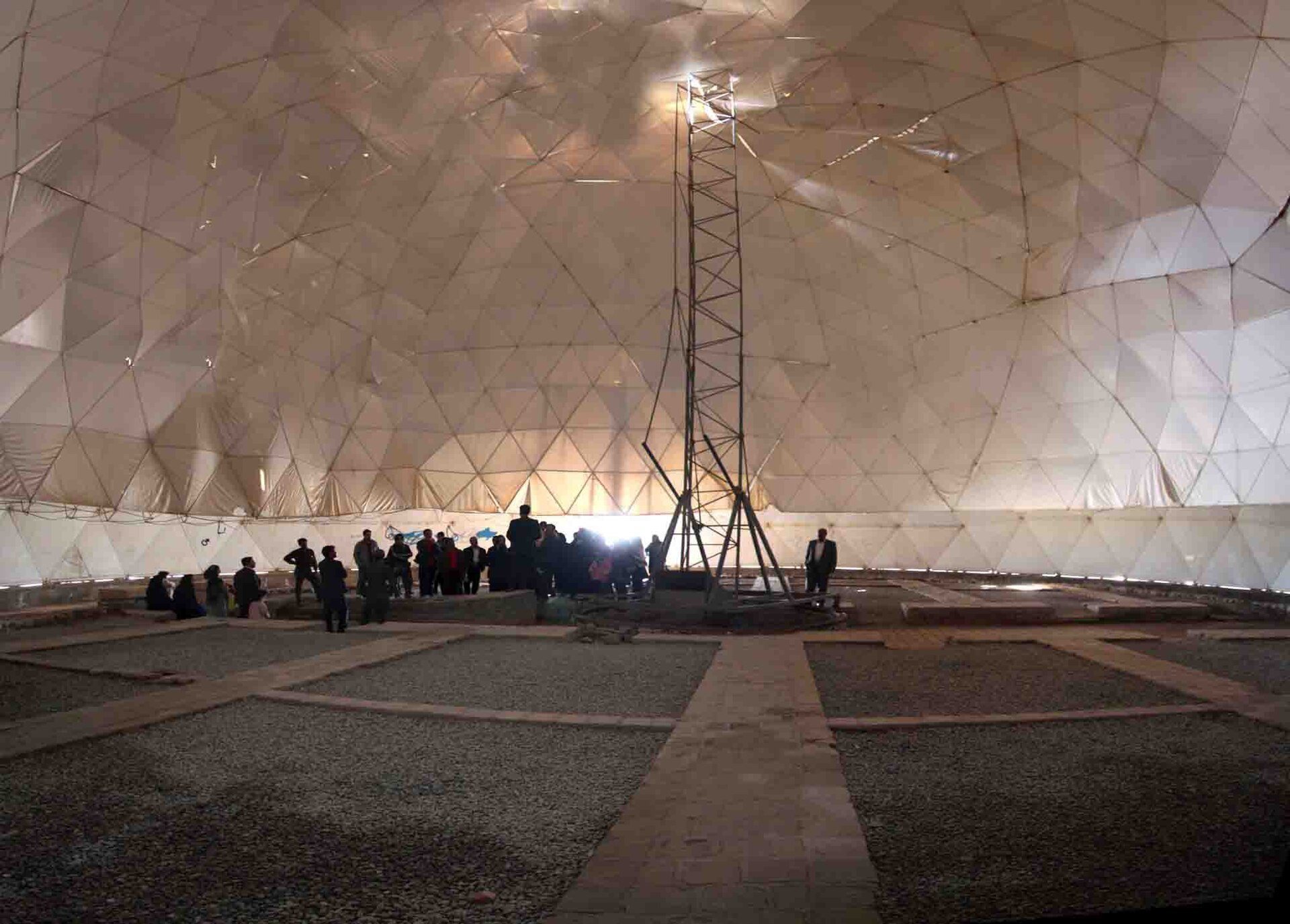
The first modern archaeological investigation took place in 1972, when the Iranian archaeologist Parviz Varjavand excavated the site in a project commissioned by the University of Tehran and the University of Tabriz. Since the late 1970s, Tabriz University has managed and protected the observatory in cooperation with the municipality of Maragheh. A dome-shaped protective cover now shields part of the remains, and further renovation projects have been undertaken. The observatory is recorded as a nationally registered historic property in Iran.
Remains
The observatory stood west of Maragheh on a flat-topped hill near the villages of Taleb Khan and Haji Kurd. The hill is described as approximately 510 meters long, 217 meters wide, and 110 meters high. The observatory complex occupied a separate area of about 400 meters by 150 meters, and Lake Urmia could reportedly be seen in the distance. The buildings were arranged around a central tower and five smaller circular units or platforms, with scientific, educational, residential, and religious facilities distributed across the complex.
Central observing complex
Central tower
The central tower had a circular plan divided by a long corridor, with six spaces on each side. It was the principal area for astronomical observations and for storing scientific documents. Excavation has exposed the foundations of its different sections and part of a stone sextant, an instrument used to measure angular distances between celestial objects or between a celestial object and the horizon.
Instrument platforms and original dome
Five smaller circular units near the central tower are interpreted as platforms for astronomical instruments. A large dome formed part of the original arrangement and enabled resident astronomers to measure the position and movement of the Sun. The protective dome now covering part of the site was built separately from that original structure and serves to shield the surviving remains.
Supporting buildings and facilities
Workshops, library, and residences
The complex included a metalworking or casting workshop for making astronomical instruments, residential areas for staff and scholars, and a large library. Its buildings also included a school, a mosque, a residence associated with Hulagu, and a well. Brick, carved and engraved stone, and glazed tile were used in construction and architectural ornament.
Rasadkhana caves
On the western side of the hill, Varjavand identified the so-called Rasadkhana caves. These underground spaces contain temple-like rock structures resembling Chinese and Mongol religious architectural styles. During the Ilkhanid period, visitors are believed to have used them for religious ceremonies.
Instruments and archaeological finds
Observational instruments
Instruments associated with the observatory included a mural quadrant with a radius of approximately 430 centimeters, an armillary sphere, an equatorial ring, a solstitial ring, and an azimuth ring. An armillary sphere is a framework of rings representing celestial circles. A mural quadrant is a large graduated quarter-circle for measuring the altitude of celestial objects. Al-‘Urdi is credited with designing the mural quadrant and armillary sphere and may also have helped design a complex system of water wheels.
A celestial globe associated with the observatory was probably made around 1300 by Muhammad, the son of al-‘Urdi. Made of brass with silver and gold inlay, it bears its maker’s signature. Augustus, Elector of Saxony, acquired it in 1562, and it is now preserved in Dresden, Germany.
The History of the Yuan Dynasty records that instruments from Maragheh were later acquired for the establishment of the Beijing Observatory under the Yuan dynasty. The listed equipment included an armillary sphere, an alidade, two observation tubes, an equal-hours plate, a celestial globe, a terrestrial globe, and a torquetum. A torquetum was a medieval instrument for determining and converting celestial coordinates. The observation tubes were reportedly used both to observe celestial bodies and to view distant objects at sea.
Excavated materials
Excavation recovered fragments of glass and pottery, copper coins, and a gold coin from the Ilkhanid period. These finds accompany the surviving foundations and architectural materials, which include brick, carved and engraved stone, and glazed tile used in the buildings and their ornamentation.