Afqa Grotto: An Ancient Cave and Sanctuary in Lebanon
Site at a Glance
- Rating
- 4.3
- Popularity
- Low
- Country
- Lebanon
- Primary era
- Classical
- Eras represented
- Classical
- Civilizations
- Roman
- Site type
- Religious
- Remains
- Sanctuary
On this page8 sections
History
Afqa Grotto is an ancient cave and sanctuary in the Lebanon Mountains of Lebanon, near ancient Byblos. The site is associated with the source of the Nahr Ibrahim, formerly known as the Adonis River, and was recognized as a sacred place by the second millennium BC.
Ancient sanctuary and classical traditions
The sanctuary’s reputation reaches back to the Paleo-Babylonian period, an early second-millennium-BC phase of Mesopotamian history, since Afqa is identified with a famous place in that period’s version of the Epic of Gilgamesh. In the classical era, the sanctuary was commonly connected with Aphrodite, the Greek goddess of love and sexual attraction, or with Astarte, a major ancient Near Eastern goddess whose worship was sometimes associated with Aphrodite. Rites linked to Adonis, a figure associated with fertility and seasonal renewal, also formed part of the site’s later interpretation.
Lucian of Samosata, a Greek-language author and satirist of the second century AD, probably visited the sanctuary. He placed it a full day’s journey from Byblos and described its temple of Aphrodite as ancient. He attributed its foundation to Cinyras, a legendary king associated in classical tradition with Cyprus and the worship of Aphrodite.
Destruction and Christian reuse
Eusebius of Caesarea and Sozomen describe the destruction of the Aphaca temple by order of Emperor Constantine, whose reign included the Roman Empire’s move toward official support for Christianity. They also describe the prohibition of its cult, which they regarded as licentious. The temple is said to have been rebuilt in the fourth century under Constantine’s nephew Flavius Julian, later known as Julian the Apostate. A late-antique Christian basilica with an apse, a rounded or polygonal end of a church, may subsequently have occupied the temple site.
The association with Aphrodite, Astarte, and Adonis remains interpretive because no surviving monument confirms or disproves the identification. Since the nineteenth century, writers have also proposed Afqa as the location of the tomb of Adonis, who was sometimes identified with the related Mesopotamian and Levantine figure Tammuz or Thammuz.
Legend and modern investigation
Local tradition connected with the De Dea Syria places the story of Adonis beneath the cave entrance. In the legend, Adonis and Venus concealed their love in the cave, and Mars, transformed into a wild boar, killed Adonis. The river’s former name encouraged the belief that its water was the blood of the slain demigod. Its reported annual red discoloration has a natural explanation in iron-bearing material washed from the ground during the rainy season, while tradition interpreted it as Adonis’s blood.
The cave is explored by the Lebanese speleological club. Landslides have affected the archaeological remains and natural features, possibly because galleries cut beneath the sanctuary terrace weakened the ground.
Remains
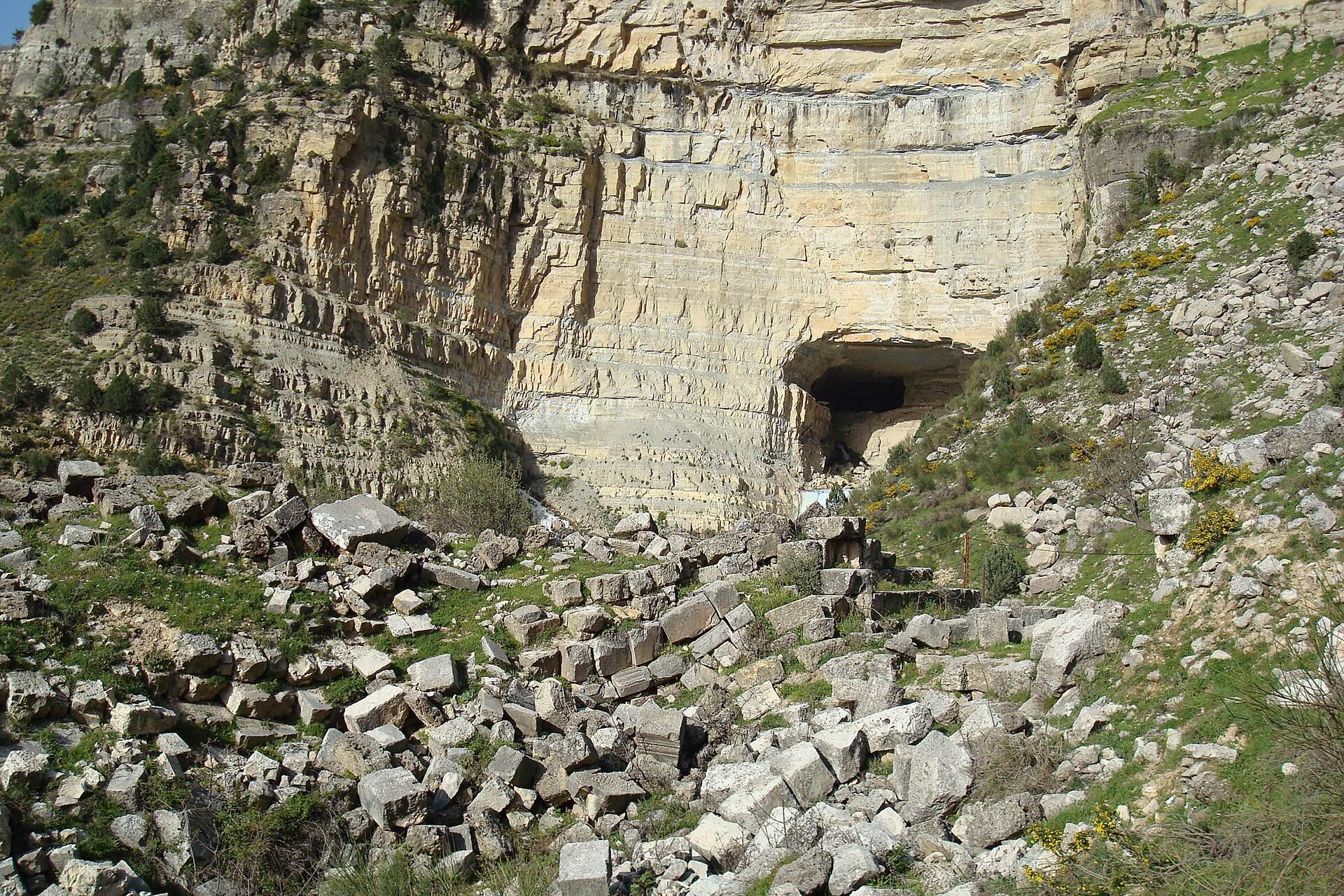
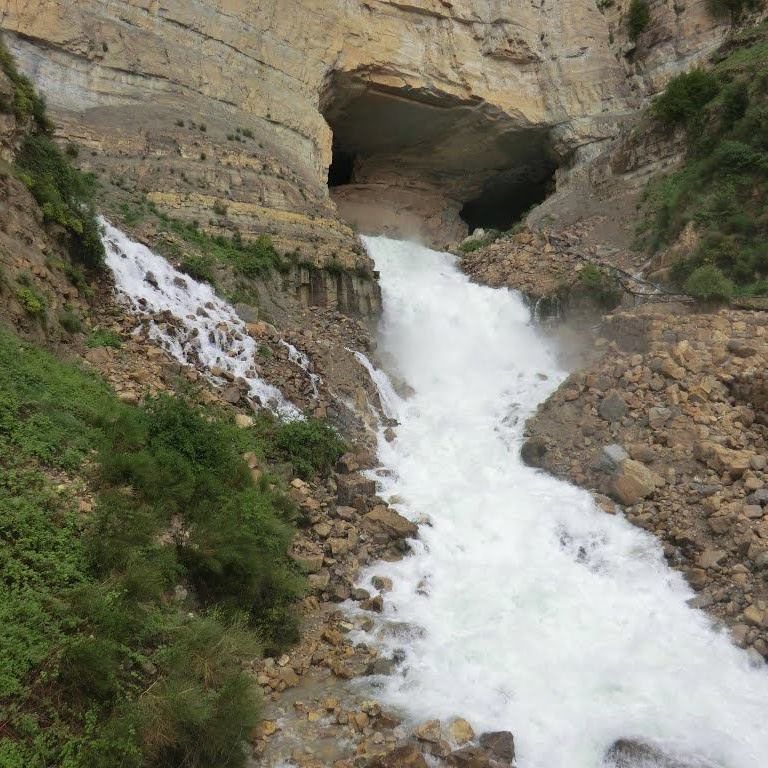
Afqa Grotto is a limestone cave at the foot of a very high cliff in the Lebanon Mountains. Its elevation is reported at approximately 1,100 to 1,255 metres above sea level, and its opening faces an abyss described as more than 200 metres deep. The explored passage system extends for more than 3,600 metres, with interconnected corridors, fossilized passages, a difficult-to-reach level, and conduits that are being filled with clay.
Cave and river
An underground spring emerges from the cave and forms the headwaters of the Nahr Ibrahim. At the entrance, the young river moves through successive cascades and, after snowmelt, has been described as descending about 180 metres over natural rock steps. The cave’s spring is one of the principal outlets of underground water draining the mountain massifs around the Nahr Ibrahim valley, together with the spring of Rouais near Aaqoura.
Roman sanctuary terrace
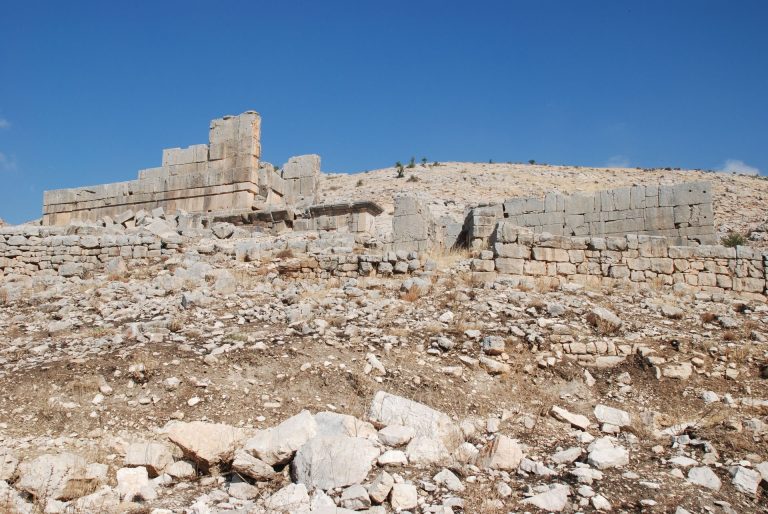
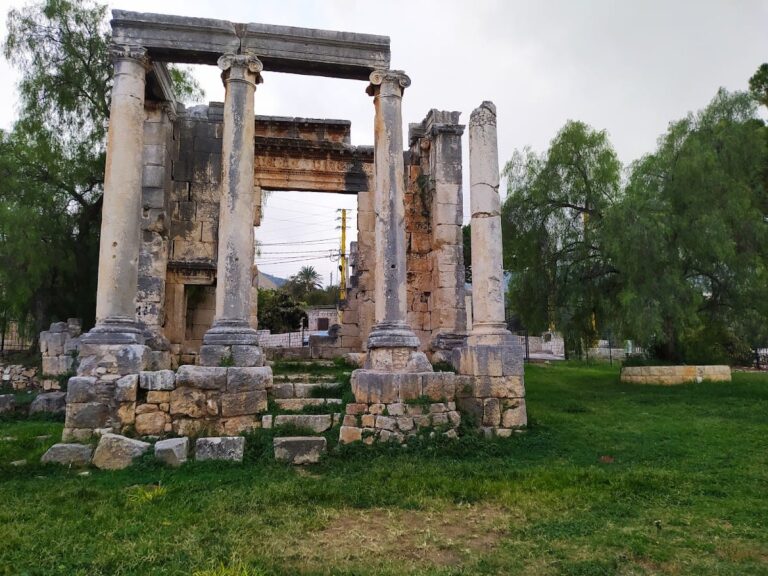
Roman-period ruins occupy a modified natural terrace west of the cave. Landslides caused the buildings to collapse. The clearest surviving structure is a temple about 40 metres long, raised on a podium and described as tetrastyle, meaning that its portico had four columns, and Corinthian, an architectural order known for capitals decorated with acanthus leaves. Its foundations used yellow-ochre sandstone blocks, while the visible walls were built mainly from blue-grey limestone. Engaged pilasters decorated the exterior, and engaged half-columns shaped the interior.
Below the temple, toward the riverbed, a vaulted gallery formed part of the sanctuary’s substructure and collected water from an underground spring. A second gallery above it probably carried runoff from beneath the temple. These excavated passages may have weakened the terrace and contributed to the landslides that damaged the sanctuary.
Additional sanctuary structures
A late-antique Christian basilica with an apse may have stood where the temple once stood. Near the cave entrance, several remaining stone blocks have been identified as the remains of a temple dedicated to Ištar, a Mesopotamian goddess associated with love, fertility, and war. A description of the Phoenician sanctuary divides it into an inner area for the deity and worship, an outer passage leading into that area, and a public court beside residences for priests and officials.
A stone bridge crosses the emerging river at the cave and dates from the Roman period. It belongs to the site’s surviving water-crossing features, alongside the natural cascades formed by the spring as it leaves the cave.