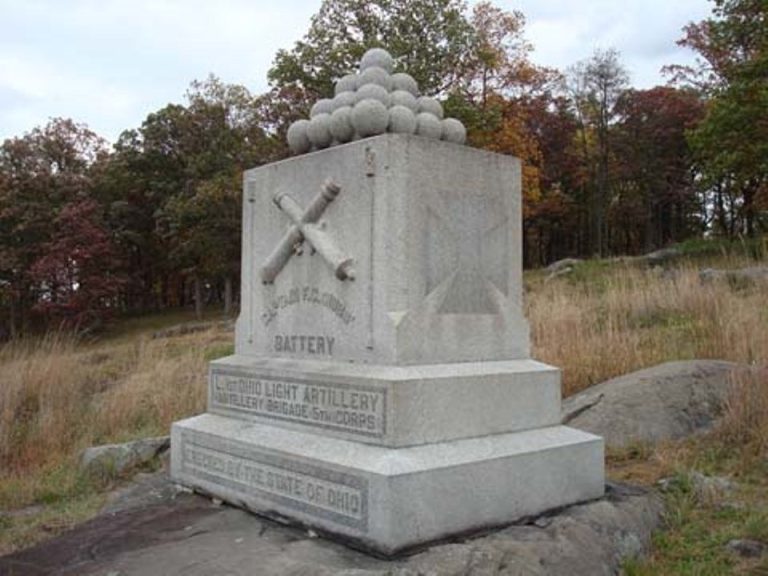
Antietam National Battlefield: A Civil War Battlefield and Memorial Landscape
Site at a Glance
- Rating
- 4.9
- Popularity
- Medium
- Country
- United States
- Primary era
- Modern
- External website
- Open
- Eras represented
- Modern
- Civilizations
- Unclassified
- Site type
- Military
On this page9 sections
History
Antietam National Battlefield, in Sharpsburg, Maryland, United States, commemorates the Battle of Antietam, fought on September 17, 1862, during the American Civil War. The conflict, fought between the Union and the Confederacy from 1861 to 1865, reached this landscape during General Robert E. Lee’s first invasion of the North. The battle ended that campaign and produced a combined total of 22,717 dead, wounded, or missing, making it the bloodiest single day in United States history.
The battle on September 17, 1862
The fighting began at dawn when Union Maj. Gen. Joseph Hooker ordered an artillery bombardment of Confederate positions commanded by Maj. Gen. Thomas J. “Stonewall” Jackson in Miller’s Cornfield. Union troops initially forced the Confederates back, but Jackson’s reinforcements restored the position. Union Maj. Gen. Joseph K. Mansfield then regained part of the ground lost during the opening struggle.
At midday, Union Maj. Gen. William H. French’s troops moved to support Maj. Gen. John Sedgwick but veered into Confederate positions held by Maj. Gen. D. H. Hill along the Sunken Road. Combat continued there for four hours before Union troops captured the defensive position.
During the afternoon, Maj. Gen. Ambrose E. Burnside’s IX Corps tried to cross Antietam Creek. About 500 Georgia sharpshooters delayed the advance, but Union troops crossed Burnside’s Bridge at approximately 1 p.m. They took the heights beyond the creek and later moved toward Sharpsburg. Maj. Gen. A. P. Hill’s division arrived from Harpers Ferry in time to prevent the Union force from entering the town and pushed it back toward the heights.
During the night of September 18, Lee withdrew his army across the Potomac River, leaving the battlefield and Sharpsburg to Union commander George B. McClellan. The result brought the battle’s immediate military operations to an end, while the dead and wounded shaped the landscape’s later commemorative history.
Burial and commemoration
Antietam National Cemetery was commissioned in 1865, and burials began in 1867 after efforts to identify the dead succeeded in approximately 40 percent of cases. Civil War burials there were limited to Union soldiers. Confederate dead were buried at Washington Confederate Cemetery in Hagerstown, Mount Olivet Cemetery in Frederick, and Elmwood Cemetery in Shepherdstown, West Virginia. The cemetery later received veterans and their wives from the Spanish-American War, the two World Wars, and the Korean War.
The cemetery came under the War Department on July 14, 1870, and transferred to the National Park Service, the federal agency responsible for administering national parks and other protected historic areas, on August 10, 1933. Additional interments ended in 1953, with exceptions in 1978 and 2000. The battlefield was established as Antietam National Battlefield Site on August 30, 1890. It also transferred to the National Park Service in 1933 and was redesignated on November 10, 1978. The property entered the National Register of Historic Places, the federal register of significant historic properties in the United States, on October 15, 1966, with additional National Park Service documentation recorded on February 27, 2009.
Preservation and interpretation
The Pry House served as General George B. McClellan’s headquarters during the battle and later became the Pry House Field Hospital Museum. Its interpretation focuses on the house’s history and on period medical care. A field hospital was a temporary medical facility established near military operations to treat wounded soldiers.
From 1988 through 1991, Antietam National Battlefield appeared on a list of America’s Most Endangered Places because of a proposal for a shopping center and other buildings on battlefield land. Local, state, and federal agencies, together with nonprofit organizations, responded with preservation action. By 2017, the battlefield was identified as a successful preservation effort. By mid-2023, the American Battlefield Trust and federal, state, and local partners, including the Save Historic Antietam Foundation, had acquired and preserved 468 acres. This included the 44.4-acre Wilson farm tract between Miller’s Cornfield and the Dunker Church. Its postwar house and barn were removed, allowing the land to return to its wartime appearance.
A battlefield illumination began in 1989 and continues annually on the first Saturday in December. More than 1,000 volunteers place 23,000 small lights in rows across the northern portion of the battlefield. Each light represents a soldier killed, wounded, or missing in the battle.
Remains
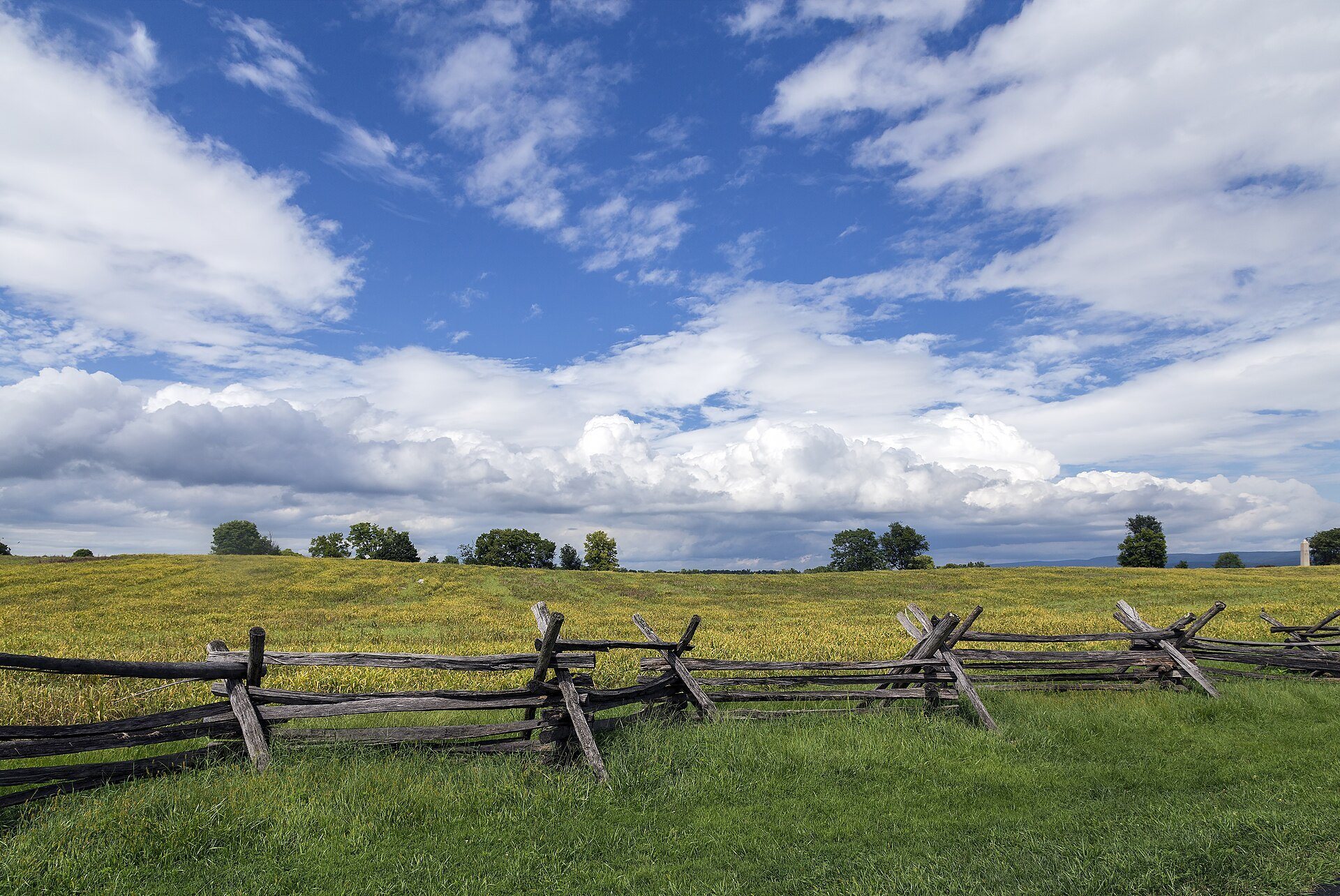
The preserved area covers approximately 3,229 acres along Antietam Creek, among fields in the Appalachian foothills near the Potomac River. It includes the battlefield, Antietam National Cemetery, Burnside’s Bridge, the visitor center, and the Pry House Field Hospital Museum. These elements preserve both the ground over which the battle was fought and the later structures that shaped its commemoration and interpretation.
Battlefield features
Miller’s Cornfield preserves the principal location of the opening phase. The Sunken Road retains the setting of the Confederate defensive position captured by Union troops after four hours of fighting. Burnside’s Bridge is a stone-arch bridge over Antietam Creek. Union troops crossed it during the afternoon battle before taking the heights beyond the waterway.
The Wilson farm tract covers 44.4 acres between Miller’s Cornfield and the Dunker Church. Preservation work removed the postwar house and barn, returning the tract to its wartime appearance. The battlefield’s visitor center, built in 1962 through the Mission 66 program, contains museum exhibits on the battle and the Civil War. It also serves as the interpretive center for an 8.5-mile driving route with eleven stops.
Antietam National Cemetery
Antietam National Cemetery adjoins the battlefield and covers 11.36 acres. It contains more than 4,976 interments, including 1,836 unidentified individuals, along with later graves of veterans and their wives from several American wars. Its entrance includes a gatehouse designed by Paul J. Pelz, who later designed the Library of Congress.
The cemetery also contains the U.S. Soldier Monument, known as “Old Simon.” Carl Conrads sculpted the monument, which was designed by George Keller and dedicated on September 17, 1880. The monument and the cemetery’s graves form a later memorial landscape beside the ground associated with the 1862 battle.
Pry House Field Hospital Museum
The Pry House Field Hospital Museum occupies the house that served as McClellan’s headquarters during the battle. Its exhibits address medical care for wounded Civil War soldiers and the history of the Pry House, connecting the preserved building with the military and medical events that took place around it.
Battlefield illumination
The annual illumination uses paper bags filled with sand and a candle as small memorial lights. Each luminary represents a soldier killed, wounded, or missing during the Battle of Antietam, and the lights are arranged in rows on the northern portion of the battlefield.