Iron Pillar of Delhi: A Gupta-Period Religious Monument in Mehrauli
Site at a Glance
- Rating
- 4.6
- Popularity
- Medium
- Country
- India
- Primary era
- Classical
- Eras represented
- Classical
- Civilizations
- Gupta
- Site type
- Religious
On this page11 sections
History
The Iron Pillar of Delhi is a forged iron religious monument in the Qutb complex at Mehrauli, Delhi, India, constructed in the early fifth century CE during the Gupta period. It was made under the Gupta dynasty, probably during the reign of Chandragupta II, and is associated with Vaishnavism, the Hindu devotional tradition centered on Vishnu. Its inscription, engineering, and later incorporation into the Qutb complex connect Gupta religious culture with the later history of Delhi.
Gupta-period origins
The pillar’s oldest inscription names a king called Chandra. He is generally identified with Chandragupta II, who ruled approximately from 375 to 415 CE, although the inscription has no date and the identification remains debated. The text presents Chandra as a devotee of Vishnu and describes the erection of a dhvaja, a religious or ceremonial standard, dedicated to the god on a hill called Vishnupada or Vishnupadagiri.
The inscription praises Chandra’s campaigns in the Vanga region, his crossing of the seven mouths of the Sindhu, and his conquest of the Vahlikas, an ancient people whose precise identity is uncertain. It also declares that he attained supreme sovereignty and that his fame endured after his passage to the other world. Whether this language refers to a deceased ruler or to a living king who had withdrawn from active rule remains unresolved.
The original setting of the pillar is uncertain. An earlier interpretation identified Vishnupadagiri with Mathura, while later archaeological, inscriptional, iconographic, and metallurgical arguments have connected it with Udayagiri in central India, probably near the Udayagiri Caves. This proposal fits the area’s Gupta-period association with Chandragupta II and Vishnu worship, as well as central India’s established traditions of iron mining and working. Vidisha has also been proposed as the original location. The pillar may once have stood near Udayagiri with a wheel or discus at its top, but neither its first position nor the circumstances of its removal are known with certainty.
Transfer to Delhi
The date and agency of the pillar’s transfer to Delhi remain disputed. A short and difficult inscription connected with the Tomara ruler Anangpal has been read in two ways. One interpretation links it to the establishment or population of Delhi in 1052, while another understands it as referring to the tightening or installation of the pillar. The nineteenth-century archaeologist Alexander Cunningham therefore attributed the relocation to Anangpal. A Jain text composed in 1132 also seems to describe a pillar already associated with Delhi, if its reference is to this monument.
Another possibility places the transfer during the thirteenth-century Muslim rule of Delhi. One theory connects it with Qutb al-Din Aibak’s establishment of the Qutb complex around 1200, while another associates it with Sultan Iltutmish after his attack and sack of Vidisha. In this interpretation, the pillar was brought to the developing Quwwat-ul-Islam Mosque and Qutb complex as a trophy, possibly under Iltutmish. The exact circumstances remain uncertain.
Later damage and modern interpretation
The pillar suffered a large impact that is generally interpreted as a close-range cannonball strike. The damage is tentatively associated with Nadir Shah’s invasion of Delhi in 1739, although no contemporary account identifies the event. The intended target may have been the pillar, a decorative element at its top, or valuables believed to be concealed inside it. Fragments from the shot may also have damaged the nearby Quwwat-ul-Islam Mosque.
The monument became an important subject of archaeological, metallurgical, and materials-science research because of its unusual resistance to corrosion. Its preservation reflects the composition and working of the iron, including its high phosphorus content, slag, unreduced iron oxides, and repeated wetting and drying in Delhi’s atmosphere. These qualities have also been regarded as evidence of the advanced ironworking skills of ancient Indian smiths.
The pillar’s inscription drew sustained attention from nineteenth-century scholars. William Elliott made a facsimile in 1831, James Prinsep published an initial lithograph in 1834 and an improved version in 1838, and Bhagwan Lal Indraji and Bhau Daji Lad produced a revised reading in 1875. John Faithfull Fleet published a critical edition in 1888. Later studies of the script placed the inscription in the first half of the fifth century and compared it with dated Gupta-period inscriptions.
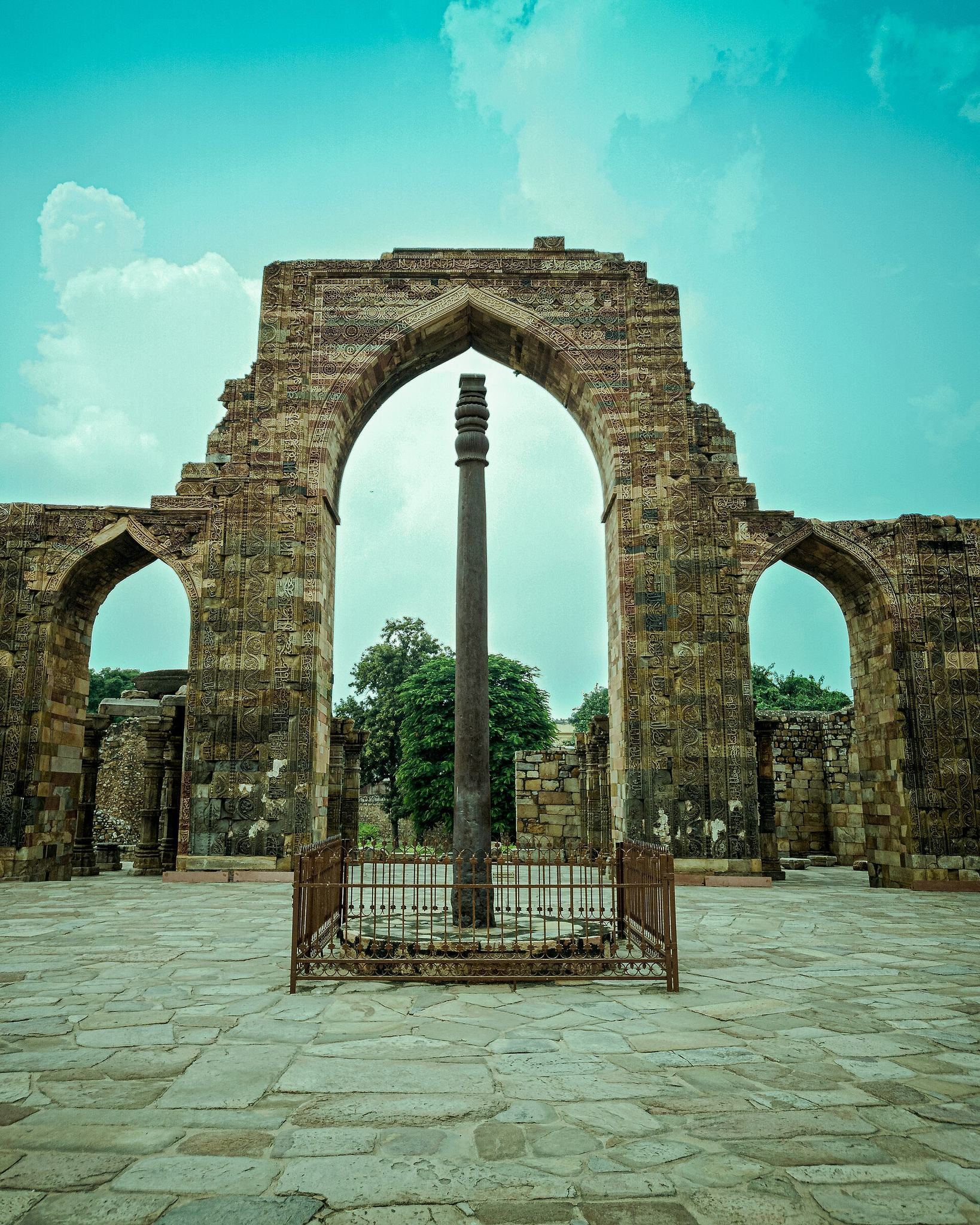
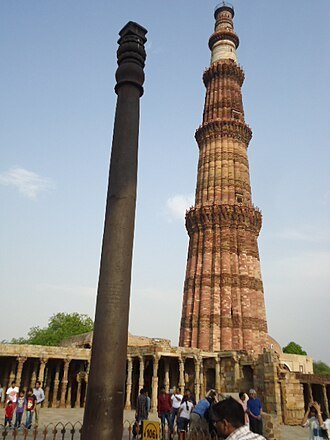
The Iron Pillar and the Qutb complex form part of the UNESCO World Heritage Site known as Qutb Minar and its Monuments, designated in 1993 under cultural criterion (iv). The pillar has also attracted religious visitors and popular beliefs, including the idea that embracing it from behind brings good fortune or grants a wish. A protective fence was installed around it in 1997 to prevent vandalism. The suggestion that ritual applications of oil and incense helped preserve the surface remains hypothetical.
Remains
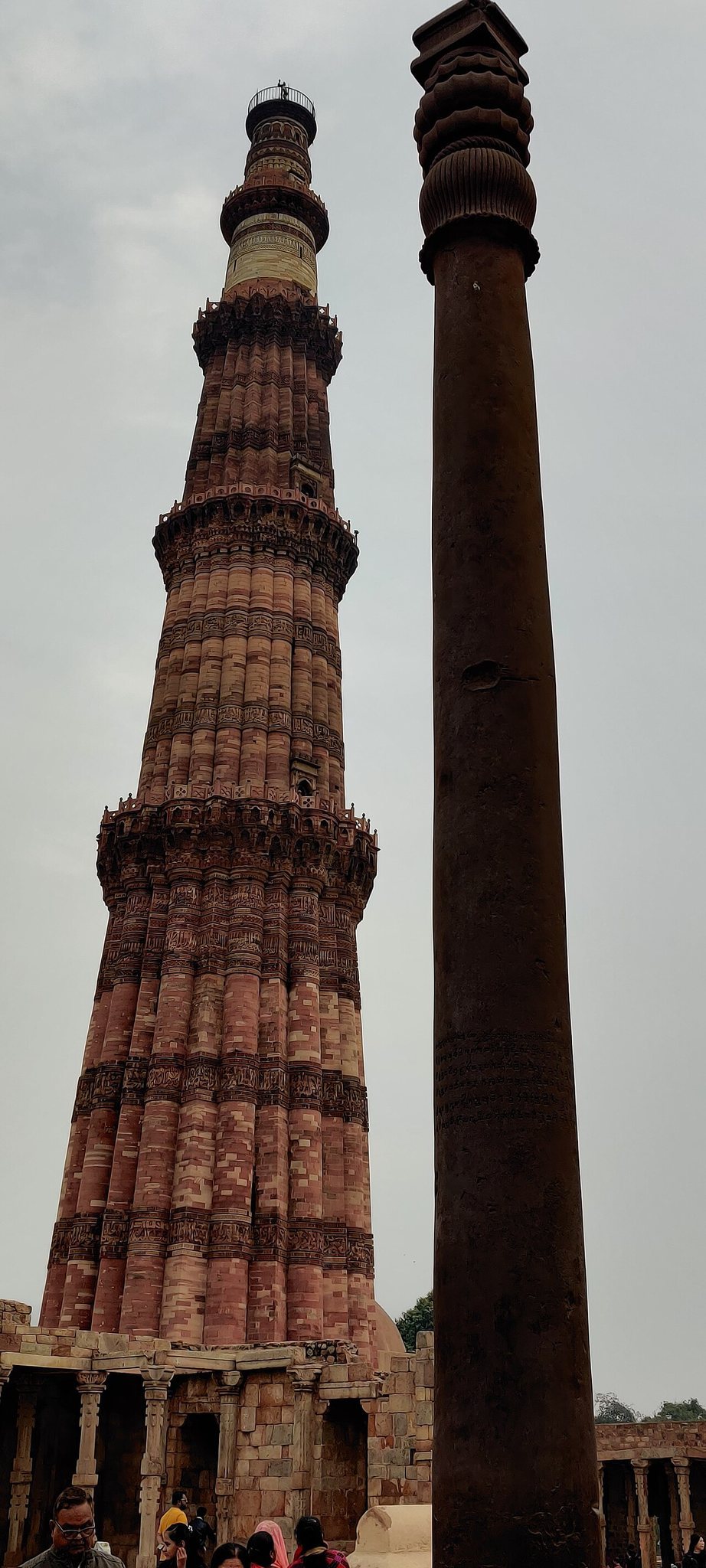
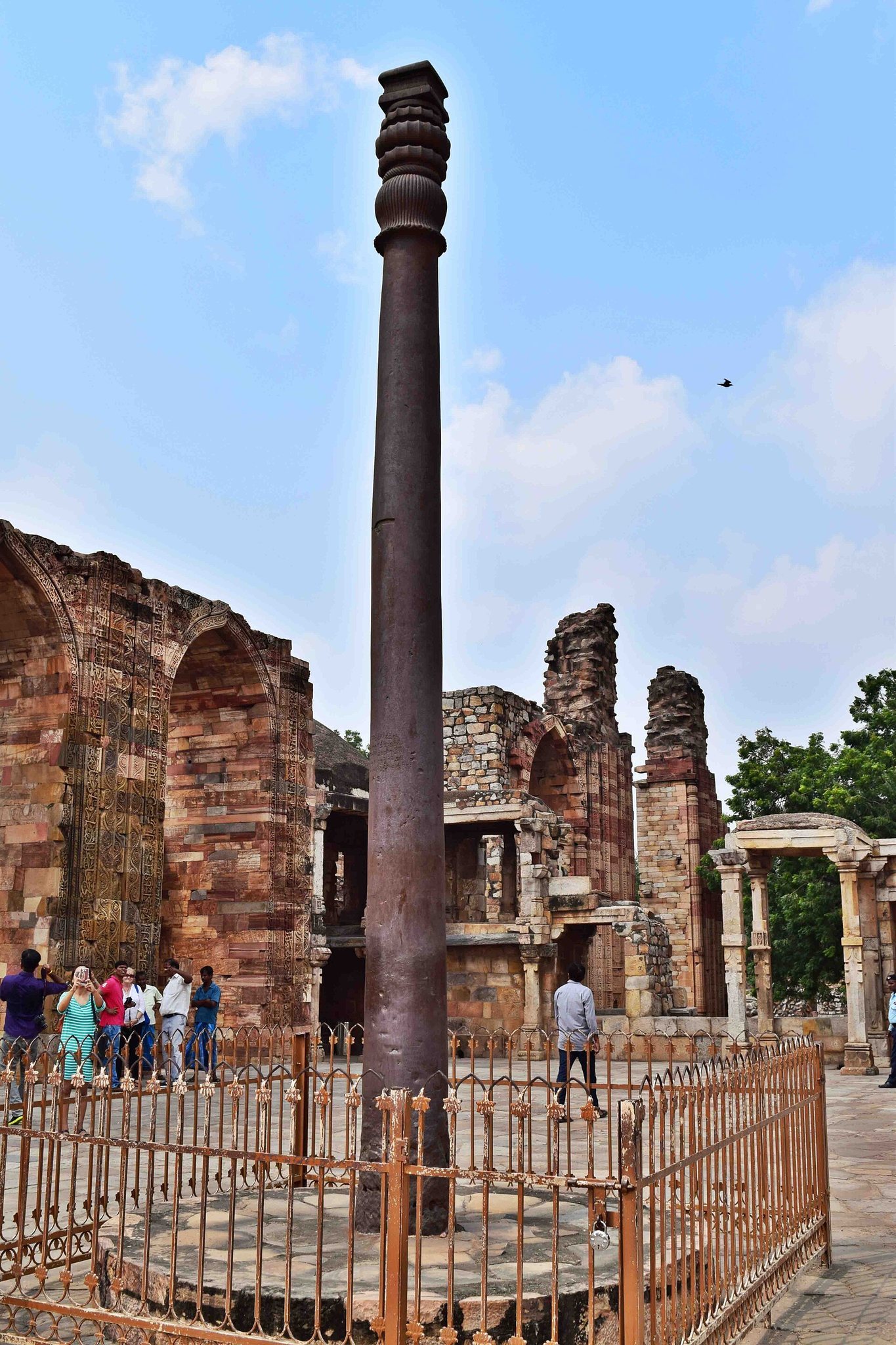
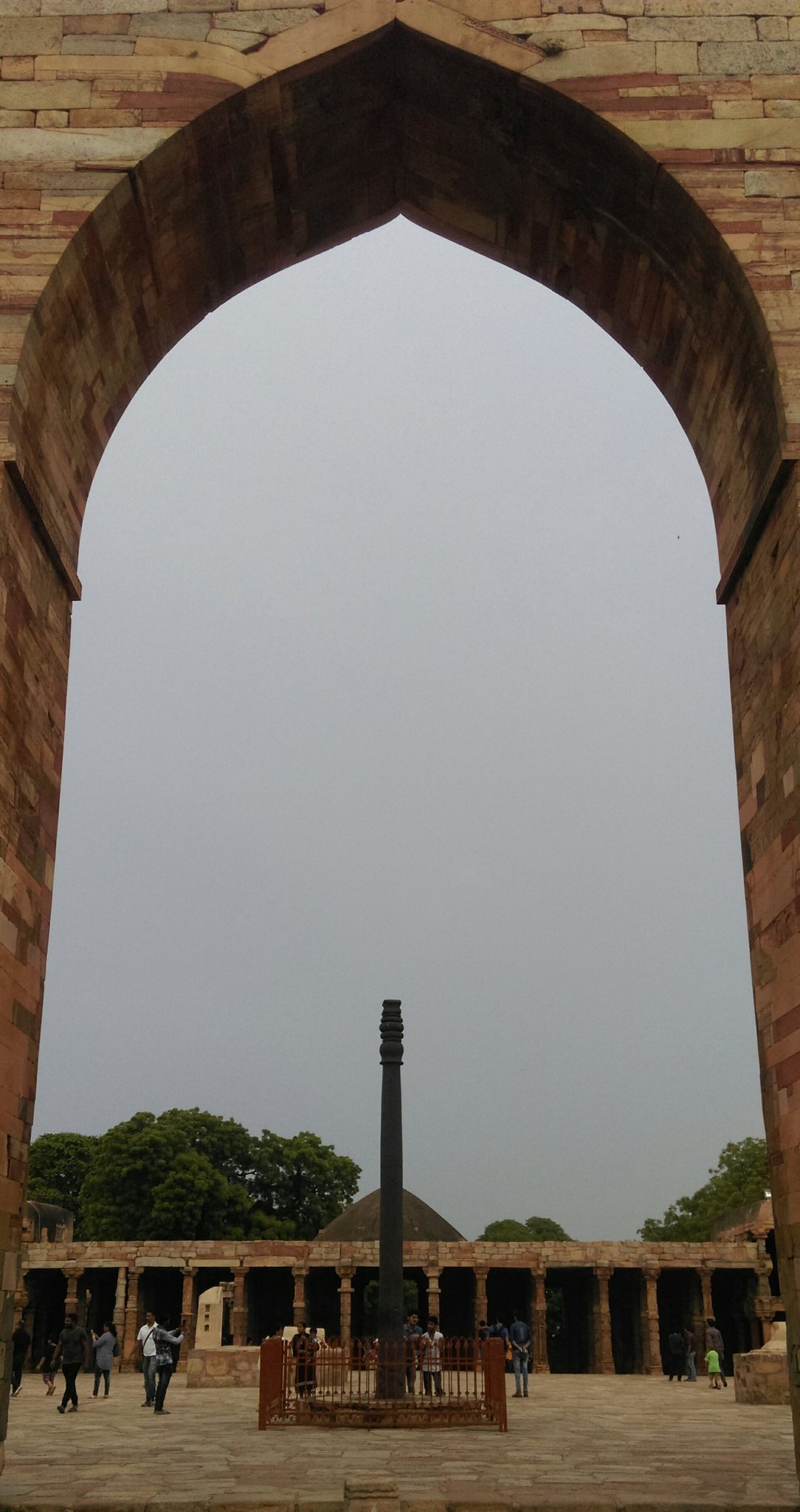
The Iron Pillar stands as a freestanding monument within the Qutb complex, physically associated with the Quwwat-ul-Islam Mosque and the wider group of monuments at Mehrauli. It rises 7.21 metres from the top to the bottom of its base, with about 1.12 metres buried below ground. Its stated diameter is approximately 41 centimetres, and its weight exceeds six tonnes, with one estimate placing it at about 6.511 tonnes. The shaft narrows from its lower section toward the top and ends in a bell-shaped capital.
Structure and manufacture
The pillar was produced from bloomery or wrought iron, an early form of iron made as a spongy mass containing slag and then consolidated by hammering. It was assembled by forge-welding separate pieces rather than cast or forged as one block. Visible hammer marks and weld lines preserve evidence of this process, while individual iron blooms may have weighed up to approximately 36 kilograms.
The lower diameter has been measured at about 0.485 metres and the upper diameter at about 0.223 metres. The bell-shaped capital is approximately 306 millimetres high. The metal contains little sulfur, very little or no nickel, negligible manganese, substantial slag and other non-metallic inclusions, and an unusually high proportion of phosphorus. These characteristics distinguish it from stainless steel, meteoritic iron, and chemically pure iron.
Corrosion-resistant surface
Above ground, the pillar is protected by passivation, the formation of a surface film that greatly slows corrosion. Its high phosphorus content, slag, unreduced iron oxides, and alternating exposure to moisture and drying helped form this layer. The protective film includes crystalline iron phosphate hydrate and related iron oxyhydroxides. After approximately 1,600 years, the crystalline phosphate layer has been described as only about one-twentieth of a millimetre thick.
The monument has not remained entirely free of corrosion. The oxide layer above ground measures approximately 50 to 500 micrometres, while the buried portion has experienced much greater corrosion, including about a centimetre of rust and locally deep pits. The surface condition is consistent with the relatively low atmospheric aggressiveness and dryness of Delhi’s climate.
Inscriptions
Chandra inscription
The oldest inscription is a Sanskrit eulogy of King Chandra, engraved in an eastern variety of Gupta script and composed in the Shardulavikridita metre. Its panel measures approximately 65.09 by 26.67 centimetres, and its letters are about 0.3 to 0.5 inches high. The text is comparatively well preserved because it was cut into corrosion-resistant iron, although some strokes became imperfect when the metal closed over them during engraving.
The script resembles Gupta inscriptions on the Allahabad Pillar and at Bilsad. Differences in letter forms have been related to the contrast between engraving on hard iron and carving on softer sandstone. The Sanskrit also contains deviations from standard spelling, including forms involving a dental nasal in place of an anusvara, omission of a repeated consonant, and an additional consonant in the word for “enemy.”
Anangpal inscription
A shorter inscription associated with the Tomara ruler Anangpal is difficult to decipher. Its readings either connect Anangpal with the establishment or population of Delhi in 1052 or state that he tightened or installed the iron pillar. The text therefore contributes to the debate over when the monument arrived in Delhi, without resolving it.
Impact and upper ornament
A significant indentation appears approximately 4 metres above the present courtyard level. The impact caused horizontal fissuring on the opposite side, but the pillar remained standing. Its original upper arrangement is uncertain. A wheel or discus may once have crowned it near the Udayagiri Caves, and earlier interpretations have also connected the top with an image of Garuda. The surviving pillar is now incorporated into the Qutb complex as a freestanding monument.