Beijing Temple of Confucius: A Yuan-Dynasty State Temple in China
Site at a Glance
- Rating
- 4.5
- Popularity
- Low
- Country
- China
- Primary era
- Medieval
- External website
- Open
- Eras represented
- Medieval, Early Modern, Modern
- Civilizations
- Ming, Qing, Yuan
- Site type
- Religious
- Remains
- Temple
On this page13 sections
History
Beijing Temple of Confucius is a Yuan-dynasty Confucian temple in Beijing, China, founded for state ceremonies honoring Confucius and constructed between 1302 and 1306. Confucius was a Chinese teacher and philosopher whose teachings shaped Chinese ethical, educational, and governmental traditions. The temple stands beside the Imperial Academy, the state institution for advanced education and official training.
Yuan foundation and imperial patronage
After Kublai Khan, the Mongol founder of the Yuan dynasty, established his capital at Dadu, the city later known as Beijing, he ordered the continuation of established ritual traditions. The official Wang Ji was sent to create a Confucian temple on the former site of the Jin dynasty’s Privy Council, a senior military and administrative institution. In 1298, the Yuan chancellor Halahasun proposed a temple and school, and construction began at the chosen location in 1302. The work was completed in 1306.
In 1307, the Yuan court posthumously honored Confucius as the “Most Sagely King of Great Accomplishment and Literary Propagation.” A stone stele recording the decree still stands before the Gate of Great Accomplishment. In 1331, the court ordered the compound to follow palace regulations and added corner towers. The temple became the central government’s official place for ceremonies dedicated to Confucius.
Ming and Qing transformations
Warfare at the end of the Yuan period left the temple in disrepair. The Ming dynasty restored it in 1411, and the court altered its ritual arrangements in 1530 by adding the Hall for Reverence for the Sage. Under the Qing dynasty, which followed the Ming, the roof coverings were changed in 1737. Yellow glazed tiles were placed on the main halls, while the Hall for Reverence for the Sage received green glazed tiles.
The compound was enlarged during both the Ming and Qing periods. It became the second-largest Confucian temple in China after the temple at Qufu. In 1906, ceremonies for Confucius were raised to the status of grand state sacrifices, prompting extensive repairs. The Hall of Great Accomplishment was expanded from seven bays and three structural sections to nine bays and five structural sections, and the project was completed in 1916.
Modern history and commemoration
The temple opened to the public in 1928. After the People’s Republic of China was established in 1949, schools used the complex for municipal cadre training, opera, and book distribution. On 23 August 1966, Red Guards linked to the Beijing Federation of Literary and Art Circles and Girls’ No. 8 Middle School publicly persecuted cultural figures including the writers Xiao Jun and Lao She at the temple. Lao She died by suicide the following day, and the episode became known as the 23 August Incident.
From 1979, the compound housed the Capital Museum and was used mainly to display and store historical artifacts from Beijing. Part of the museum’s art collection remained there from 1981 until 2005, when the museum moved to a new site. The Confucius Temple and Imperial Academy Museum was established in 2008. Beijing Temple of Confucius was designated a Major National Historical and Cultural Site in 1988.
Remains
Layout and principal buildings
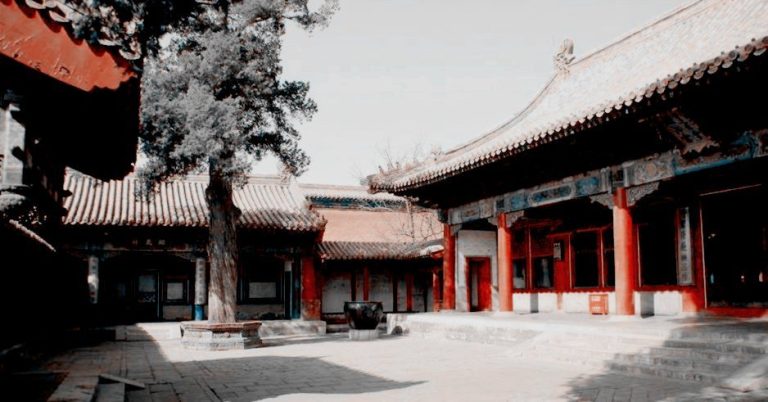
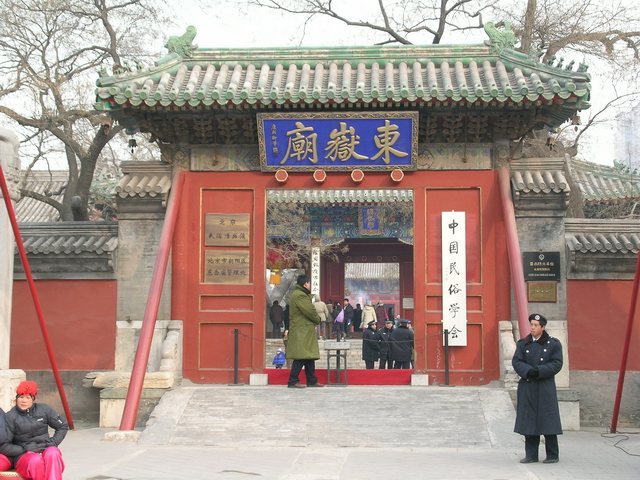
The complex covers about 20,000 square meters and is arranged as four courtyards along a south to north central axis. Its main sequence runs from the Gate of the Former Teacher through the Gate of Great Accomplishment and the Hall of Great Accomplishment to the Hall for Reverence for the Sage. It stands on Guozijian Street beside the Imperial Academy, while part of the present street crosses land that formerly belonged to the temple.
Gate of the Former Teacher
The southern entrance is three bays wide and seven purlins deep. Its single-eaved hip-and-gable roof rests above large bracket sets, interlocking timber supports beneath the eaves, that survive from the Yuan period. The adjoining outer walls have the form of a gate. Two Qing-period stone steles outside the entrance carry the instruction “Officials and others must dismount here” in six scripts. Opposite the gate, a red wall once served as a screen wall intended to protect the temple from harmful spirits.
Gate of Great Accomplishment
Built during the Yuan period and reconstructed under the Qing, the Gate of Great Accomplishment is five bays wide and nine purlins deep. It has a single-eaved hip roof and stands on a high brick-and-stone platform. A central route across the platform bears a high-relief carving of five dragons playing with a pearl among waves. Ten replica stone drums stand beside the front corridor, each carrying an ancient hunting poem in seal script. A reproduction of Western Zhou stone drums made during the Qianlong reign is also kept in the temple, while other Qing stone drums stand beyond the gate.
Hall of Great Accomplishment
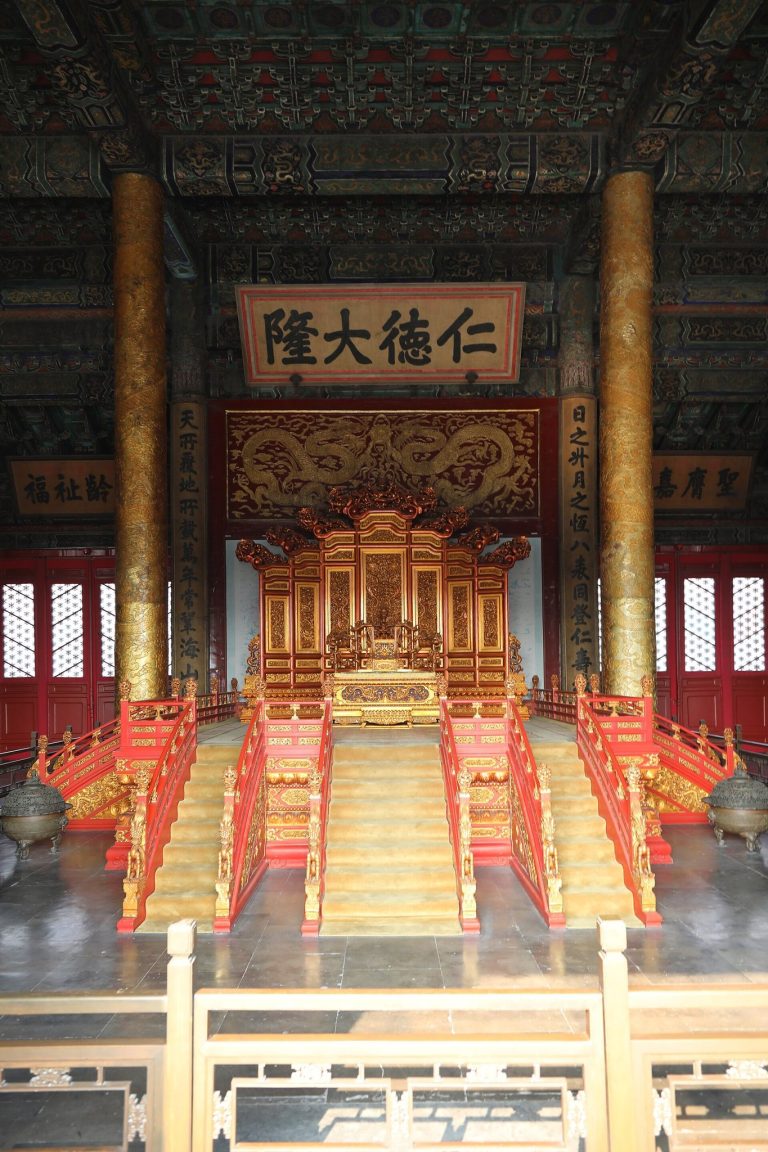
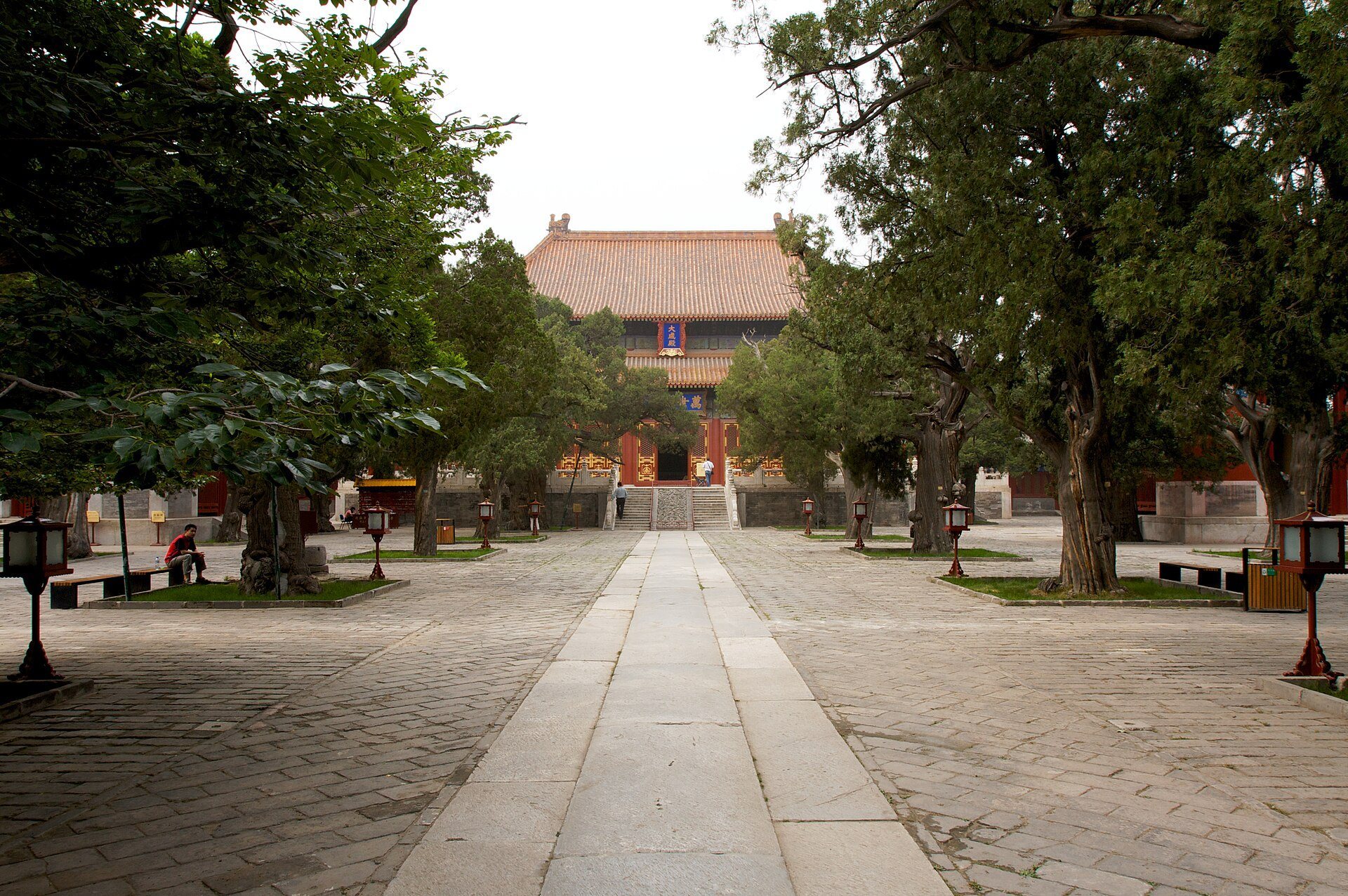
The Hall of Great Accomplishment is the principal building of the temple. Begun in 1302, it was destroyed during warfare and rebuilt in 1411, then enlarged from seven to nine bays in 1906. Its double-eaved hip roof is covered with yellow glazed tiles, and its floor is made of gold-colored brick. A ceiling decorated with a coiled-dragon well pattern completes the interior. The building’s form represented the highest architectural rank of its period.
The central shrine holds a spirit tablet for Confucius under his Yuan-period title, “Most Sagely King of Great Accomplishment and Literary Propagation.” Tablets for the Four Assessors and Twelve Philosophers stand on either side. These were eminent figures in the Confucian tradition who were honored alongside Confucius. Before the shrine, a sacrificial table holds five types of ritual vessel, zun, jue, you, bian, and dou, made by imperial order during the Qianlong reign. Bells, drums, and other ancient musical instruments stand beside the shrine.
The hall and its exterior carry imperial plaques commissioned by nine Qing emperors from Kangxi to Xuantong, along with plaques associated with Li Yuanhong, president of the Republic of China. Carvings in the temple include two dragons playing with a pearl among clouds, a motif more commonly associated with imperial palaces than with Confucian temples.
Hall for Reverence for the Sage
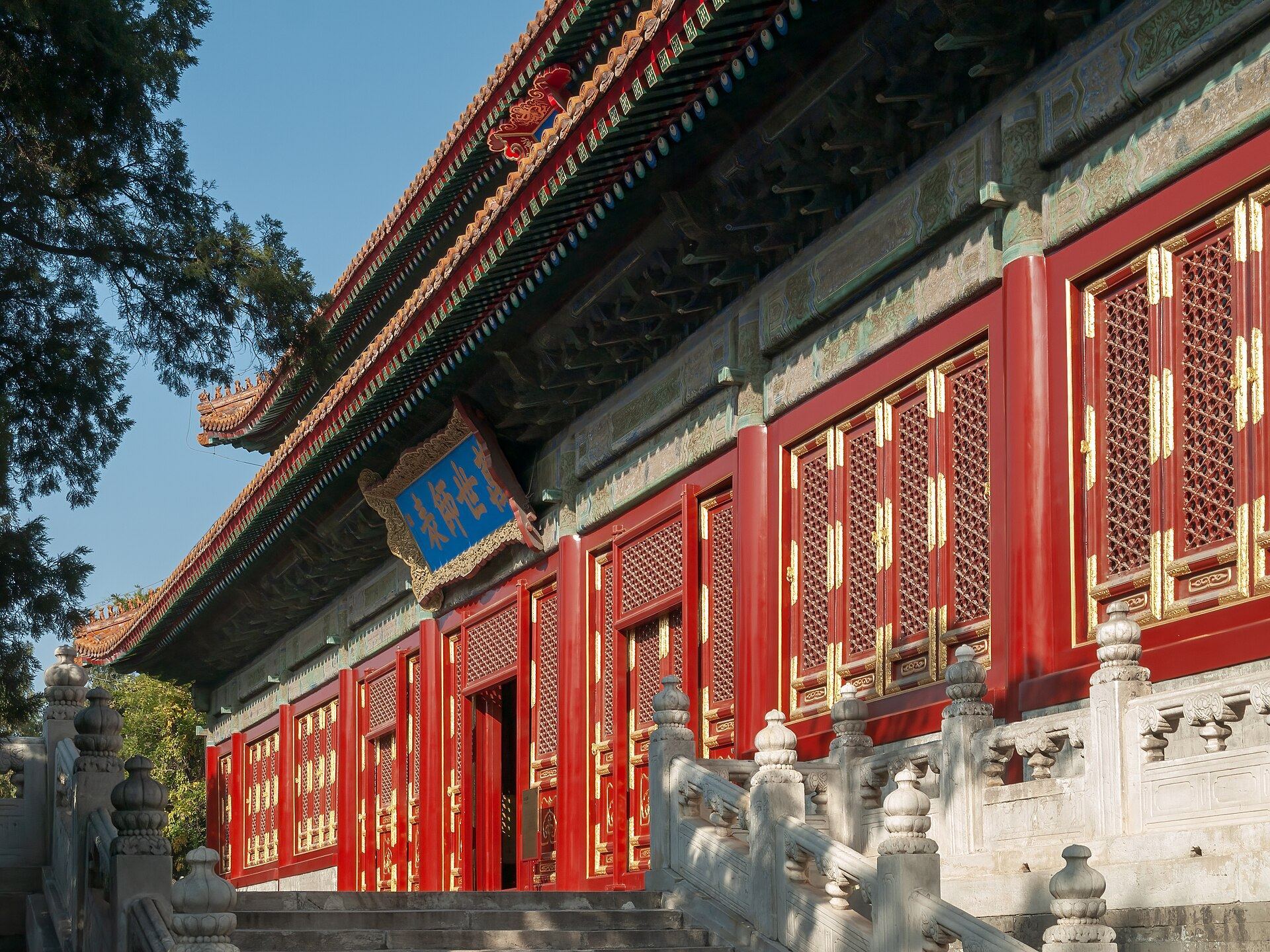
The Hall for Reverence for the Sage stands behind the Hall of Great Accomplishment. It was built in 1530 or 1531 for sacrifices connected with five generations of Confucius’s lineage. The hall received green glazed roof tiles during the Qing-period changes ordered in 1737.
Stelae, courtyards, and historic trees
Examination tablets and classical texts
The first courtyard contains 198 stone tablets listing more than 51,624 successful candidates who received the jinshi degree under the Yuan, Ming, and Qing dynasties. The jinshi was the highest qualification awarded through China’s traditional civil-service examinations. Fourteen stele pavilions from the Ming and Qing periods contain historical inscriptions and documents. A separate forest of nearly 200 tall tablets carries the Thirteen Confucian Classics, based on a handwritten copy produced over twelve years by Jiang Heng, a tribute student from Jintan in Jiangsu. Other tablets bearing these classics were presented by the city of Jintan. The courtyard also contains a modern statue of Confucius, while additional stele pavilions occupy the larger courtyard.
Touch-Evil Cypress
Numerous old trees grow across the grounds. The best-known is a cypress below the stone steps before the Hall of Great Accomplishment. Tradition attributes its planting to Xu Heng, a Yuan-period scholar and official who directed the Imperial Academy, and places its age at nearly 700 years. Known as the Touch-Evil Cypress, it is linked to a Ming-period story in which its branches knocked the official cap from Yan Song while he was acting for the Jiajing emperor during a temple ceremony. The incident gave the tree a reputation for distinguishing loyal people from corrupt ones.