QV44: A Royal Tomb for Prince Khaemwaset
Site at a Glance
- Rating
- 4.6
- Popularity
- Very Low
- Country
- Egypt
- Primary era
- Iron Age
- Eras represented
- Iron Age
- Civilizations
- Egyptian
- Site type
- Burial
- Remains
- Tomb
On this page11 sections
History
QV44 is a tomb in the Valley of the Queens on the west bank of Luxor, Egypt, built by the ancient Egyptians during the Twentieth Dynasty in the twelfth century BCE for Prince Khaemwaset, a son of Ramesses III. Its Ramesside design derives on a smaller scale from the royal tombs of the Valley of the Kings. The tomb formed part of a group of monuments prepared for the sons of Ramesses III, and its decoration places the king prominently within the prince’s ritual journey through the afterlife.
Construction for Khaemwaset
Khaemwaset served as a priest of Ptah at Memphis, the city whose chief deity was the creator god Ptah, but he did not become high priest. He was probably a younger brother of Amunherkhepeshef. His identification with the tomb’s owner rests chiefly on the inscription on the lid of his sarcophagus.
QV44 was probably completed while Khaemwaset was still alive. The careful execution of its plan and decoration suggests that the work was not rushed. A later alteration appears to have been made only after the original tomb had been completed. The monument’s paintings repeatedly show Khaemwaset behind his father, while Ramesses III presents him before funerary and cosmic deities.
Reuse during the Third Intermediate Period
Khaemwaset’s burial was later disturbed. During the Twenty-First Dynasty, his mummy was probably moved to the royal cache at Deir el-Bahari to protect it from looting. QV44 was subsequently reused as a non-royal family burial place and became a repeated deposit for coffins, mummies, and funerary equipment.
More than forty wooden coffins from the Twenty-Fifth and Twenty-Sixth Dynasties were found inside the tomb, together with an assemblage of about ninety mummies. Many coffins and bodies had been broken, scattered, or robbed, and some mummies showed damage that may have been caused by hyenas. This later use transformed the tomb from a royal monument for one prince into a crowded burial place used by several generations.
Discovery and modern study
The tomb was discovered on 15 February 1903 during the first excavation campaign of the Italian Archaeological Mission in the Valley of the Queens. Ernesto Schiaparelli led the campaign, with Francesco Ballerini as his principal collaborator. Ballerini located QV44 while work was taking place at the bottom of the valley. Howard Carter, then Superintendent of Antiquities for Upper Egypt, was notified and entered the tomb during the initial investigation with Schiaparelli.
QV44 was open and plundered when it was found. Excavation recovered fragments of the original granite sarcophagus, funerary furniture, and other objects, while the later coffins and mummies were removed from the vestibule and burial chamber. Part of the material is now preserved in the Museo Egizio in Turin. The prince’s granite sarcophagus lid, catalogued there as Suppl. 5215, carries an inscription dating it to the reign of Ramesses IV, although the lid itself belongs to the Twentieth Dynasty.
Between 2016 and 2020, the Museo Egizio and the University of Turin digitally recorded much of the tomb’s decoration. The project supported conservation and made the painted programme accessible through three-dimensional models.
Remains
Plan and painted decoration
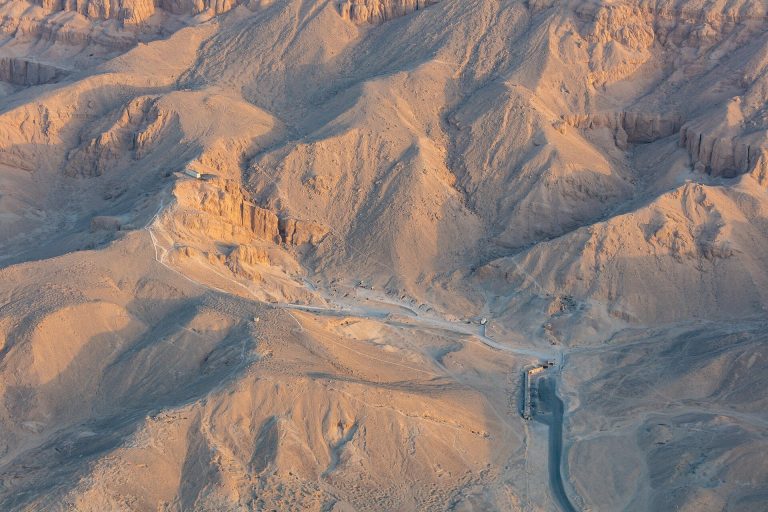
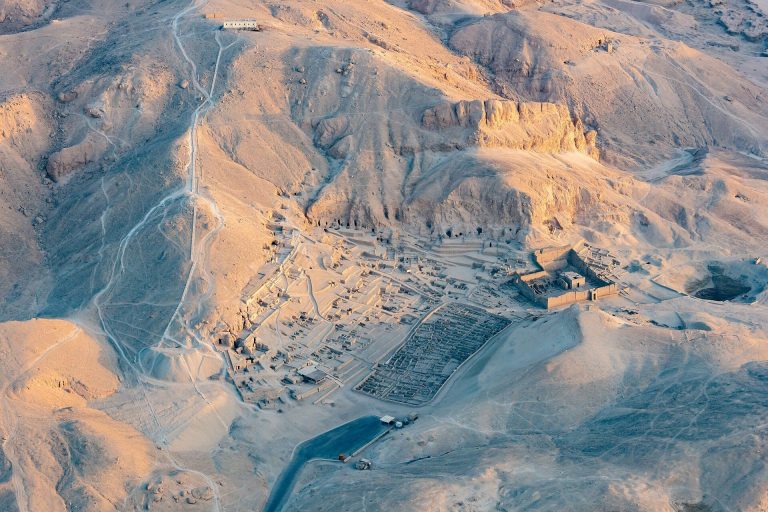
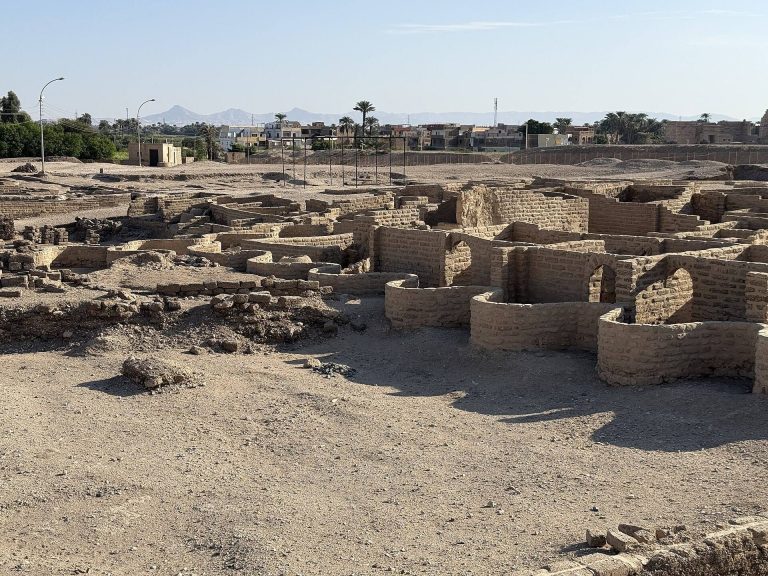
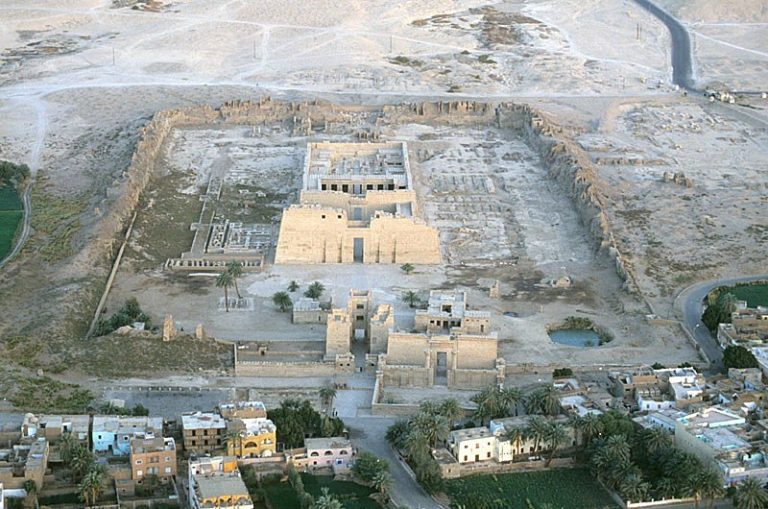
QV44 is cut into the mountainside on the south-western slope of the main wadi, near the principal wadi and close to QV42 and QV43. It extends for approximately 30 metres from north-east to south-west, with the main entrance at the north-east. The plan contains a descending entrance corridor divided into two sectors, two corridors, two laterally offset side chambers, a vestibule, a burial chamber, and an upper annex. Among the tombs associated with the sons of Ramesses III, it is one of the largest and most elaborately designed.
Corridors and side chambers
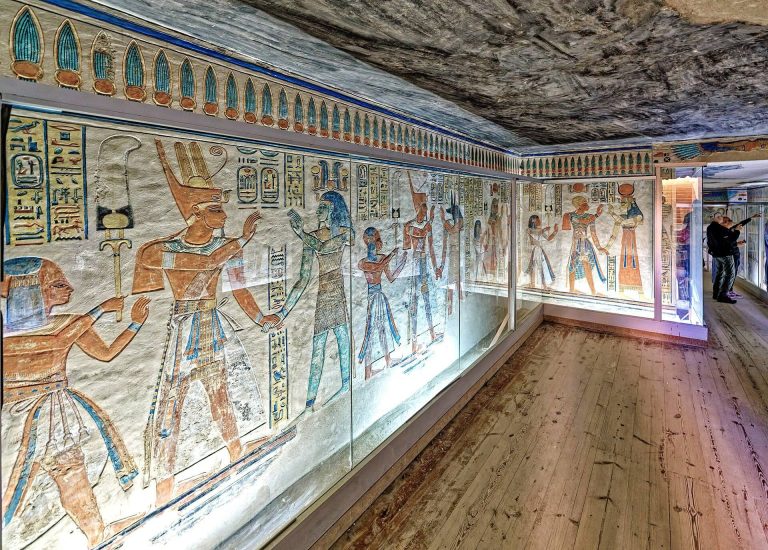
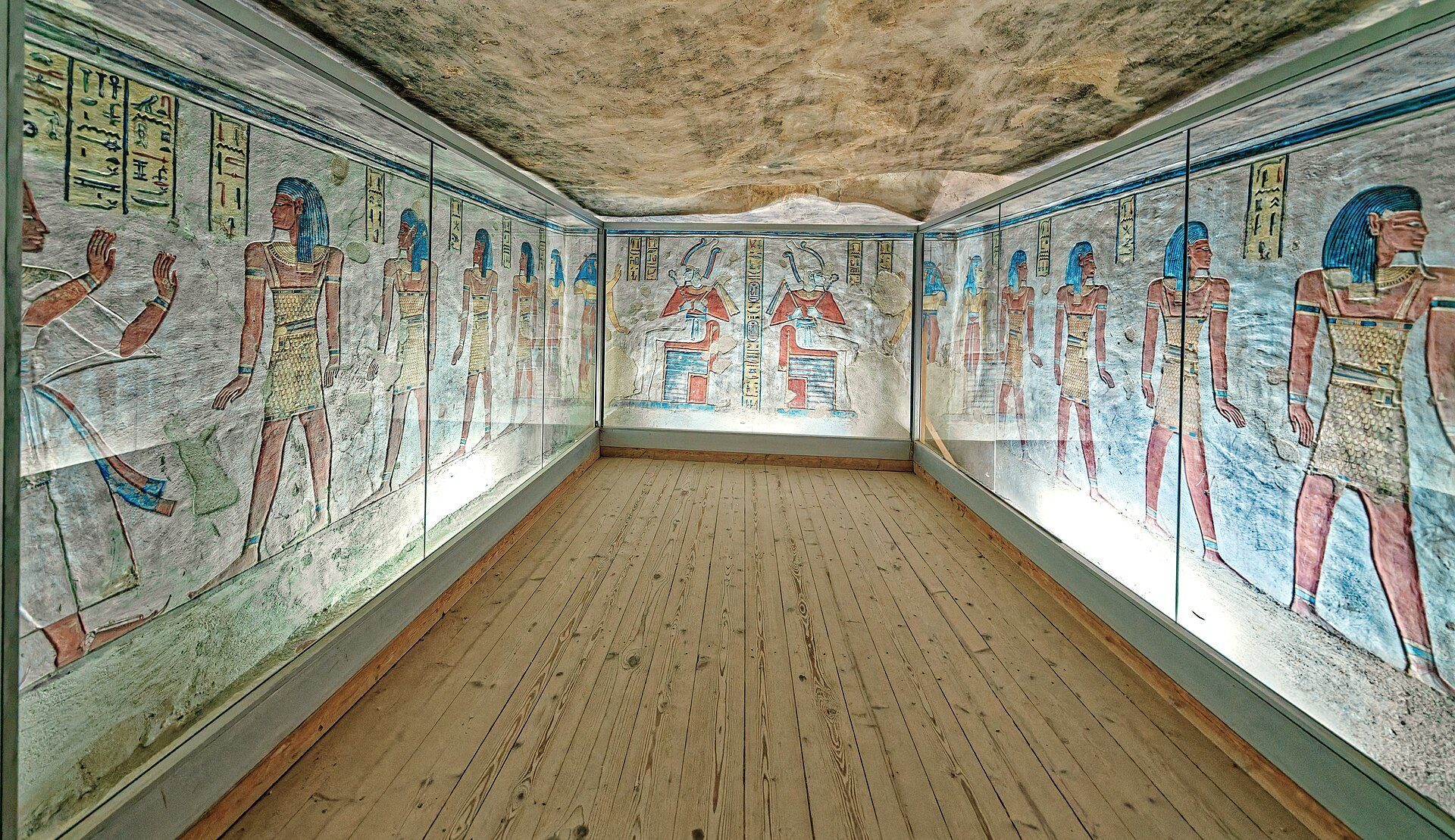
The corridor is approximately 212 centimetres wide, about four royal cubits. The second corridor has a vaulted ceiling and two laterally offset niches at its rear. These niches appear to reflect an unfinished change made after the original plan had been completed. Vivid paintings and painted reliefs cover the walls, presenting offerings, acts of worship, ceremonial appearances, and the deceased’s passage through the afterlife.
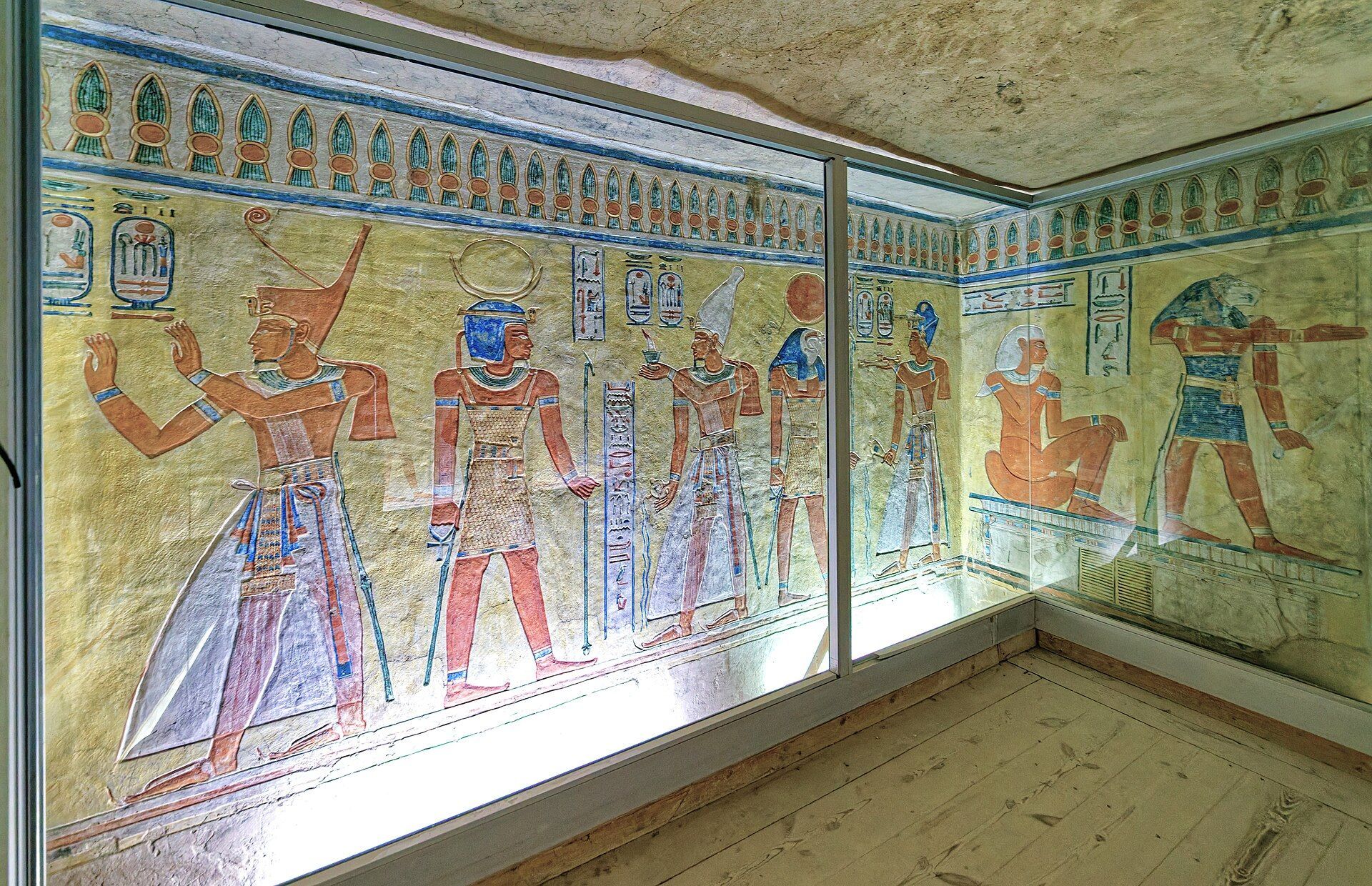
The entrance is framed by the winged goddess Maat. In the first corridor, Ramesses III appears before Ptah, Ptah-Sokar-Osiris, Shu, Geb, Anubis, Thoth, Re-Harakhty, and Atum, arranged in paired groups. The side chambers contain the four Sons of Horus, protective deities associated with organs removed during mummification and placed in canopic containers, as well as Isis, Nephthys, Neith, and Serket. Khaemwaset is shown alone in parts of this decoration, raising his arms in worship. Osiris appears twice as a back-to-back enthroned figure, accompanied by Isis and Nephthys.
The second corridor contains scenes from the Book of Gates, a funerary composition describing passage through successive gates of the underworld. Each gate is guarded by supernatural beings whose names the deceased must know in order to pass. Khaemwaset appears there as an Iunmutef, a priestly and ritual figure associated with protecting and renewing the deceased. He alternately carries ritual fans and a heqa sceptre.
Burial chamber
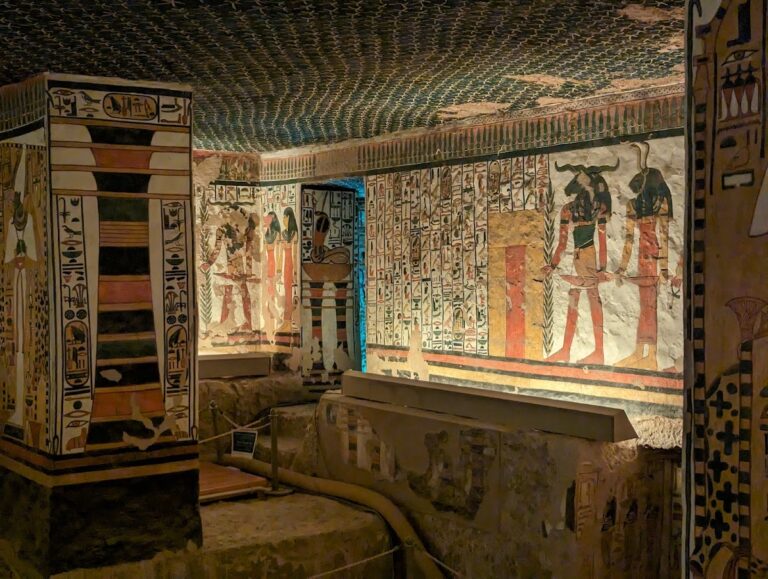
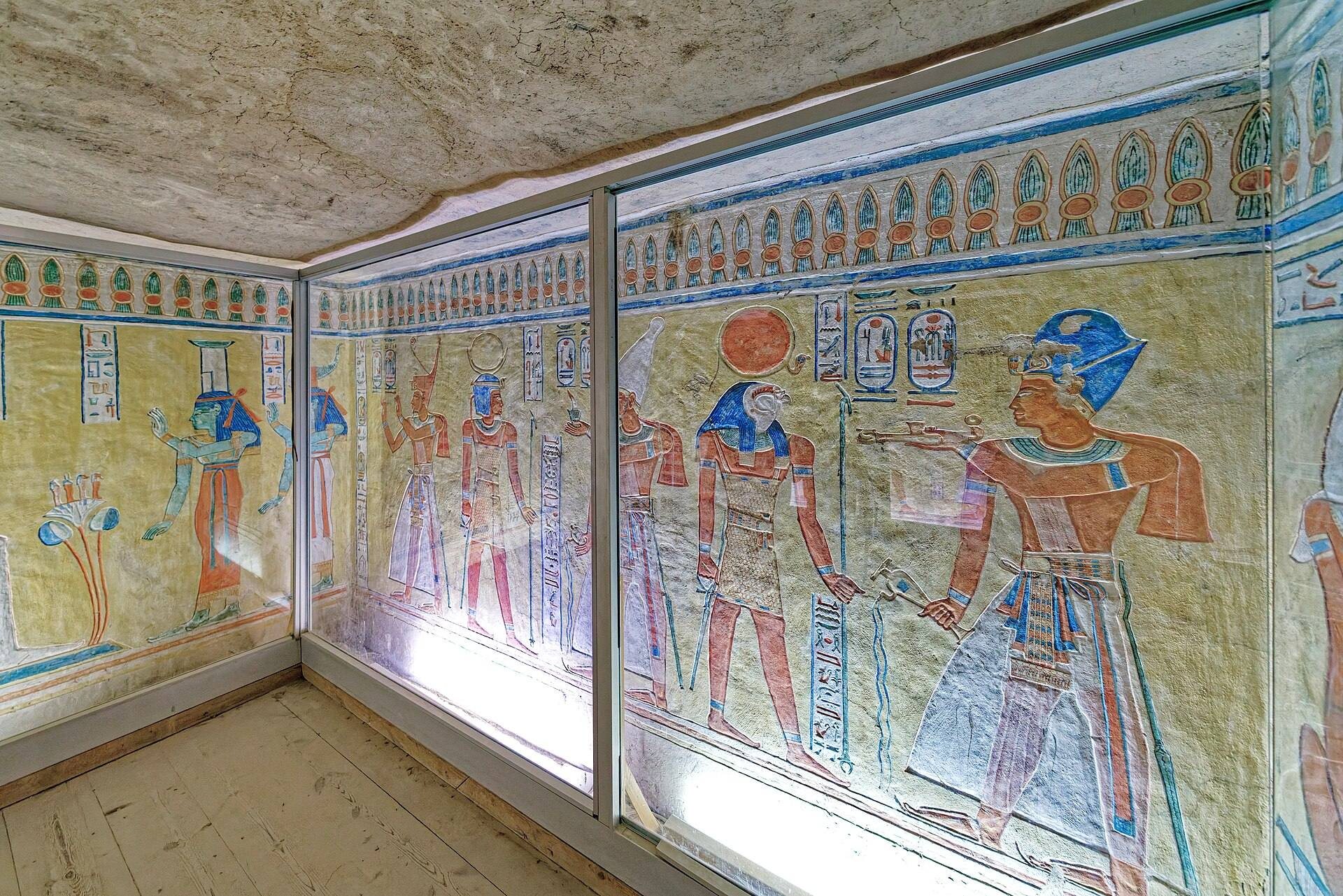
The entrance to the burial chamber is decorated with Djed pillars and vertical hieroglyphic inscriptions invoking the king alongside Osiris-Khontamenti and Meresger. Beyond this point, Ramesses III appears without the prince. The burial chamber is the only room with a yellow ground colour, and its paintings show guardian deities including Anubis, Thoth, Harsiesis, Horus, and other named figures, together with the king’s royal titulary.
On the rear wall, Osiris is again represented twice, seated back-to-back on a throne with Isis, Nephthys, Neith, and Serket. Lotus flowers and buds at the god’s feet contain small images of the Sons of Horus. Across the tomb, Khaemwaset is portrayed as a young prince with a side-lock of youth, sometimes with a shaved head or wig. He wears a tunic and a transparent, wide-sleeved garment, with sandals and ritual objects such as feather fans, a flail, and the heqa sceptre. Ramesses III is shown in several scenes in an Osirian, divinized form.
Later burials and recovered objects
Prince Khaemwaset’s sarcophagus
After the later coffins and mummies were removed, the burial chamber revealed the remains of Khaemwaset’s large red-granite sarcophagus. Its lower part was damaged or mutilated. The surviving lid carries a raised-relief image of the prince and a hieroglyphic inscription along its edge. Its association with the prince provides the principal identification of the tomb’s original owner.
Coffins and funerary equipment
Objects associated with QV44 and neighbouring QV43 include the wooden box and lid of the coffin of Nesymendjam, dating to the Twenty-Fifth or Twenty-Sixth Dynasty. The mummy found inside was wrapped in a red-dyed funerary shroud. The coffin components and mummy are preserved in the Museo Egizio in Turin.
The outer coffin of Hor is made of wood and stucco and belongs to the qeresu type, a rectangular Egyptian coffin with small pillar-like projections. It also dates to the Twenty-Fifth or Twenty-Sixth Dynasty and is preserved in the Museo Egizio. Other objects associated with the reused funerary group include fragments of canopic jars, a funerary net decorated with a winged scarab and the four Sons of Horus, approximately fifty faience scarabs, and a wooden cosmetic spoon with floral decoration from the New Kingdom. These materials reflect the later burial use of QV44 and QV43 alongside the remains of the original royal tomb.