Amheida: Ancient Trimithis in Egypt’s Dakhla Oasis
Site at a Glance
- Rating
- 3.9
- Popularity
- Very Low
- Country
- Egypt
- Primary era
- Classical
- External website
- Open
- Eras represented
- Bronze Age, Iron Age, Classical
- Civilizations
- Egyptian, Roman
- Site type
- City
On this page16 sections
History
Amheida is the archaeological site of ancient Trimithis in Egypt’s Dakhla Oasis. The settlement preserves ancient Egyptian, Roman, and early Christian phases extending from the Old Kingdom to Late Antiquity, when its population may have numbered about 5,000 to 10,000 people. Under Roman rule, Trimithis became a recognized polis, a formally organized Greek-style city with civic institutions, and grew into the main urban center of the surrounding area.
Egyptian Origins and the Temple of Thoth
In ancient Egyptian times, the settlement was called Set-wah, meaning “place of rest.” Old Kingdom remains show that the site was already occupied in early Egyptian history. A temple or shrine existed there during the New Kingdom, and a stela bearing the name of Seti II, a pharaoh of the Nineteenth Dynasty, was found at Amheida.
The local temple was dedicated to Thoth, the Egyptian deity associated with writing, knowledge, calculation, and the scribal arts. A sandstone block bearing the name of Petubastis I places the temple in the Twenty-Third Dynasty. During the Twenty-Sixth Dynasty, the sanctuary was renewed under Necho II, Psamtik II, and Amasis. The temple remained the central focus of the later Roman city.
The Greek name Trimithis developed from the Coptic form Trimhite, meaning “northern storehouse.” The modern names Amheida and Amhida probably derive from the Greek or Coptic form. A portal found in 2013 and 2014 bears the name of Petubastis Seheribre. Olaf E. Kaper proposed that this prince and rival king may have defeated an army of Cambyses II, the Achaemenid Persian king who conquered Egypt in the sixth century BC, from this location. That interpretation remains uncertain.
Roman City and Military Administration
Trimithis expanded markedly under Roman rule. A foundation charter for the polis dates to AD 304, when the city possessed civic institutions and a city council, or boule. The Roman urban area, including its cemetery, covered at least 2.5 by 1.5 kilometers. The settlement also had an important military role as the headquarters of the ala I Quadorum, a Roman auxiliary cavalry unit.
The late Roman administrative document called the Notitia Dignitatum lists Trimithis as the headquarters of this mounted formation. Ostraca, written texts on potsherds and other fragments, describe the provisioning of military groups in Trimithis and the wider Dakhla area. These supplies included barley, oil, hay, and wine. The texts mention mounted archers associated with the Tentyrites and a detachment of legio II Traiana, probably present temporarily, as well as officers and support personnel such as an optio, a camelarius, a stationarius, scribes, and other military officials.
Civilian landowners, including Serenos, supplied part of this military economy. A Greek dipinto, meaning a painted or written inscription on a wall or other surface, names Flavius Apollonius as commander of the camp at Trimithis. Because the name Flavius was used after AD 325, the inscription belongs to the later Roman period. About two kilometers north-northeast of the city, the fort at el-Qasr formed part of the military infrastructure of the oasis. Its broad date range, from the third to the fifth century AD, may connect it with the frontier defenses strengthened under Diocletian, emperor from AD 284 to 305.
Late Antiquity and Christian Change
A church complex was established at Amheida during the fourth century AD. It included east and west churches, while another basilical Coptic church of approximately the mid-fourth century was excavated in 2023. This church contained the oldest funerary crypts yet found in Egypt. The Christian buildings belong to a period when the city’s religious landscape was changing and its population was later declining rapidly.
The fourth-century house conventionally called the house of Serenos belonged to a wealthy landowner and city councillor. It was occupied for about 25 years before being abandoned around AD 365. An ancient school was also built in the mid-fourth century and seems to have operated for less than two decades, probably under a single teacher. The later connection between part of the school and the house of Serenos reflects a change in the use of the complex.
Trimithis declined rapidly during Late Antiquity. Its final population has been estimated at approximately 5,000 to 10,000 people, before the settlement lost much of its urban importance.
Rediscovery and Excavation
Bernardino Drovetti described the site in 1821. John Gardner Wilkinson visited it in 1825 and later recorded its modern name as Lémhada in 1843. Ahmed Fakhry began archaeological excavations in 1963. Columbia University began a new excavation program in 2004, followed by New York University from 2008 to 2015. These campaigns exposed the Roman-style bath, the house of Serenos, and other fourth-century remains. Work was temporarily suspended during the Egyptian Revolution of 2011, while excavations in 2012 and 2013, directed by Roger S. Bagnall, focused on the fourth-century church complex.
Remains
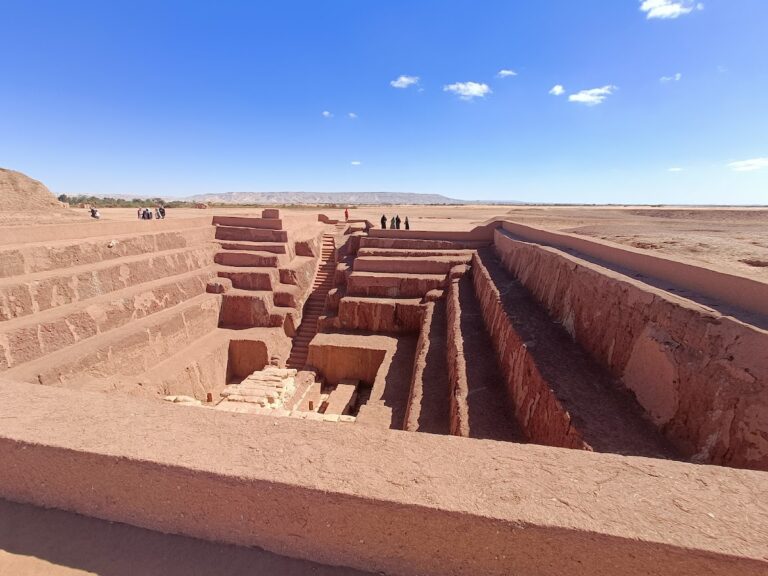
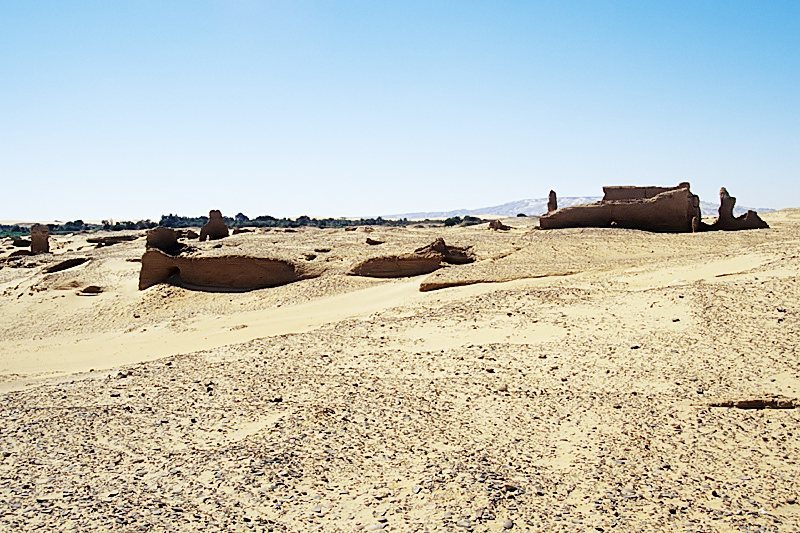
Amheida is an extensive ruined settlement whose visible remains principally belong to the Greco-Roman city of Trimithis. The urban area and cemetery together extend across at least 2.5 by 1.5 kilometers. The city was organized around the temple of Thoth, with residential, educational, religious, funerary, and military features distributed across the settlement and its surrounding area. Ceramic fragments range from the Old Kingdom through the Late Roman period.
Temple and Cemetery
Temple of Thoth
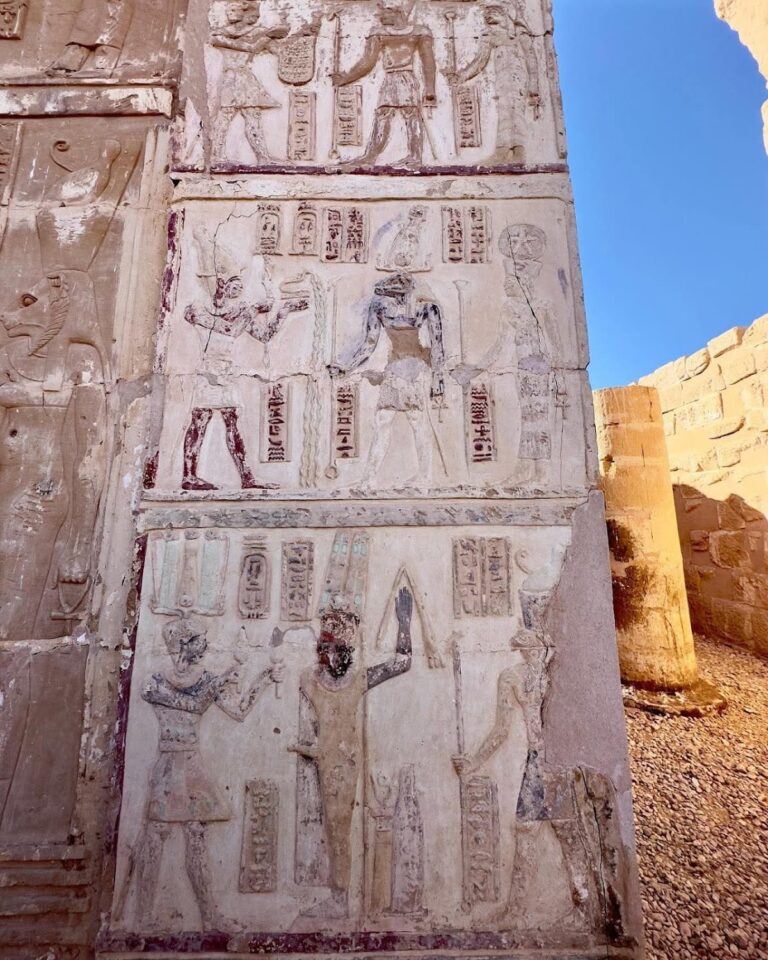
The temple complex formed the central focus of the city. Its surviving history combines a New Kingdom shrine with a later temple that included a sanctuary from the Twenty-Sixth Dynasty. A portal bearing the name of Petubastis Seheribre belongs to this religious complex. The temple’s successive phases preserve the long association of Amheida with Thoth and the changing political authority of Egypt.
Funerary Chapels
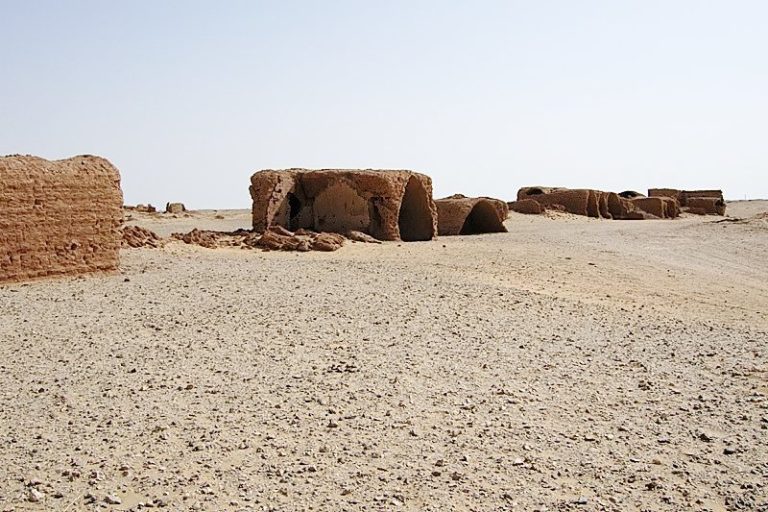
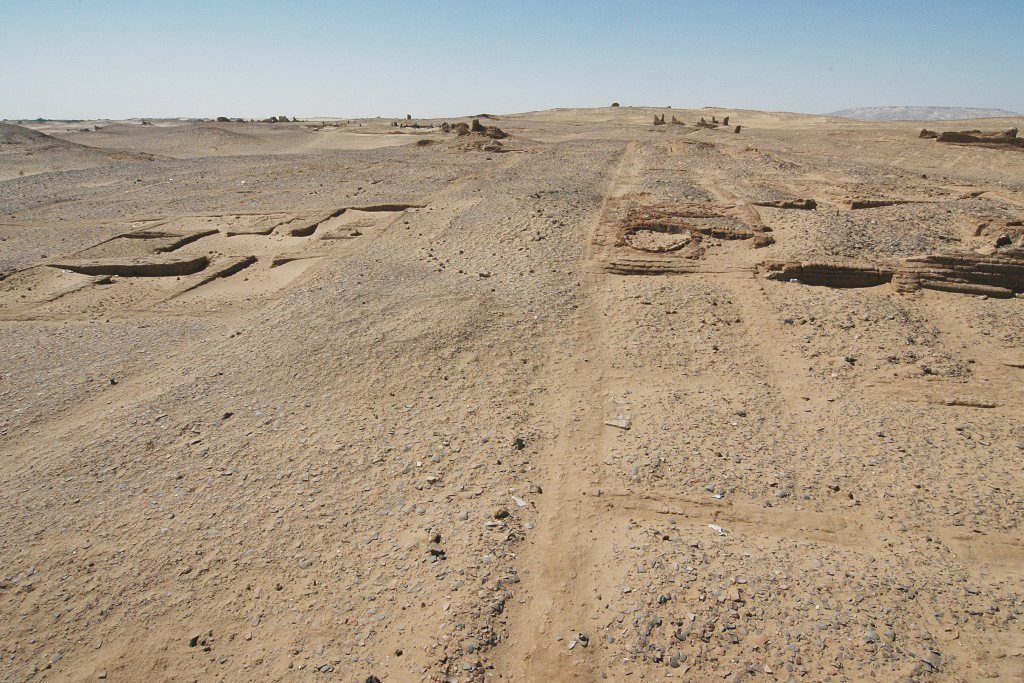
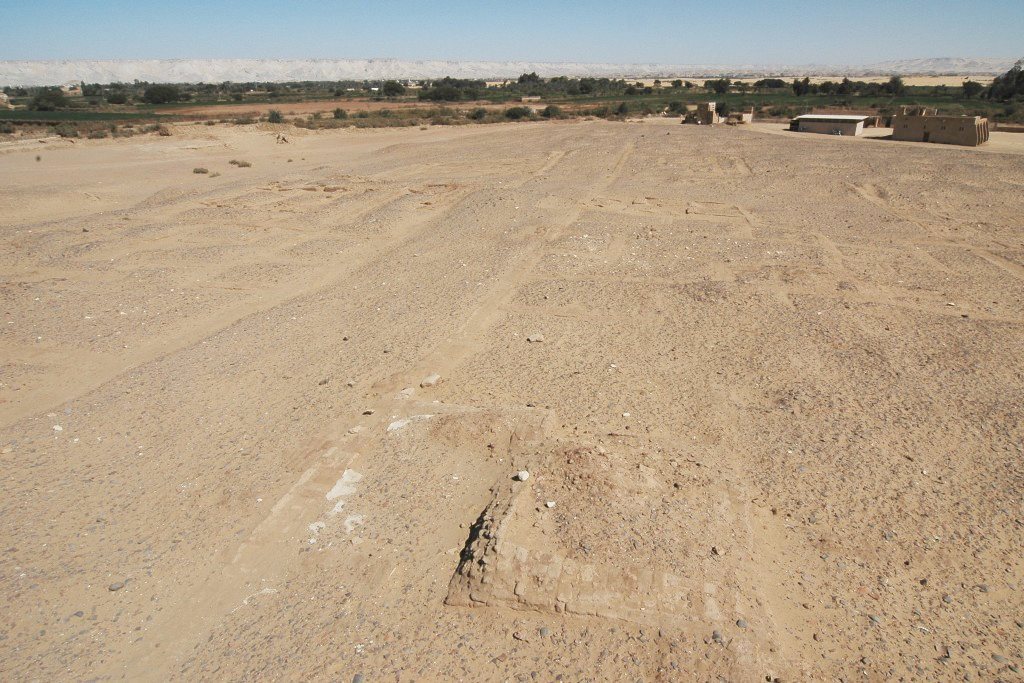
The cemetery contained extensive mud-brick funerary chapels, including two burials with mud-brick pyramids. These structures formed part of the wider urban area and provide evidence for the funerary landscape surrounding Trimithis.
Residential and Educational Buildings
House of Serenos
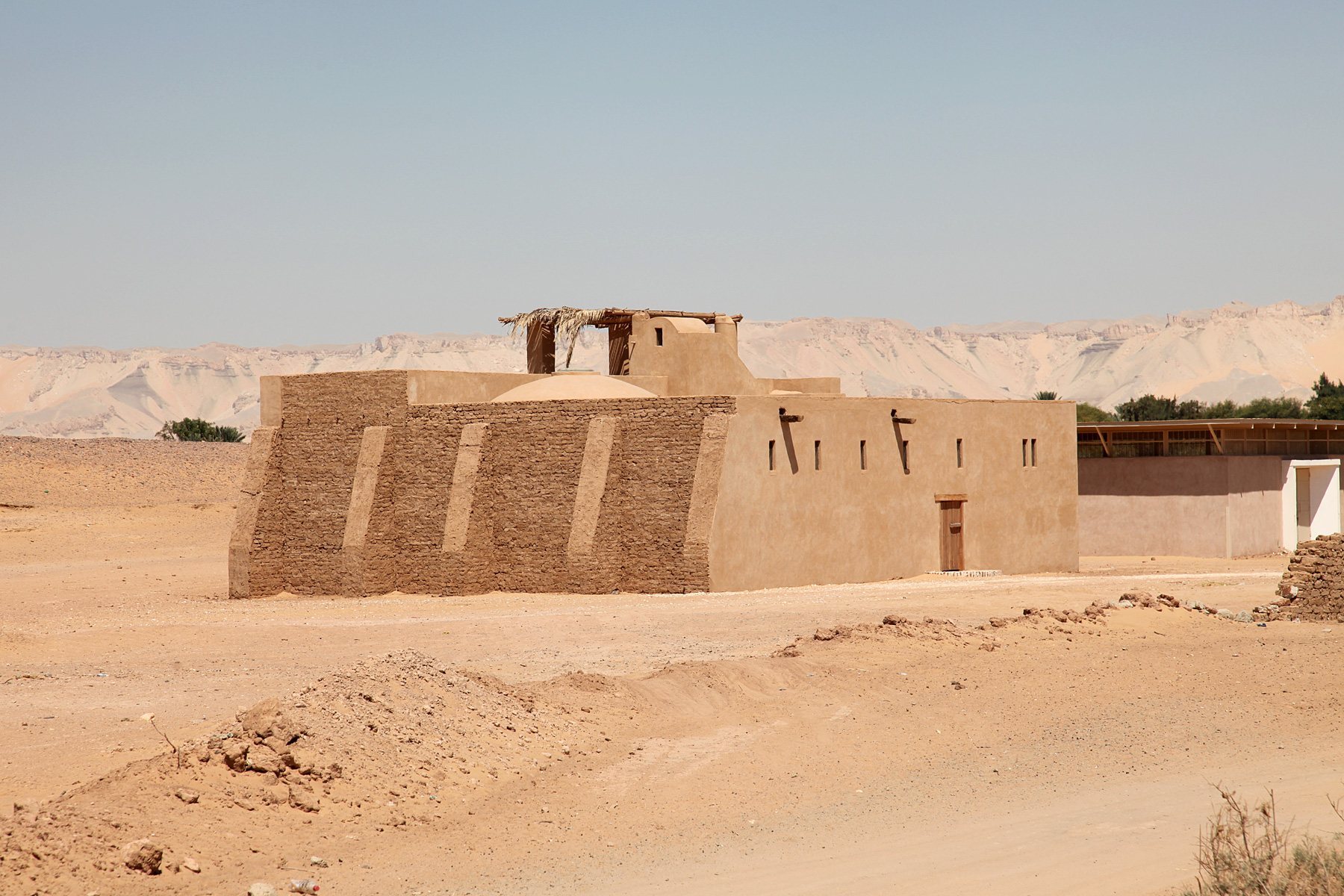
The house of Serenos, also designated B1, was a large mud-brick residence in a central residential quarter east of the main temple. Built in the mid-fourth century AD over earlier debris that included the remains of a Roman bath, it contained rooms arranged around a central space, corridors, and entrances from two streets. Several rooms had painted plaster decoration. A domed dining room contained scenes from Greek mythology, while other rooms displayed geometric panels, plant motifs, and ornamental patterns.
Walls, door jambs, and painted surfaces preserved short Greek inscriptions, graffiti, and dipinti. In Room 13, a line from Hypsipyle, a lost tragedy by Euripides, was written in chalk beside painted mythological names that appear to have served as captions. The quotation helps reconstruct a play otherwise known mainly through fragmentary papyri. Other wall texts in the house and adjoining rooms include literary excerpts, poems, mythological names, and paraphrased anecdotes.
School
The school originally comprised at least three large rooms with low benches along their perimeter walls. This arrangement suited formal instruction in which pupils read and copied texts while standing to write on the walls. One room was later incorporated into the house of Serenos immediately to the south.
Literary texts written in red ink on plaster survive in the school and adjacent rooms. Room 15 contains a long didactic poem invoking the Muses and Hermes and referring to the labors of Heracles. Written in five columns, it probably served as an instructional text. Accent marks and reading signs show attention to pronunciation and poetic composition. Room 19 preserves a passage from Book 4 of Homer’s Odyssey about Helen’s drug of forgetfulness, together with a paraphrased anecdote apparently derived from Plutarch about Ateas, a Scythian king portrayed as indifferent to music. The arrangement and variation in handwriting suggest repeated consultation, copying, and classroom use, with some texts possibly written by pupils.
Churches and Military Structures
Church Complex
The east church had a ceiling painted with a complex geometric scheme. Elongated lozenges, pentagons, hexagons, squares, and octagons were combined into a patterned surface. Some lozenges formed four- and eight-pointed stars, while hexagons and octagons contained simple floral motifs resembling six- or eight-petalled rosettes. Reddish pink and yellow areas were separated by thick black outlines and parallel black hatching that imitated a coffered ceiling.
The mid-fourth-century basilical Coptic church excavated in 2023 contained funerary crypts. Its remains add an early Christian burial complex to the churches and other religious buildings of Amheida.
Fort at el-Qasr
The fort at el-Qasr lies approximately two kilometers north-northeast of the city and is approximately square in plan. A Coptic ostracon calls it the “imperial fort.” Its remains date broadly from the third to the fifth centuries AD and formed part of the military infrastructure associated with Trimithis and the surrounding oasis.
Bathhouse and Military Texts
A bathhouse complex yielded the Greek dipinto naming Flavius Apollonius as commander of the camp at Trimithis. Ostraca from the site preserve details of military supplies and personnel, including barley, oil, hay, and wine. Together with the literary wall texts from the school and house, these inscriptions make the surviving plaster and potsherds an important part of the physical remains of the settlement.