Tubusuctu: Roman Veteran Colony in Algeria
Site at a Glance
- Rating
- 5
- Popularity
- Very Low
- Country
- Algeria
- Primary era
- Classical
- Eras represented
- Classical
- Civilizations
- Roman
- Site type
- City
On this page13 sections
History
Tubusuctu is a Roman veteran colony at El-Kseur in Algeria, in the fertile Soummam Valley of Kabylia. Augustus, the first Roman emperor, founded it in 27 BC as Colonia Iulia Augusta Legionis VII. Its settlers included veterans of Legio VII Claudia, a legion of the Roman imperial army, who joined the existing population of the valley. The site’s period of flourishing is given as approximately 330 BC to AD 640.
Foundation and Roman development
Tubusuctu stood near the port of Saldae, in the area of modern Béjaïa, and developed within an agriculturally productive region. Its olive oil was highly valued, and jars from Tiklat have been found across the Roman Empire. This distribution indicates the commercial importance of the Soummam Valley by the beginning of the Christian era.
Ancient writers including Pliny the Elder, Claudius Ptolemy, and Ammianus Marcellinus mention the town. It also appears in the Ravenna Cosmography, a late antique geographical compilation, and in the writings of Julius Honorius. Tubusuctu is not included in the Antonine Itinerary, a Roman listing of routes and stations.
Military and Christian importance
During the late Roman period, Tubusuctu became the center of a military district. The surrounding region experienced numerous revolts during the third and fourth centuries, and the town’s military role appears to have encouraged the construction of major waterworks.
The town also became a center of early Christianity. Its bishops are recorded in AD 411 and 484. The bishopric survives as a titular see of the Roman Catholic Church, meaning that it remains an episcopal title even though it no longer functions as the administrative center of an active local diocese.
Archaeological study and conservation
The ruins were studied by the French archaeologist Jean-Pierre Laporte during the 1960s. Archaeological authorities in the Béjaïa district later planned conservation work to limit further degradation, as cultivation around the site has damaged parts of the remains.
Remains
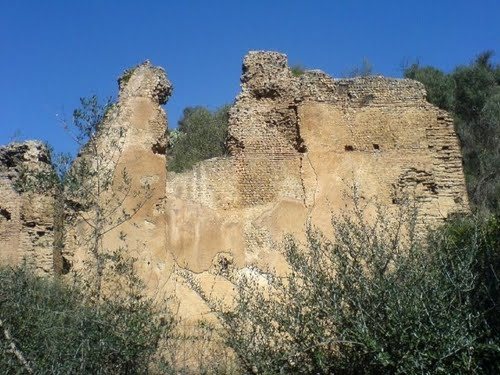
The ancient town occupied an elevated area and the adjoining plain on the left bank of the Soummam. It extended toward the south and east, and surviving ramparts help define the settlement. The remains include public baths, extensive reservoirs, aqueducts, inscriptions, and an almost intact mosaic. The water installations were not necessarily built at one time, so their archaeological chronology is not uniform.
Town and public buildings
Ramparts
Remains of the town’s ramparts survive around the ancient settlement. Their condition has been affected by cultivation in the surrounding region, which has also damaged other parts of the ruins.
Baths
Important baths stand south of the elevated area. They cover approximately 50 by 50 metres and are described as well preserved, providing one of the principal surviving public structures at Tubusuctu.
Inscriptions and mosaic
The site retains several inscriptions and an almost intact mosaic. These surviving elements form part of the archaeological evidence for the town’s public and civic life.
Waterworks
Northern cisterns
Large cisterns lie north of the elevated area, near the center of the ruins. The northern group measures approximately 35.5 by 77 metres and contains 15 interconnected basins. An aqueduct approached from the west to supply them. Their vaults had semicircular sections and were strengthened by buttresses on both the interior and exterior.
Eastern cistern
Another large cistern stands to the east. It was supplied by an aqueduct approaching from the south, which crossed the river on a bridge that has since disappeared. The surviving remains of this eastern installation are confused and disjointed.
Aqueducts
The surviving waterworks include the aqueduct serving the northern reservoirs and the southern approach to the eastern cistern. Together with the baths and storage basins, they show the scale of the systems that supplied and managed water in the ancient town.