Fort Michilimackinac: A French and British Fort and Trading Post
Site at a Glance
- Rating
- 4.7
- Popularity
- Medium
- Country
- United States
- Primary era
- Early Modern
- External website
- Open
- Eras represented
- Early Modern
- Civilizations
- French
- Site type
- Military
- Remains
- Fort
On this page10 sections
History
Fort Michilimackinac is an eighteenth-century French and British wooden fort and trading post at the Straits of Mackinac in Mackinaw City, Michigan, United States. France built the fort in 1715 as part of a network connecting the Atlantic coast and the St. Lawrence River with the Great Lakes and the Mississippi River through the Illinois Country. Its position between Lake Huron and Lake Michigan made it a supply depot for traders in the western Great Lakes and a major center of the fur trade.
French foundations and the fur trade
French activity in the straits began in 1671, when Father Jacques Marquette founded the Jesuit St. Ignace Mission on the Upper Peninsula. The French established Fort de Buade near the mission in 1683, but the garrison and mission closed in 1701 after Antoine de Lamothe-Cadillac moved the soldiers to Fort Detroit. These earlier establishments were predecessors rather than one continuously occupied fort.
France decided by 1713 to restore its presence in the straits. In 1715, Constant le Marchand de Lignery arrived with soldiers and workmen to build Fort Michilimackinac on the northern tip of Michigan’s Lower Peninsula. The fort remained an important French trading post, and its commandants included Jacques Testard de Montigny, a lieutenant and Knight of the Order of Saint Louis who served there from 1730 to 1733 after commanding Fort La Baye in the western Great Lakes.
British control and the 1763 attack
France ceded the fort and its Canadian territory to Britain after the French and Indian War, the North American theater of the Seven Years’ War between Britain and France and their allies. The British continued to use Michilimackinac as a major trading post. Most of its residents remained French and Métis, a term referring here to people of mixed Indigenous and European, especially French, ancestry. They mainly spoke French and worshipped at Sainte Anne Church, while British fur traders also lived within the fort, including some in its southeastern row house.
On June 2, 1763, during Pontiac’s War, an Indigenous uprising against British control and policies in the Great Lakes and interior North America, Ojibwe staged a game of baaga’adowe outside the fort. The stick-and-ball game, regarded as a predecessor of modern lacrosse, served as a diversion. Players entered the fort during the match, killed most of the British inhabitants, and captured the post. The Ojibwe held it for about a year, until Britain regained control after promising to provide more and better gifts to the Indigenous people of the region.
Relocation to Mackinac Island
The British later judged the mainland fort too vulnerable. In 1781 they built a limestone successor on nearby Mackinac Island, initially also calling it Fort Michilimackinac. Associated buildings were moved there over the following two years, transported by water in summer and across the ice in winter. Patrick Sinclair, lieutenant governor of Michilimackinac, ordered the remaining mainland fort burned after the relocation. The mainland site was abandoned by 1783, while the island successor, now known as Fort Mackinac, continued as a British military position.
Fort Mackinac was captured by the British on July 17, 1812, in the first land engagement of the War of 1812 in the United States. An American attempt to retake it on August 4, 1814, failed, and Britain retained the island fort until the war ended in 1815.
Archaeology and reconstruction
A palisade reconstruction and a small museum were created at the mainland site in 1933. Archaeological investigation began in 1959 under the Mackinac Island State Park Commission and Michigan State University and has continued annually. Workers from the Pellston Corrections Camp took part in the work from 1959 to 1966, followed by paid and volunteer teams. Excavations outside the fort from 1970 to 1973 located three houses, while research returned inside the fort walls from 1974 onward.
The grounds became a National Historic Landmark in 1960 and were added to the National Register of Historic Places in 1966. Michigan had already designated the site a State Historic Site in 1956. The 1933 palisade was demolished in 1960, after which reconstruction based on archaeological investigation began. The reconstructed fort now forms the principal historic feature of Colonial Michilimackinac Historic State Park and operates as part of the Mackinac State Historic Parks. The present village of Mackinaw City developed around the site.
Remains
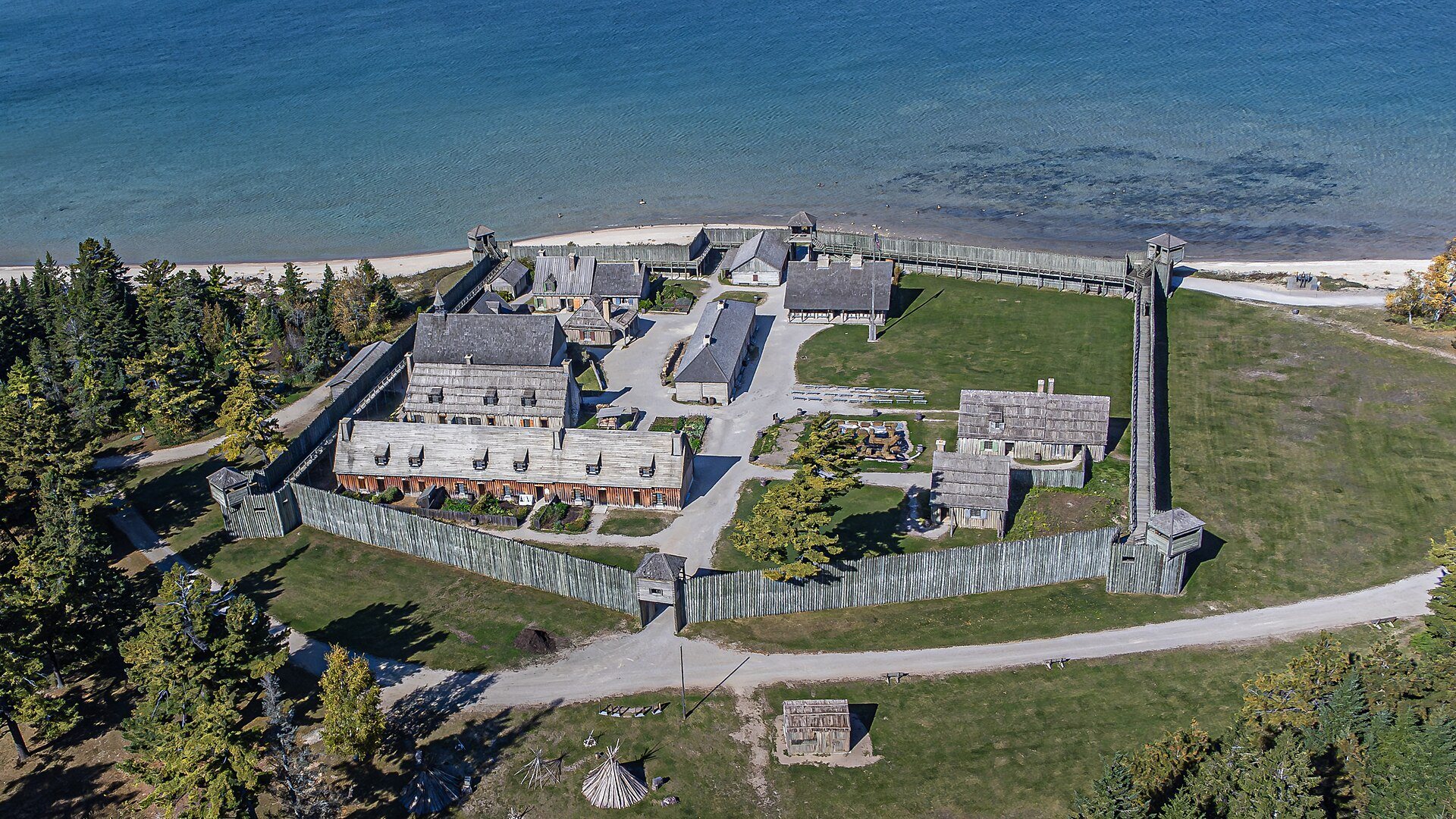
Fort Michilimackinac survives as an archaeological site and reconstructed open-air museum beside the Straits of Mackinac. The former establishment was enclosed by wooden palisade walls, a defensive barrier made from upright posts, and contained buildings serving military, residential, religious, and trading purposes. French authorities altered and expanded the palisades several times after the fort’s construction. Archaeological work had identified evidence of at least 40 structures within the walls by 2024, with approximately 65 percent reconstructed in wood on the basis of excavated evidence.
Fort enclosure
Wooden buildings and palisades
The reconstructed enclosure presents the fort’s wooden buildings and palisades as an interpretation of the eighteenth-century layout rather than as an entirely surviving structure. Sainte Anne Church occupied a small log building inside the fort before it was dismantled and moved to Mackinac Island with other associated buildings. British civilian fur traders also lived within the enclosure, including residents of a row house along its southeastern side.
Structures beyond the walls
The archaeological area extends beyond the palisade. Excavations carried out from 1970 to 1973 revealed three houses outside the fort walls, adding residential evidence to the remains of the enclosed military and trading establishment. The recovered layout and material remains provide the basis for interpreting how the fort and its surrounding settlement were organized.
Historic park setting
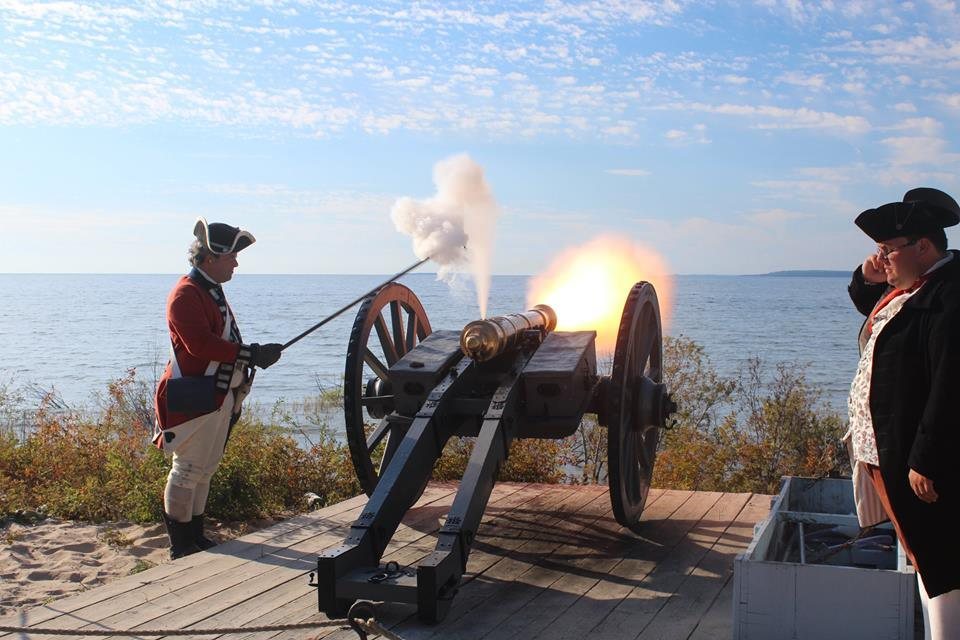
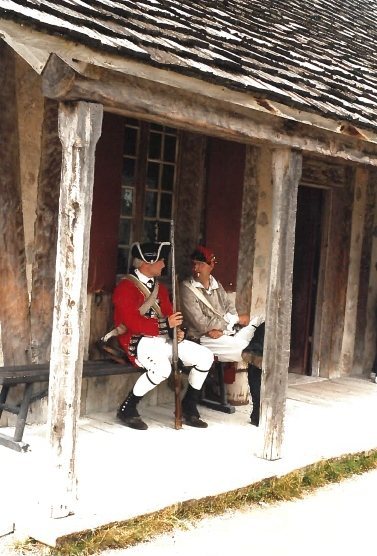
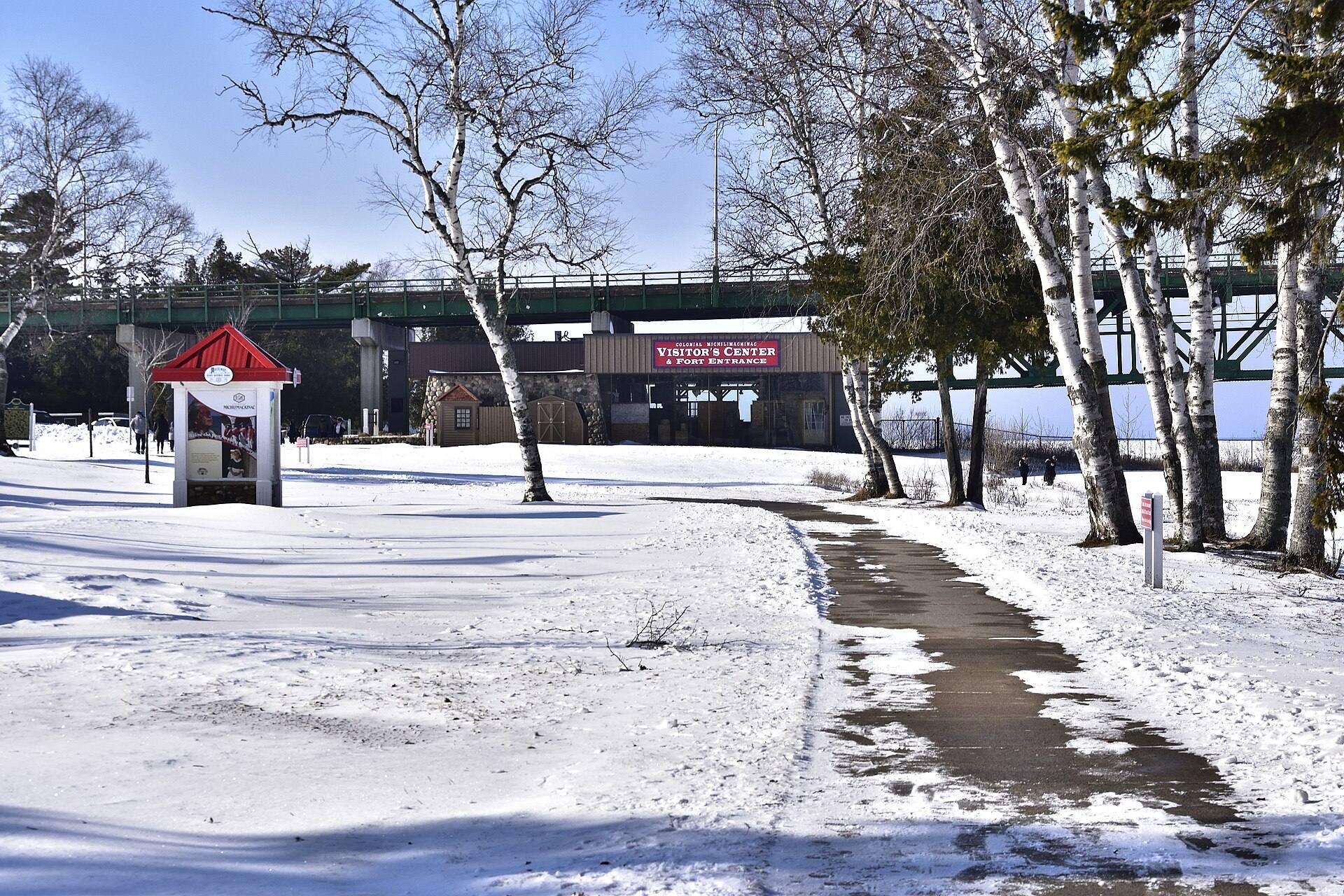
The fort occupies part of Colonial Michilimackinac Historic State Park. The wider park grounds include the foot of the Mackinac Bridge and the 1892 Old Mackinac Point Lighthouse, with views toward the bridge and Mackinac Island. Interpreters and demonstrations at the reconstructed site present its French, British, Indigenous, and trading-post history.