Fort Mackinac: A British and U.S. Military Fort on Mackinac Island
Site at a Glance
- Country
- United States
- Primary era
- Early Modern
- Eras represented
- Early Modern, Modern
- Civilizations
- British
- Site type
- Military
- Remains
- Fort
On this page10 sections
History
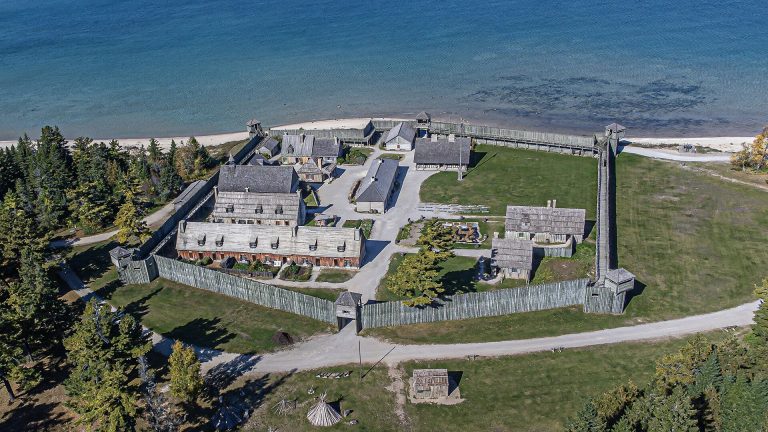
Fort Mackinac is a limestone fort on Mackinac Island in the United States, built by the British in 1780–1781 under Lieutenant Governor Patrick Sinclair to control the Straits of Mackinac and the Great Lakes fur trade.
British foundation and transfer to the United States
Before 1763, France controlled the straits from Fort Michilimackinac on the mainland’s southern shore. After capturing that post, the British considered its wooden buildings difficult to defend. Sinclair therefore established Fort Mackinac on the island. Britain retained the fort during the American Revolution, the conflict in which its thirteen mainland colonies gained independence, and after the 1783 Treaty of Paris formally ended the war. Captain Daniel Robertson commanded the garrison from 1782 until Lieutenant George Clowes took over in 1784.
Britain handed the fort to the United States in 1796 after ratifying the Jay Treaty, which addressed unresolved disputes between the two countries, including British occupation of some western posts.
The War of 1812 and the 1814 attack
When the War of 1812, a conflict between the United States and Britain, began, about 60 U.S. soldiers under Lieutenant Porter Hanks held the fort. On July 17, 1812, a British force led by Captain Charles Roberts attacked under orders from Major General Isaac Brock. It included about 200 British and Canadian troops and several hundred Indigenous allies, who arrived in 70 war canoes and 10 boats. Hanks surrendered without a fight, fearing the Indigenous allies might kill his men and their allies. The Americans were released on parole, a promise not to fight again during the war, while island residents had to swear allegiance to Britain.
British forces soon captured the American sloops Erie and Friends Good Will, whose crews had arrived unaware that war had begun. The British took the latter into service as HMS Little Belt. The schooners Mary and Salina carried prisoners to Detroit. Hanks later faced a charge of cowardice over the surrender. Before his court-martial began, a British attack on Fort Detroit killed him when a cannonball struck the room where he stood.
After taking the island, Colonel Robert McDouall had Fort George built at its highest point to guard against an American attempt to retake it by the same approach. In 1814, U.S. officers George Croghan and William Henry Harrison planned a campaign to regain control of the Great Lakes and disrupt the fur-trade alliance between Britain and Indigenous nations. The campaign also included an attack on Prairie du Chien.
On July 26, five U.S. ships arrived with 700 soldiers. Their guns could not reach elevated Fort George, and two days of bombardment achieved little. Most shells landed in the garrison’s vegetable gardens. Dense fog then forced the Americans away from the island for a week. They returned under Major Andrew Holmes and landed at the northern end. After moving through woods protected by British Indigenous allies, they entered a clearing below the fort. McDouall’s troops, positioned behind low defensive earthworks, opened fire with muskets, rifles, and two field guns. Thirteen Americans were killed, including Holmes and two other officers, and 51 were wounded. Croghan ordered a retreat. The British later captured two U.S. ships left behind.
The defeat kept Mackinac Island and its forts in British hands until the War of 1812 ended. U.S. forces returned to Fort Mackinac in July 1815 under the Treaty of Ghent, which ended the war. They renamed Fort George Fort Holmes in memory of the major killed in the attack. As relations with Britain eased and the northern border was settled, the fort’s military importance diminished.
U.S. service and later use
In the following decades, the U.S. Army used Fort Mackinac intermittently as a reserve troop station, at times coming close to abandoning it. Mackinac Island also remained an important fur-trading post. Benjamin Kendrick Pierce commanded the post from 1816 to 1821. On June 6, 1822, trader Alexis St. Martin was seriously wounded when a gun discharged at close range as he waited to trade. Army surgeon William Beaumont treated him. St. Martin survived with an opening in his stomach, and Beaumont’s care and experiments led to a detailed account of digestion.
The fort served as a base for U.S. exploration in the northern Michigan Territory, including Lewis Cass’s expedition to investigate the Mississippi River’s headwaters. In the 1830s, U.S. Indian agent Henry Rowe Schoolcraft studied Indigenous languages and cultures in the region. His research was aided by his marriage to Jane Johnston, who had Ojibwe and British heritage and was the daughter of Sault Ste. Marie fur trader John Johnston.
During the Mexican–American War and for long stretches of the Civil War, an Army ordnance sergeant was left responsible for the fort. During the Civil War, three Confederate political prisoners were held there briefly under the summer guard of a volunteer militia. Two gained release after swearing loyalty to the United States; the Army transferred the third elsewhere.
From 1875 to 1895, Fort Mackinac and much of Mackinac Island formed part of Mackinac National Park, the country’s second national park after Yellowstone. Soldiers stationed at the fort also cared for the park. In 1895, Congress closed the fort and park and transferred them to Michigan, which established Mackinac Island State Park, its first state park. The fort was adapted as a museum. It is a National Historic Landmark, became a Michigan State Historic Site in 1958, and joined the National Register of Historic Places in 1966.
Remains
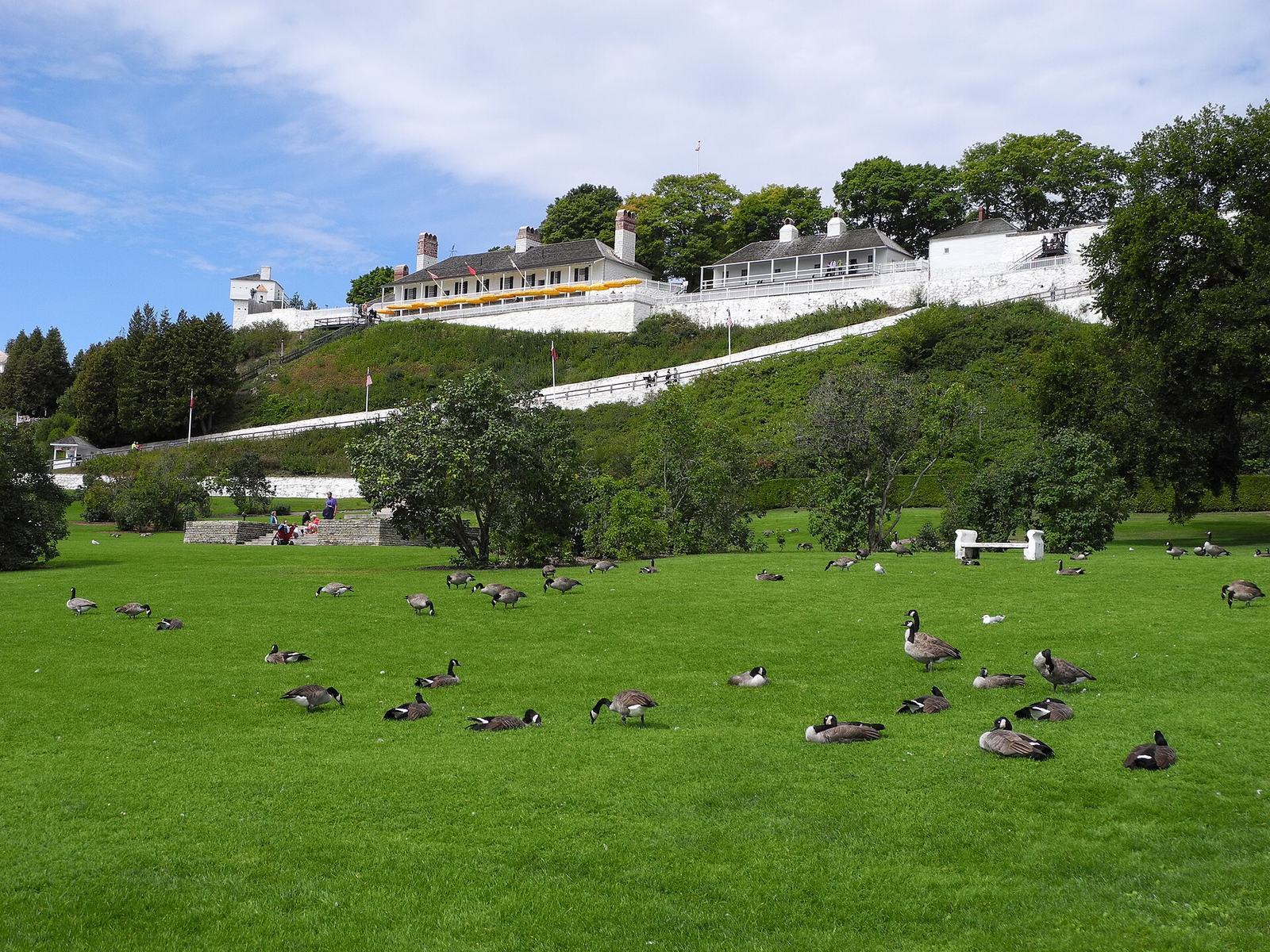
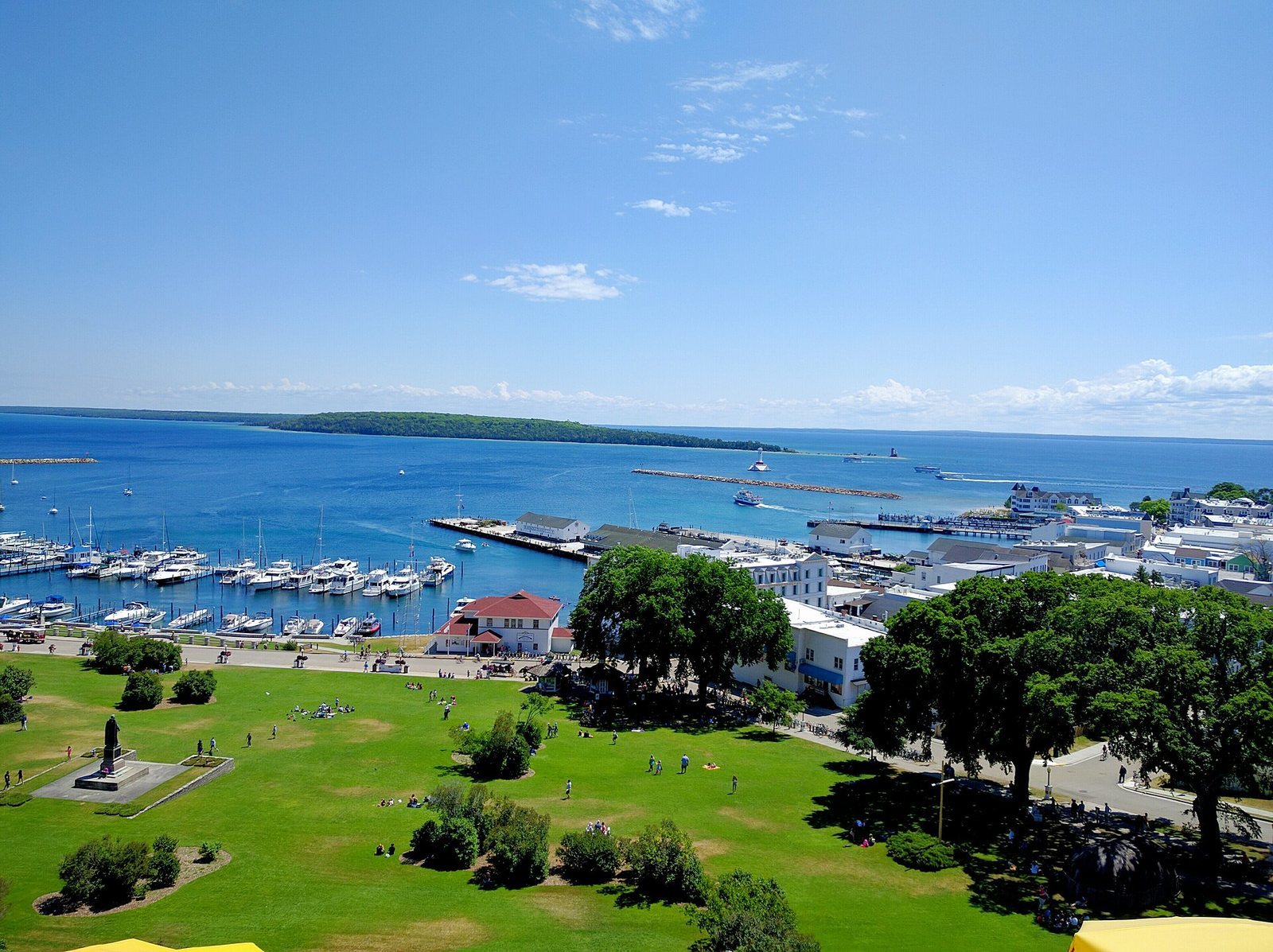
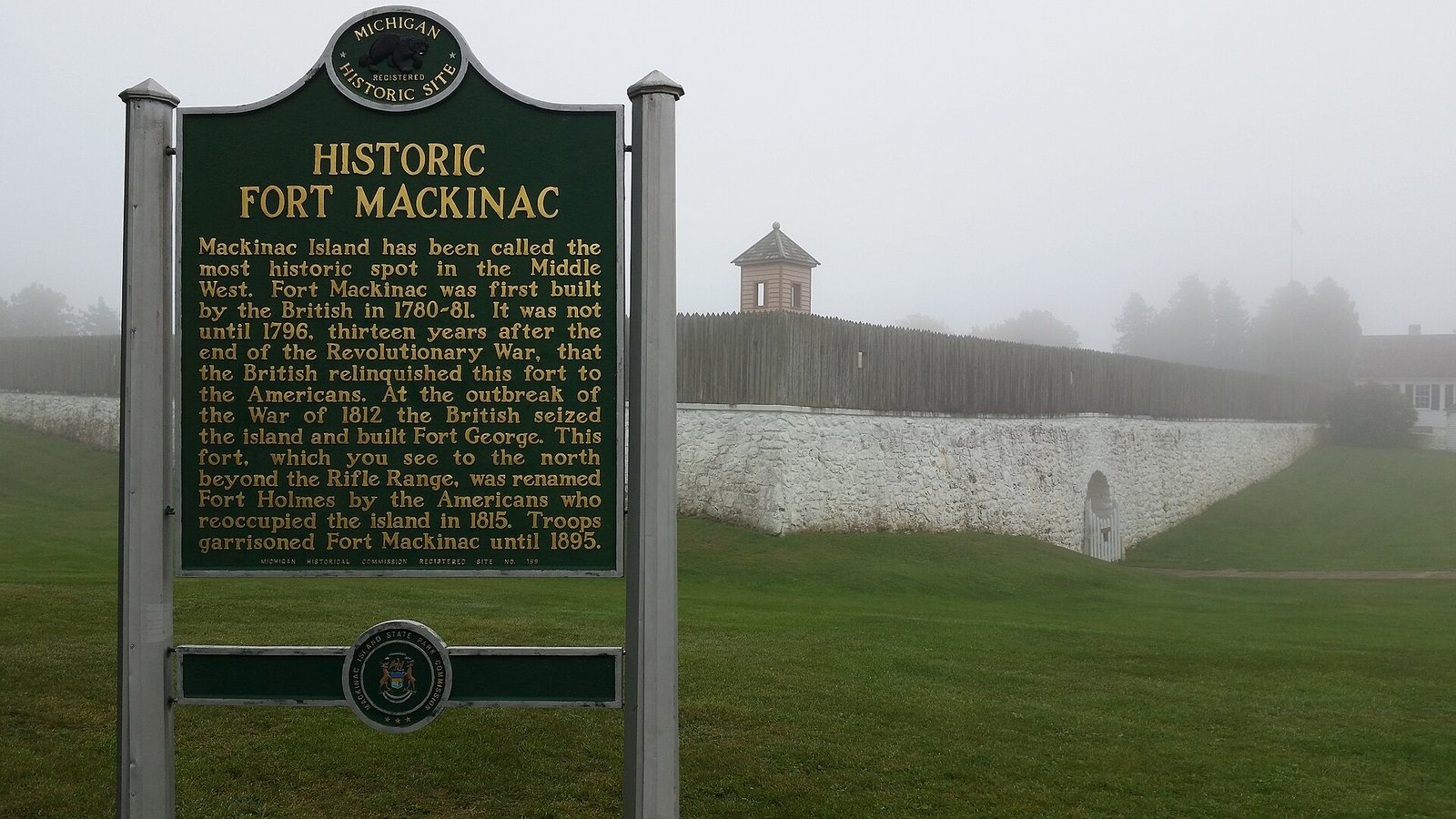
The surviving fort stands on limestone bluffs about 150 feet above the Straits of Mackinac. Its complex includes weathered gates and stone walls, while the grounds also contain the parade ground and rifle range. Fort Mackinac’s museum includes 14 historic buildings.
Fortifications
Fort Mackinac
The fort’s limestone walls and gates remain part of the complex. Their position on the bluffs above the straits reflects the site’s commanding location, while the parade ground and rifle range form part of its grounds.
Fort Holmes
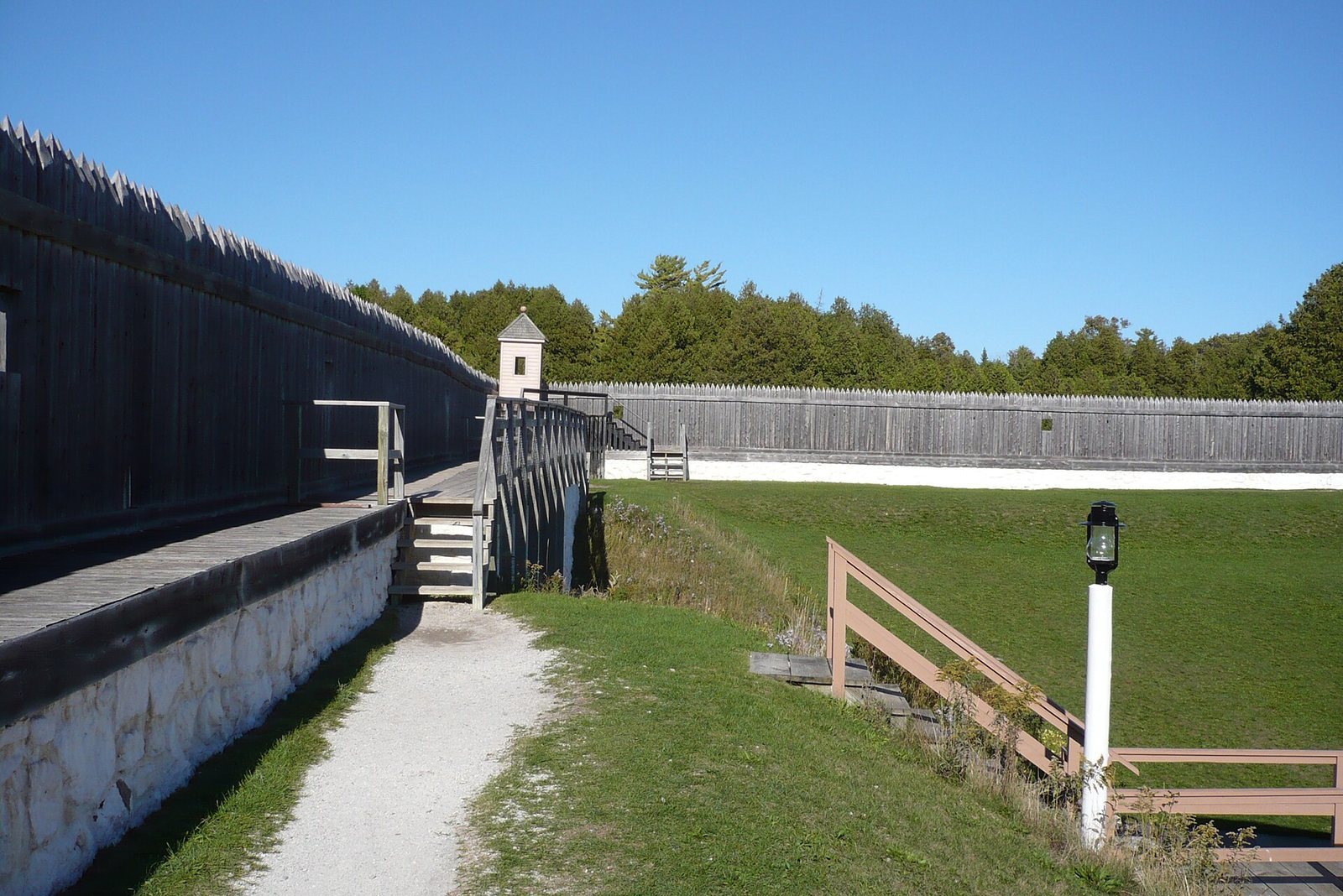
At the island’s highest point, Fort Holmes occupies the location of the earlier Fort George. That fort consisted of a timber stockade, a defensive enclosure of upright logs, and a blockhouse, a fortified building. U.S. forces renamed it in 1815, and its position had been chosen to guard against an American landing like the one attempted in 1814.
National-park-era grounds and buildings
A bathhouse, a post toilet fitted with flush toilets, and a canteen were built during the national-park period. The rifle range was used for target practice at distances of 600 or 1,000 yards.
Cannon and painted view
A six-pounder, a cannon classified by the weight of its shot, of the 1841 model is associated with the fort. In 1872, Seth Eastman painted Fort Mackinac in oil. The painting is now held by the U.S. Senate.