Gò Tháp: A Funan Archaeological and Religious Complex in Vietnam
Site at a Glance
- Rating
- 4.5
- Popularity
- Low
- Country
- Vietnam
- Primary era
- Classical
- Eras represented
- Classical, Medieval
- Civilizations
- Unclassified
- Site type
- Religious
- Remains
- Sanctuary
On this page18 sections
History
Gò Tháp is a major archaeological and architectural complex in Đồng Tháp, Vietnam, associated with the Funan kingdom and the Óc Eo cultural tradition. Its history extends across roughly ten centuries, from the first century AD to about the twelfth or thirteenth century, and includes settlement, religious activity, craft production, burial, and cultural exchange in the wetlands of the Mekong Delta.
Funan and the Óc Eo cultural tradition
The principal remains belong to Funan, an early Southeast Asian kingdom whose influence extended through parts of the Mekong Delta between approximately the first and seventh centuries AD. Gò Tháp became a religious and cultural center of the Đồng Tháp Mười region. Its settlements, temples, cemeteries, craft remains, and water-transport connections reveal links between economic activity, social life, and the development of Hinduism and Buddhism.
A fifth-century stone inscription known as K5 describes the conquest of the marshland by the Funan king Jayavarman. It states that Jayavarman appointed his son Gunavarman to govern the territory. The inscription reflects Vaishnavism, the Hindu tradition centered on Vishnu, while other remains show that Shaivism, centered on Shiva, and Buddhist practice also existed at Gò Tháp within the wider Óc Eo cultural sphere.
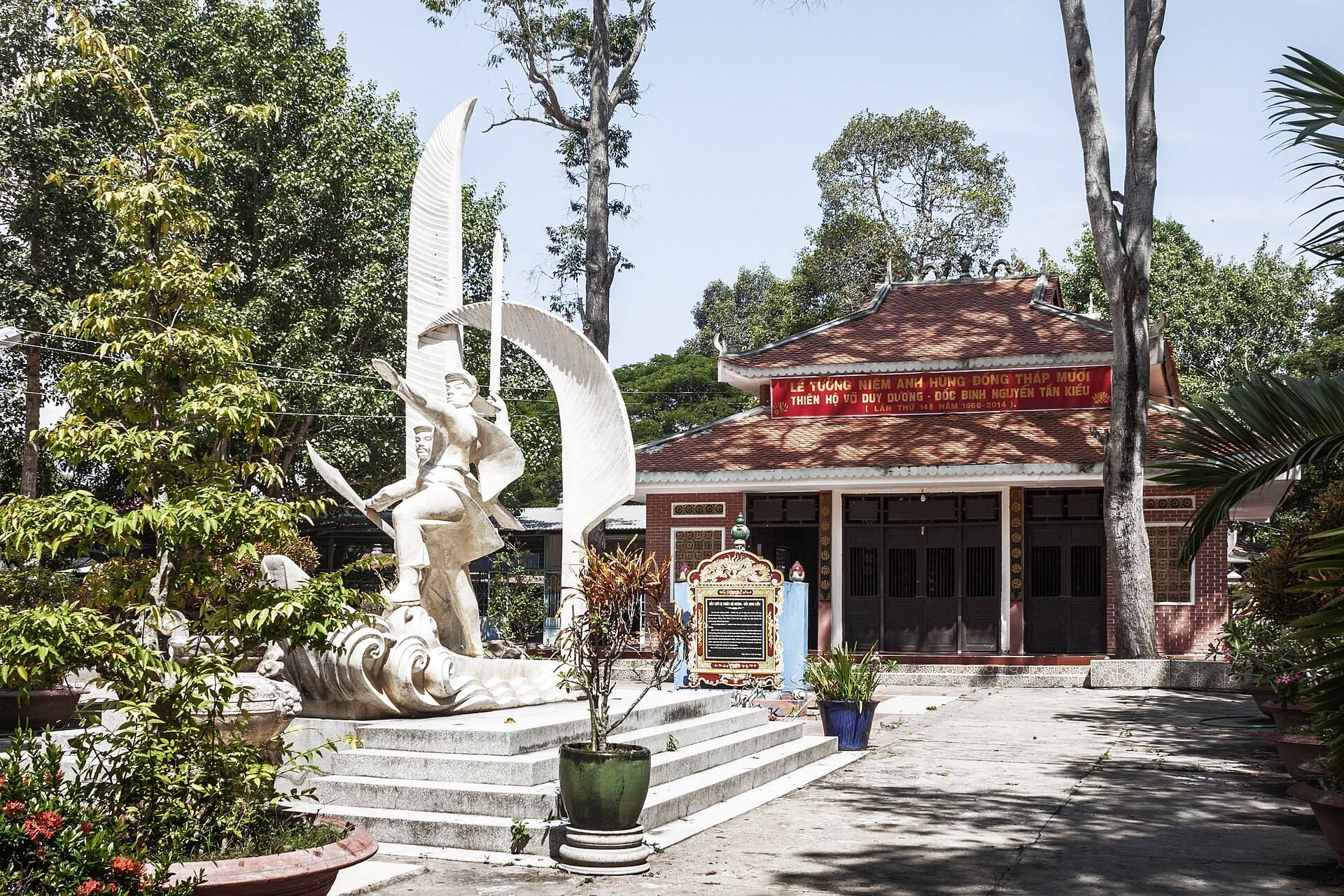
Gò Tháp was associated with worship of Vishnu and Shiva, as well as with Buddhist religious activity. The wider complex preserves evidence of these traditions in temples, sculptures, ritual objects, inscriptions, and burial practices. Later religious institutions at the site include Tháp Mười Ancient Pagoda, shrines to Thiên Hộ Võ Duy Dương and Đốc Binh Kiều, the Bà Chúa Xứ shrine, and the Hoàng Cô shrine.
Later religious traditions
Tháp Mười Ancient Pagoda is traditionally dated to the reign of Emperor Thiệu Trị, from 1841 to 1847. It originally stood at Gò Tháp Mười before being relocated by the government of Ngo Dinh Diem. Commando forces of the Kien Phong Provincial Liberation Army destroyed it in 1956, after which the site became derelict. Local residents later contributed to the construction of a new pagoda. The Hoàng Cô shrine beside it is traditionally associated with a younger sister of Nguyễn Ánh, who later became Emperor Gia Long.
Nineteenth-century resistance
During the nineteenth-century resistance to French colonial conquest, Gò Tháp served as the headquarters of forces led by Võ Duy Dương, also known as Thiên Hộ Dương, and his deputy Nguyễn Tấn Kiều, known as Đốc Binh Kiều. The site formed part of the broader Đồng Tháp Mười base, whose marshy landscape supported guerrilla warfare.
Võ Duy Dương led an uprising in the Đồng Tháp Mười region from 1862 to 1866. He established a base at Bình Cách, joined forces with other anti-French leaders, recruited nearly one thousand men, and used the wetlands as a military refuge. Nguyễn Tấn Kiều had continued resistance from bases in the Kiến Đăng area after the fall of Gia Định in 1859 and the French destruction of the Kỳ Hòa defensive position in 1861. He later joined Võ Duy Dương and received the rank of deputy general.
In April 1866, French forces attacked Gò Tháp from three directions with approximately 1,000 troops, warships, and artillery. The operation targeted the insurgent headquarters, and the Trung Fort was captured after heavy fighting. The resistance forces withdrew. Đốc Binh Kiều was shot while ascending an observation platform and taken to Giồng Dung for treatment. He died later that year, although a local tradition holds that he fell in close combat. His remains were buried at the former Trung Fort with several false graves intended to conceal the burial place.
A joint shrine once commemorated Võ Duy Dương and Đốc Binh Kiều. After a separate shrine to Võ Duy Dương was built in 2015, the two leaders were worshipped separately at Gò Tháp. Annual observances include the Bà Chúa Xứ festival on the full moon of the third lunar month and commemorations for Võ Duy Dương and Đốc Binh Kiều during the eleventh lunar month. Their shared death anniversary is observed on the fourteenth day of that month.
Modern archaeological and historical status
Gò Tháp became known to researchers in the late nineteenth century. French researchers surveyed the area during the early twentieth century and published findings on ancient buildings, cult statues, stone stelae, and inscriptions. Vietnamese archaeologists later carried out repeated surveys, test excavations, and excavations with Vietnamese and international specialists.
In the later twentieth century, the area also served as a base for the Southern Regional Party Committee, the Southern Resistance Administrative Committee, and the Zone 8 Party Committee. It was sometimes described as a resistance capital and was associated with senior revolutionary officials including Lê Duẩn, Lê Đức Thọ, Phạm Hùng, and Trần Văn Trà.
Gò Tháp became a national historical-cultural monument in 1998 and received special national monument status in 2012 as an archaeological and architectural-artistic complex. From 2005, Đồng Tháp provincial authorities established protected boundaries and prepared a master plan covering approximately 300 hectares. The planned areas included conservation and museum facilities, ecological forest, services, and wildlife breeding. The designated complex is also described as covering about 320 hectares, with a separate ecological zone of approximately 167 hectares.
Remains
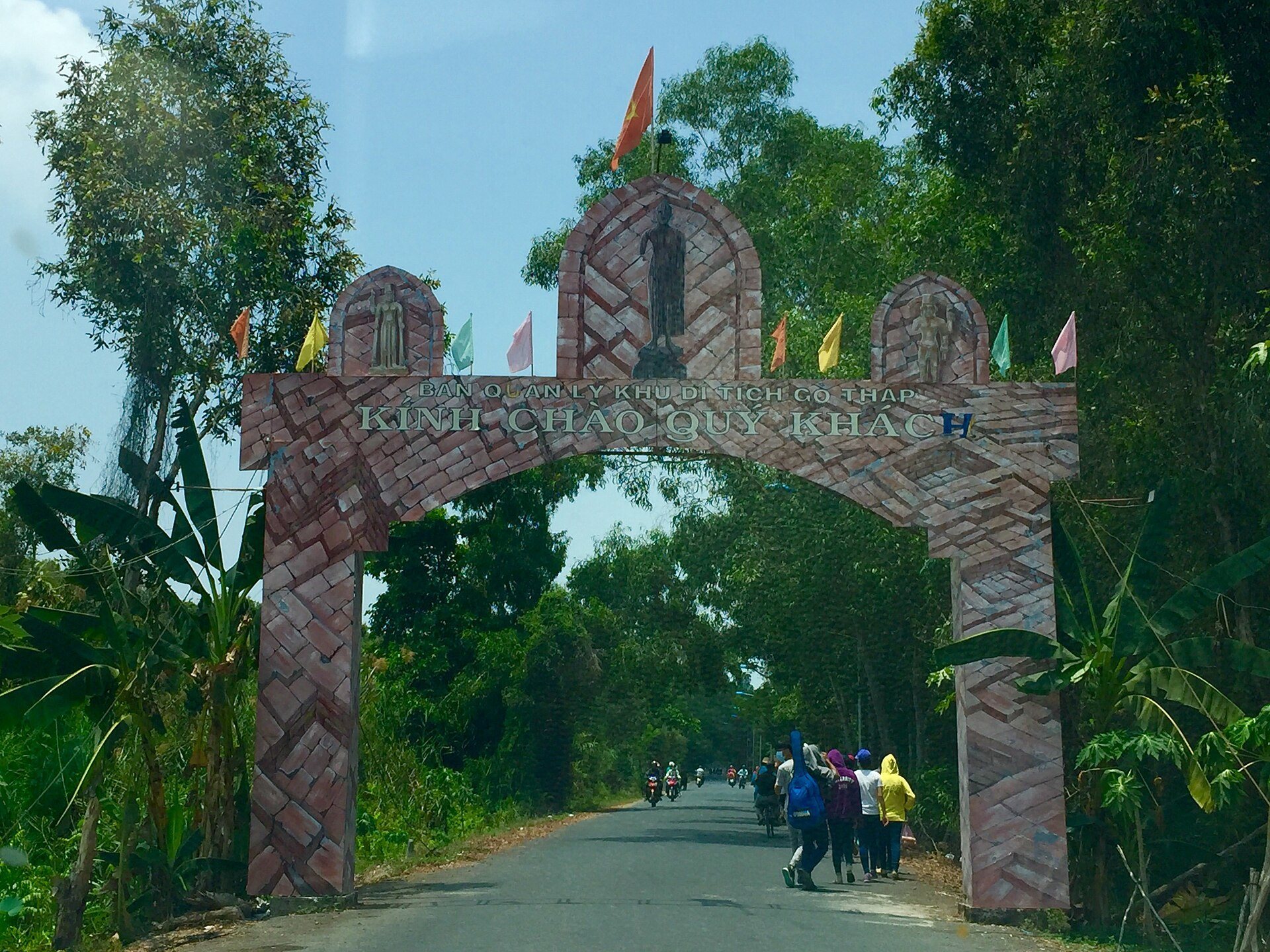
Gò Tháp lies in the Đồng Tháp Mười wetlands and contains three main categories of archaeological remains: architecture, settlements, and burials. The central protected area, known as Gò Tháp or Gò Cát Nổi, contains excavated Funan structures, graves, and covered outdoor archaeological displays. The broader complex includes Gò Tháp Mười, Tháp Mười Ancient Pagoda, the shrine and tomb of Đốc Binh Nguyễn Tấn Kiều, Minh Su Mound, the shrine of Thiên Hộ Võ Duy Dương, and the Bà Chúa Xứ shrine and mound.
Central Funan architecture
Gò Tháp Mười
Gò Tháp Mười rises about 3.8 metres above the surrounding fields and reaches approximately 5.046 metres above sea level. The mound covers around 4,500 square metres and is shaded by old trees. An adjacent trôm tree has been recognized as a Vietnamese Heritage Tree. Excavations and surveys recovered numerous bricks, dozens of large stone blocks, fragments of yoni, and columns. A yoni is a Hindu ritual symbol associated with the generative principle and is often found with a linga in temple contexts.
Three granite columns have square sections measuring approximately 0.48 metres on each side. They are about 1.56, 1.10, and 1.42 metres long. One end of each column has a projecting dowel and the other a socket, allowing the pieces to be assembled vertically. The clearest building remains form a brick structure about 17.30 metres from east to west and 12 metres from north to south. Its angled corners and symmetry between the northern and southern halves indicate a substantial building connected with surrounding structures.
Other finds from the mound include spouted ceramic vessels, yoni fragments, moulds, and Vishnu sculptures. Two incomplete Vishnu statues are particularly fine examples among the recovered sculpture. The K5 stone inscription, dated to the fifth century, was also found at Gò Tháp and connects the physical remains with Funan administration and religious traditions.
Tháp Mười Ancient Pagoda
Tháp Mười Ancient Pagoda stands about 100 metres north of Gò Tháp Mười. A former building was replaced by a newer, larger, and more substantial pagoda after the earlier structure was destroyed. The pagoda forms part of the later religious landscape that developed around the ancient archaeological remains.
Settlement and cemetery remains
Minh Su Mound settlement
Minh Su Mound is a Funan settlement and cemetery whose occupation extended from approximately the first to the eighth century AD. Settlement remains spread around the mound and across the surrounding low-lying fields. Five excavations have taken place there. A January 2001 excavation uncovered an undisturbed settlement and cemetery about 120 metres southeast of the mound. Finds included stone objects, roof-tile fragments, a monkey figure, stamped objects, relief fragments, and yoni spouts.
More than 18,000 ceramic fragments were recovered at Minh Su, including vessels, jars, and pots. Many large pieces could be reconstructed and appear to have come from vessels that collapsed and broke within the settlement and cemetery area. Large jars and pots held cremation ash. Burial M1 contained a pear-shaped vessel with a cylindrical neck, a missing rim, sloping shoulders, a rounded body, and a low ring-shaped base. Its fine fabric was yellowish ivory, with a white-grey body containing small amounts of laterite gravel. Another vessel had a dense black fabric and a mottled brick-red surface.
Minh Su cemetery
The concentration of ash-filled vessels at Minh Su represents the first identified dense cemetery of this type within the Óc Eo cultural sphere. Excavations in March 2002 revealed numerous graves placed on laterite-gravel terraces or overlapping one another. The graves were basin-shaped or funnel-shaped, with sand-lined bases and, in some cases, a layer of blue-grey clay beneath them. Laterite is an iron-rich tropical soil or stone that formed the gravel terraces and some of the geological surfaces associated with the graves.
The graves contained broken pottery, animal bones, charcoal, small stones, and objects made from stone, bone, glass, metal, and wood. Glass slag, metal slag, a metal pouring cup, and stone-slab fragments indicate several craft industries at the site. The burial evidence points to cremation and possibly to inhumation or partial inhumation. A third excavation in April 2003 further clarified the combined settlement and cemetery character of Minh Su. Seasonal occupation took place on low mounds beside small channels, while soil was accumulated to enlarge usable ground in the wetland environment.
Minh Su temple complex
An excavation in 2009 identified a Shiva temple complex at Minh Su. Large areas of brick were arranged in a vertical cylindrical pattern, while rectangular brick lines extended from the center. Together they formed a structure about 12 metres long, with a central rectangular opening, an intersecting edge, and a channel approximately 0.5 metres wide. At least two archaeological layers were present, and the complex was rebuilt several times, with later construction covering earlier remains.
The 2009 excavation produced gold earrings, bronze ear ornaments, a broken horse head, wheel-shaped objects, small discs, and a gold ring bearing a conch-shell design surrounded by stylized foliage. The conch shell was identified as a symbol of Vishnu, and the ring was regarded as a unique specimen. Excavation west of Minh Su in 2013 uncovered damaged Vishnu statues that retained their bases, along with approximately 80 gold objects decorated with lively cow imagery, wheel motifs, and other ornaments. These objects have been interpreted as ritual offerings to deities.
Temple, sculpture, and ritual remains
Bà Chúa Xứ mound
The Bà Chúa Xứ mound contains the remains of a large Hindu temple excavated in 1984. The structure measures approximately 20.90 by 13.40 metres and has angled corners of differing lengths. Its foundation and footings contain brick-built square compartments, in places reaching 1.4 metres in thickness. The upper structure was destroyed, but the surviving foundations and architectural stone fragments identify a formally constructed Hindu temple dated to the sixth century.
Gold ritual fragments
The complex contains 321 gold fragments engraved with deities, mythical creatures, and decorative patterns. Their dating indicates that they were made over a long period rather than at one time, from approximately the fourth or fifth century BC to the fifth century AD. The objects reflect long-term Indian cultural influence within the religious environment of Gò Tháp.
Wooden Buddhist sculpture
Gò Tháp is known for numerous wooden Buddha sculptures associated with Óc Eo Buddhist art. Many were found during pond excavation and agricultural work. They vary in size and form, combining outside artistic influences with a locally distinctive style. The sculptures were carved from locally available tamanu wood, a durable material that allowed varied forms. The fifth to seventh centuries were an important period for indigenous Buddhist sculpture in the region, represented by the wooden Buddha collection from Đồng Tháp.
Wetland adaptation and later monuments
The surviving remains include architectural fragments, temple and funerary structures, settlement objects, ritual offerings, sculptures, inscriptions, domestic objects, and cooking-floor remains. Ancient residents adapted to the wetlands by occupying and enlarging raised ground, building religious structures and funerary towers on old alluvial mounds, and living in stilted structures on lower ground.
The central protected area preserves excavated Funan architecture, burials, and covered outdoor archaeological displays. Around it, the pagoda, shrines, tombs, and mounds preserve later religious and historical traditions associated with Gò Tháp. Together these remains present a landscape in which settlement, worship, craft production, burial, and resistance were repeatedly organized around the raised ground of the Đồng Tháp Mười wetlands.