Ancient Sites in Gush Halav: The History and Remains of an Upper Galilean Town
Site at a Glance
- Rating
- 4.5
- Popularity
- Very Low
- Country
- Israel
- Primary era
- Classical
- Eras represented
- Classical
- Civilizations
- Roman
- Site type
- City
On this page11 sections
History
Ancient sites in Gush Halav are the remains and religious landmarks of an ancient Jewish town identified with modern Jish in Israel. Known to Josephus as Gischala, Gush Halav was the most important Jewish town in Upper Galilee and served as the region’s administrative capital from the Second Temple period, the era ending with the Roman destruction of the Jerusalem Temple in AD 70, through the periods of the Mishnah and Talmud. Tradition also identifies it as a walled city from the time of Joshua.
Gush Halav before the Roman revolt
The town’s name has been linked either with halav, meaning “milk,” or with helev, meaning “animal fat,” perhaps reflecting local prosperity. Another explanation connects the name with the pale limestone of the hill. Suggestions associating it with abundant olive oil or cattle are not supported by the surviving evidence. Gush Halav’s fertile surroundings produced highly regarded olives and high-quality olive oil. Rabbinic writers used the end of the olive season at Gush Halav and nearby Meron to determine when produce from the sabbatical year could no longer be eaten throughout the Land of Israel.
Josephus, a first-century Jewish historian who had served as a commander in Galilee, provides the principal ancient narrative for the town during the Great Revolt, the Jewish uprising against Roman rule from AD 66 to 73. John of Gischala, also called Yohanan ben Levi, was a wealthy local official. Before the revolt, he collected grain taxes for the Roman authorities. After surrounding non-Jewish communities attacked, burned, and damaged Gush Halav, he organized about 400 fighters, raided hostile towns, restored the settlement, and strengthened its defenses.
The Great Revolt and Roman conquest
John financed the fortifications by selling Roman imperial grain stored in Galilee. He recruited refugees rather than relying on the town’s own inhabitants, suggesting that many residents were reluctant to support the uprising. Gush Halav became the last Galilean town to resist the Roman advance.
In AD 67, Titus approached the town with 1,000 cavalry. John secured a delay for the Sabbath, then secretly departed at night with several thousand Zealots, Jewish rebels who opposed Roman rule. The inhabitants opened the gates to the Romans the following day. Titus subsequently damaged or dismantled part of the town’s fortifications.
Jewish life after the Roman conquest
Jewish settlement continued at Gush Halav after the destruction of the Second Temple and lasted into the nineteenth century. Medieval and later evidence describes a substantial Jewish community engaged in farming and commerce, including long-distance trade in oil and wine. Jewish landowners were still present in the mid-nineteenth century.
Medieval visitors associated the town with the graves of Shemaiah and Avtalion, leading teachers of the late Second Temple period, as well as with the tombs of other religious figures. A thirteenth-century Cairo Geniza letter uses both Gush Halav and Jish for the town. Benjamin of Tudela, Samuel ben Samson, and Ashtori ha-Parchi also described Jewish activity or sacred places there. In 1320, Ashtori ha-Parchi stated that residents read the Book of Esther on both the fourteenth and fifteenth of Adar.
An inscription found at Gush Halav refers to the institution of Yeshivat Gaon Yaakov, describing it as the successor to the Sanhedrin, the central Jewish judicial and religious council of late Second Temple and early post-Temple tradition. The inscription presents the institution as continuing Palestinian Jewish scholarly traditions after 425 and is dated broadly between the eleventh and fifteenth centuries.
Pilgrimage to the graves attributed to Shemaiah and Avtalion continued from the Middle Ages. Safed mystics also visited them, and tradition states that Isaac Luria came to the graves in 1572 for prayer and spiritual consultation. The attribution of another tomb at Gush Halav to Rabbi Meir Baal HaNes remains uncertain. It may refer to the Tanna Rabbi Meir, whose principal traditional tomb is at Tiberias, or to a different person identified with a medieval Tosafist.
In 1885, land near Gush Halav was nearly purchased for the Hovevei Zion movement after Jewish investors from Poland financed the acquisition of plots. The purchase was cancelled later that year. Jerome also associated Gischala with the family of Paul of Tarsus before its move to Tarsus, a tradition that places Paul’s birth at Gischala.
Remains
The surviving remains extend across the modern village and its surroundings. They include a synagogue in an olive grove northeast of the village, ancient remains on the hill summit now occupied by Mar Boutros church, and burial complexes on the western slope. A possible lower settlement beside Gush Halav Stream may have been a dependent suburb that later became independent, although the difference in elevation and the lack of continuous building leave that relationship uncertain. A small spring rises northwest of the lower settlement.
Settlement and synagogue remains
Ancient synagogue in the olive grove
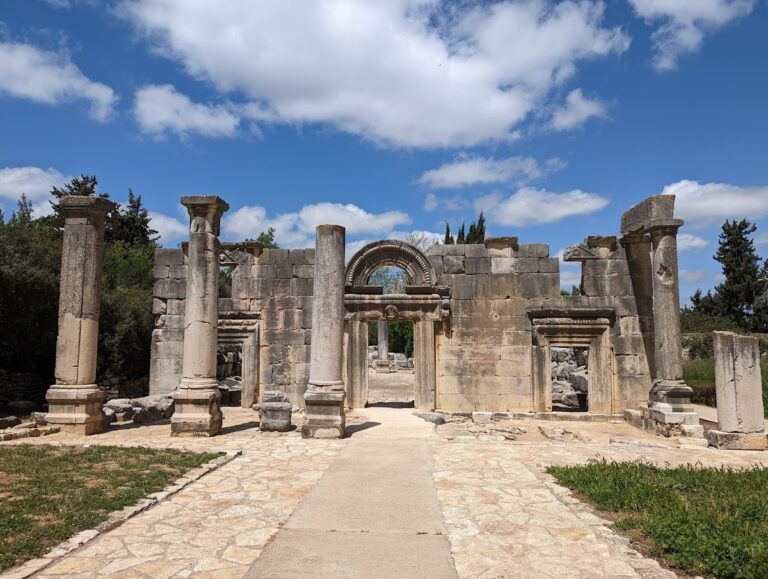
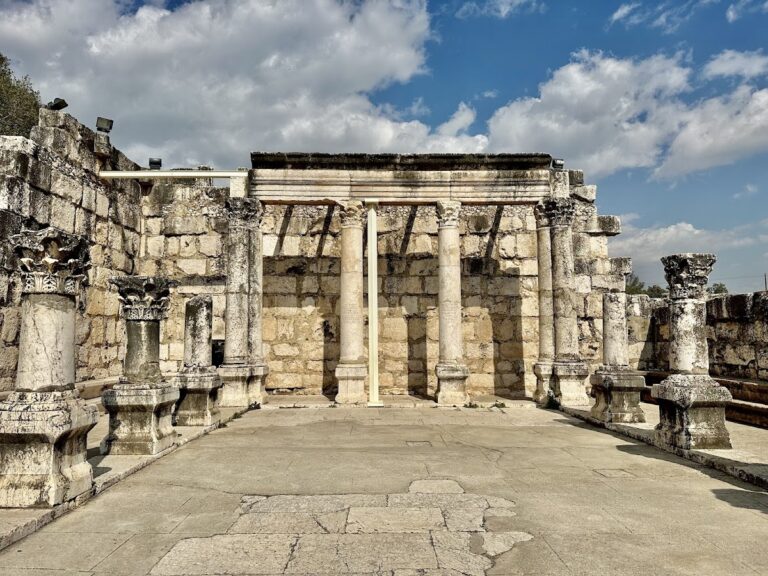
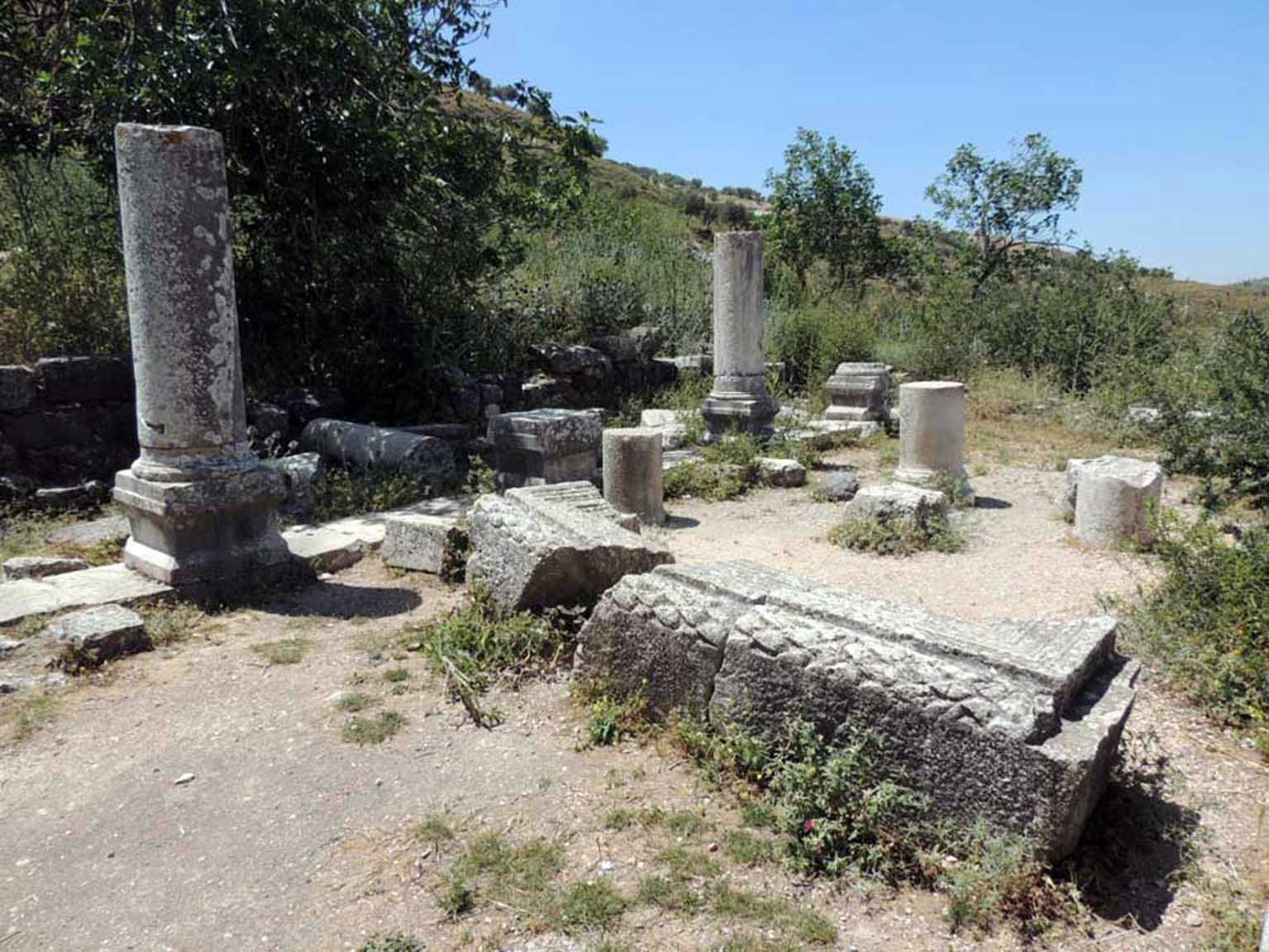
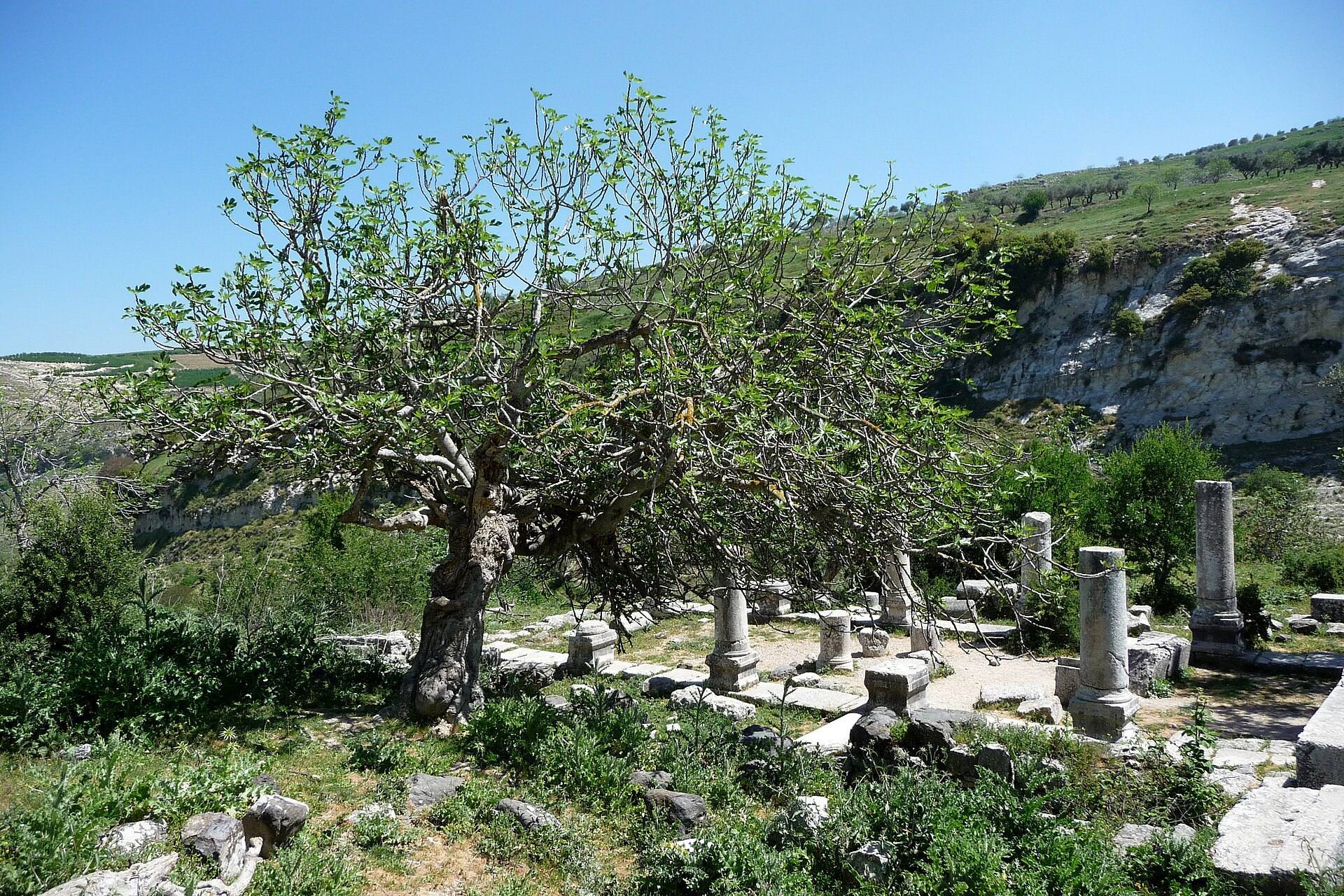
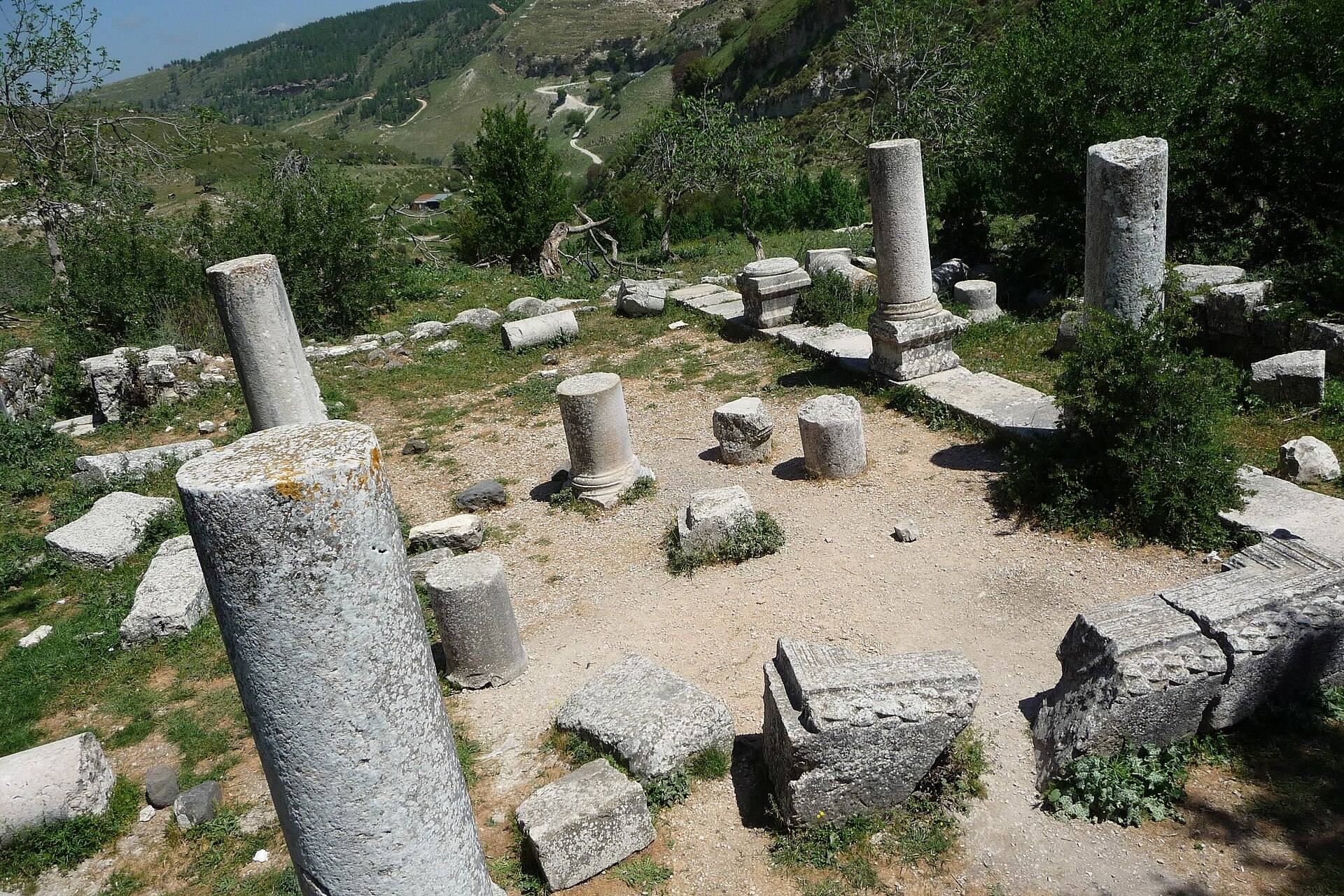
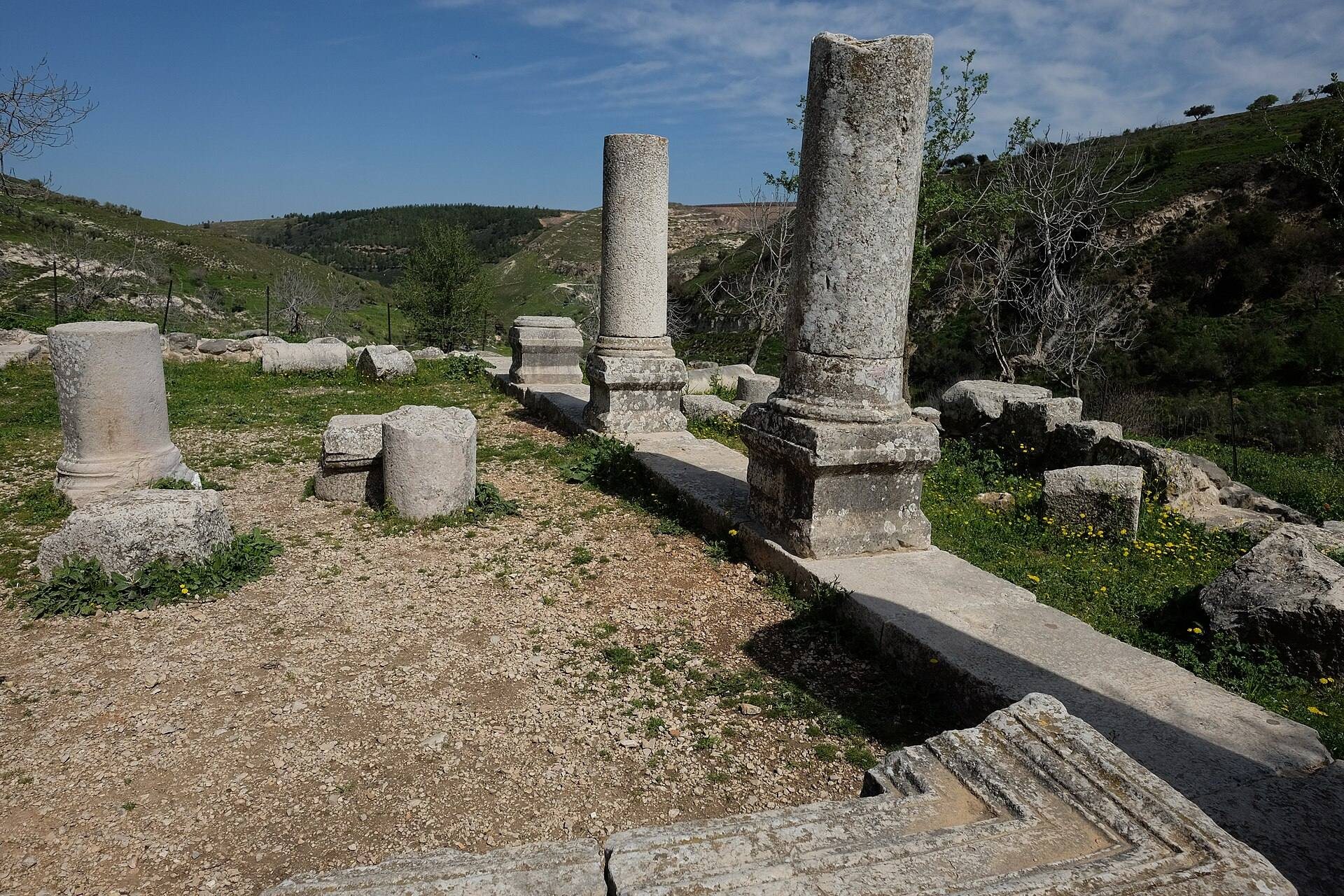
An ancient synagogue stands in an olive grove about half a kilometre along the road northeast of the village. Heinrich Kohl and Carl Watzinger first excavated it in 1905. The building was approximately square and had one entrance facing south toward Jerusalem. Its prayer hall measured almost 14 metres from north to south and 11 metres across, with narrow, elongated spaces along three sides. Parallel rows of columns stood beside the walls, following an arrangement found in other Galilean synagogues.
The entrance used large carved doorposts that supported an unusual lintel. A scale pattern decorated the southern exterior, and a high-relief eagle appeared above the heads of those entering. Another lintel showed a spread-winged eagle holding a wreath in its beak. An Aramaic dedication on a southern column states in translation that Yosa son of Nahum made the column and wished it to bring blessing, apparently identifying its donor.
The synagogue was probably built in the late third century. A second phase in the fourth century added a small platform above the earlier one. The building was destroyed or damaged in 551. A hoard placed in a pottery jar in the western side space contained 1,943 coins, mostly Tyrian issues from the fourth and fifth centuries. Stone removal during the two excavations may partly account for differences between this building and other Galilean synagogues.
Synagogue remains on the village hill
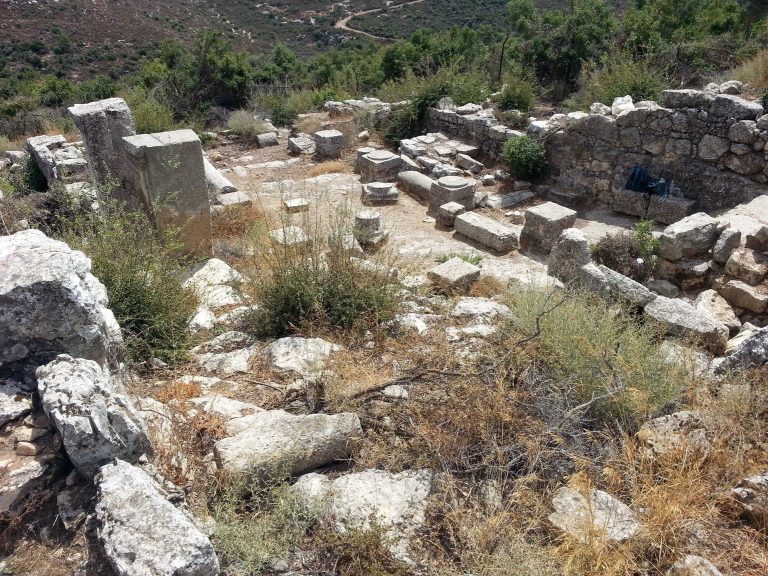
Surveyors working between 1871 and 1878 identified synagogue remains on the summit of the village hill, which they regarded as the ancient citadel of Gush Halav. The site is now occupied by Mar Boutros church. Ancient remains are visible beside the church, and local residents stated that many synagogue stones had been incorporated into its walls.
Burial monuments
Burial complex on the western slope
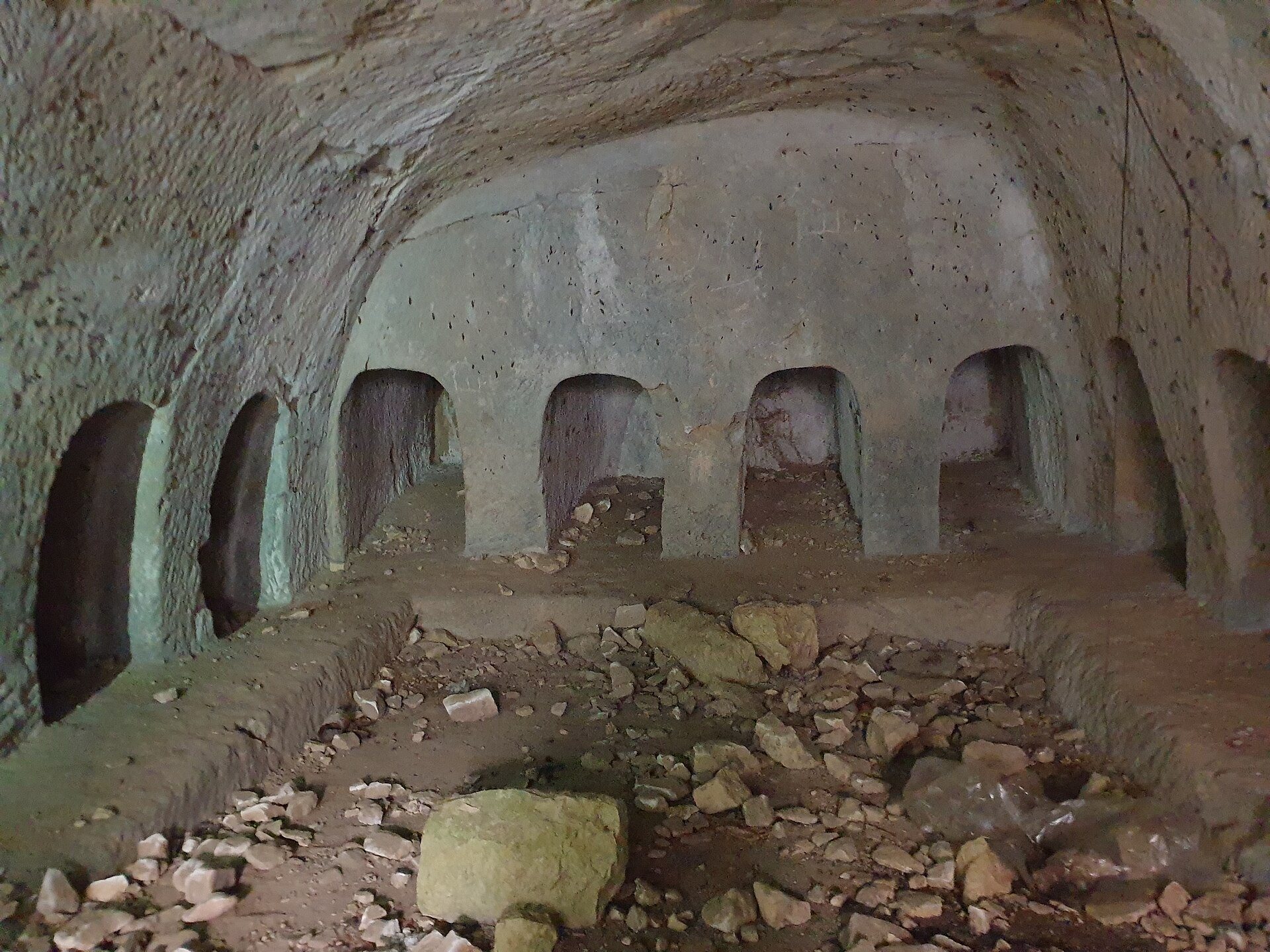
A well-built burial complex was exposed on the western slope in 1973. A paved courtyard leads to a vaulted entrance hall furnished with stone benches. Openings from the hall lead into burial caves, including one with its original stone door and fittings for an iron handle and bolt.
The vaulted chamber behind the door contains ten rock-cut burial niches, five on each side. Rosettes, circles, and lines were carved on the walls, although their meaning is uncertain. Clay lamps and a glass bottle were found on the floor. Above the entrance hall is a roofless room containing a double sarcophagus. Fifteen skeletons were placed inside it with jewelry and vessels made of glass, gold, and bronze. The architectural style dates the sarcophagus to the second or third centuries, while the associated offerings date to the fourth century.
Tomb attributed to Shemaiah and Avtalion
Near the village entrance stands the tomb traditionally attributed to Shemaiah and Avtalion. The burial monument forms part of Gush Halav’s long-standing pilgrimage landscape and remains connected with the town’s religious heritage.