Lissos Archaeological Site: An Ancient Cretan Harbour and Healing Centre


Site at a Glance
- Rating
- 4.6
- Popularity
- Low
- Country
- Greece
- Primary era
- Classical
- External website
- Open
- Eras represented
- Classical, Medieval
- Civilizations
- Ancient Greek, Byzantine, Roman
- Site type
- City
On this page19 sections
History
Lissos Archaeological Site in Greece preserves the remains of the ancient Cretan city of Lissos, also known as Lisos or Lissus, on the southern coast of Crete in the Agios Kirykos area. Established by at least the Classical period and flourishing into Late Antiquity, it served as one of the two harbours of Elyros, alongside Syia. Its location, maritime activity, and healing sanctuary made Lissos an important centre on the southern Cretan coast.
Early settlement and maritime prosperity
Minoan pottery indicates activity in the area before the formation of the historical city. Lissos has a pre-Greek name, which has led to the suggestion that its foundation may reach back to the seventh or sixth century BCE, although its early history remains uncertain. The settlement occupied difficult terrain with little cultivable land, so access and economic life depended largely on the sea.
Lissos developed strong trading and fishing fleets. Maritime commerce, fishing, and visitors to the sanctuary of Asclepius, the ancient Greek and Roman god of healing and medicine, all contributed to the city’s prosperity. In the fourth century BCE, Lissos appears to have been independent and minted its own coins.
The League of the Oreioi
Around 300 BCE, Lissos joined the League of the Oreioi, a political and religious association of Cretan cities whose name means “mountain people.” Its core members included Lissos, Elyros, Hyrtacina, and Tarrha, while Syia and Poecilasium served as outports. Lissos and Hyrtacina were allies and conducted trade with a common currency, reflecting their close economic relationship.
Between approximately 279 and 274 BCE, the Oreioi concluded a treaty with Magas, king of Cyrene. The league later allied with Gortyn. In 221–220 BCE it initially supported Knossos, but during the Lyktian War of 221–219 BCE, a conflict between Cretan powers, it changed sides and fought alongside Lyktos against Knossos. The league was dissolved around 200 BCE.
A treaty inscription discovered at Lissos mentions Dictynna, a Cretan goddess associated with a western Cretan religious tradition and sometimes identified with Artemis. The inscription has supported the interpretation that a major federal sanctuary of the Oreioi may have stood at Lissos. The city also became an important centre of the cult of Asclepius. Its healing sanctuary and sacred spring probably formed a major source of local wealth.
Roman and Christian Lissos
Lissos remained prosperous during the Roman period and continued to attract people seeking healing. In the Christian period, it became an episcopal see within the metropolitan jurisdiction of Gortyn, probably retaining this status until the ninth century. Two early Christian basilicas, a church type usually divided into aisles by rows of columns, were built at Lissos in the fifth or sixth century.
Religious activity continued during the Byzantine period, although the settlement was probably abandoned between the seventh and ninth centuries. This decline may have been connected with the upheavals surrounding the Muslim conquest of Crete. Lissos was not subsequently reinhabited, while its religious character continued in Byzantine buildings established over earlier structures.
Rediscovery and archaeological investigation
Robert Pashley correctly identified the ancient remains as Lissos after visiting the site in 1833. Thomas Abel Brimage Spratt later recorded that the coast had risen by approximately 6.70 metres since antiquity. Conrad Bursian and other nineteenth-century investigators also described the remains. Inscriptions were discovered by John Linton Myres and Gaetano De Sanctis, and Gaspare Oliviero transferred four inscriptions to the museum in Chania in 1913–1914.
Excavation began in 1957, after local farmers searching for a water source uncovered numerous statues. Nikolaos Platon excavated the sanctuary of Asclepius from 1957 to 1961. Wider work in 1957–1958 revealed the theatre, aqueduct, cemetery, baths, and early Christian basilicas. Further excavation of the theatre took place in 2022–2023.
More than 40 statues were found in the collapsed sanctuary, and the large number of sculptures recovered at Lissos has been associated with the prosperity and influence of its healing cult. The finds are held in the archaeological museums of Chania and Heraklion. Powerful earthquakes raised the coast by approximately 6.70 metres, making the ancient harbour unusable by leaving its installations inland and dry. Lissos is now uninhabited.
Remains
Lissos lies in a small hollow or valley between hills facing the sea, with the surrounding landscape forming a roughly theatre-like setting. The settlement occupied land with little cultivation potential and was difficult to approach overland. The residential quarter lay on the left side of the valley, while the Agora and other public buildings probably occupied the central area. Most urban remains are ruined and partly concealed by dense vegetation. The sanctuary of Asclepius stands in the northern part of the valley, about 430 metres from the shore, while the ancient harbour lay nearer the coast.
Sanctuary of Asclepius
Temple of Asclepius
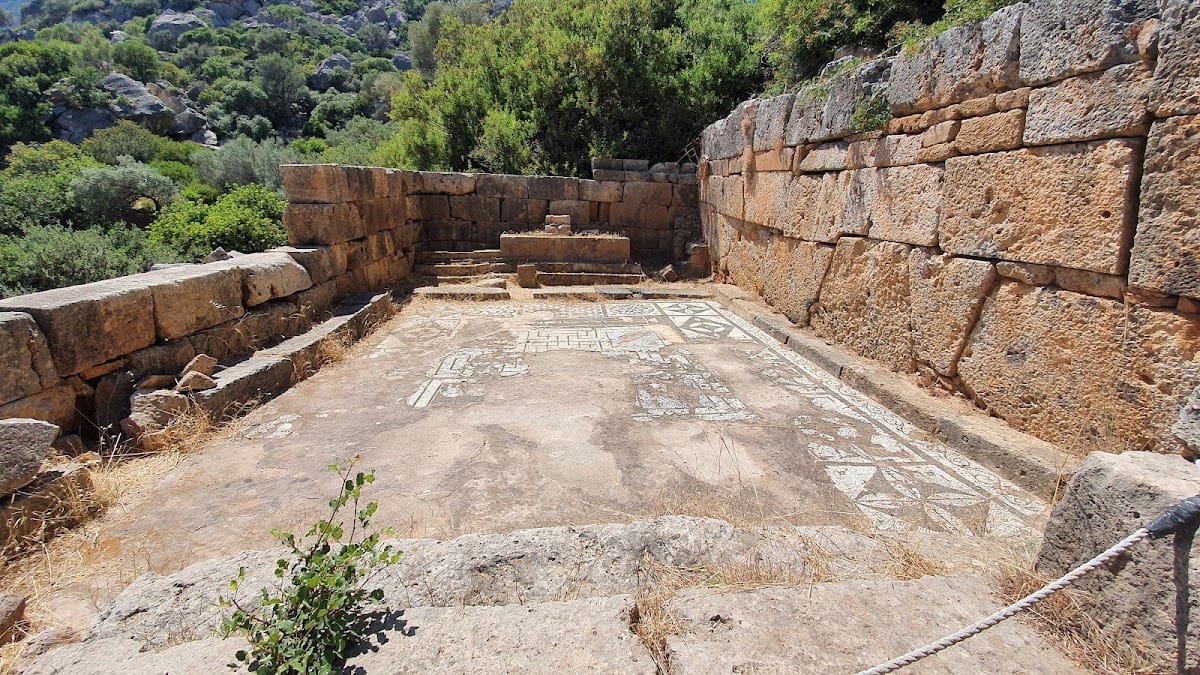
The sanctuary of Asclepius is the most prominent ancient complex at Lissos. Its small rectangular Doric temple dates from the third century BCE and measures approximately 6.50 by 11 metres. Built from porous stone blocks, it had no entrance hall, or pronaos, and an eastern doorway opened directly into the main chamber, known as the cella. A three-step stairway led to the entrance.
Official inscriptions from the second and first centuries BCE were attached to the temple’s southeastern exterior walls. Fragments of the upper architectural structure, including the entablature, triangular wall divisions, and undecorated metopes, remain scattered around the building. Inside, a mosaic floor measuring approximately 5 by 6 metres was added during Roman remodelling, probably in the first century CE. A continuous wall base probably supported the original floor, while a surviving rear pedestal held the cult statue of Asclepius. A recessed hollow beside it probably received liquid offerings.
A rockfall from the cliff behind the temple destroyed the building, probably during the severe earthquake of 21 July 365 CE. The collapse sealed fragments of approximately 40 statues, including cult images of Asclepius and Hygieia, the goddess associated with health and bodily cleanliness. These sculptures were later removed to the Archaeological Museum of Chania.
Sacred spring and sanctuary facilities
The sacred spring still rises beneath the temple. Its water was channelled westward into a reservoir lined with hydraulic mortar, a waterproof material used to contain water, and a large cistern stood beside the spring. A stepped approach led from the terrace to the water source, which became the focus of a healing and water-treatment complex.
Foundations west of the temple have been identified as priests’ quarters and accommodation for pilgrims or other visitors. The sanctuary also contained Hellenistic honorary decrees built into the entrance. An inscription dedicated to Emperor Tiberius was found among fallen inscribed blocks. During the early Christian period, crosses were engraved on the masonry, apparently as part of an effort to Christianize or purify the former temple. A partially preserved mosaic floor belongs to the Roman-period sanctuary.
Public and civic buildings
Theatre or council building
The Roman-period theatre, or small performance building, measures approximately 23.40 metres in diameter and contained 14 rows of seats. The seating was supported by a substructure with a vaulted passage. Its rectangular stage and small size have led to the interpretation that it may instead have functioned as an odeon, a small building for music and recitation, or as a bouleuterion, a meeting place for a city council.
The theatre was built in the first century CE. Water descending from the mountain badly damaged its northern section, probably as a consequence of the earthquake of 365 CE. Excavations in 2022–2023 revealed the building and continue to examine whether it also served as a council house.
Tower, baths, and waterworks
Approximately 30 metres west of the theatre stands the best-preserved building of the Greek-Roman settlement, conventionally called the Tower. The foundations of the baths lie about 20 metres farther east, and the settlement extended south of them. An aqueduct and a large Roman bath building formed part of the urban infrastructure.
Two modern threshing floors lie near the theatre and baths. One is approximately 10 metres south of the theatre, and the other is about 40 metres southwest of it.
Christian buildings
Agios Kyrikos
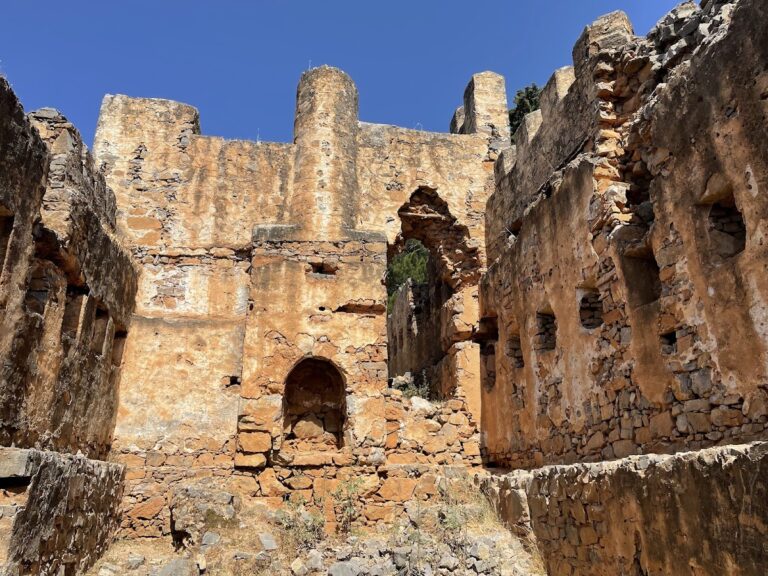
The late Byzantine chapel of Agios Kyrikos stands approximately 75 metres southwest of the temple of Asclepius. It dates from the fourteenth century and was built over the remains of a sixth-century, three-aisled early Byzantine basilica. The chapel is a single-aisled church measuring approximately 6.50 by 4.50 metres. Its structure includes a pointed barrel vault, a transverse arch, and a semicircular eastern apse. Well-preserved frescoes remain inside.
Part of the earlier basilica’s mosaic floor survives south of the chapel, in front of the side entrance. The walls of Agios Kyrikos incorporate the treaty inscription with Magas of Cyrene. Since the inscription also refers to Dictynna, this location has been proposed as a possible site of the Dictynnaion, a sanctuary associated with that goddess.
Panagia
The Byzantine chapel of Panagia stands approximately 300 metres southeast of the theatre and about 50 metres from the coast. It was built over a three-aisled early Byzantine basilica, sections of whose walls remain visible. Panagia is a single-aisled church measuring approximately 6.50 by 4.50 metres, with a pointed vault, a transverse arch, and an unusually rectangular eastern apse. Its floor lies about half a metre below the surrounding ground level.
The chapel incorporates architectural fragments from the earlier basilica and reused Greek-Roman stonework. A sarcophagus lid decorated with a Medusa head is built into its northwestern corner. Five clay bowls are set into the wall above the entrance in a cross-shaped arrangement.
Harbour and cemetery
Ancient harbour
The ancient harbour basin lay approximately 25 metres west of Panagia. Sections of a pier survive about 90 metres from the beach, including a stretch approximately 25 metres long and 1.50 metres wide. Tectonic uplift raised the coast, leaving the harbour inland and transforming the relationship between the settlement and the sea.
Roman necropolis
The Roman necropolis occupied the western slope south of the theatre and extended towards the building known as the Customs House. It contains 118 visible tomb structures, most built from masonry with rectangular plans and barrel-vaulted roofs. Typical tombs measure approximately 1.5 by 2 metres.
A group of roughly 50 tombs occupies the southwestern side of the plain. Many contain an arcosolium, an arched recess containing a burial. Three tombs have two storeys, and at least four have a forecourt with a surrounding bench.
Sculpture, inscriptions, and coinage
Sculptures and votive objects recovered at Lissos include representations of Asclepius, Hygieia, Pluto, and worshippers or patients. Many statue heads were found separated from their torsos. Several statue bases carry dedications to Asclepius and Hygieia. The sculptures are mainly Hellenistic and Roman in date, although they often reproduce Classical types.
Lissos also minted coins with maritime and religious imagery. Some show the caps and stars of the Dioscuri with a quiver and arrow. Other types depict a female head probably representing Artemis or Dictynna with a dolphin, or a dolphin or flying dove paired with an eight-rayed star and the legend “LISION,” meaning “of the Lisians.” Together with the shared currency of Lissos and Hyrtacina, these coins reflect the city’s commercial activity and religious associations.