Archaeological Site of Ramnous: An Ancient Fortified Deme of Attica


Site at a Glance
- Rating
- 4.5
- Popularity
- Low
- Country
- Greece
- Primary era
- Classical
- Eras represented
- Iron Age, Classical
- Civilizations
- Ancient Greek, Roman
- Site type
- City
On this page14 sections
History
The Archaeological Site of Ramnous in Greece preserves an ancient Greek city and deme of Attica, established in 508 BC and developed as a fortified settlement during the Classical period. Ramnous belonged to the Aeantis tribe and its coastal trittys, a territorial division grouping demes within a tribe, and operated within the Athenian democracy. Its citizens, known as Ramnousians, took part in civic institutions while the settlement controlled maritime routes and two small harbours.
Athenian Deme and Strategic Stronghold
A deme was a local civic and administrative community within ancient Athens and Attica. Ramnous remained in existence until the third century AD, when it was replaced by the deme of Marathon. Its name derived from the thorny buckthorn shrub that still grows in the area. The settlement stood in a strategically valuable position, and grain was imported through its harbours for Athens during the Peloponnesian War, the long conflict between Athens and Sparta and their allies that began in 431 BC.
An Athenian garrison of ephebes was stationed at Ramnous. These young Athenian men underwent civic and military training during the transition to adult citizenship. The settlement was regarded as one of Attica’s principal fortified places and is described as fortified in the Periplus of Pseudo-Scylax, an ancient geographical account. Inscriptions also preserve evidence for the deme’s political organization.
Ramnous sent eight representatives to the Athenian Council of 500 from 508 to 307/306 BC and again from 307/306 to 224/223 BC. The Council, or boule, prepared business for the citizen assembly and administered civic affairs. Between 224/223 and 201/200 BC, Ramnous was represented by twelve members in the Council of 600. The number of representatives in the later periods, from 201/200 BC to the third century AD, is unknown.
Fortification and Hellenistic Conflict
The fortified centre was established during the fourth century BC, while the acropolis is dated to about 413 BC. In 295 BC, Ramnous was conquered by Demetrius I of Macedon, also known as Demetrius Poliorcetes, a Hellenistic king and military commander. The settlement soon returned to Athenian control. It later served as a base for allied Ptolemaic forces during the Chremonidean War of 268 or 267 to 261 BC, a conflict in which Athens and its allies opposed Macedonian power.
Ramnous was also the birthplace of the orator Antiphon of Ramnous. Iphicrates, an Athenian general, was enrolled in the deme. The town’s position and defenses continued to give it a role in the protection of the Attic coast, while its religious institutions connected the local community with wider Greek traditions.
The Sanctuaries of Ramnous
The sanctuary of Nemesis became Ramnous’s principal religious centre and was regarded in antiquity as the most important sanctuary of Nemesis in Greece. Nemesis was the goddess associated with retribution and the restoration of moral balance. The earliest evidence for her cult at Ramnous dates to 499 BC, although the worship may have begun earlier.
The sanctuary was established during the Archaic period within an enclosed sacred precinct, or temenos, an area set apart for religious use. At first it coexisted with the surrounding settlement. As houses and other infrastructure spread through the area, the sanctuary became more isolated from the inhabited centre. A smaller sanctuary was originally dedicated to the healing hero Aristomachos. During the fifth century BC, his cult was gradually superseded by that of Amphiaraos, who was also worshipped at the Amphiareion of Oropos.
The small temple of Nemesis and Themis was probably destroyed during the Persian invasion of 480 to 479 BC. Another interpretation places its destruction near the end of the Peloponnesian War, when Persian allies of Sparta may have attacked it. The date and cause therefore remain uncertain. Construction of the larger temple of Nemesis began around 460 to 450 BC and continued until approximately 430 to 420 BC. Its completion was probably interrupted by the Peloponnesian War.
The larger temple was probably built to honour Nemesis as the goddess who had avenged the Persian insult to her worship. The sanctuary continued to flourish under Roman rule and received dedications linked with the imperial cult. Around AD 46, dedications were made to the deified Livia, wife of Augustus, and to the emperor Claudius. In the second century AD, Herodes Atticus dedicated busts of Marcus Aurelius and Lucius Verus, as well as a statue of his pupil Polydeucion.
Worship of Nemesis at Ramnous formally ended in AD 382, when the Eastern Roman emperor Arcadius ordered the destruction of surviving polytheist temples in the countryside. The sanctuary and fortress were not completely buried, and their remains remained visible after the end of the ancient cult.
Excavation and Historical Study
Modern understanding of Ramnous advanced substantially through Jean Pouilloux’s study of the fortress and the inscriptions of the area. The Society of Dilettanti conducted the first exploratory excavation in 1813. Dimitrios Filios excavated the site in 1880, and Valerios Stais led further work from 1890 to 1892, uncovering the sanctuary of Nemesis, the fortress, and numerous funerary enclosures.
Additional investigations took place in 1922 and 1923 and again in 1947. Those campaigns involved Anastasios Orlandos, Willy Zschietzschmann, William Hugh Plommer, William Bell Dinsmoor, Jean Pouilloux, and J. Marcadé. Efthymios Mastrokostas carried out a short excavation in 1958, followed by work by I. D. Kondis and Vassilios Petrakos in 1960. Since 1975, Ramnous has been systematically excavated and studied with the support of the Archaeological Society at Athens under the direction of Vassilios Petrakos.
John Peter Gandy produced the first modern documentation of the sanctuary in 1813 through notes and drawings made before further deterioration affected the remains. William Martin Leake later questioned the tradition that the Persians had brought the marble block used for the statue of Nemesis. Ramnous is among the best-preserved ancient demes of Attica, although its archaeological remains have also been described as belonging to one of the region’s most isolated archaeological areas.
Remains
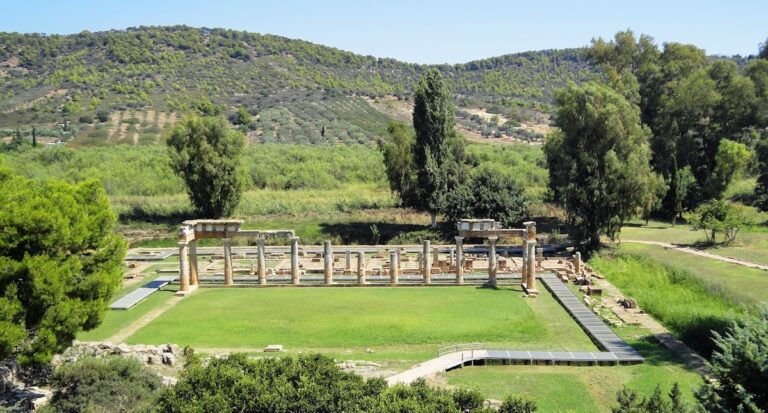
The archaeological site occupies a hill approximately 28 to 30 metres high near the sea, between two bays. The ancient town stood on a rocky peninsula surrounded by the sea along roughly two-thirds of its circumference and joined to the mainland by a narrow ridge. Its walled area measured approximately 230 by 270 metres. The fortified acropolis occupied the upper part of the hill, while the wider enclosure contained the theatre, gymnasium, sanctuaries, public buildings, and dwellings.
Fortified Town
Walls and Gates
The acropolis controlled two small harbours on opposite sides of the site. Both harbours have become extensively silted since antiquity. The main gate stood on the southern side of the fortress beside the southern wall and the narrow ridge, while smaller gates provided additional access. The southern wall rose approximately 6.1 metres high, and the fortress walls were approximately 2.30 to 2.70 metres thick.
The walls were built from local marble obtained near the modern area of Agia Marina. In later periods the fortress was also called Taurokastron, Obriokastron, Linikon, and Hellenikon. The ancient road between Ramnous and Marathon passed through the settlement and ended at the fortress gate, linking the fortified town with the funerary monuments and cemeteries along its route.
Acropolis and Public Buildings
Within the walls were the acropolis, gymnasium, theatre, sanctuary of Nemesis, and other sanctuaries. The wider religious landscape included sanctuaries of Aphrodite Hegemone, Dionysus, Zeus Soter, Athena Soteira, and the heroes Archegetes and Aristomachus, together with the sanctuary of Amphiaraos, or Amphiareion. Performances, including comedies, were held in honour of Dionysus, and torch-racing competitions formed part of the ceremonies of Nemesis.
Traces of houses survive outside the fortified sacred area, and numerous buildings once stood beyond the fortifications. The surviving arrangement places the religious, civic, residential, and defensive elements within a settlement shaped by the rocky peninsula and its narrow connection to the mainland.
Sanctuary of Nemesis
The sanctuary lies approximately 600 to 630 metres south of the later town beside the road leading toward the fortress. It occupied a large artificial platform supported by a white marble wall. Two closely adjacent temples stood within the precinct, although their alignments were not perfectly parallel. Their remains preserve the development of Nemesis worship from the Archaic period through the Classical and Roman periods.
Small Temple of Nemesis and Themis
The original small temple dates from the late sixth century BC. It was built of poros stone and covered with Laconian roof tiles, and it was probably destroyed during the Persian Wars. A Doric temple measuring approximately 6.15 by 9.9 metres was then built over the earlier remains, with a six-by-twelve column arrangement. The building was dedicated jointly to Nemesis and Themis, the personification of divine law, right order, and justice.
The reconstructed temple used locally quarried dark marble and had a terracotta-tiled roof. Its cella walls and the terrace of the sanctuary platform were built in Lesbian polygonal masonry, a technique using irregular stone blocks fitted closely together. Two fourth-century BC marble seats bearing dedications to the two goddesses stood in or near the porch, while cuttings on the steps allowed stelai to be inserted. The temple probably later served as a treasury for the larger temple and as a repository for cult statues, and it survived until the fourth century AD.
A life-sized Archaic statue fragment lacking its head and shoulders was found among the ruins. Made in the style of the Aeginetan school, it is now in the British Museum. A statue of Themis and other dedications from the cella are preserved in the National Archaeological Museum in Athens.
The statue of Themis was discovered in the cella during Stais’s excavations in 1890. It is made of Pentelic marble and shows the goddess wearing a high-belted chiton, a richly folded himation, and sandals. Its head was inserted separately, as was the marble piece forming the right hand. An inscription on the front of the base names Chairestratos of Ramnous as the sculptor and records its dedication by Megacles to Themis. The statue dates to approximately 300 BC and is now in the National Archaeological Museum in Athens.
Larger Temple of Nemesis
The larger temple was a Doric peripteral building, meaning that it was surrounded by a single colonnade, with a hexastyle front of six columns. It measured approximately 22 metres long and 10 metres wide, had twelve columns along each side, and contained a pronaos, or front porch, a cella, or principal inner room, and a posticum, or rear porch.
The temple stood on a substantial artificial platform. Its euthynteria, the lowest levelling course of the foundation, and the lowest course of the stepped base were made from local dark marble. The remaining elements were made of white marble. The unfinished condition of the building is visible in its unfluted columns and incomplete upper platform blocks, whose corners and upper surfaces retained excess protective marble.
The pediments had no sculpture, and the metopes lacked sculptural decoration, although the roof was ornamented with sculpted acroteria, the ornaments placed at the roof’s corners and apex. The eastern end and upper courses suffered severe damage after the original construction. Replacement blocks and different tooling indicate a later repair, probably during the Roman period. The repaired elements included parts of the frieze, cornice, pediment field, sloping cornice, roof ornaments, raised roof edge, roof tiles, and recessed ceiling panels.
An inscription on the central architrave block at the eastern end records a rededication by the deme to the deified Livia and may be connected with these Roman-period repairs. Unlike several other Attic temples, the building was not stripped of useful architectural elements or dismantled for transport to Athens. It was restored as an important local monument.
Cult Statue and Dedications
The cella housed a colossal cult statue of Nemesis approximately 4 metres high. Literary tradition said that its marble came from Paros, although the fragments recovered at Ramnous are made of Attic marble. The statue’s attribution remains uncertain. It was generally associated with Agoracritus, a fifth-century BC sculptor and pupil of Phidias, while Pausanias attributed it to Phidias. Another tradition claimed that it had originally been a statue of Aphrodite rejected by its principal commissioner and remodelled as Nemesis.
John Peter Gandy found a badly damaged, larger-than-life-size marble head from the cult statue in the ruins of the larger temple during the early nineteenth century. Perforations allowed a gold crown to be attached, and the style has been compared with the sculptures of the Parthenon pediments from 440 to 432 BC. The head is now in the British Museum.
Early Christians destroyed the cult image, scattering hundreds of fragments around the sanctuary. These fragments were recovered and reassembled, and they enabled the identification of eleven smaller Roman copies of the original statue. The reconstructed base is approximately 90 centimetres high and 240 centimetres wide. Reliefs on three sides depict the presentation of Helen to her mother Nemesis by Leda, preserving the commemorative imagery associated with the cult.
Roadside Cemeteries and Funerary Monuments
Large funerary monuments and several cemeteries stood along the road between Ramnous and Marathon. They included the funerary enclosure of Menestides and the enclosure of Hierocles, placing commemorative monuments along the approach to the fortified settlement.
A Pentelic-marble funerary relief from approximately 325 to 300 BC shows a mature bearded man leaning on a staff while a young woman silently clasps his hand. It formed part of a funerary naiskos, a small temple-like monument, from the enclosure of Hierocles. The pedimental crowning element names Hieron, son of Hierocles and a citizen of Ramnous, and Lysippe. The base, which remains at Ramnous, bears an epigram referring to Hieron and the four siblings who died before him. The relief itself is preserved in the National Archaeological Museum in Athens.