Semsey Castle: A Late-Classical Estate Residence in Hungary
Site at a Glance
- Rating
- 4.6
- Popularity
- Low
- Country
- Hungary
- Primary era
- Modern
- Eras represented
- Early Modern, Modern
- Civilizations
- Habsburg, Hungarian
- Site type
- Domestic
- Remains
- Castle
On this page16 sections
History
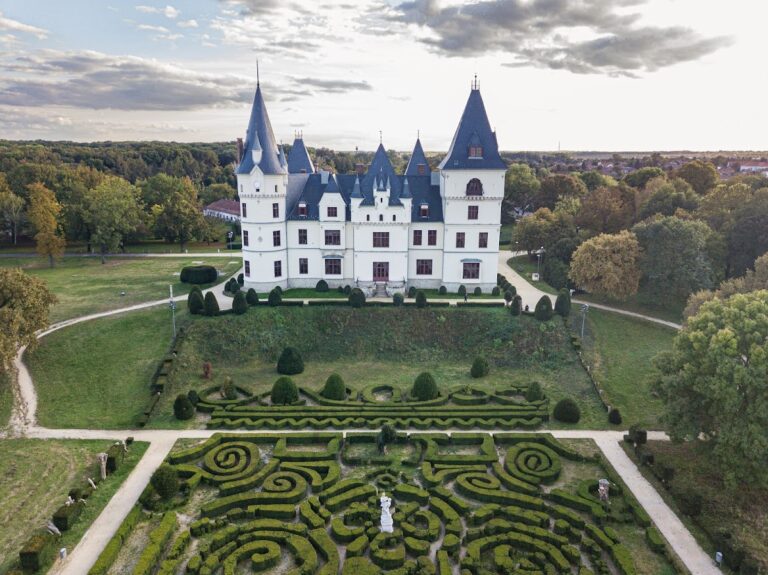
Semsey Castle is a historic estate residence in Balmazújváros, Hungary, built for the Semsey family between 1798 and 1805 on the site of an earlier Andrássy manor house. Its present appearance reflects a late-Classical reconstruction around 1840, and its history follows the changing ownership and administration of the Balmazújváros estate.
The Andrássy estate
In 1753, Maria Theresa granted Balmazújváros to Zsigmond Andrássy. His sons, the younger Zsigmond Andrássy and István Andrássy, later held the estate. István and his wife lived in the manor house that stood on the site of the present castle, while the younger Zsigmond occupied a smaller manor elsewhere. That separate building was demolished in 2003, and another manor associated with him at Karácsonyfok has also been destroyed.
The two brothers died without heirs, causing the estate to revert to the Crown. In 1798, Francis I granted the territory to András Semsey. Construction of the present castle began that year, using building materials accumulated by the Andrássy family, and was completed by 1805. The finished estate included the castle and a garden extending over several hectares.
Settlement and nineteenth-century use
The estate’s population changed over several generations. In 1766, the Andrássy family settled German inhabitants in Újváros. After the transfer to the Semseys in 1798, partly Slovak Catholic settlers from the region around Košice were brought in to work as estate servants. During the second half of the nineteenth century, capitalist economic development contributed to increasing social differences within the population.
The castle served as the Semsey family’s residence during the nineteenth century. After his father’s death in 1856, Andor Semsey received one of three legally restricted hereditary divisions of the family estate and began managing the Balmazújváros portion. He leased the estates and moved to Budapest in 1866. Later known as a major patron of science and culture, he supported projects including the Budapest zoological garden’s birdhouse in the 1860s and the National Geological Institute in the 1890s.
By the end of the nineteenth century, the castle was used less often and mainly for hunting. Its furnishings were reduced, and usually only the estate director lived there. András Andor Semsey, the last Semsey owner, lived in Argentina from 1941.
War, nationalization, and renewal
In 1944, the castle was used as a deportation centre. During ten days in January 1945, GPU officers, members of the Soviet state security and political-police organization, arrested nearly 1,000 people in Balmazújváros. They confined the detainees in the town hall and the castle, targeting mainly people of German origin. From the castle, 547 people were deported to Ukraine.
After 1945, the castle was nationalized and used mainly as a factory warehouse. During the 1950s it briefly housed a cultural centre offering clubs, public entertainment, educational lectures, and cultural events. Later uses included a cultural centre, library, bookshop, bank branch, and furniture shop.
The building was declared a protected historic monument in 1959 and was included among Hungary’s nationally prominent monuments in 1971. Reconstruction began in July 2012 and ended in 2013. The Semsey Andor Museum moved into the castle at the end of that year and regained regional-museum status in 2014. The building also became a venue for exhibitions, lectures, and cultural events.
Remains
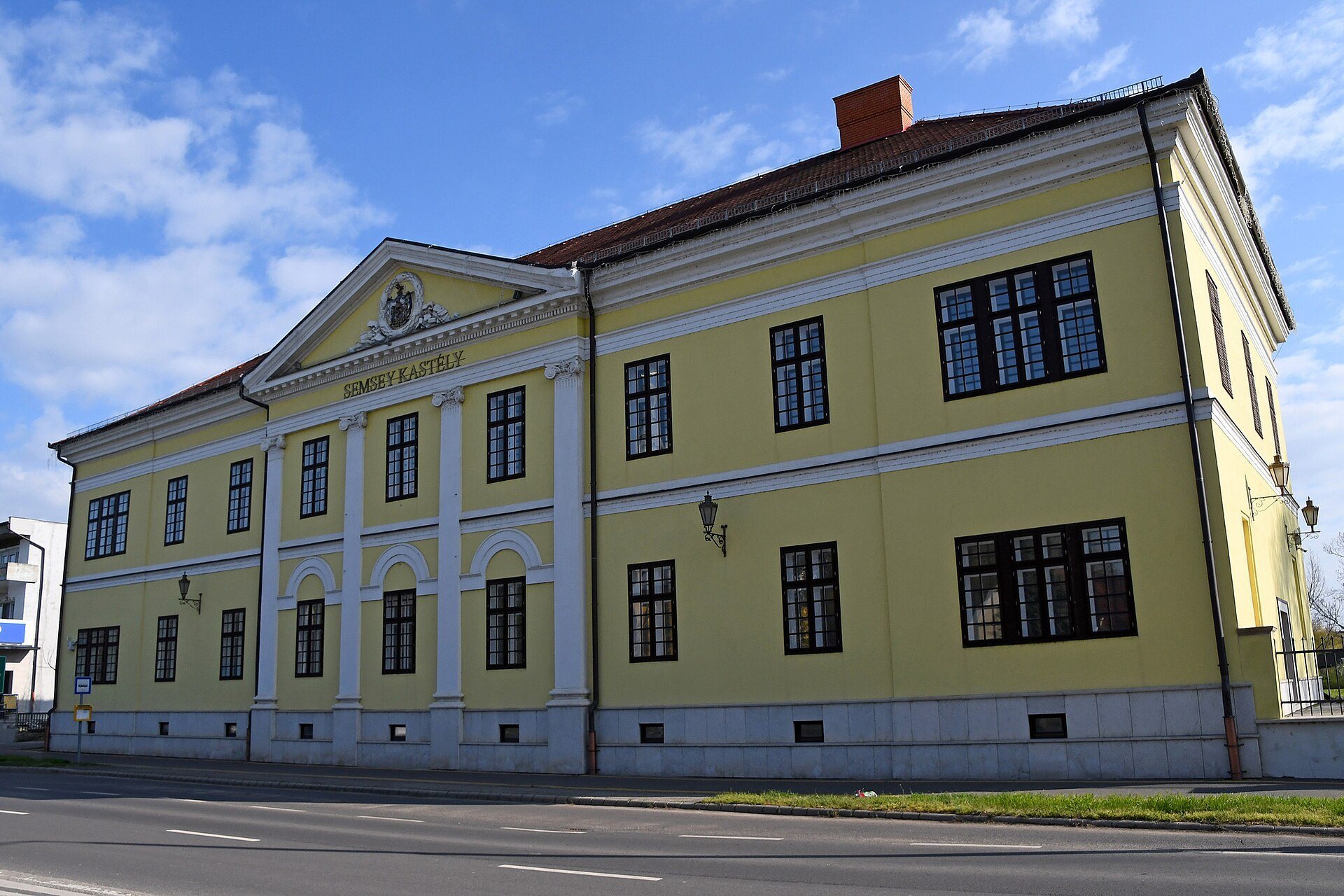
Semsey Castle is a two-storey rectangular building in the southwestern part of its former garden, beside the main square. It covers 1,534 square metres and stands above a large system of vaulted cellars. The earliest building probably had late-Baroque characteristics, while the reconstruction around 1840 gave the castle its present late-Classical appearance.
Exterior facades
Southwest facade
The southwest facade is arranged horizontally around a central projecting section and two smaller side projections. Its openings follow a 1+2+3+2+1 pattern. Four pilasters with Ionic capitals divide the central section into three parts, and four Ionic columns support the pediment above it. The pediment formerly displayed the Semsey family’s lesser noble coat of arms, granted by King Sigismund in 1401; it now carries the family’s comital arms.
Northeast facade
On the northeast side, only the centre projects from the main wall, creating three nearly equal wall surfaces with openings arranged in a 4+5+4 pattern. The central section contains a carriage passage supported by four pillars in the Doric tradition. Its formerly flat roof was covered with marble from Süttő. Divided panelled doors occupy the central axis, with the upper storey opening onto a balcony and the ground floor formerly serving as the principal entrance. Four Doric pilasters face the ground-floor pillars, while six pilasters appear above, including an additional pair at the edges of the projection.
Entrance and architectural details
Courtyard entrance
Following the arrangement of older manor houses, the principal entrance was placed on the courtyard side beneath a carriage entrance supported by four stone columns. Its flat ceiling was enclosed by a decorative iron-grille parapet, forming a large terrace reached from the upper floor.
Cornices and upper structure
A main cornice with a row of small tooth-like blocks crowns the central projection. A continuous dividing cornice runs around the building beneath it and rests directly on the pilasters of the upper storey. A similar cornice marks the junction between the two floors.
Garden and associated buildings
Former estate garden
The castle garden was completed by 1805. It formerly contained a granary and a stable. A Penny Market building now occupies the site of those structures.
Carriage house collection
An adjacent carriage house contains restored equipment formerly used by the municipal fire service. The collection includes two fire carts, a cart with shafts, a disinfection cart dating from the First World War, and a ladies’ carriage.
Museum installation
Semsey Andor Museum
The present museum installation occupies the castle and includes a permanent ground-floor exhibition, a picture gallery, an event hall, and a Tourinform office. These uses preserve the building as a public cultural institution while retaining its historic architectural setting.