Poláky Castle: A Baroque Manor Castle in Czechia
Site at a Glance
- Rating
- 4.6
- Popularity
- Low
- Country
- Czechia
- Primary era
- Early Modern
- External website
- Open
- Eras represented
- Early Modern
- Civilizations
- Habsburg, Holy Roman Empire
- Site type
- Domestic
- Remains
- Castle
On this page7 sections
History
Poláky Castle is a Baroque castle in Czechia, developed from a Renaissance fortress built in the first half of the sixteenth century by the Mašťov branch of the Lords of Kolovrat. The first written record dates to 1546, when Jan Žďárský of Žďár purchased the fortress from the Kolovrats. Its later rebuilding reflects the changing ownership and architectural priorities of a Bohemian estate.
The Renaissance fortress and noble estates
In 1552, Jan Žďárský’s son sold the entire estate to Felix Hasištejnský of Lobkovice of Líčkov. After Felix died, the property passed to his sister Barbora. In 1557, the village and fortress passed to Václav Lobkovic of Duchcov, who sold them in 1560 to Bohuslav Felix Hasištejnský of Lobkovice. Bohuslav Felix assigned their use to his second wife, Anna of Fictum and Egerberk, and later named his eldest son, Jan Valdemar Hasištejnský of Lobkovice, as heir to Poláky.
From 1589, Poláky belonged to Jan the Elder of Lobkovice of Točník and later to his brother Ladislav Popel of Lobkovice of Zbiroh. Ladislav and his brother Jiří Popel of Lobkovice lost favour with Emperor Rudolf II and fled abroad in 1593. The Royal Chamber, the Habsburg administration responsible for royal finances and crown property, confiscated Ladislav’s estates. Poláky, Felixburk, and Egerberk were returned to his wife, Magdaléna of Salm, because much of the property had originated from her dowry. She sold Poláky to Linhart Štampach of Štampach in 1596.
The Štampach family temporarily lost the estate because of its participation in the Estates’ Revolt, an uprising of Bohemian estates against Habsburg authority. Poláky was returned to Zdeslav Štampach in 1628 because, although he was Protestant, he had remained loyal to the Habsburgs. He soon sold it to Jindřich Šlik. Jindřich’s daughter, Marie Sidonie, later litigated with her husband over the estate. In 1662, he was required to return Poláky and compensate her for the resulting damages. Later owners included the Strojetický family of Strojetice, Count Gustav Adolf of Warmsbach, and the Counts of Questenberg.
War damage and the Baroque rebuilding
The original fortress was severely damaged during the Thirty Years’ War, the European conflict of 1618 to 1648 that combined religious and dynastic struggles and caused extensive destruction in Bohemia. The village belonged to the Counts of Pergen from 1738 to 1815. Leopold von Pergen acquired it, his widow inherited it, and their son Johann Anton owned it from 1772 to 1811.
Johann Anton von Pergen probably had the damaged fortress demolished and replaced it with the present Baroque castle toward the end of the eighteenth century. The Baroque was an architectural period known for monumental forms, strong projections, and rich decoration. Plans for the rebuilding were prepared by Vavřinec Rodt, a builder from Žatec. A topographical description from 1791 listed Poláky as the allodial estate of Pohlig, meaning hereditary private property, with fourteen houses, an old castle, and a pheasantry belonging to Imperial Count Johann Anton von Pergen.
Later ownership and preservation
The Windischgrätz family became the last aristocratic owners in 1815, followed by the Lobkovic family of Dolní Beřkovice from 1869. After the land reform of 1926, the castle and its farmyard successively belonged to Josef Hrbáček and Adolf Kollmann. A major repair took place in 1928 under the direction of Antonín Rimpl, a builder from Libědice.
During the second half of the twentieth century, the castle housed the administration of a state farm. It has been protected as a cultural monument since 1963. Miloš Dempír, the castellan of Svojanov, has owned the property since 2020 and has sought to save the building and make it accessible to the public. A reconstructed part of the castle has been open during the season since 2024.
Remains
Castle and agricultural courtyard
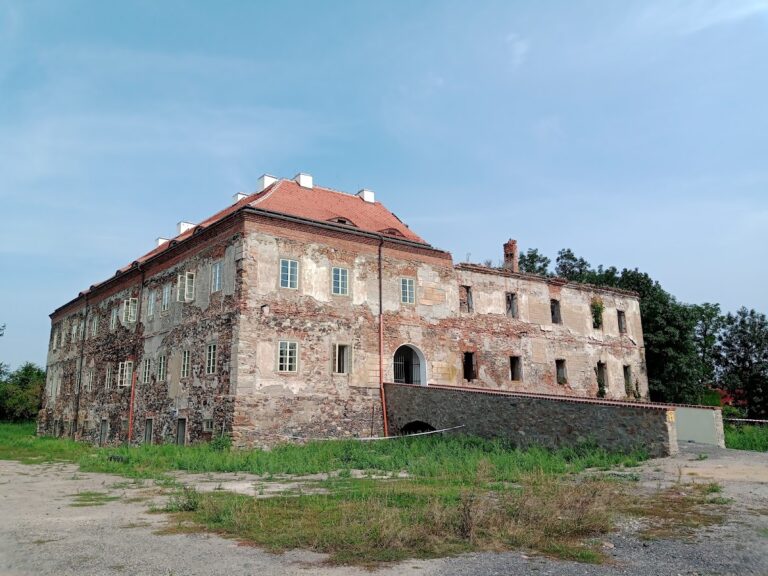
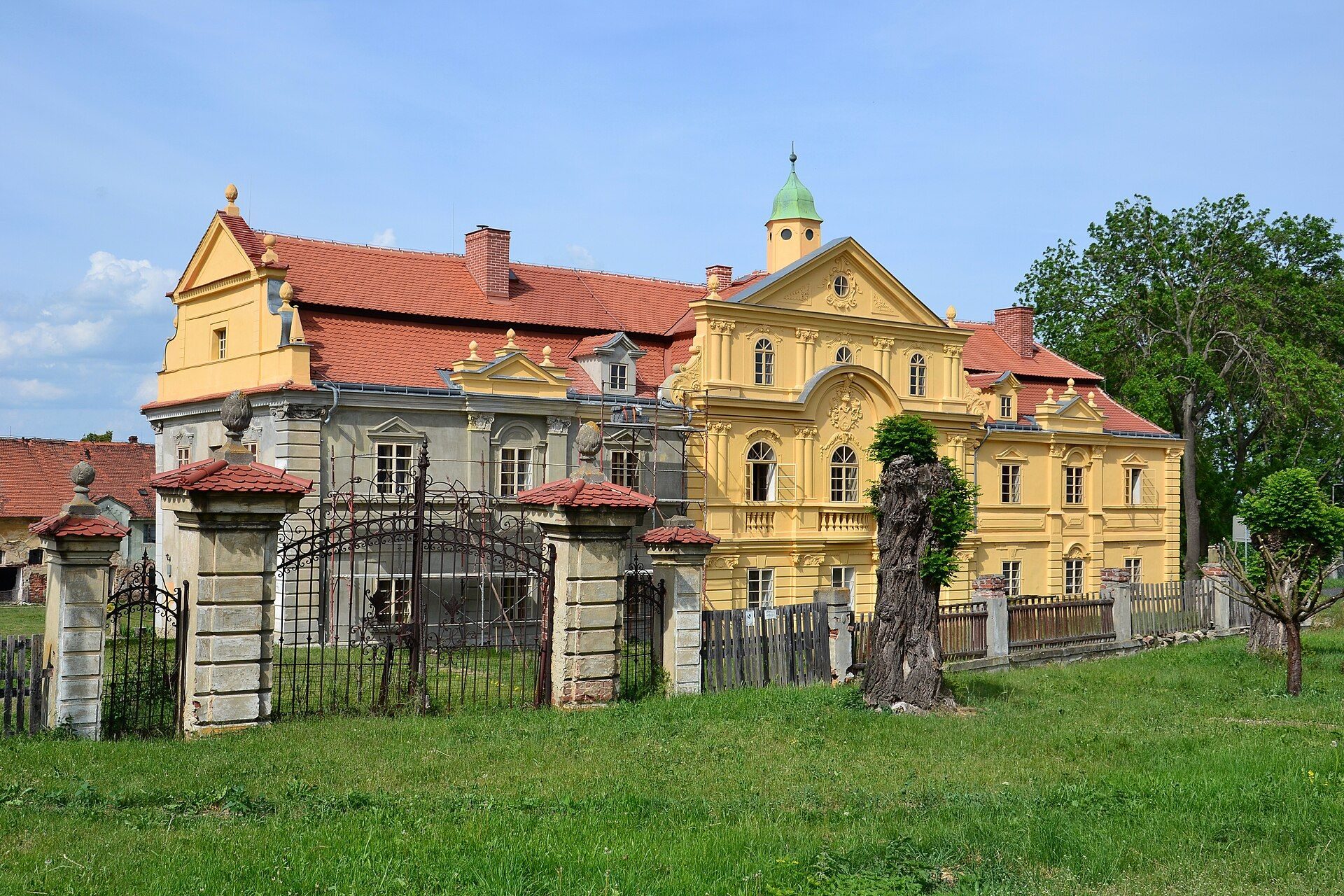
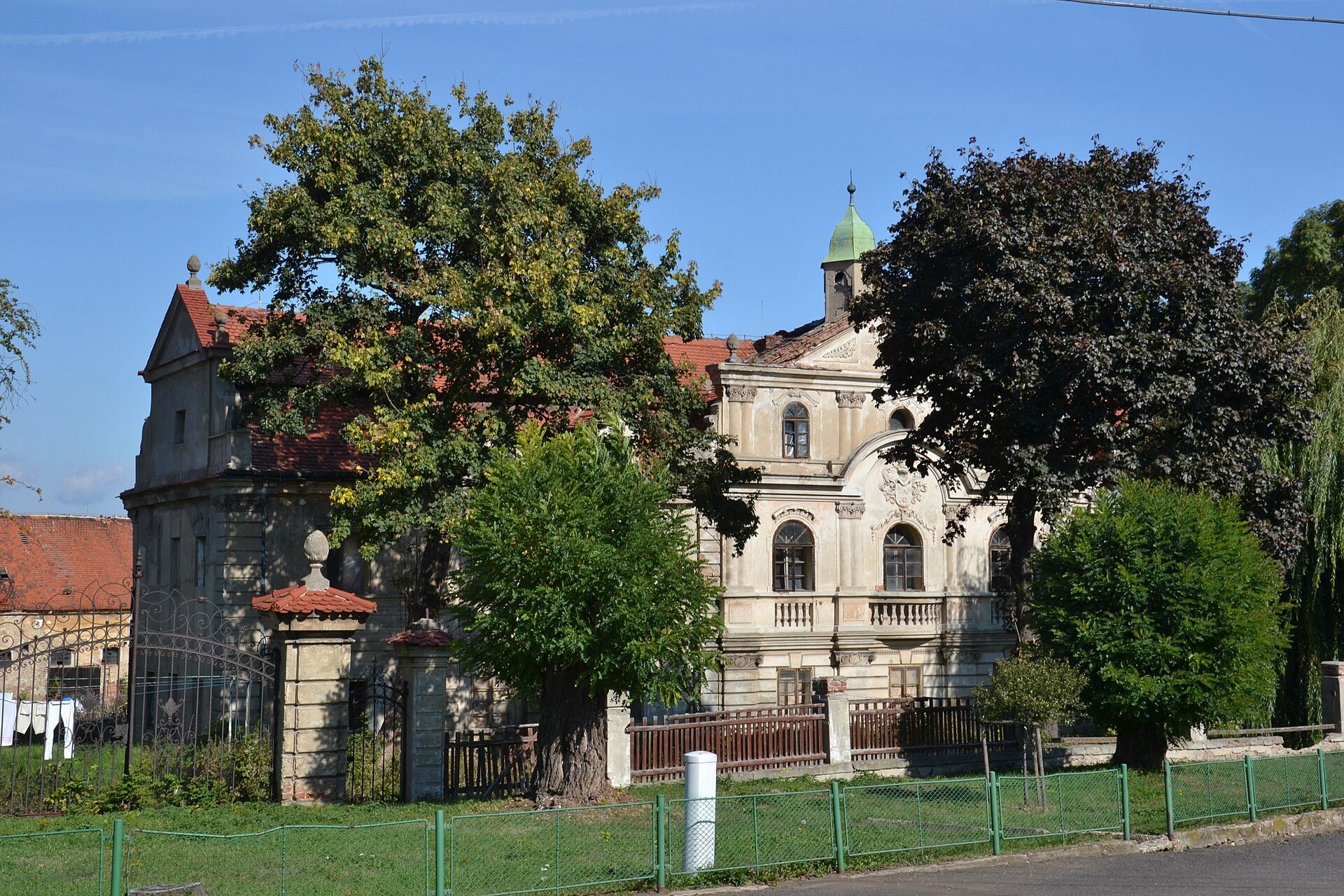
Poláky Castle forms the southeastern corner of a large agricultural courtyard. The two-storey Baroque building consists of two wings arranged at right angles. At the courtyard corner, a cylindrical projecting bay rises beneath a dome. The bay contains a two-flight staircase and gives the courtyard elevation a distinctive rounded form.
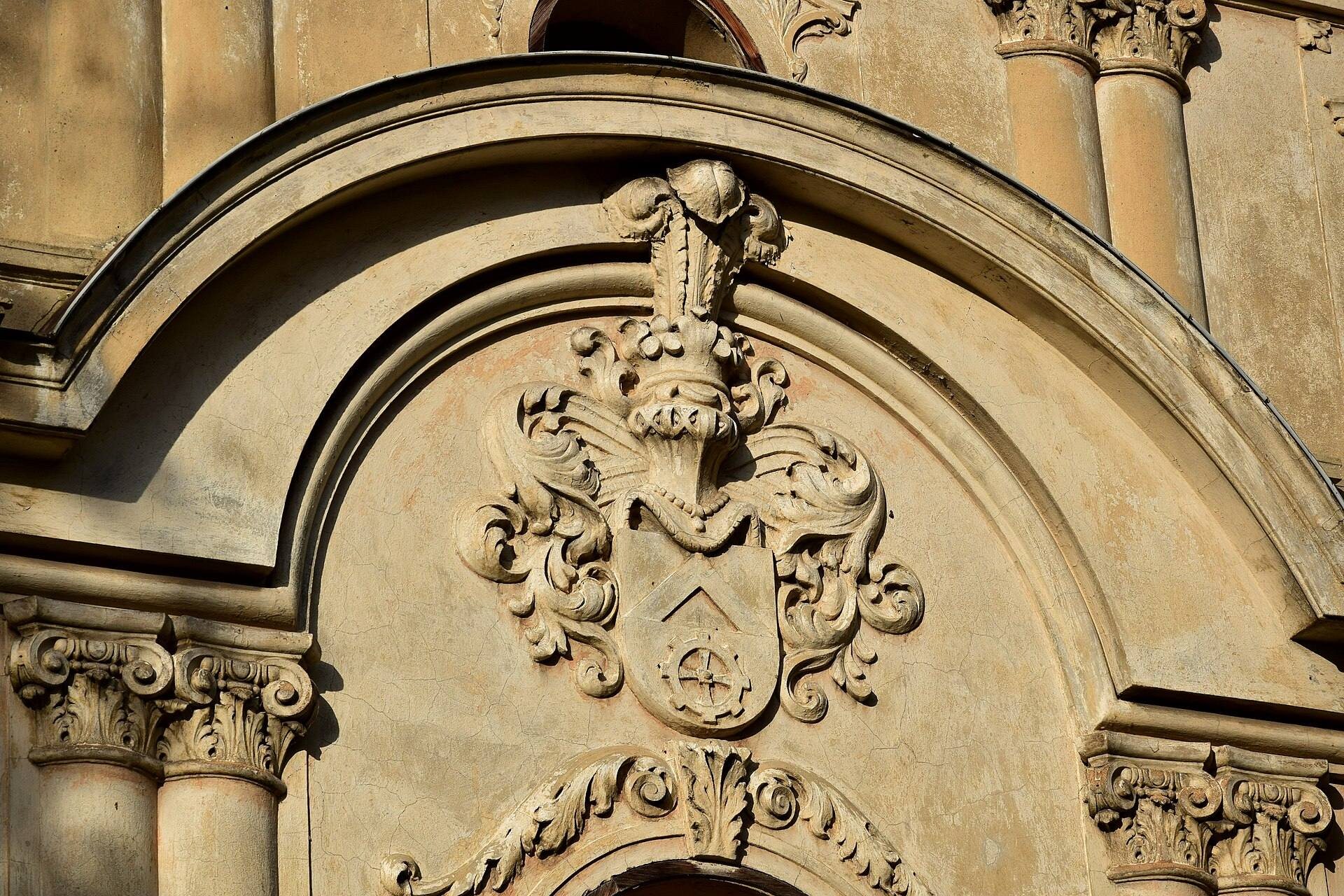
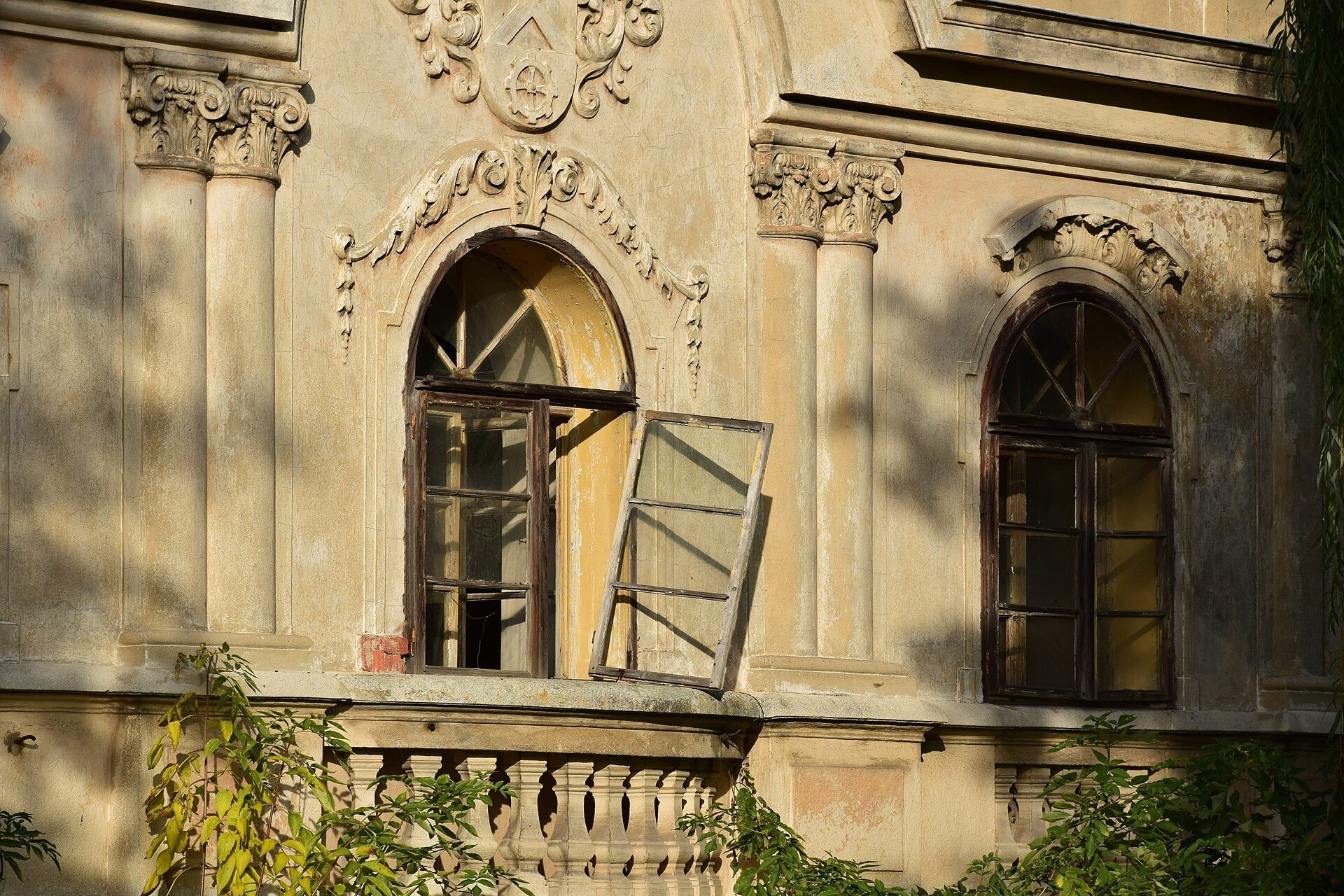
The facade facing the village square is richly decorated. Its projecting section is topped by a triangular pediment and a six-sided turret, creating a prominent architectural focus on the principal exterior. The building’s present form belongs to the late eighteenth-century Baroque rebuilding associated with Johann Anton von Pergen and the plans of Vavřinec Rodt.
Vaulted interiors and earlier remains
The ground-floor rooms contain groin vaults, formed by the intersection of two vaults, and barrel vaults with a continuous curved profile. These interiors belong to the castle’s Baroque construction and survive within the later residential building.
Remains of the earlier Renaissance fortress survive in the castle cellars. They preserve a physical connection with the sixteenth-century building that preceded the present castle and with the structure damaged during the Thirty Years’ War.