Gallipoli Cathedral: A Baroque Co-Cathedral in Italy
Site at a Glance
- Rating
- 4.7
- Popularity
- Medium
- Country
- Italy
- Primary era
- Early Modern
- External website
- Open
- Eras represented
- Early Modern
- Civilizations
- Kingdom of Naples, Spanish
- Site type
- Religious
- Remains
- Cathedral
On this page19 sections
History
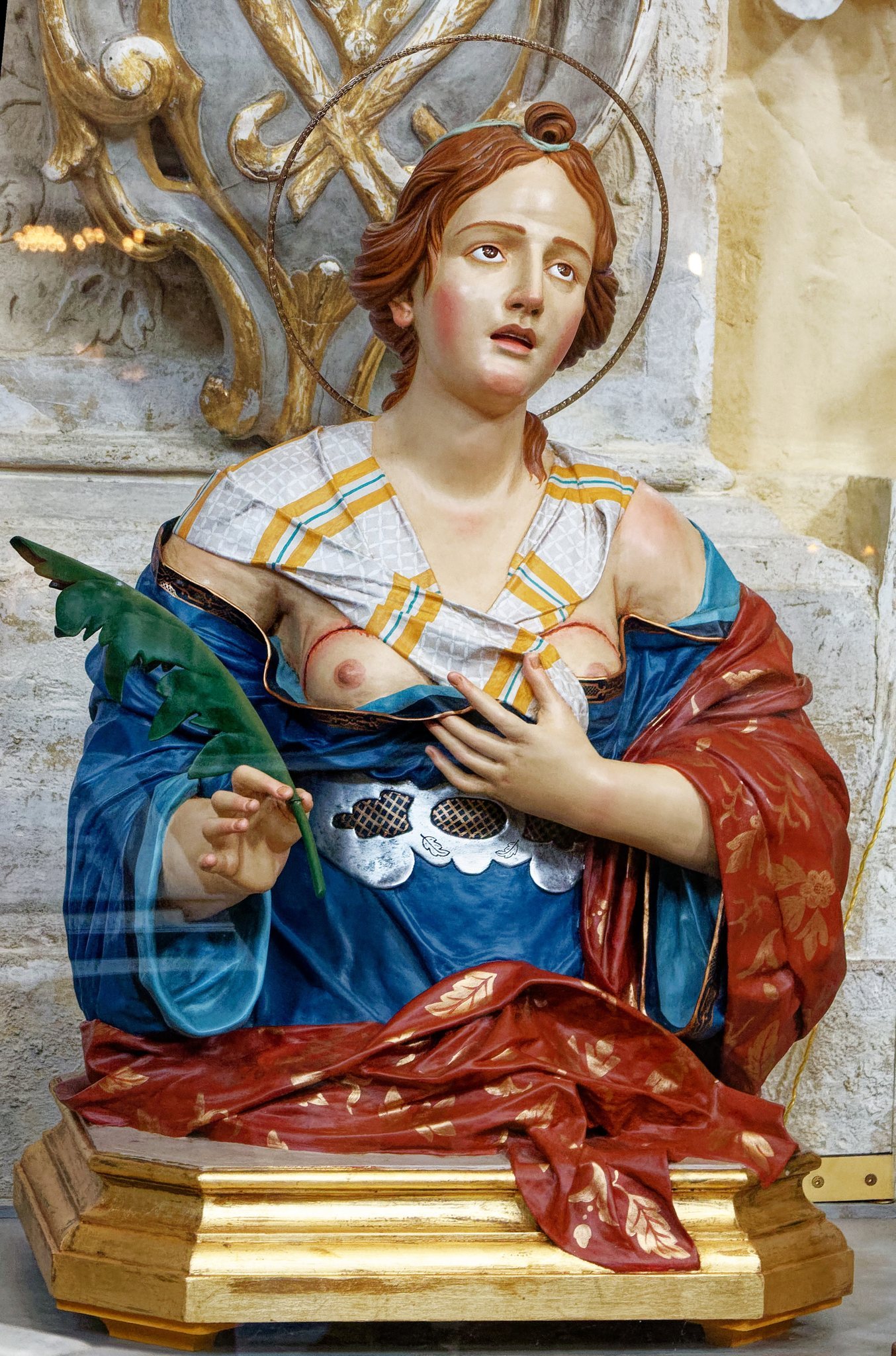
Gallipoli Cathedral is a Roman Catholic co-cathedral in Italy, dedicated to Saint Agatha, the patron saint of Gallipoli and of the Diocese of Nardò-Gallipoli. Built in the Lecce Baroque tradition during the seventeenth and early eighteenth centuries, it replaced an earlier Romanesque church on the island’s highest point. An episcopal see existed at Gallipoli from approximately the end of the sixth century, giving the site a long ecclesiastical history.
Early cathedral and the cult of Saint Agatha
The site was probably used for sacred purposes in antiquity and may have contained an ancient temple. The predecessor church was dedicated to Saint John Chrysostom before being rededicated to Saint Agatha by 1126, following the reported rediscovery of part of her relics. Saint Agatha was a Christian virgin and martyr traditionally associated with Catania, and her cult was connected with protection from fire, volcanic eruptions, and illness.
The history of the earlier cathedral remains uncertain. One tradition says that Charles I of Anjou, the thirteenth-century Angevin king of Naples, destroyed it in 1284 during his occupation of Gallipoli. According to the same tradition, the inhabitants moved to Alezio and used the church of Lizza as their cathedral for nearly a century. Documentary evidence does not conclusively establish that the city and cathedral were completely destroyed, however.
A local tradition states that a relic identified as Saint Agatha’s breast was miraculously found at Gallipoli on 8 August 1126. It remained at the cathedral until 1380, when Raimondello del Balzo Orsini, prince of Taranto, secretly transferred it to the monastery of Saint Catherine of Alexandria at Galatina. The relic remains there, despite repeated later attempts to recover it for Gallipoli.
Construction of the present cathedral
By the late fifteenth century, the old cathedral required extensive repairs. One wing collapsed in 1497, and further work followed, but by the beginning of the seventeenth century the building was considered too fragile. The decision was therefore taken to demolish it and construct a replacement.
The old church was demolished, and the foundation stone of the present cathedral was laid on 31 May 1629. The ceremony took place in the presence of the archpriest Michele di Valandia, who acted for the absent bishop Consalvo de Rueda. Giovan Bernardino Genuino designed the new building, while Francesco Bischettini and Scipione Lachibari carried out its construction. Tomaso Sanasi directed the works from 1667 and designed the new sacristy.
Funding came partly from the estate of Giovan Giacomo Lazari, a physician, philosopher, professor, and writer, as well as from Bishop Consalvo de Rueda and wealthy Gallipoli families. The facade was completed in 1696 under Bishop Antonio Perez della Lastra, and the choir area was finished on 31 January 1707. Interior decoration continued into the early 1730s.
Eighteenth-century decoration and later status
Bishop Oronzo Filomarini substantially completed the church’s Baroque interior in the eighteenth century. He brought the Neapolitan painter Nicola Malinconico to Gallipoli, promoted the installation of the high altar, and sponsored the wooden choir and episcopal throne. The cathedral’s decoration consequently brought together local commissions, artists connected with the Neapolitan milieu, and elaborate marble work.
The cathedral was declared an Italian national monument by King Victor Emmanuel III on 21 November 1940 because of its historical and artistic importance. In 1946, Pope Pius XII raised it to the rank of pontifical minor basilica at the request of Bishop Nicola Margiotta. A minor basilica is a church given a special papal status because of its religious, historical, or artistic importance.
On 30 September 1986, the former Diocese of Gallipoli was united with the Diocese of Nardò under the decree Instantibus votis, creating the Diocese of Nardò-Gallipoli. Gallipoli Cathedral remains the seat of an archpriesthood, a chapter of canons, and its parish. The cathedral chapter probably originated with the diocese. In the nineteenth century it included nineteen canons, eighteen choir priests, five priests appointed by the bishop, and three chaplains, making thirty-seven priests in all. The present chapter consists of four canons headed by a president-primicerius-theologian.
Relics, the Shroud copy, and diocesan collections
A relic associated with Saint Faustus reached the cathedral in 1679 through the treasurer Onofrio Castellana and Bishop Antonio Perez de la Lastra. It was formally presented in the sacristy and carried in procession through the city in 1681. The relic was then placed in a gilded and silvered wooden reliquary secured by three keys, held respectively by the bishop, a canon, and the mayor.
Bishop Sebastiano Quintiero Ortiz donated a copy of the Shroud of Turin, probably made in Turin. The cloth measures approximately 4.10 by 1.40 metres and bears a figure about 1.78 metres long. It was reportedly placed on the original shroud during its display at the church of San Lorenzo in Turin. During Lent, the cathedral also displays a relic containing a piece of wood identified with the Cross and bearing the coat of arms of Bishop Zelodano.
The diocesan museum beside the cathedral was established in 2004 in the former diocesan seminary. The Baroque seminary was begun in 1752 under Bishop De Rueda, completed in 1756, and inaugurated in 1760. Its collections include paintings, ecclesiastical treasures, vestments, bells, silver-gilt statues, and other furnishings from the seventeenth and eighteenth centuries.
Remains
Facade, roofline, and church plan
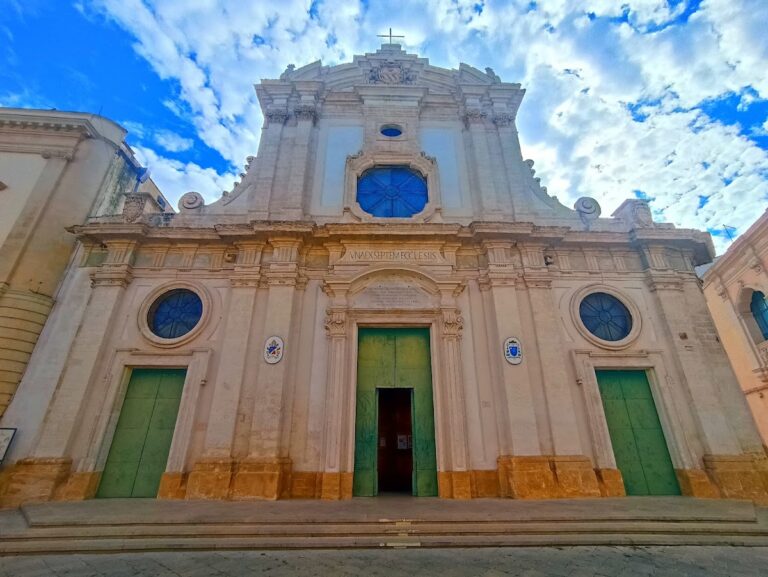
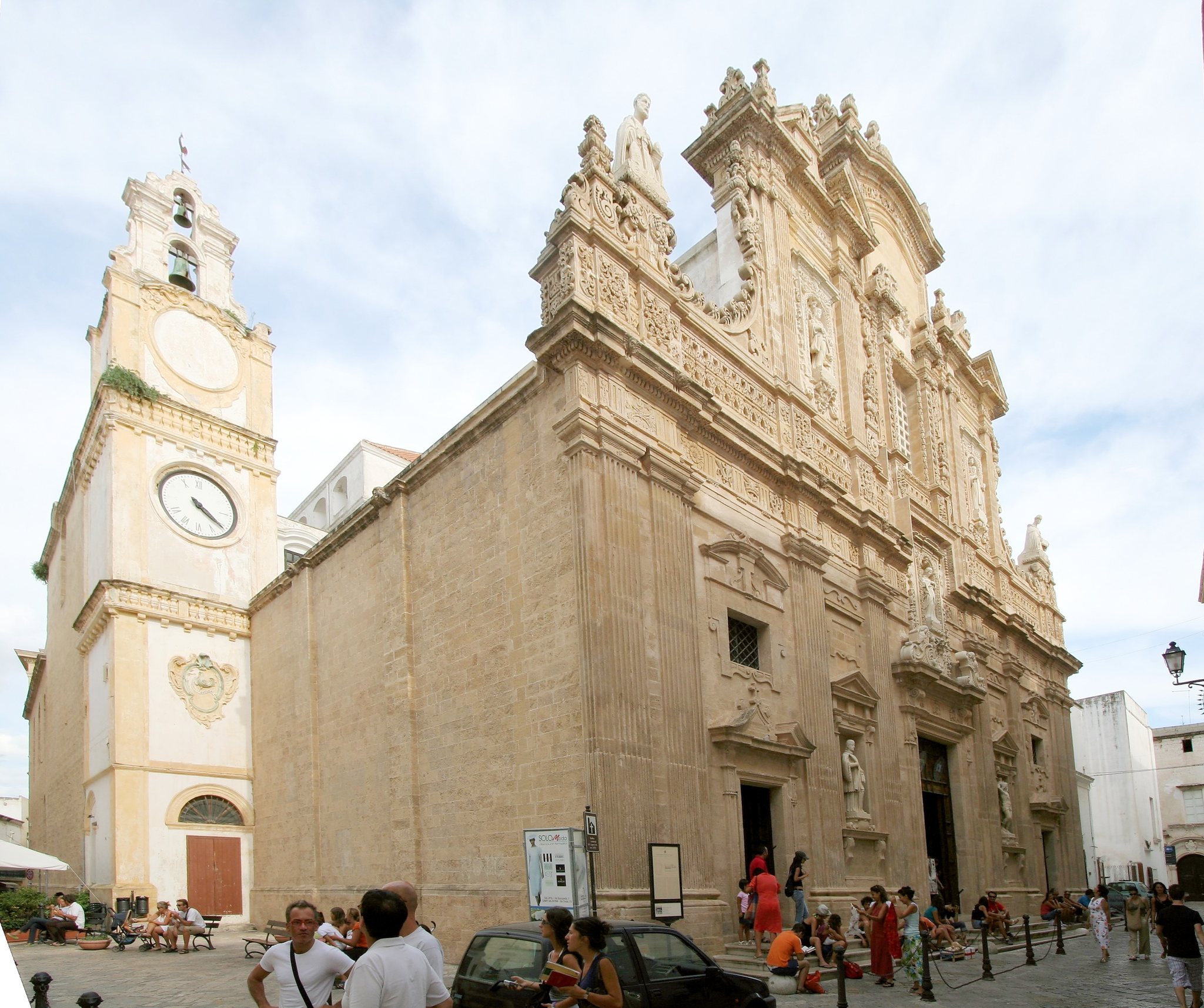
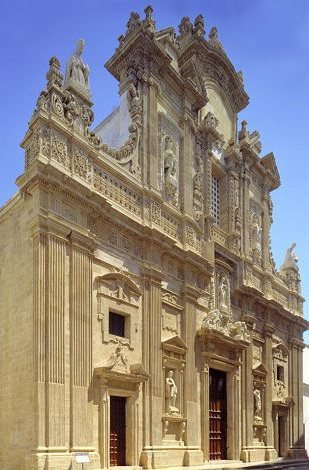
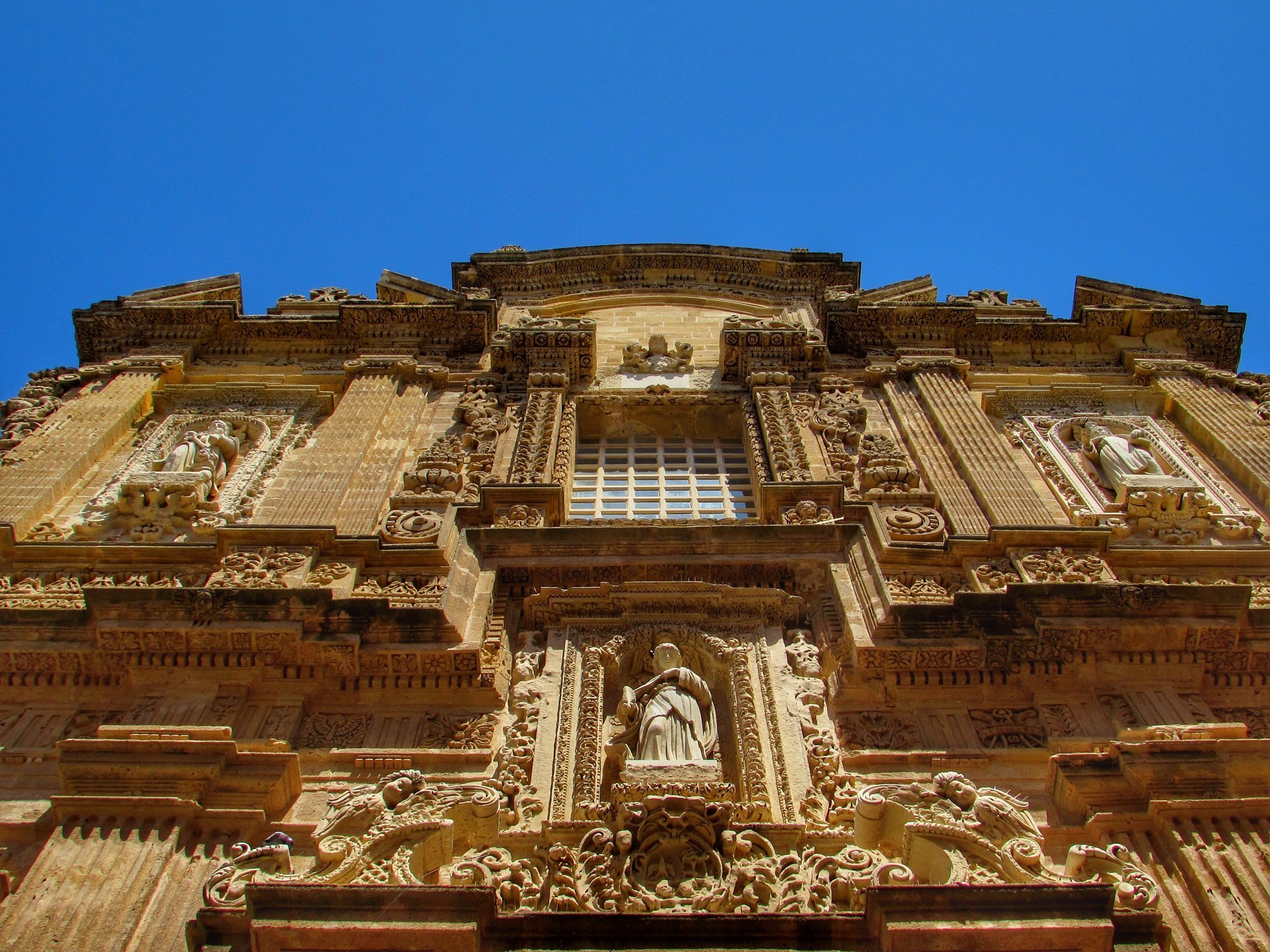
Gallipoli Cathedral stands at the centre and highest point of Gallipoli’s island. Its facade is built from golden-yellow carparo, a local calcarenite widely used in southern Apulia and in the Lecce Baroque tradition. Divided into two orders, it has a lower level with fluted Doric pilasters and three portals. Niches contain statues of Saint Agatha, Saint Faustus, and Saint Sebastian, with the Latin inscription “Isteque morbo liberat urbem” beneath Saint Sebastian.
The upper order uses Ionic pilasters and more elaborate ornament. It contains statues of Saint Marina and Saint Teresa of Avila, a large central window with a honeycomb-like form, and busts of Saint Thomas Aquinas and Saint John Chrysostom on the connecting volutes. A pediment bearing the date 1696 crowns the facade, whose upper design was influenced by Giuseppe Zimbalo, a leading architect and sculptor of the Lecce Baroque.
The cathedral has no conventional bell tower. Its bells hang in openings along the roofline, forming a bell gable, a wall pierced by openings for bells rather than a separate tower. The adjacent tower is the civic tower, whose bells were used for civil timekeeping. The church formerly had two asymmetrical bell towers: one had three levels and openings divided into two parts, while the larger had five levels, a domed top, and a cross.
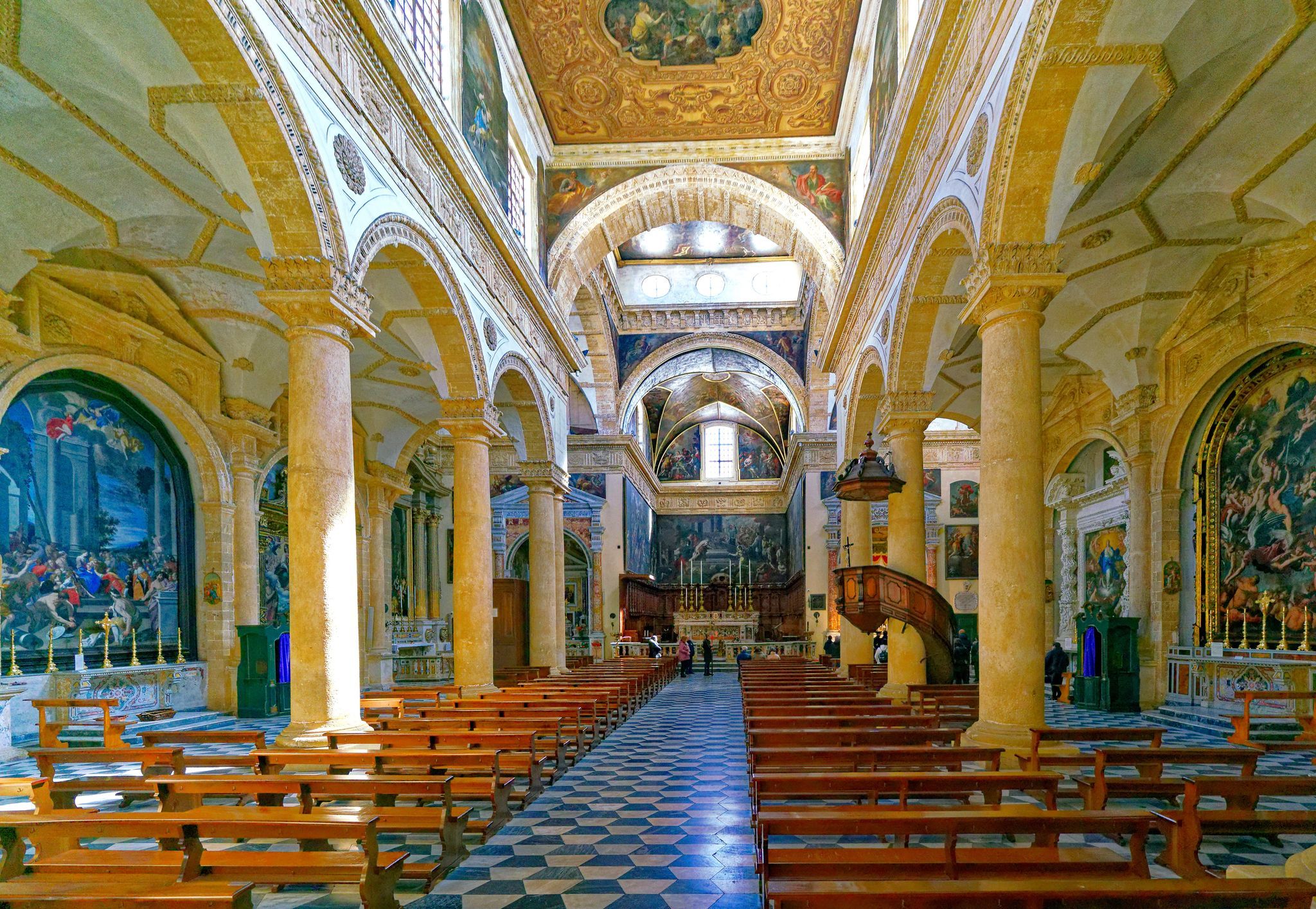
The interior follows a Latin-cross plan, with a long central axis crossed by a shorter transept. Three naves lead to the transverse arm and rectangular choir. The building measures approximately 45 metres in length, 31 metres in width, and 30 metres in height. Twelve columns or supports divide the naves, while round arches rest on Tuscan columns made of carparo.
Nave altars and paintings
Baroque altars
An architrave, the horizontal band above the arcades, runs around the nave. Its triglyphs and metopes, grooved blocks and intervening panels in a classical frieze, carry bas-reliefs with historical, heraldic, religious, and symbolic subjects. Alongside it, a series of Baroque altars is dedicated to Saint Isidore the Farmer, Saint Francis of Paola, the Epiphany, the Madonna of Graces with Saints Andrew and John the Baptist, Saint Agatha, Saint Sebastian, the Immaculate Conception, the Souls in Purgatory, the Assumption of Mary, and the Coronation of Mary with Saints Oronzo and Nicholas.
Paintings of the nave
The left-side altars include a painting of Saint Isidore attributed to Luca Giordano, Saint Francis of Paola and the Miracle and the Epiphany by Giovanni Andrea Coppola, and a Madonna of Graces by Giovanni Domenico Catalano with smaller surrounding scenes by Coppola. On the right, Coppola painted the Souls in Purgatory, the Assumption of Mary, and the Coronation of Mary. The Immaculate Conception is by an unidentified artist and has been attributed either to a Capuchin friar named Facis or to a member of the Genuino family.
Transept chapels and high altar
Transept altars
The transept contains major altars dedicated to Saint Agatha and Saint Sebastian. Coppola painted the Martyrdom of Saint Agatha. The Martyrdom of Saint Sebastian has been attributed variously to Nicola Malinconico, his son Carlo, or both.
Chapel of the Madonna del Soccorso
The left transept contains the chapel of the Madonna del Soccorso, a devotional title meaning “Madonna of Help.” Decorated with polychrome marble, it holds an anonymous image of the Madonna, the Ravenna family tomb, and two large paintings by Nicola Malinconico depicting the Marriage of Mary and Joseph and the Flight into Egypt.
Sacrament Chapel
The Sacrament Chapel on the opposite side is also decorated with polychrome marble. Its altar painting, the Triumph of the Eucharist with Saints Thomas Aquinas and John Nepomuk, is signed “Francesco Giordano.”
High altar
The high altar is made of polychrome marble by Cosimo Fanzago. It was originally created for the Filomarini Chapel in the Church of Santi Apostoli in Naples and was brought to Gallipoli at the beginning of the eighteenth century through Bishop Oronzo Filomarini’s initiative. The wooden crucifix on the tabernacle is attributed to Giovan Bernardino Genuino.
Choir, ceiling, and furnishings
Choir and episcopal throne
The rectangular choir is slightly raised and contains three large paintings by Malinconico. Behind the altar is the Burial of Saint Agatha, while the side walls carry the Healing of the Paralytic and the Entry of Jesus into Jerusalem. Biblical scenes and episodes from the martyrdom of Saint Agatha fill the vault and lunettes, the curved areas of wall or vault framed by arches.
The wooden choir was made from walnut by the German artist Giorgio Aver at Bishop Filomarini’s initiative. Begun in 1706 and completed in 1707, it has three rows of seats and fifty-one stalls, with carved foliage, ornament, putti, and Filomarini’s episcopal arms. The more elaborate episcopal throne occupies the centre beneath a shaped canopy.
Malinconico’s decorative cycle
Malinconico painted Christ Driving the Merchants from the Temple on the entrance wall, scenes from the Old and New Testaments in the choir, and the Martyrdom of Saint Sebastian in the right transept. He also created cycles depicting the Life of Saint Agatha and the discovery of her relic. Ceiling paintings include the Glory of Saint Agatha, Saint Peter Visiting Saint Agatha in Prison, and the eruption of Mount Etna halted by Saint Agatha’s veil. The ceiling bears the coats of arms of Bishops Oronzo Filomarini and Gaetano Muller, the latter associated with its restoration in 1905.
Fonts, statues, and preserved relics
A coloured-marble baptismal font near the entrance dates from the beginning of the eighteenth century. It replaced a 1588 font by Vespasiano Genuino, which was given to the church of Santa Maria della Lizza at Alezio. The cathedral also contains statues of Saint Agatha and Saint Sebastian, the city’s patron saints, together with the Madonna dei Fiori and the Sorrowful Virgin.
The copy of the Shroud of Turin is preserved in the cathedral, while the Saint Faustus relic remains in its dedicated wooden reliquary. The altar is reported to incorporate a reused ancient Roman marble stele, an upright stone slab, bearing an Ancient Greek inscription. In translation, the text describes the stele as a precious gift placed on an altar and refers to Marsilios, a patron and priest, and Bishop Pantoleon.