Salamanca New Cathedral: A Late Gothic Cathedral in Spain
Site at a Glance
- Rating
- 4.7
- Popularity
- High
- Country
- Spain
- Primary era
- Early Modern
- External website
- Open
- Eras represented
- Early Modern
- Civilizations
- Crown of Castile, Spanish
- Site type
- Religious
- Remains
- Cathedral
On this page38 sections
History
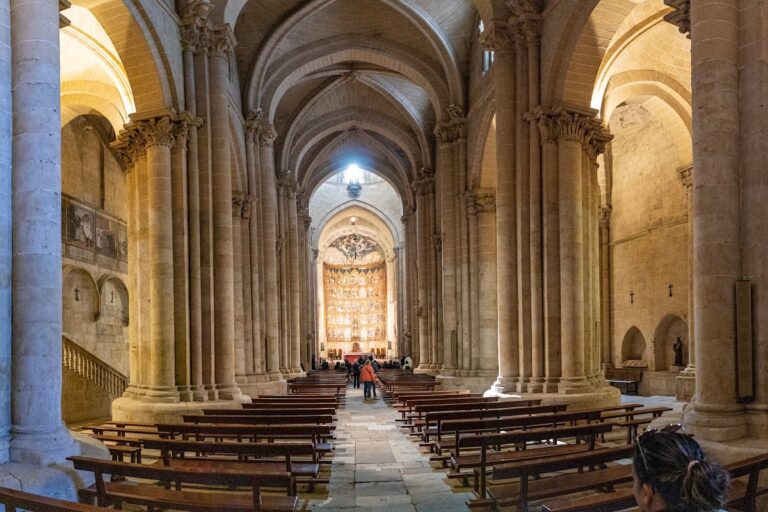
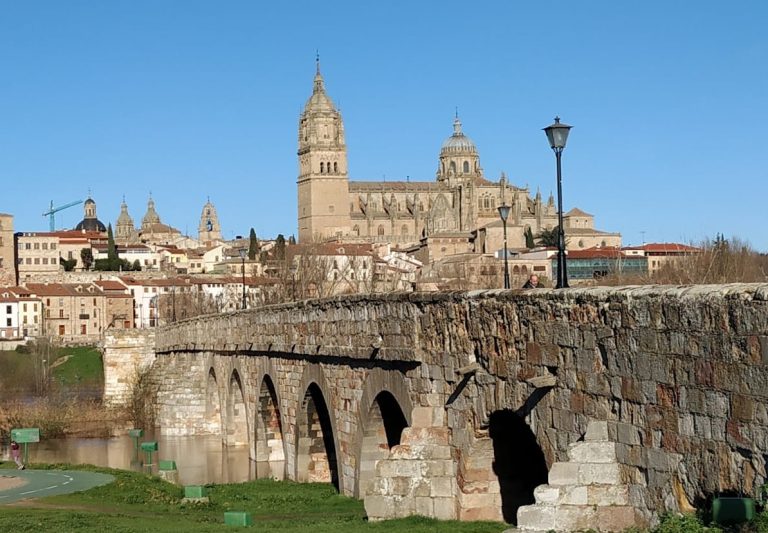
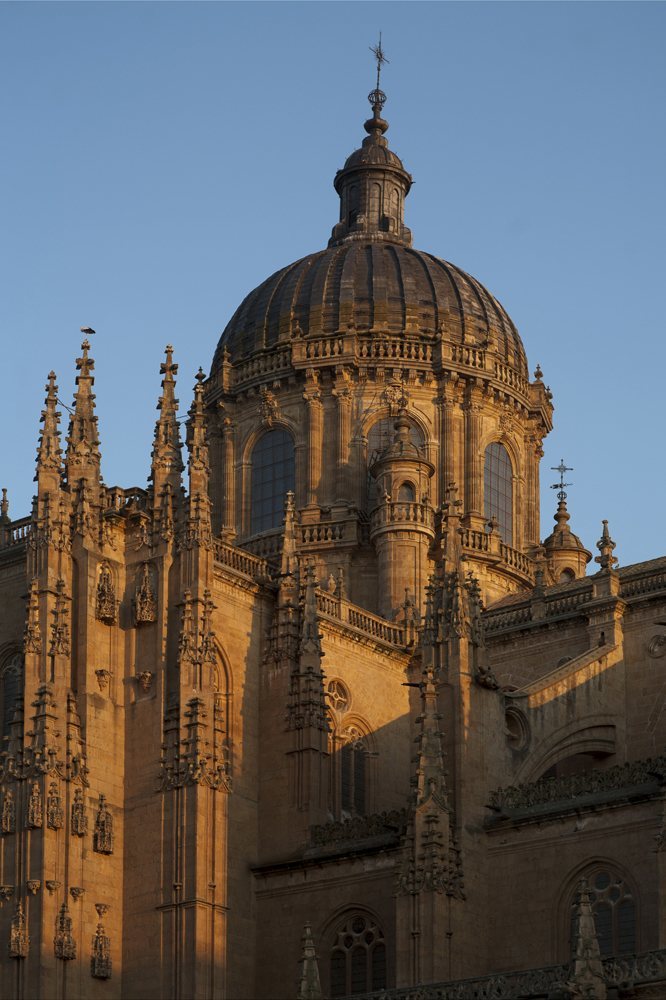
Salamanca New Cathedral is a Catholic cathedral in Salamanca, Spain, built for the Diocese of Salamanca and dedicated to the Assumption of the Virgin Mary. Conceived in the fifteenth century and constructed between 1513 and 1733, it is one of Spain’s last Gothic cathedrals, with Renaissance, Plateresque, Baroque, and later Neoclassical additions. It was built beside the Old Cathedral so that worship could continue there during the long construction campaign, and the older building was ultimately preserved.
Origins and construction
The proposal for a new cathedral developed as Salamanca’s population grew, particularly through the attraction of its university. The Old Cathedral was regarded as too small, dark, and low for the city’s needs. Ferdinand the Catholic, Ferdinand II of Aragon, supported the project and in 1509 ordered Antón Egas and Alonso Rodríguez, architects associated with the cathedrals of Toledo and Seville, to prepare designs in Salamanca. After extended discussion, leading architects approved the location and general arrangement in 1512.
Francisco de Bobadilla, bishop of Salamanca, laid the first stone in 1512, and construction began in 1513. Juan Gil de Hontañón served as the initial master builder, while Juan de Álava worked on the lateral chapels. After Juan Gil’s death, his son, Juan Gil de Hontañón the Younger, continued the work until 1531. Juan de Álava became works inspector in that year and master builder in 1534, followed by Rodrigo Gil de Hontañón in 1538.
The builders retained a Gothic conception while adapting it over time. Rodrigo Gil de Hontañón continued the Gothic design but introduced Classical elements. In 1584, Juan Ribero de Rada changed the planned eastern end of the church. The intended polygonal chevet, the eastern end of a church, together with its ambulatory and radiating chapels, was replaced by a flat rectangular chevet influenced by the design associated with Juan de Herrera at Valladolid Cathedral. Juan de Nates was called to continue the work in 1588.
Seventeenth- and eighteenth-century completion
Work stopped for most of the seventeenth century, largely because funds were insufficient. Major construction resumed in the eighteenth century under Joaquín de Churriguera, who began the crossing tower and dome in 1714. The crossing is the point where the nave and transept meet, and the tower or dome rises above it. Joaquín’s brother Alberto de Churriguera completed these works in 1725 and remained associated with the cathedral until 1738. The cathedral was consecrated on 10 August 1733.
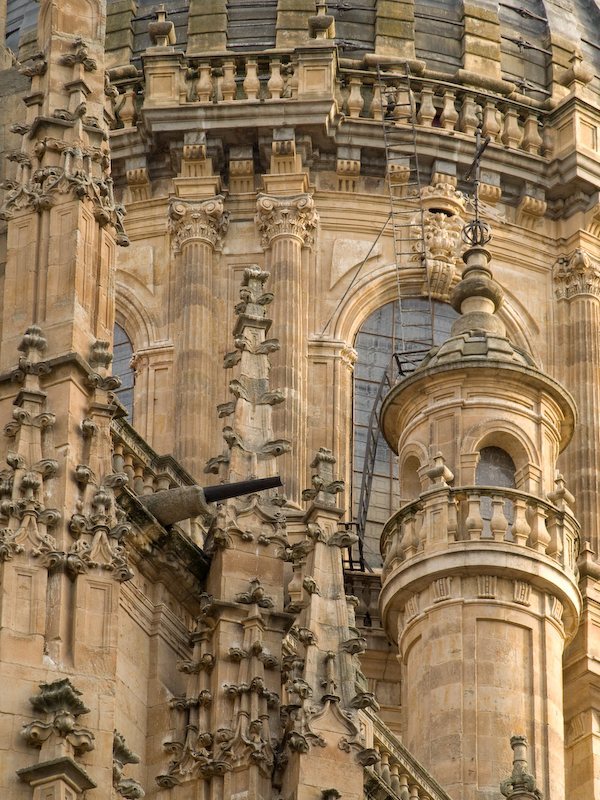
The original dome was a Baroque structure with ribs and elaborate decoration. After the Lisbon earthquake of 1 November 1755, it was badly cracked and had to be rebuilt. Juan de Sagarvinaga replaced it with the present Neoclassical dome, while the crossing tower was rebuilt in 1765.
The 1755 earthquake and later changes
The earthquake also broke stained-glass windows and damaged the bell tower, which tilted and threatened to collapse. Several architects recommended demolition, but Baltasar Dreveton proposed stabilizing the tower with eight tensioned chains and covering it in sloping stonework up to the bell stage. Jerónimo García de Quiñones directed the work with Manuel de los Ríos between 1768 and 1771. The tower consequently retains both its visible stone casing and its inclination.
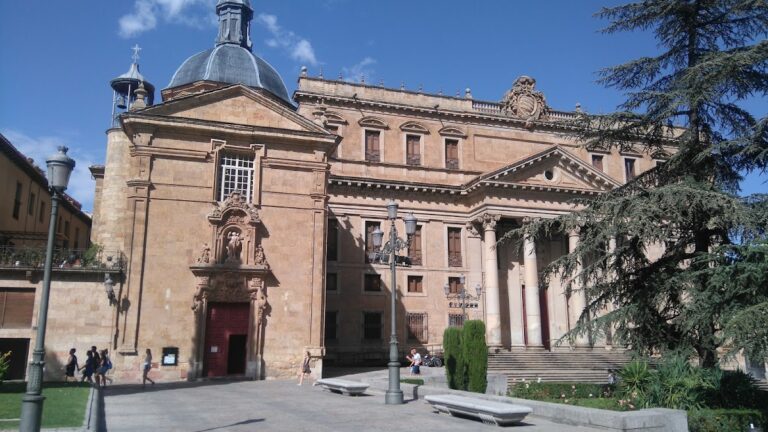
The earthquake is remembered in Salamanca through the Mariquelo tradition, observed on 31 October. Around 1812, the French army of occupation demolished the block of houses north of the cathedral, creating the present Plaza de Anaya. This exposed the north facade, although that side had not been designed as the principal public view. The principal facade remained in a narrow street.
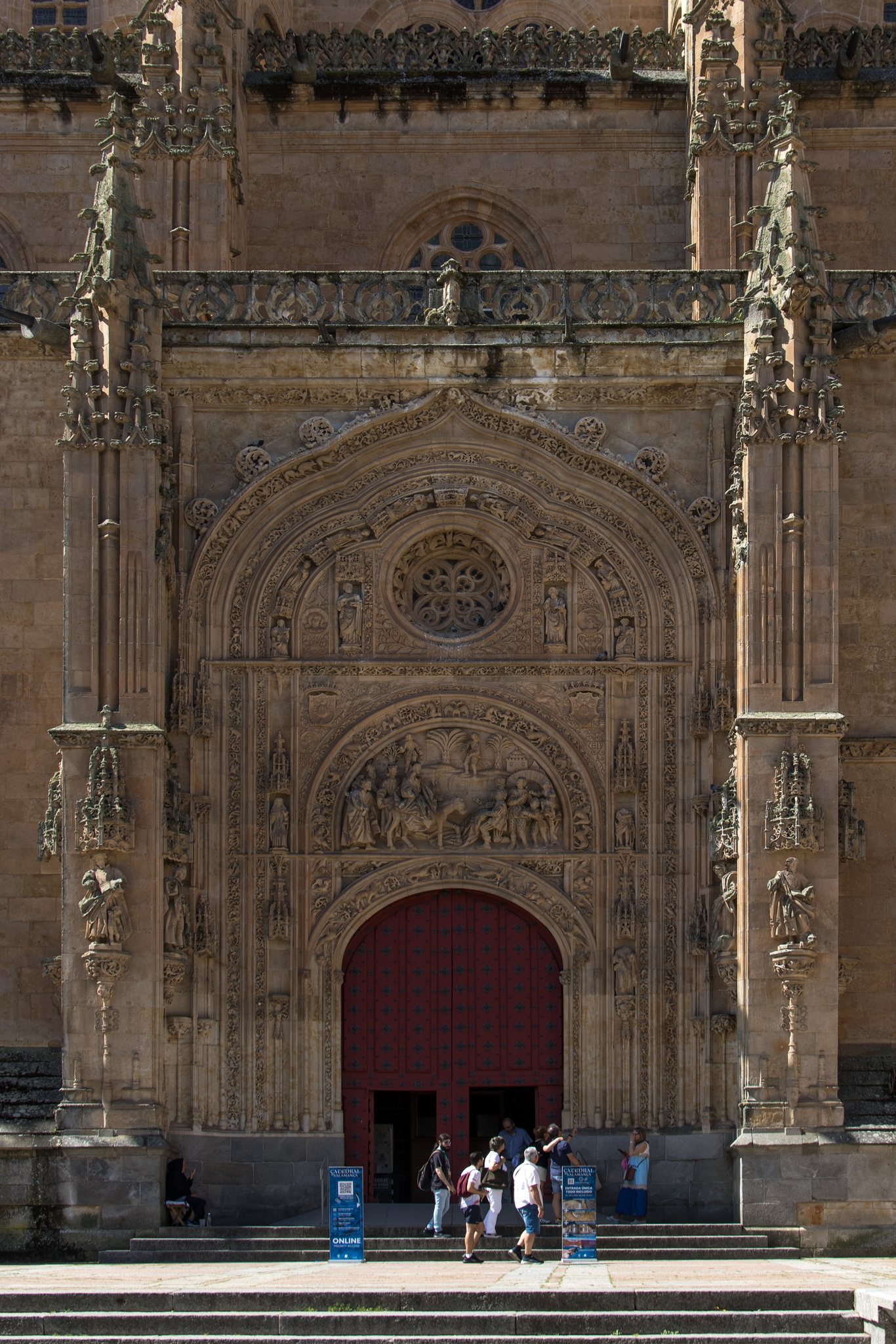
The cathedral was declared a National Monument by royal decree in 1887 and received protected-surroundings status in 1999. It also forms part of the UNESCO World Heritage inscription for the Old City of Salamanca, made in 1988. In 1992, the Puerta de Ramos was restored before Salamanca hosted the exhibition Las Edades del Hombre. The restoration included a contemporary stone astronaut carved by Miguel Romero, following the practice of adding a modern element to each restoration. The astronaut’s right arm was broken in an act of vandalism in 2010.
Worship and musical heritage
The cathedral remains connected with Catholic worship and Salamanca’s Holy Week processions. Among the associated devotional works are the Christ of the Redeeming Agony, the processional group known as La Borriquilla, Our Lady of Solitude, the Pieta, and the Recumbent Christ of Mercy.
The cathedral’s Gospel Organ was altered in the nineteenth century. It was restored in 1992 with assistance from the Japanese monarchy and on the recommendation of the Japanese master Tsuji. The restoration recovered its earlier character and added an electric air-pump system. A Belgian specialist found the instrument in excellent condition despite its long period without tuning, partly because of Salamanca’s dry climate.
Remains
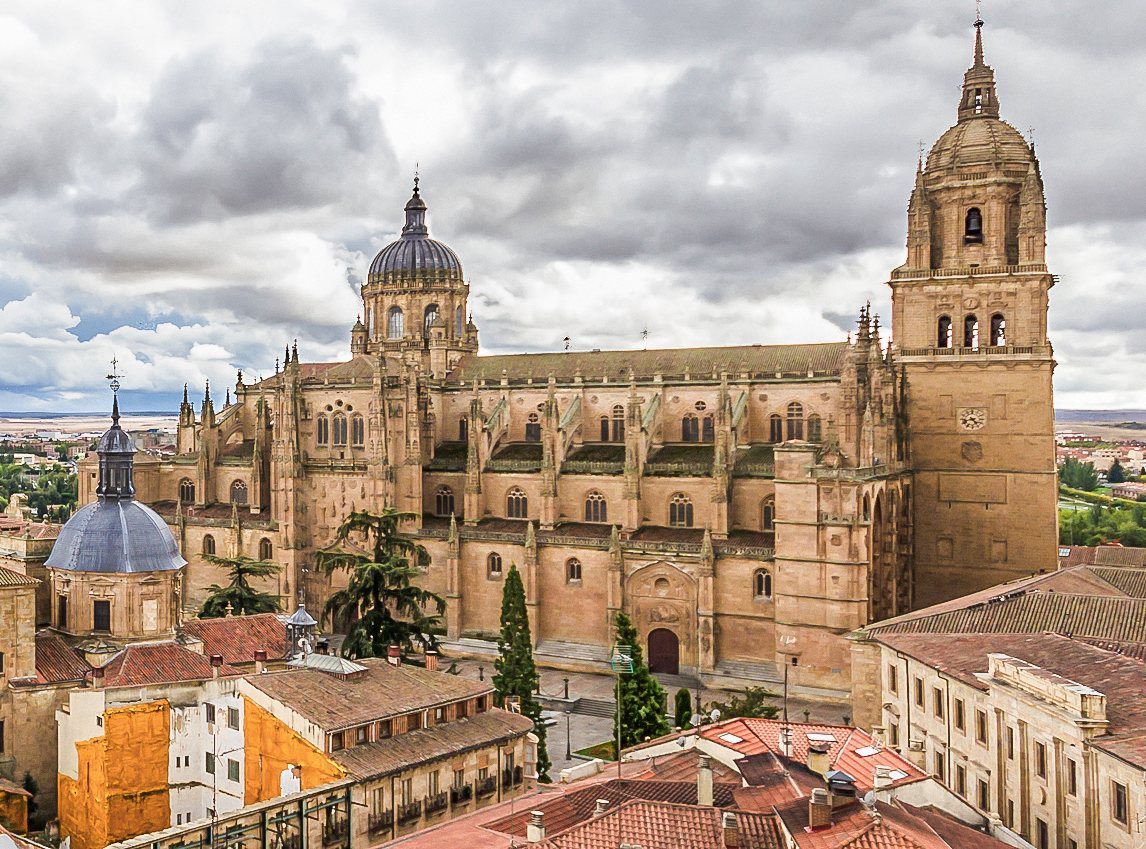
The cathedral stands parallel to the Old Cathedral and is built in Villamayor freestone. Its rectangular plan contains three naves and two additional groups of niche chapels. The intended ambulatory and polygonal apses were replaced by the flat rectangular chevet, producing a broad, hall-like arrangement. The exterior retains Gothic flying buttresses, which transfer the outward pressure of the vaults to separate supports, together with conventional buttresses.
Exterior and Gothic structure
Facades and towers
The main entrance has three richly decorated arches corresponding to the three naves. The south wall of the New Cathedral rests on the north wall of the Old Cathedral, reducing the older building’s lateral nave and requiring reinforcement inwardly. The New Cathedral’s bell tower was built over the Old Cathedral’s former bell tower. The nave rises to approximately 92 metres, while the bell tower is generally given as about 92 to 93 metres high.
Puerta de Ramos
The Puerta de Ramos on the north side carries the 1992 stone astronaut by Miguel Romero on its left flank. Other contemporary or symbolic decorations include a lynx, a bull, a smiling dragon holding a three-scoop ice cream, a crayfish, a stork, and a hare. The last three represent water, sky, and earth in Salamanca.
Interior arrangement and chapels
Naves, galleries, and vaults
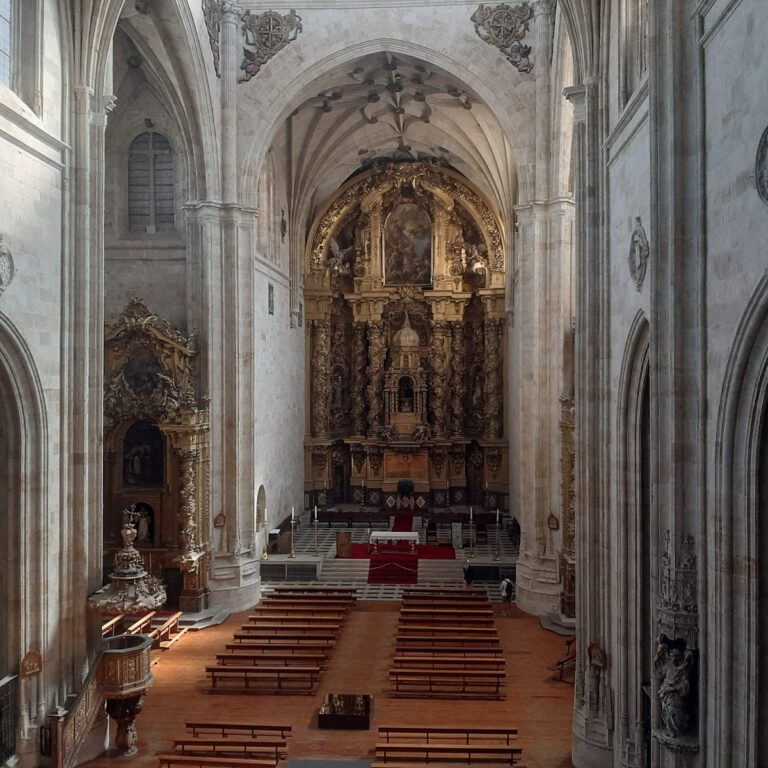
The interior follows an ad triangulum Gothic arrangement. The side naves are lower than the central nave but rise higher than usual, creating a wide and luminous interior. Two continuous galleries at different levels take the place of the traditional triforium and run around the perimeter. Slender shafts carry the weight of the vaults, with each shaft descending along a rib toward the floor. The vaults combine ribs, curved ribs, and tiercerons, specialized ribs that create varied geometric patterns.
Niche chapels
The lateral niche chapels were completed in 1520. Juan Gil de Hontañón built those on the left and Juan de Álava those on the right. Their shared arrangement includes an altar or altarpiece at the end, arcosolia, or arched recesses originally intended for burials, star-shaped vaults, varied grilles, and, in some cases, altar fronts made with Talavera tiles.
Crossing and dome
Joaquín and Alberto de Churriguera erected the original crossing tower and Baroque dome, completed in 1725. The dome’s ribs and decoration were compared with those of Burgos Cathedral. The present Neoclassical dome is the work of Juan de Sagarvinaga, who rebuilt it after the 1755 earthquake.
Main Chapel
The Main Chapel has a rectangular plan and a ribbed, star-patterned vault that is cusped and polychrome, meaning that it uses several colors. Alberto de Churriguera’s 1732 altarpiece was dismantled in 1743. A costly replacement tabernacle designed by Ventura Rodríguez was never built, although its model survives in the Cathedral Museum.
The chapel contains a crimson velvet canopy with an image of the Assumption by Esteban de Rueda, dated 1624 and polychromed by Antonio González, accompanied by angels by Francisco Sánchez. The entablature above the presbytery retains figures of Religion, angels, and Church Fathers from the dismantled altarpiece. A marble and jasper tabernacle by Simón Gavilán, dated 1750, stands with silver urns containing the remains of Saint John of Sahagún and Saint Thomas of Villanova.
Choir and organs
Joaquín de Churriguera built the choir between 1730 and 1740. Several artists produced its upper and lower stall sections, while Duperier made the grilles enclosing the choir and Main Chapel. The Renaissance Epistle Organ dates from the sixteenth century. The Baroque Gospel Organ was built in 1744 by Pedro Echaverría. Its nineteenth-century alteration changed the original construction, but its later restoration preserved the instrument’s earlier character.
Chapels of the northern and western side
Chapel of San Clemente
The Chapel of San Clemente has an altarpiece with paintings of the Virgin of Succour and Saint Clement. It formerly gave access to the exterior terrace above the principal entrance.
Chapel of Diego de Neyla
The Chapel of Diego de Neyla occupies the section corresponding externally to the Puerta de Ramos and is not fully enclosed. It contains the Renaissance tomb of Canon Diego de Neyla, who died in 1577, with a panel of the Virgin, Child, and Saint John the Baptist surrounded by angels and God the Father. Above a Gothic arcosolium is a Renaissance fresco of the Annunciation. The chapel also contains the tomb of Archdeacon Roque de Vergas.
Chapel of Santiago and Saint Teresa
The Chapel of Santiago and Saint Teresa, also called the Chapel of Almansa, contains a 1628 altarpiece by Antonio González Ramiro with sculptures by Antonio de Paz. The tombs of the bishops Tomás de Cámara y Castro and Francisco Frutos Valiente are also preserved there.
Chapel of Our Lady of Truth
Bishop Antonio Corrionero founded the Chapel of Our Lady of Truth, which contains tombs by Antonio de Paz. Its titular Virgin is a twelfth-century image that was re-carved and polychromed in the Baroque period. A slight movement of the head is associated with the tradition that explains the chapel’s name.
Chapel of Saint Anthony
The Chapel of Saint Anthony contains an eighteenth-century altarpiece and titular image by local artists. Its attic has a copy of Alessandro Allori’s Magdalene, while a 1621 painting of the Baptist’s martyrdom is signed by Santiago Jerónimo Espinosa.
Altar of the Christ of the Redeeming Agony
The Altar of the Christ of the Redeeming Agony occupies the north arm of the transept, the crosswise section of the church that intersects the nave. Its anonymous fifteenth-century Crucified Christ has three nails, natural hair, open eyes, and a partly open mouth. The polychromy emphasizes bodily details, including the veins. Bones and a skull at the foot of the cross traditionally represent Adam. Francisco de Bobadilla is buried opposite the altar.
Chapels of Marian and Christological devotion
Chapel of the Virgin of la Cabeza
The Chapel of the Virgin of la Cabeza contains a seated Gothic Virgin holding the Child and the processional group La Borriquilla.
Chapel of the Virgin of Lourdes
The Chapel of the Virgin of Lourdes, also called the Chapel of Saint Tirso, contains images of Church Fathers from the former main-altar tabernacle together with an image of its titular figure.
Chapel of the Virgin of the Pilar
The Chapel of the Virgin of the Pilar contains an eighteenth-century painting of the Virgin’s coming to Zaragoza and a Gothic sculpture of the Virgin of the Pilar.
Chapel of Our Lady of Solitude
The Chapel of Our Lady of Solitude has a Baroque altarpiece by Joaquín de Churriguera and a dressed image of Our Lady of Solitude made by Mariano Benlliure in 1941.
Chapel of the Christ of the Battles
The Chapel of the Christ of the Battles contains a Romanesque image probably dating from the first half of the twelfth century. The dark-colored Christ has four nails. Alberto de Churriguera made the eighteenth-century altarpiece, which Bishop José Sancho Granado donated in 1734. The chapel also contains an urn with the remains of Bishop Jerome and an image of the Virgin of Carmel by Antonio de Paz.
Chapel of Saint Joseph
The Chapel of Saint Joseph has a Baroque rocaille altarpiece, using asymmetrical shell-like and naturalistic forms associated with the Rococo. It includes an image of Saint Joseph with the Child and paintings of Saint John, the Magdalene, and Saint James Matamoros.
Chapel of the Sorrows
The Chapel of the Sorrows, or Chapel of the Blessed Sacrament, lies beneath the beginning of one of the projected towers of the chevet and is reached from the ambulatory through the Chapel of Saint Joseph. Juan de Sagarvinaga designed its Neoclassical altarpiece, crowned by an image of God the Father and angels possibly by Carmona. The niche contains Luis Salvador Carmona’s 1760 Pieta. Its polychromy and serene Virgin anticipate Neoclassicism, while the treatment of the naked Christ remains Baroque.
Chapel of Saint Nicholas of Bari
The Chapel of Saint Nicholas of Bari contains a Baroque altarpiece dedicated to the saint, crowned by a painting of the Virgin with the sleeping Child. It also has a Neoclassical altarpiece with an Immaculate Conception attributed to Alejandro Carnicero.
Chapel of Jesus the Nazarene
The Chapel of Jesus the Nazarene contains Italian paintings including Carlo Maratta’s Christ and Veronica and Romanelli’s oval painting of the Penitent Magdalene. Two Neapolitan paintings in the rear arcosolia, depicting the Massacre of the Innocents and the Expulsion of the Merchants from the Temple, are attributed to Micco Spadaro.
Chapel of the Virgin of Reparation
The Chapel of the Virgin of Reparation contains an altarpiece assembled in 1664 as an act of reparation after an opponent of the doctrine of the Immaculate Conception slashed the face of an Immaculate Conception canvas with a dagger. The altarpiece is described as the first in Spain to use Solomonic columns.
Chapels associated with the Old Cathedral and historic patrons
Chapel of the Virgin of Morales
The Chapel of the Virgin of Morales, also called the Chapel of Saint Bartholomew, formerly provided passage between the two cathedrals. Its altarpiece includes a painting of the Virgin, Child, and Saint John the Baptist by Luis de Morales, apparently from the church of San Felices de los Gallegos, and an attributed Ecce Homo by the same artist. The altarpiece was originally dedicated to Saint John the Baptist and later to Saint Bartholomew. Antonio de Paz made the images of Saint Gregory of Ostia and Saint Augustine. Enrique Orejudo’s 1991 image of the Recumbent Christ of Mercy is also preserved here.
Chapel of the President
Francisco Fernández de Liébana, president of the Royal Chancery of Valladolid, endowed the Chapel of the President in 1577. Its altarpiece contains a copy of Titian’s Burial of Christ, the Apparition of the Resurrected Christ to His Mother, apparently by Fernández Navarrete, and the Virgin of Bethlehem attributed to La Roldana. A seventeenth-century Ecce Homo bust by Pedro Hernández came from the demolished Church of San Adrián.
Golden Chapel
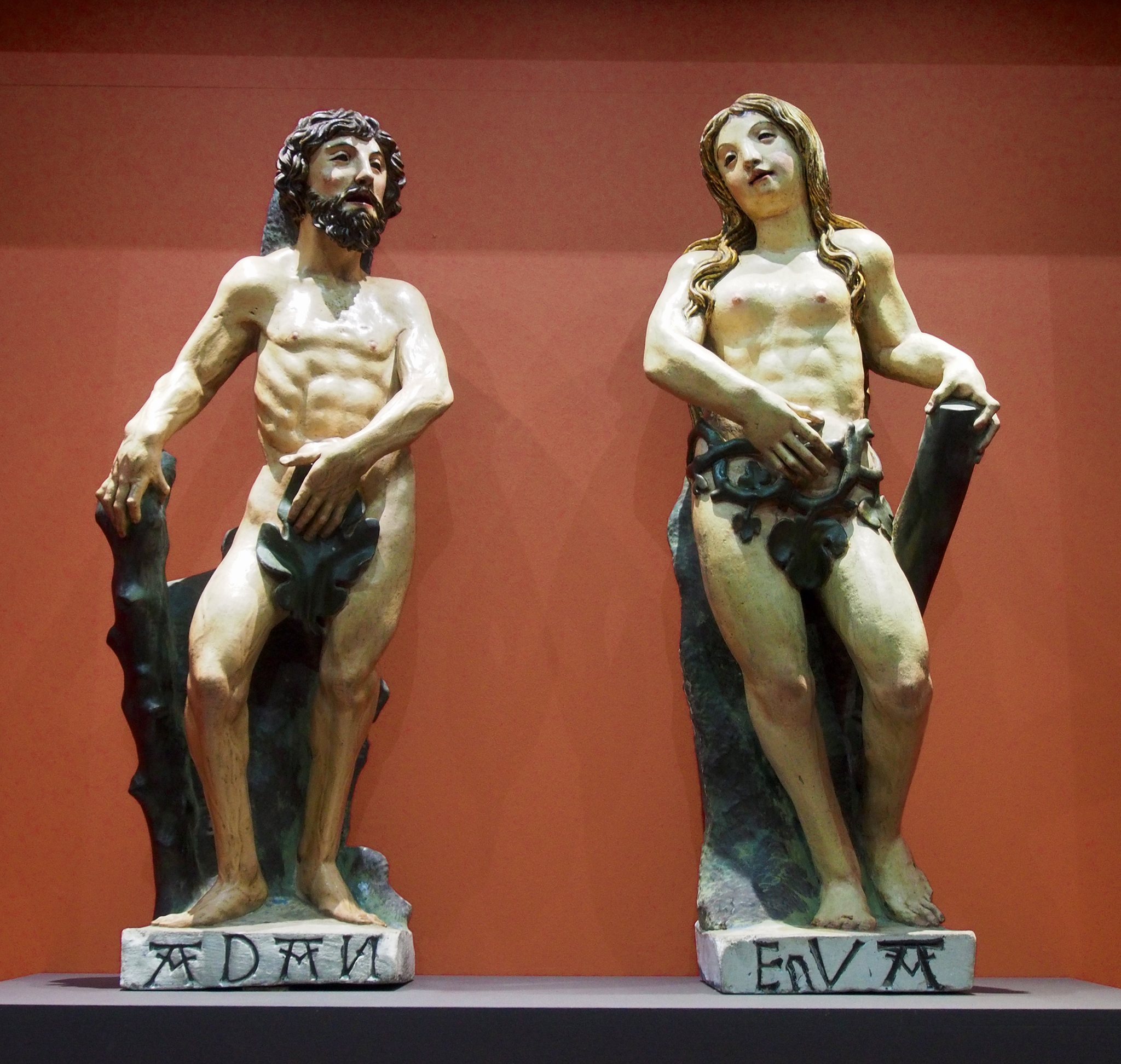
The Golden Chapel, or Chapel of All Saints, was commissioned in 1515 by Francisco Sánchez de Palenzuela, archdeacon of Alba de Tormes, and designed architecturally by Juan de Álava. Its arcades contain tombs, including that of its founder. Approximately 110 statues of apostles, saints, sibyls, prophets, and other figures from the Old and New Testaments stand on polychromed and gilded shelves. Adam and Eve echo figures of Apollo and Venus on the facade of the University of Salamanca. A representation of Death occupies a niche with a toad between its legs, symbolizing lust.
A Calvary dominates the altarpiece against a painted background by Adiosdado de Olivares. The altar below is decorated with Talavera de la Reina tiles.
Chapel of Saint Lawrence
The Chapel of Saint Lawrence was founded by Lorenzo Sánchez de Acebes. Its altarpiece contains a relief of the saint’s martyrdom attributed to Antonio de Paz, and the chapel provides the present access to the Old Cathedral.