Hanuman Dhoka: A Royal Palace Complex in Kathmandu, Nepal
Site at a Glance
- Rating
- 4.6
- Popularity
- Medium
- Country
- Nepal
- Primary era
- Early Modern
- Eras represented
- Early Modern, Modern
- Civilizations
- Unclassified
- Site type
- Domestic
- Remains
- Palace
On this page18 sections
History
Hanuman Dhoka is a royal palace complex in Kathmandu, Nepal, built and expanded by the Malla kings and later used by the Shah dynasty. Its earliest parts date either to the fifteenth century or the mid-sixteenth century, and the complex became an important centre of royal life in the Kathmandu Valley.
Malla foundations and expansion
The eastern wing, which contains ten courtyards, dates from the mid-sixteenth century and may occupy the site of an older palace. King Pratap Malla expanded Hanuman Dhoka during the seventeenth century, adding numerous temples and giving the palace much of its present character. The Malla dynasty ruled the Kathmandu Valley during the medieval and early modern periods.
The name Hanuman Dhoka comes from the stone image of Hanuman beside the principal entrance. Hanuman, a Hindu deity traditionally represented in monkey form, is associated with strength and devotion in the Ramayana. In Nepali, dhoka means door or gate.
Shah rule and royal ceremonies
In 1768, Prithvi Narayan Shah conquered Kathmandu and established Shah rule over the city. Four lookout towers were added in the southeastern part of the palace complex after the conquest. The royal family later moved to Narayanhiti Palace, but Hanuman Dhoka continued as a royal residence into the late nineteenth or early twentieth century.
The palace remained associated with royal ceremonies and public tradition. Birendra was crowned king in the Nasal Chok courtyard in 1975, while the complex was linked with Kumari Jatra festivities during the 1850s. The Malla and Shah periods are also represented in the palace’s surviving museums and royal interiors.
Earthquakes, rebuilding, and museums
The original Maha Vishnu Temple in Nasal Chok was destroyed in the 1934 Nepal-Bihar earthquake. Hanuman Dhoka was rebuilt several times during the nineteenth and twentieth centuries, and later rebuilding work involved UNESCO. The 2015 earthquake severely damaged the complex, including the upper storeys of several buildings. Chinese assistance supported the reconstruction of Basantapur Tower, completed by 2022.
The Nepalese government administers the Hanuman Dhoka Palace Museum. Its Shah-dynasty section presents the lives of Shah rulers from childhood through marriage and coronation, while another section addresses major changes in Nepal, including the abolition of the slave system. Museums associated with King Tribhuwan and King Mahendra are also located within the complex. A museum dedicated to King Birendra has remained closed since his assassination in 2001.
Remains
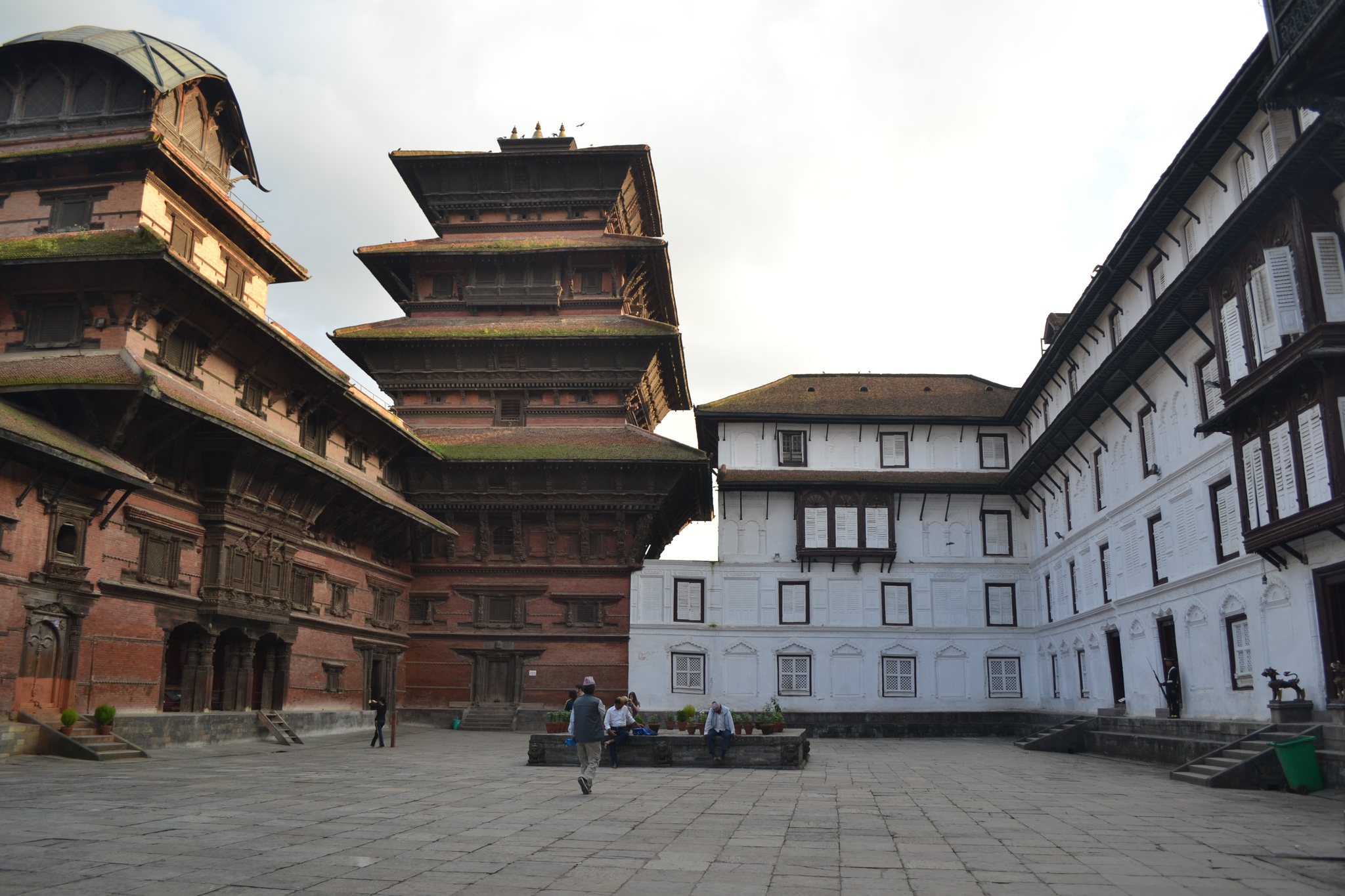
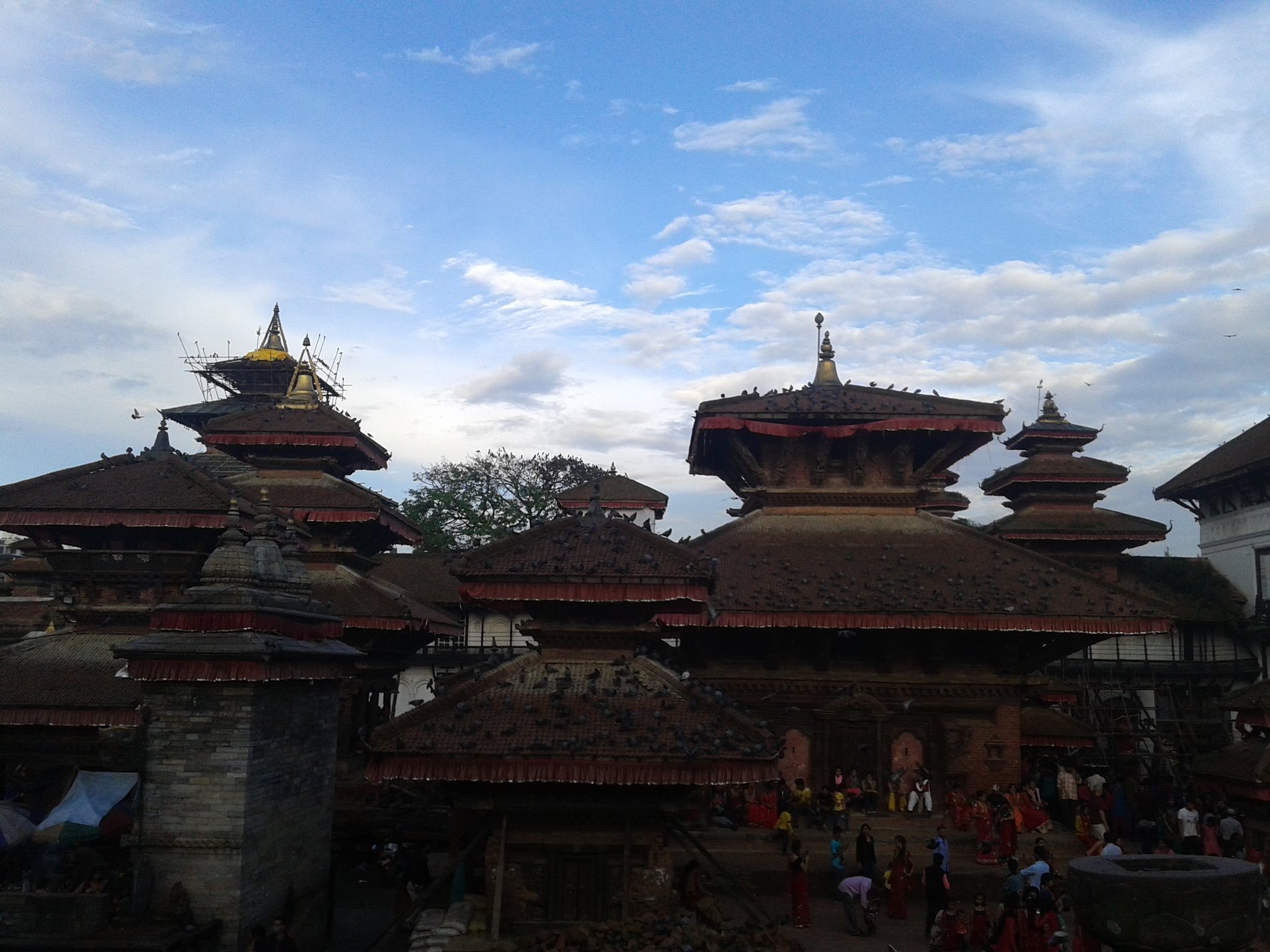
Hanuman Dhoka covers approximately 20,000 square metres and is built principally of brick and wood. Its palace and temple buildings are arranged around enclosed courtyards known as chowk, including Basantapur, Dakh, Hnuluche, Lam, Lohan, Masan, Mul, Nasal, Mohan, and Sundari. The complex stands within Kathmandu Durbar Square, with Hanuman Gate on the western side and Gaddi Baithak Durbar and numerous temples adjoining it.
Entrances and Nasal Chok
Hanuman Gate
Hanuman Gate forms the principal entrance to the palace on the western side of Durbar Square. A standing statue of Hanuman dated to 1672 guards the gateway. The figure is covered by a red cloth and umbrella, and its face is smeared with red paste. Beside it stands a stone sculpture dated to 1673 showing Narasimha, Vishnu’s man-lion incarnation, devouring the demon Hiranyakashipu. An inscription on the pedestal associates the sculpture with the reign of Pratap Malla.
An exterior stone inscription is carved in fifteen languages. The stone is a jaladroni, a drinking fountain or water outlet. A legend says that milk would flow from it instead of water for anyone able to understand all fifteen languages.
Nasal Chok
Nasal Chok is a rectangular courtyard oriented from north to south, with an entrance at its northwest corner. It adjoins the Hanuman Temple, and its name refers to the dancing image of Shiva on the eastern side. The courtyard was constructed during the Malla period, while the surrounding buildings contain intricately carved doorways, windows, and wooden struts attributed to the Rana period. The Rana family governed Nepal through a hereditary prime-ministerial regime from 1846 to 1951.
A carved doorway near the entrance, decorated with four gods, leads to the private apartments of the Malla kings. The eastern wall has an open veranda containing a golden image of Maha Vishnu. The northeast corner contains the Malla kings’ audience chamber, and another open veranda holds a throne and portraits of Shah kings.
Panch Mukhi Hanuman Temple
The Panch Mukhi Hanuman Temple occupies the northeast corner of Nasal Chok. Dedicated to five-faced Hanuman, it has five circular roofs. Entry to its sanctum is reserved for the temple priest.
Royal courtyards and temples
Basantapur Tower
Basantapur Tower rises south of Nasal Chok as a nine-storey brick and wood structure. Its wooden struts carry erotic carvings, and the tower provides panoramic views over the palace and city. It is one of four red towers associated with the historic cities of the Kathmandu Valley: Kathmandu, also called Basantapur, Kirtipur, Bhaktapur, and Patan.
Mul Chok
Mul Chok is enclosed by two-storey buildings and was used exclusively for religious rites. On its southern side stands the Taleju Temple, whose entrance has a golden torana, an ornamental gateway or arched doorway. During Dashain, Nepal’s principal Hindu festival, the image of Taleju is transferred to this temple. Images of the river goddesses Ganges and Yamuna flank the entrance.
Degu Taleju
Degu Taleju is a separate temple with three roofs, dedicated to Taleju Bhawani, the tutelary deity of the Malla royal family. Shiva Singh Malla built the temple.
Mohan Chok and Sundari Chok
Mohan Chok was built in 1649 north of Nasal Chok as the residential courtyard of the Malla kings. At its centre, several metres below courtyard level, is the ornately carved Sun Dhara golden waterspout. Tradition held that the waterspout was fed by a spring at Budhanilkantha, and the Malla kings used it for daily ablutions. Towers occupy the four corners of Mohan Chok, while Sundari Chok lies to its north.
A Malla tradition required a king to be born in Mohan Chok to become heir to the throne. Jaya Prakash Malla is associated with difficulties arising from this requirement.
Museums and later palace buildings
Tribhuwan Museum
The Tribhuwan Museum occupies the western side of Nasal Chok in a section built by the Ranas during the mid-to-late nineteenth century. Its collections include stone carvings, thrones, jewel-studded coronation ornaments, weapons, furniture, wooden temple carvings, and coins. King Tribhuwan’s bedroom and study, together with his personal effects, have been recreated and preserved there.
King Mahendra Memorial Museum
The King Mahendra Memorial Museum occupies the southeastern corner of a courtyard and contains two thrones. The wider palace museum complex also preserves a Nepalese throne and objects associated with the Shah kings, including material connected with royal lives, marriages, and coronations.
Gaddi Baithak Durbar
Gaddi Baithak Durbar adjoins Hanuman Dhoka on the east. It is a Neoclassical palace from the early twentieth-century Rana period, adding a later architectural layer to the complex of Malla and Shah courtyards and temples.