Virgin Tower in Szczecin: A Gothic Defensive Tower
Site at a Glance
- Rating
- 4.3
- Popularity
- Low
- Country
- Poland
- Primary era
- Medieval
- External website
- Open
- Eras represented
- Medieval
- Civilizations
- Duchy of Pomerania
- Site type
- Military
- Remains
- Tower
On this page6 sections
History
The Virgin Tower in Szczecin, Poland, also known as the Tower of Seven Coats, is a reconstructed Gothic defensive structure from the city’s medieval fortifications. The fortification system was built in the fourteenth century, while the tower itself was constructed in the fifteenth century, probably before 1462. It guarded the Maiden Gate, which had been built in 1307 to close the northern side of the Old Town.
Medieval fortifications
The Maiden Gate led toward a Cistercian nunnery founded in 1243. Cistercians were a Catholic monastic order whose women’s communities formed convents across medieval Europe. Szczecin’s walls extended for about 2,510 metres, including approximately 610 metres along the Oder. The system contained four main gates, seven round towers, fourteen square towers, one hexagonal tower, and fifteen open half-towers.
A water moat surrounded the city defenses. Its stated depth was 30 to 35 ells, a historical unit whose length varied by place and period, while its bottom was about 57 ells wide and its upper width about 80 ells. Local tailors financed the tower and are believed to have helped defend it during attacks. This association gave rise to the name Tower of Seven Coats. Another local legend connects the name with seven coats made for Bogislaw X, a late medieval duke of Pomerania.
Prison and later changes
Until 1723, the tower served as a prison for people sentenced to execution. Modern fortifications were built between 1724 and 1740, after which most of the medieval defenses were demolished. The tower survived, became enclosed by tenement buildings, and was used for storage.
Probably around the turn of the twentieth century, its upper section was dismantled in connection with the removal of Fort Leopold and the construction of Haken Terraces, now called the Chrobry Embankment. An octagonal tenement building was then erected on the remaining base. That building was destroyed during bombing raids in 1944, along with much of Szczecin’s Old Town.
Reconstruction and civic meaning
Wartime rubble was cleared in 1956, and the tower was reconstructed and restored between 1961 and 1964. It had already been entered in Szczecin’s register of historic monuments in 1954. After reconstruction, it served several practical functions and for a period housed the Szczecin branch of the Order of Knights and Hospitallers of Saint Lazarus of Jerusalem, a military and charitable order historically associated with caring for people affected by leprosy.
The Tower of Seven Coats is widely recognized as a symbol of Szczecin. Its stylized form has appeared in the emblems, flags, logos, and other symbols of city institutions and events.
Remains
Gothic tower structure
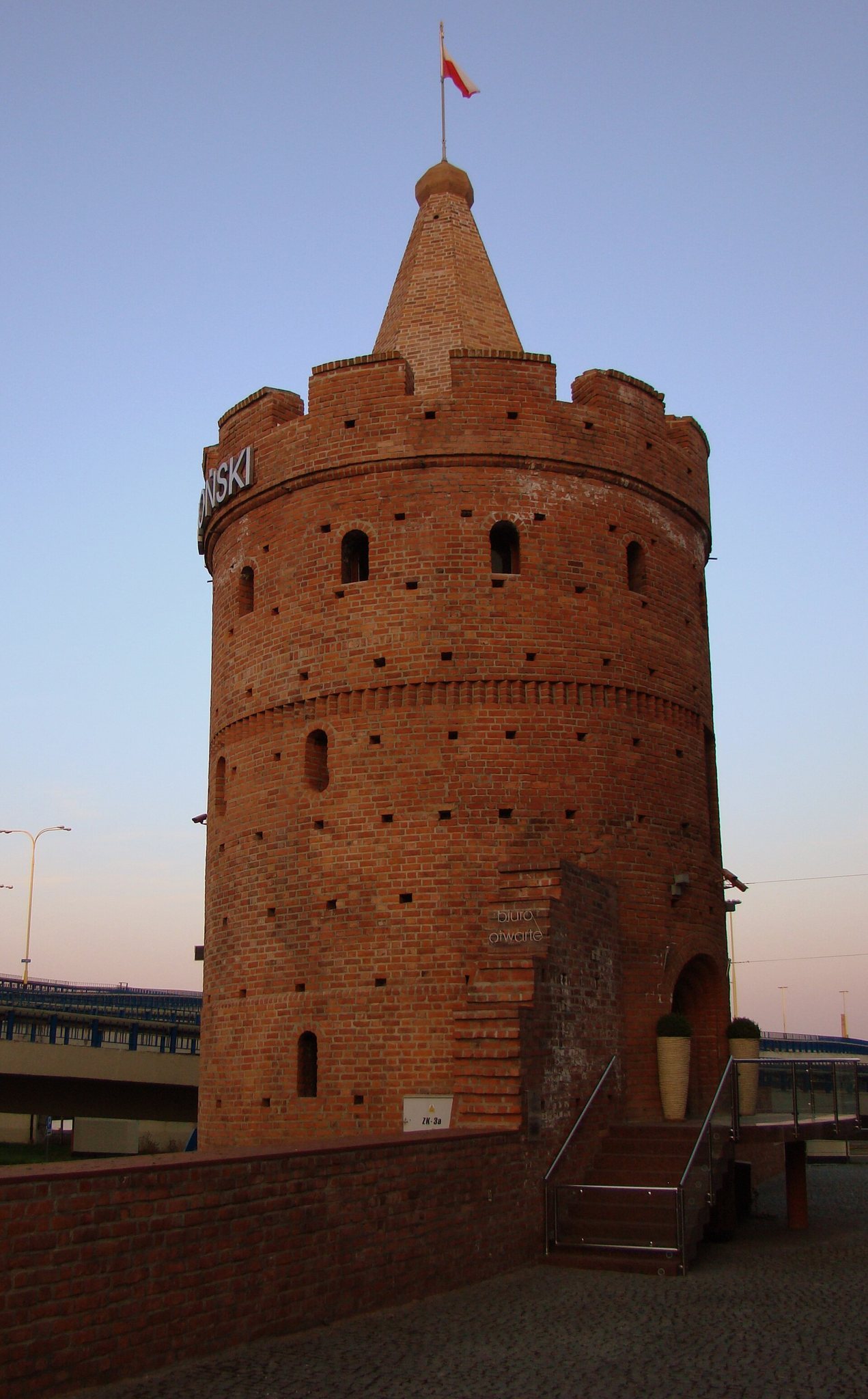
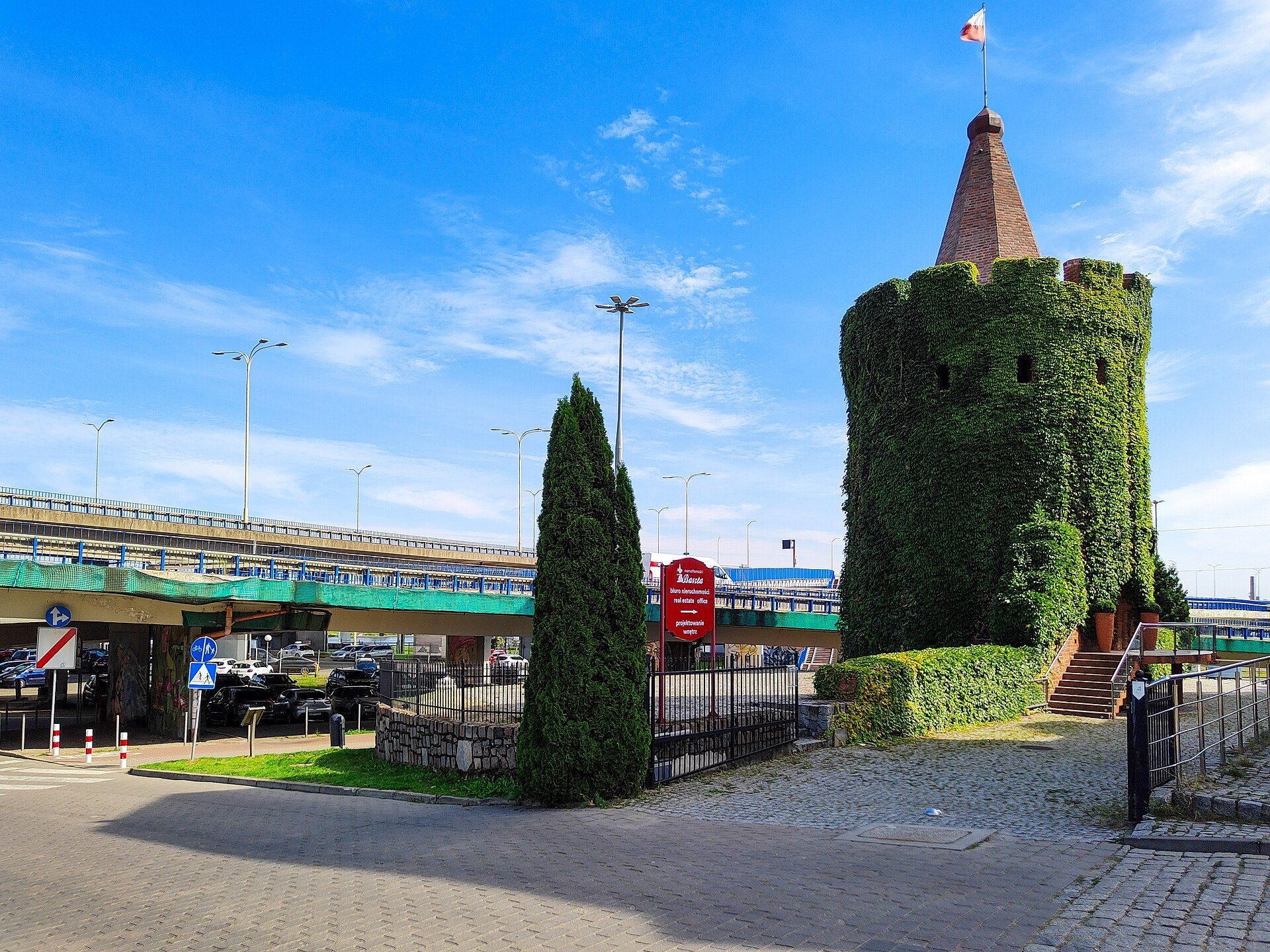
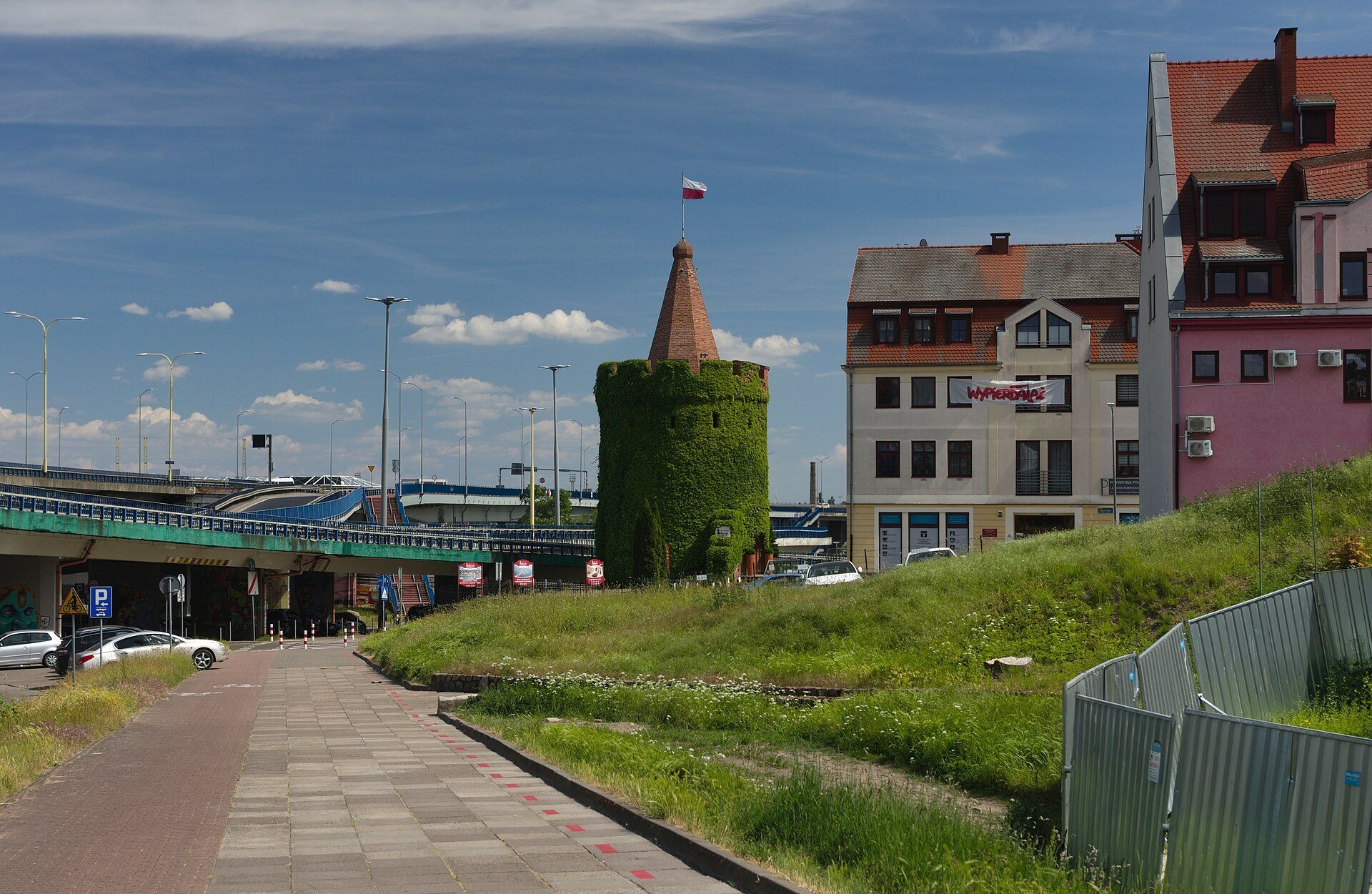
The tower stands at 47 Panieńska Street, near the Oder and at the foot of the Pomeranian Dukes’ Castle. It is a circular Gothic defensive structure with an external diameter of 9 metres and an internal diameter of 3.6 metres. Its surviving form reflects the reconstructed medieval tower rather than the later tenement building that once occupied the site.
The structure has three levels, including an underground level. The lower level is approximately 4.6 to 4.7 metres high, the ground floor is about 4.4 metres high, and the first floor is approximately 2.5 metres high. Crenellation crowns the tower, while a conical roof completes its upper profile. The names Maiden Tower and Tower of Seven Coats preserve its connections with the former gate and with the tradition of financial and defensive support from Szczecin’s tailors.