Saint-Paul-Saint-Louis Church in Paris: A Jesuit Baroque Parish Church
Site at a Glance
- Rating
- 4.6
- Popularity
- Medium
- Country
- France
- Primary era
- Early Modern
- External website
- Open
- Eras represented
- Early Modern
- Civilizations
- French
- Site type
- Religious
- Remains
- Church
On this page20 sections
History
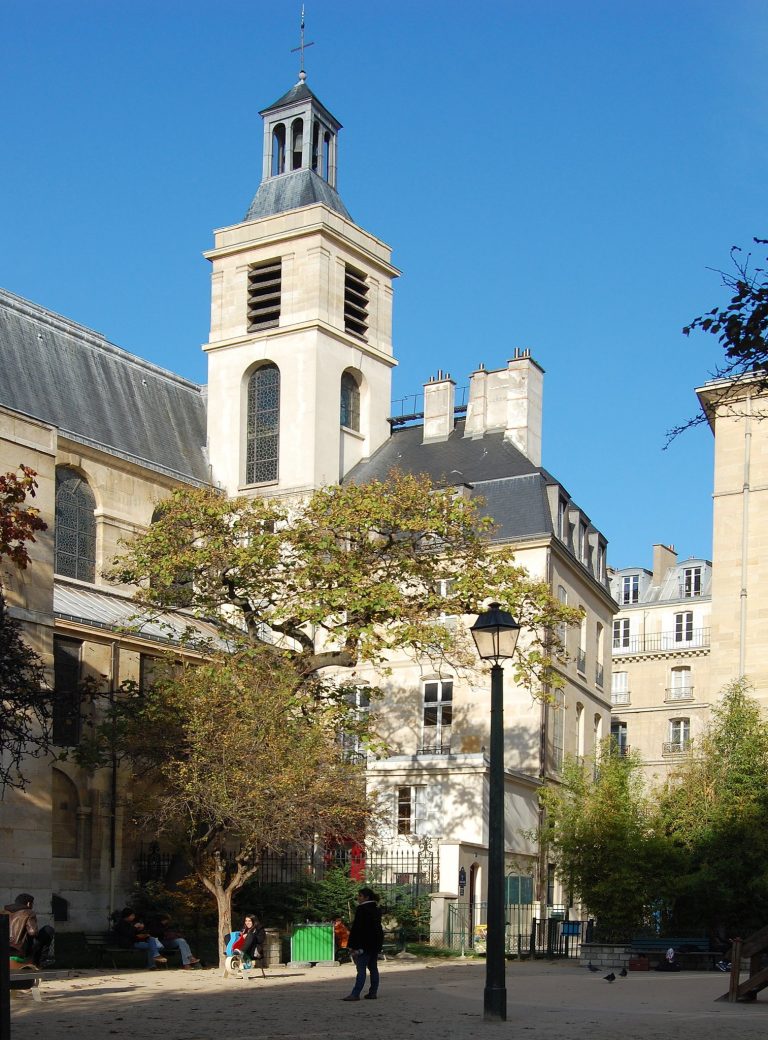
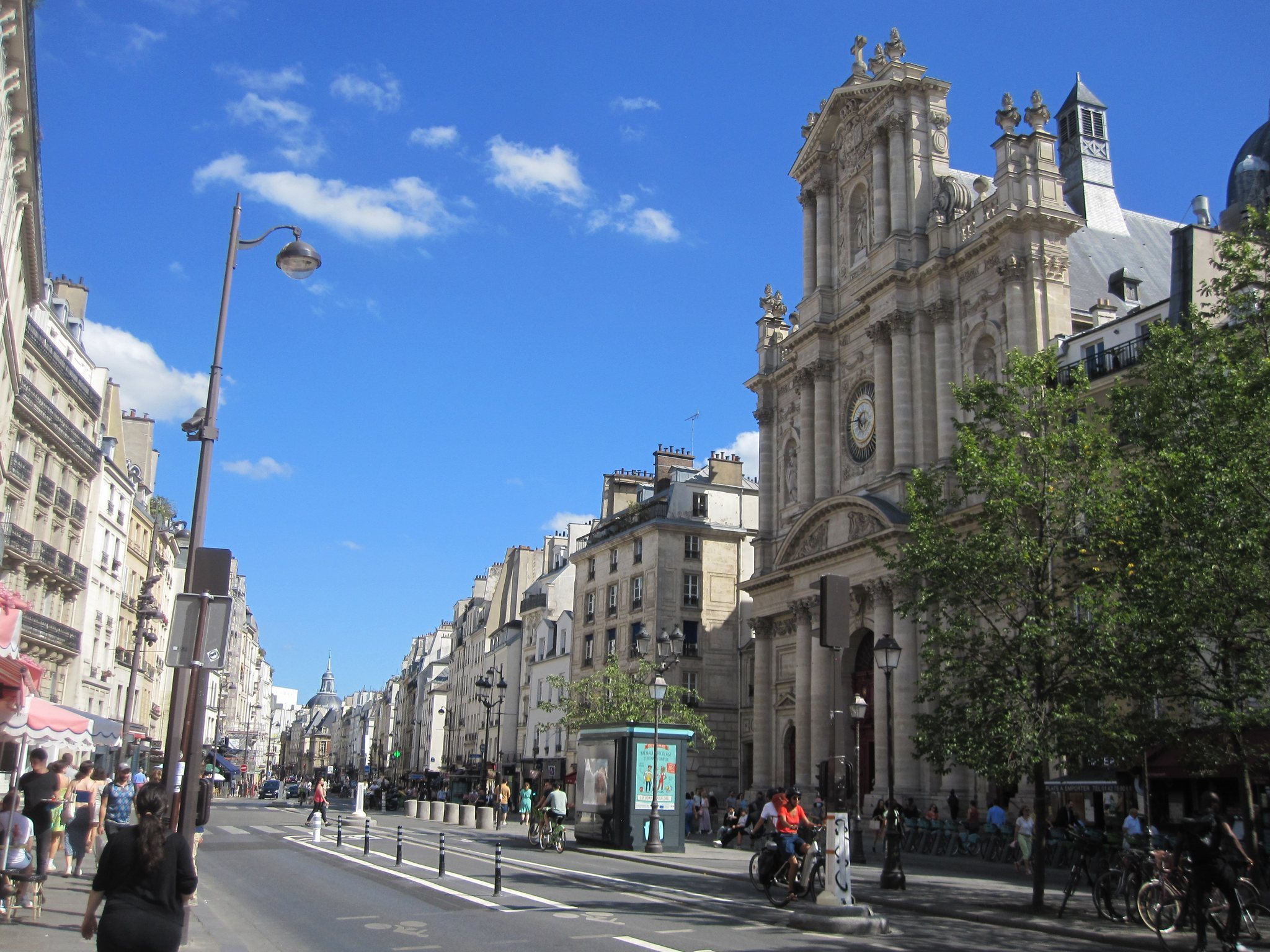
Saint-Paul-Saint-Louis Church is a Roman Catholic parish church in Paris, France, built by the Jesuits in the seventeenth century in the Baroque style. Standing in the Marais on rue Saint-Antoine beside the former Jesuit professed house, it later became the parish church of Saint-Paul-des-Champs after the Revolution. Its double dedication reflects that transfer of parish identity and the succession between the former Saint-Paul church and the Jesuit church of Saint-Louis.
Before the Jesuit Church
The Saint-Paul parish began with a cemetery chapel built around 632–642 among cultivated fields east of Paris. The chapel was associated with the cemetery of the monastery of Saint-Éloi and became a parish church in 1125. Its name passed to the surrounding Saint-Paul quarter. Rebuilt around 1430–1431, the church stood behind a cemetery that contained the burials of François Rabelais, Jean Nicot, and the architect François Mansart. Antoine Lavoisier served as an honorary second churchwarden and benefactor while administering the royal gunpowder supplies before he was guillotined during the Revolution.
The former Saint-Paul-des-Champs was demolished in the late eighteenth century during the revolutionary period. Five of its parish priests were killed in the September Massacres of 2–5 September 1792, when prisoners in Paris were killed during the French Revolution, including clergy who had rejected the revolutionary oath required by the Civil Constitution of the Clergy. A plaque in the present church commemorates the priests, who were beatified by Pope Pius XI in 1926.
The Jesuit Foundation
The present church largely occupies the site of the former Hôtel de Rochepot, also called the Hôtel de Damville. The residence had belonged to Madeleine de Savoie, widow of Anne de Montmorency, before Cardinal Charles de Bourbon gave it to the Jesuits in 1580. The Jesuits, a Catholic religious order founded in the sixteenth century, established a chapel dedicated to Saint Louis there. Saint Louis was Louis IX, the thirteenth-century king of France canonized in 1297.
After returning to France following their expulsion in 1595, the Jesuits found the chapel too small. Louis XIII, king of France from 1610 to 1643, granted them land released by the demolition of the Philippe-Auguste enceinte in 1613. In 1629 they acquired the Hôtel de la Barre and adjoining properties. Construction of the present church began in 1627 for the Jesuit professed house, the order’s principal residence and institutional center. Cardinal Richelieu laid the first stone, while the Jesuit architects Étienne Martellange and François Derand designed the building.
The church was originally dedicated to Saint Louis of the Jesuit professed house. Cardinal Richelieu celebrated its first Mass on 9 May 1641, the feast of the Ascension. On 7 November 1660, the church hosted the episcopal ordination of Ignace Cotolendi for the Missions étrangères de Paris, a Catholic missionary society established to support missions in Asia.
Preaching and Music
The church became an important setting for Catholic preaching in seventeenth-century Paris. The Jesuit preacher Louis Bourdaloue preached during Lent and Advent between 1669 and 1693, and delivered the funeral oration for the Grand Condé in 1687. Bossuet and Esprit Fléchier also preached there, while Madame de Sévigné attended Bourdaloue’s sermons.
Its musical life developed alongside its preaching tradition. Marc-Antoine Charpentier served as master of music from 1688 to 1698. Later music directors included Henry Desmarest, André Campra, Louis Marchand, and Michel-Richard de Lalande, strengthening the church’s association with major French sacred music.
Revolution and Restoration of the Parish
After the Jesuits were expelled from France in 1762, the church was entrusted to the Génovéfains, Augustinian canons associated with the Abbey of Sainte-Geneviève in Paris. During the Revolution, Catholic worship was suppressed and the building was used for revolutionary cults, including the Cult of Reason and the Cult of the Supreme Being. Maximilien Robespierre preached there against Hébertist atheism.
The Concordat of 1801, an agreement between Napoleon’s government and the Holy See that reorganized the Catholic Church in France, enabled Catholic worship to return in 1802. The restored parish was established in the former Jesuit church after the destruction of Saint-Paul-des-Champs. On 15 January 1803, the parish council requested the combined name Saint-Paul-Saint-Louis. The Saint-Paul dedication, originally associated with Paul the Hermit, an early Christian ascetic traditionally linked with Egypt, became associated with Paul of Tarsus, the apostle and missionary.
The church continued to serve as a setting for important religious and cultural events. Léopoldine Hugo married Charles Vacquerie there privately on 15 February 1843, and her father, Victor Hugo, gave two holy-water vessels for the occasion. The church is also associated with the baptisms of Madame de Sévigné in 1626 and Jean-Jacques Olier on 20 September 1608. In Les Misérables, Victor Hugo placed the marriage of Cosette and Marius in the church, while the dome became a major subject for the painter Paul de Lapparent.
The building was designated a historic monument on 10 February 1887. Victor Baltard later intervened in the church, particularly by reorganizing the choir and restoring the façade. More recent work has included façade restoration from August 2011 to October 2012, repairs to the lantern glazing and summit cross in 2014, and phased restoration of the stained glass from 2017 onward.
Remains
Plan, Dome, and Façade
Saint-Paul-Saint-Louis is a Baroque church that combines Italian models with French traditions. Its plan brings together a single nave with side chapels, an arrangement associated with the Church of the Gesù in Rome, and a French Latin-cross design with elongated, slightly projecting transepts. The short apse, high windows, and dome over the crossing recall earlier Italian architecture, including the work of Carlo Maderno, while the building’s tall proportions relate more closely to French Gothic traditions.
The Dome and Crossing
The dome rises approximately 55 metres above the crossing, where the nave and transepts meet. Its summit cross reaches approximately 56 metres. The high façade largely conceals both the dome and the bell tower from the street. Restoration work in 2014 addressed the lantern glazing, the summit cross, and the lightning conductor.
The Façade
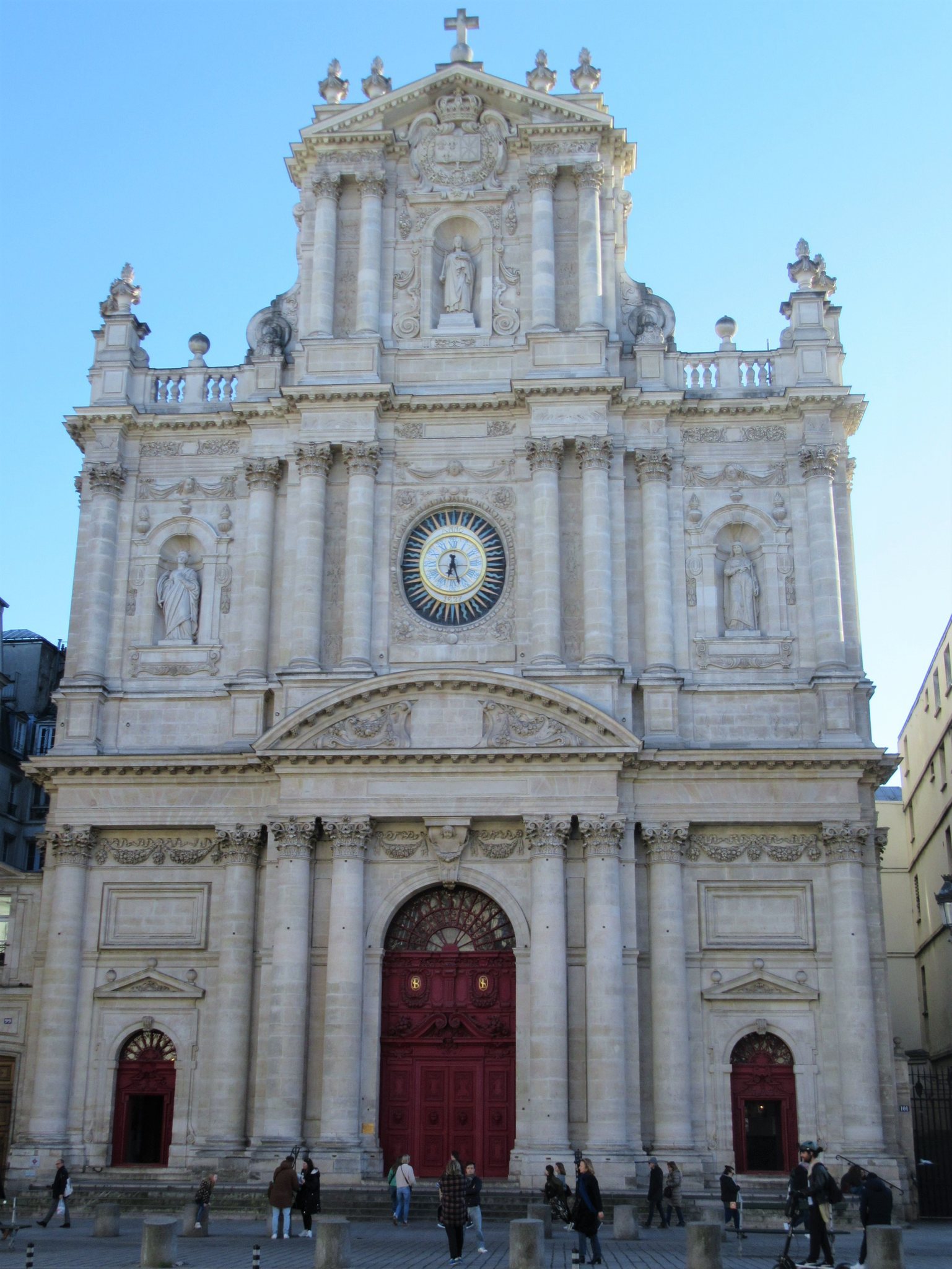
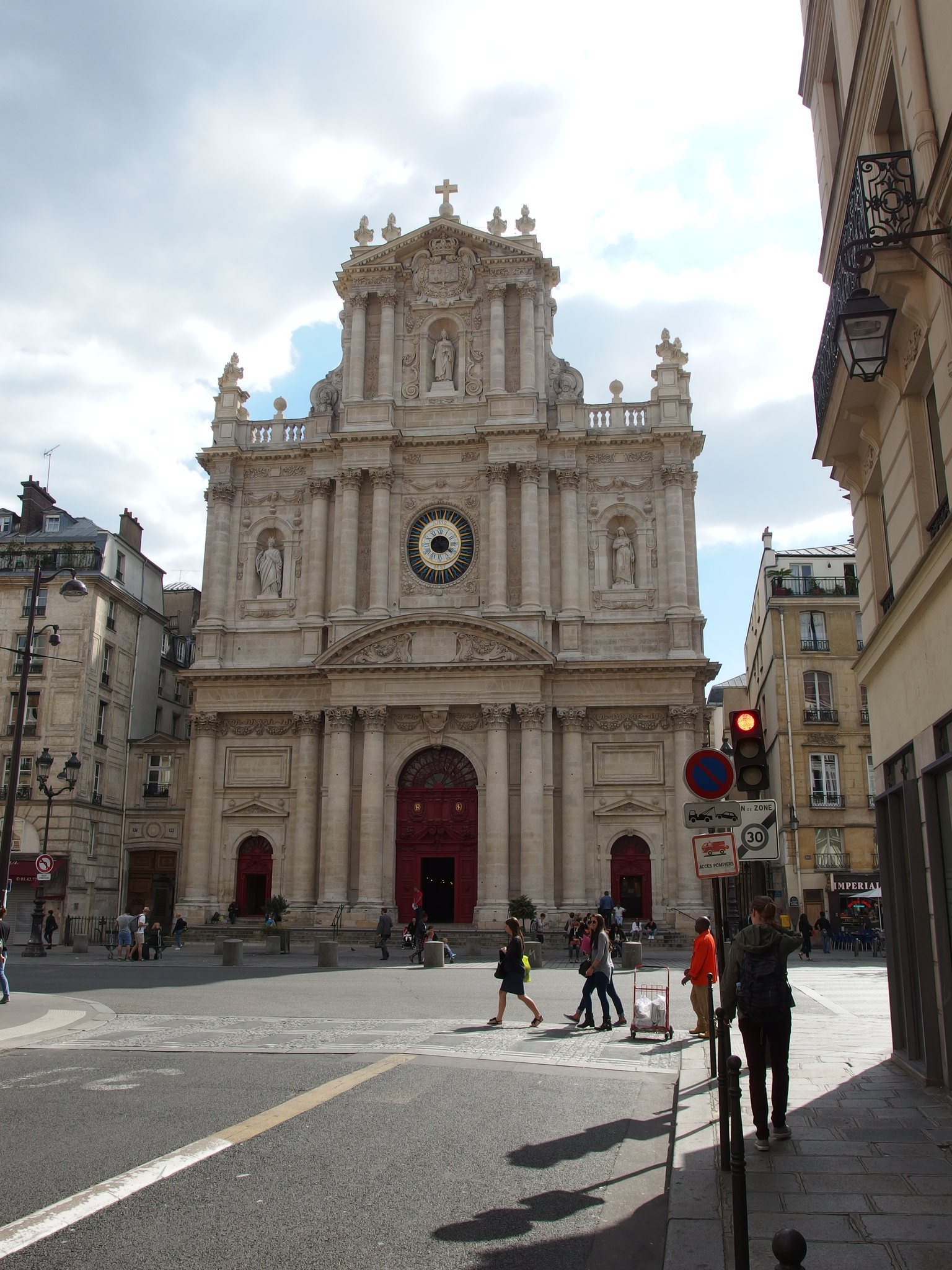
The façade combines an Italian Baroque composition with Gothic verticality and abundant ornament associated with Flemish architecture. It has three bays, with two levels in the lateral bays and three in the central bay. The central bay projects forward and is marked by paired columns. Corinthian columns occupy the two lower levels, while the upper level uses the composite order, whose capitals combine Corinthian foliage with Ionic scrolls. The façade was restored between 2011 and 2012.
Windows and Musical Instruments
Many of the Baroque windows were made largely in white glass to maximize the light inside the church. Some include the coats of arms of families who donated them. Restoration of the stained glass has proceeded in phases, including work on the windows of the Virgin and Calvary chapels in 2018, the east and west transept windows in 2019–2020, lower bays 12–16 in 2020–2021, bays 17–18 in 2022, the small gallery windows in 2023, and the two high choir windows in 2024 and 2025. The east entrance, restored in 2020, retains a rediscovered and restored gilded iron grille decorated with fleurs-de-lis.
The Main Organ
The main organ has a case from 1867 and an instrument by Martin dating from 1871. It has three 56-note manuals, a 30-note pedalboard, electric action, and 40 stops, of which 33 are real stops. The instrument was restored in 1972 and in two phases in 1999 and 2005.
The Choir Organ
A nineteenth-century Krischer choir organ has two 56-note manuals, a 30-note pedalboard, mechanical action, and 13 stops. Together with the church’s long succession of music directors, the instruments preserve its connection with Parisian sacred music.
Altars, Paintings, and Sculpture
The High Altar
The white-marble high altar was moved and remade under Louis-Philippe from fragments of the Emperor’s tomb at Les Invalides. Its front carries The Pilgrims of Emmaus, a gilded bronze bas-relief by François Anguier.
Paintings and Statues
The church contains Jacques de Létin’s The Death of Saint Louis and Eugène Delacroix’s Christ in Agony in the Garden of Olives, which was shown at the Salon of 1827. Delacroix’s painting is on long-term loan to the Metropolitan Museum of Art in New York. Germain Pilon’s Sorrowful Virgin, dated 1586, was originally intended for the Valois Rotunda at the Basilica of Saint-Denis.
Other works are connected with the life of Saint Louis, including Saint Louis Receiving the Crown of Thorns from Christ by Simon Vouet or his circle and a painting attributed to Vouet’s workshop showing Louis XIII offering Saint Louis a model of the church. The building also contains works associated with Nicolas-Sébastien Adam and Saint Vincent de Paul, as well as Louis-Alexandre Romagnesi’s bas-relief Saint Paul Preaching in Athens.
The Sacristy
The monumental sacristy contains a Crucifixion formerly kept in the chapel of the Bastille prison. Three paintings above the principal vestment cupboard are attributed to Philippe de Champaigne.
Crypt, Memorials, and Associated Features
The Crypt
The crypt contains burials of Jesuits from the seventeenth and eighteenth centuries, including François d’Aix de La Chaise. Lay burials include Catherine-Henriette de Bourbon, Duchess of Elbeuf; Louis-Henri de La Tour d’Auvergne, Count of Évreux, and his wife; and the heart of Cardinal Jacques Davy du Perron.
Revolutionary and Hugo Associations
A plaque commemorates the five Saint-Paul parish priests killed in the September Massacres. On the second pillar on the right side of the nave, a nearly effaced inscription reading “French Republic or death” is attributed to the period of the Paris Commune and the burning of the dome. The two seashell holy-water vessels given by Victor Hugo for Léopoldine’s marriage remain associated with the church.
The Catechism Chapel
A catechism chapel built in 1840 along the passage between Passage Saint-Paul and rue Charlemagne has also been restored.