Church of Saint Mary Magdalene: A Baroque Roman Catholic Church in Brno
Site at a Glance
- Rating
- 4.5
- Popularity
- Very Low
- Country
- Czechia
- Primary era
- Early Modern
- External website
- Open
- Eras represented
- Medieval, Early Modern, Modern
- Civilizations
- Austria-Hungary, Austrian Empire, Habsburg, Holy Roman Empire, Margraviate of Moravia
- Site type
- Religious
- Remains
- Church
On this page24 sections
History
The Church of Saint Mary Magdalene is a Roman Catholic church in Brno, Czechia. The present Baroque building was constructed between 1651 and 1654 for the Franciscans on the site of a former synagogue in Brno’s medieval Jewish quarter. Its history reflects the expulsion of the city’s Jewish population, the expansion and later suppression of a Franciscan monastery, a destructive nineteenth-century fire, and successive changes to its religious and parish functions.
The Jewish quarter and the first church
Jews had lived in the southeastern part of Brno by at least the mid-thirteenth century. On 27 July 1454, King Ladislaus the Posthumous ordered Brno’s Jews to leave the city by 11 November. Thirty Jewish houses, the synagogue, and the cemetery remained after the expulsion. The synagogue was subsequently converted into a small Church of Saint Mary Magdalene.
The expulsion followed a period of anti-Jewish hostility associated in part with John of Capistrano, an Italian Franciscan preacher and religious reformer. He had also promoted the establishment of a Franciscan monastery outside Brno’s walls, near the present Denis Gardens. Founded in 1451, the monastery included a church dedicated to Saint Bernard of Siena, a Franciscan saint associated with reform within the order.
Franciscan rebuilding and the monastery
The Franciscan monastery outside the walls, together with its church, was demolished in 1643 while Brno prepared for a Swedish siege. The friars, members of the Order of Friars Minor, received the former Church of Saint Mary Magdalene and four houses as compensation. They rebuilt the old church from its foundations. The foundation stone of the present building was laid on 14 February 1651, and construction was completed in 1654. The work is probably attributable to the Italian builder Ondřej Erna, who had come to Brno from the Milan area around 1620.
Between 1654 and 1671, the Franciscans added an adjoining monastery with a hospital and pharmacy. The community numbered fifty-five monks in 1656. Bishop Karel II of Lichtenstein-Castelcorno consecrated the church and monastery on 16 April 1673. Donations from Brno’s nobility between 1677 and 1704 provided the monastery with elaborate decoration, a library, and an archive.
During the 1690s, the Franciscans disputed with neighbouring Dietrichstein Palace because the palace cast excessive shade over the monastery buildings. A later renewal of the dispute ended with financial compensation, the addition of another storey to the monastery, and an agreement that the palace would not be raised further. These alterations are attributed either to Mořic Grimm or to František Benedikt Klíčník. A church tower was added in 1746.
Parish church and nineteenth-century rebuilding
The monastery was dissolved on 31 May 1787 during the Josephinian reforms, the church reforms introduced under Emperor Joseph II that included the suppression of monasteries considered nonessential. Saint Mary Magdalene then became a parish church. Soldiers occupied most of the former monastery, while the remaining rooms were left to the clergy.
On 23 May 1852, a fire that began at the U Hvězdy inn beside the Měnínská Gate destroyed five houses and severely damaged the church, particularly its tower. The building was restored with simpler decoration, and the tower was rebuilt in a Neo-Romanesque form. Much of the church’s present exterior dates from this reconstruction.
The Eucharistians and recent conservation
In 1912, Bishop Pavel Huyn settled members of the Congregation of the Brothers of the Most Blessed Sacrament, also known as the Eucharistians, at the church. This Catholic congregation was devoted particularly to the Eucharist, understood as the sacramental presence of Christ. In 1913, its members removed the original choir gallery, moved the high altar farther into the presbytery, and built a new organ gallery. Parish administration transferred on 20 January 1914 to the newly built Church of the Immaculate Conception of the Virgin Mary on Křenová Street.
The Eucharistians remained at Saint Mary Magdalene until 1951, when the Communist regime expelled them. At the request of Bishop Vojtěch Cikrle, the congregation returned in the early 1990s and stayed until 2011. Interior repairs, window replacement, new electrical and lighting systems, heating work, and repainting were carried out in 2014.
In 2019, water escaping from a water-supply connection caused a serious structural emergency. The church closed in June after plaster began falling and extensive cracks appeared in the walls and load-bearing structures of both the church and parish house. The walls were temporarily supported as the tower settled, and the vault above the presbytery also required temporary support. Josef Stern’s high-altarpiece painting was removed from the altar and hung beneath the organ gallery. In June 2021, a comprehensive reconstruction was planned for 2022 to 2024. The church is a protected cultural monument and forms part of the protected Franciscan monastery complex.
Remains
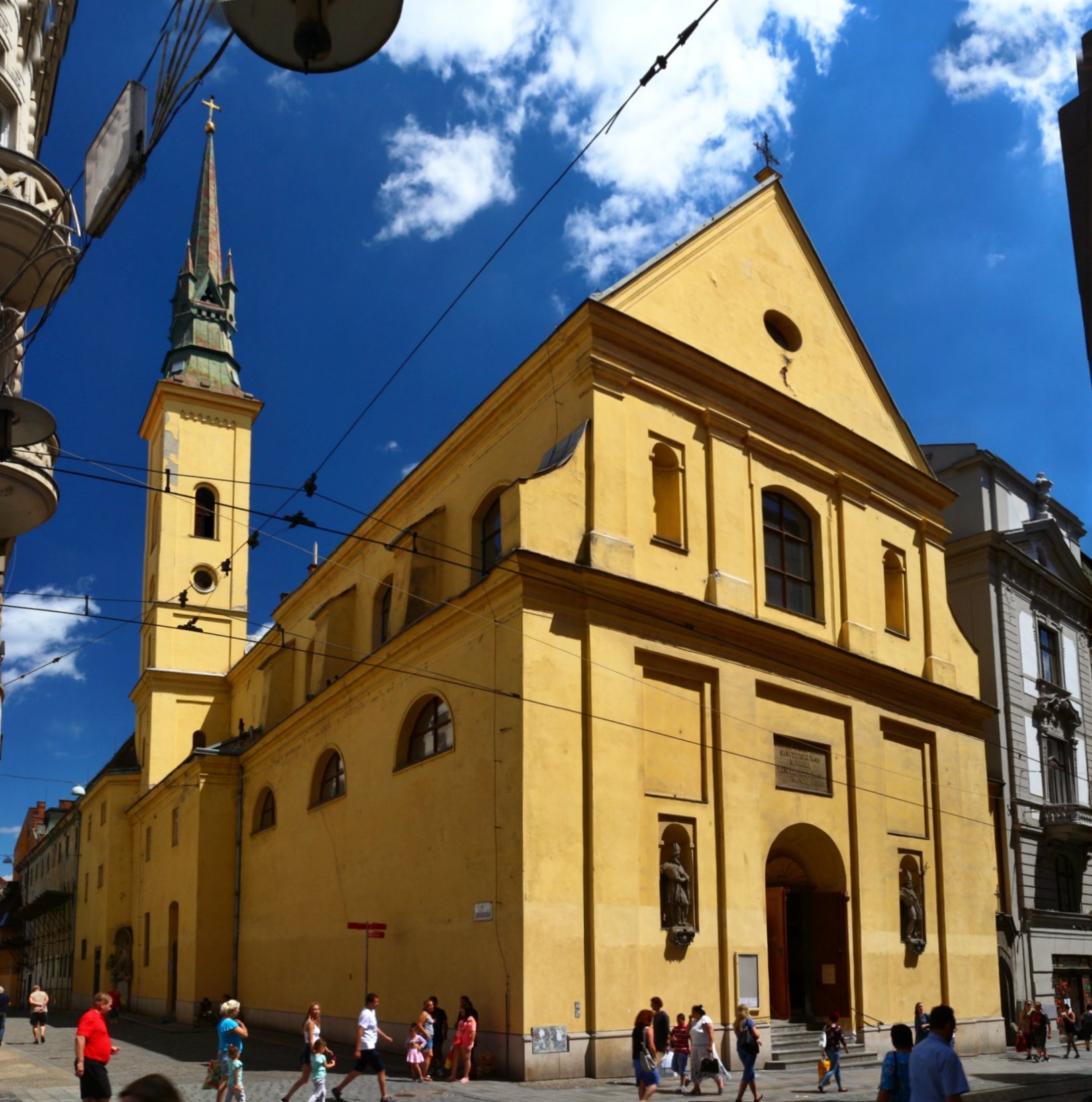
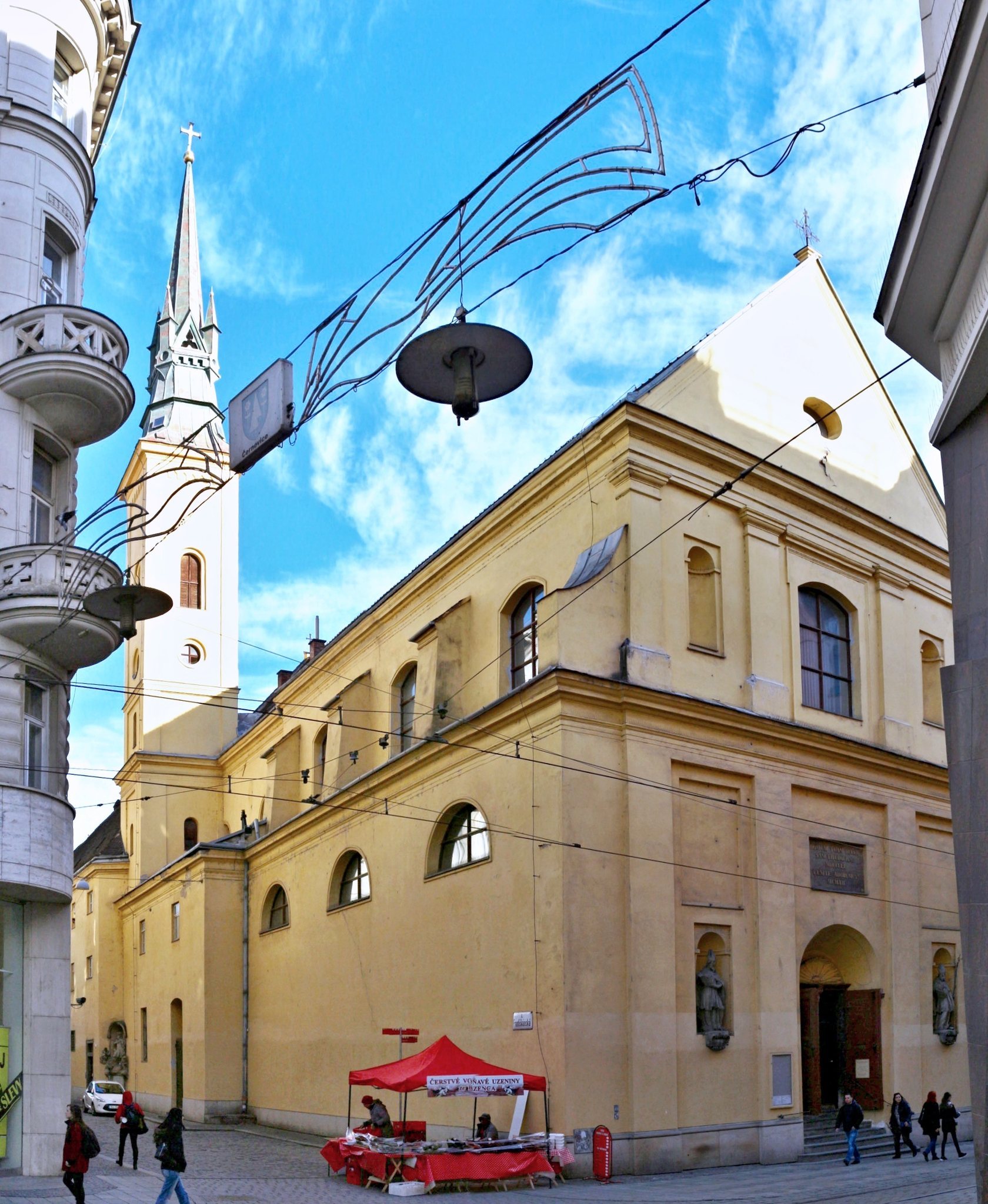
The church stands at the corner of Masarykova and Františkánská Streets. It is an oriented, longitudinal, single-nave Baroque building with a rectangular presbytery, measuring approximately 36 metres in length and 25 metres in width. The altar faces east. Archaeological remains of the earlier synagogue survive in the exposed northern wall along present-day Františkánská Street.
Exterior and archaeological remains
West facade
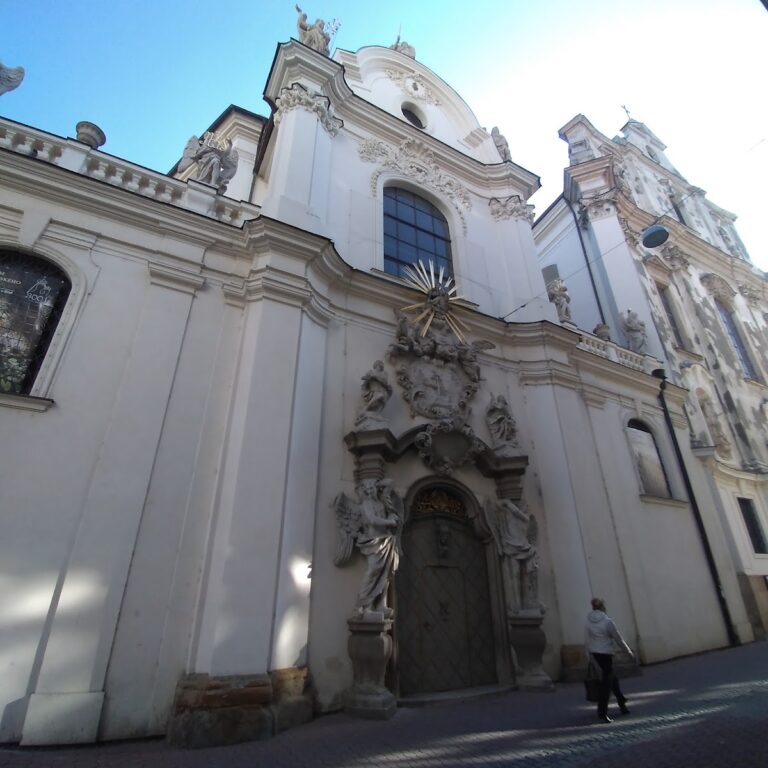
The west facade was simplified after the fire of 1852. Its plain ground floor is articulated by pilasters and recessed panels containing niches. A profiled cornice separates it from the first floor, which repeats the composition. The facade is crowned by a triangular pediment. The side facade is similarly plain, apart from semicircular chapel windows and windows set between the piers of the nave.
Tower and entrance plaque
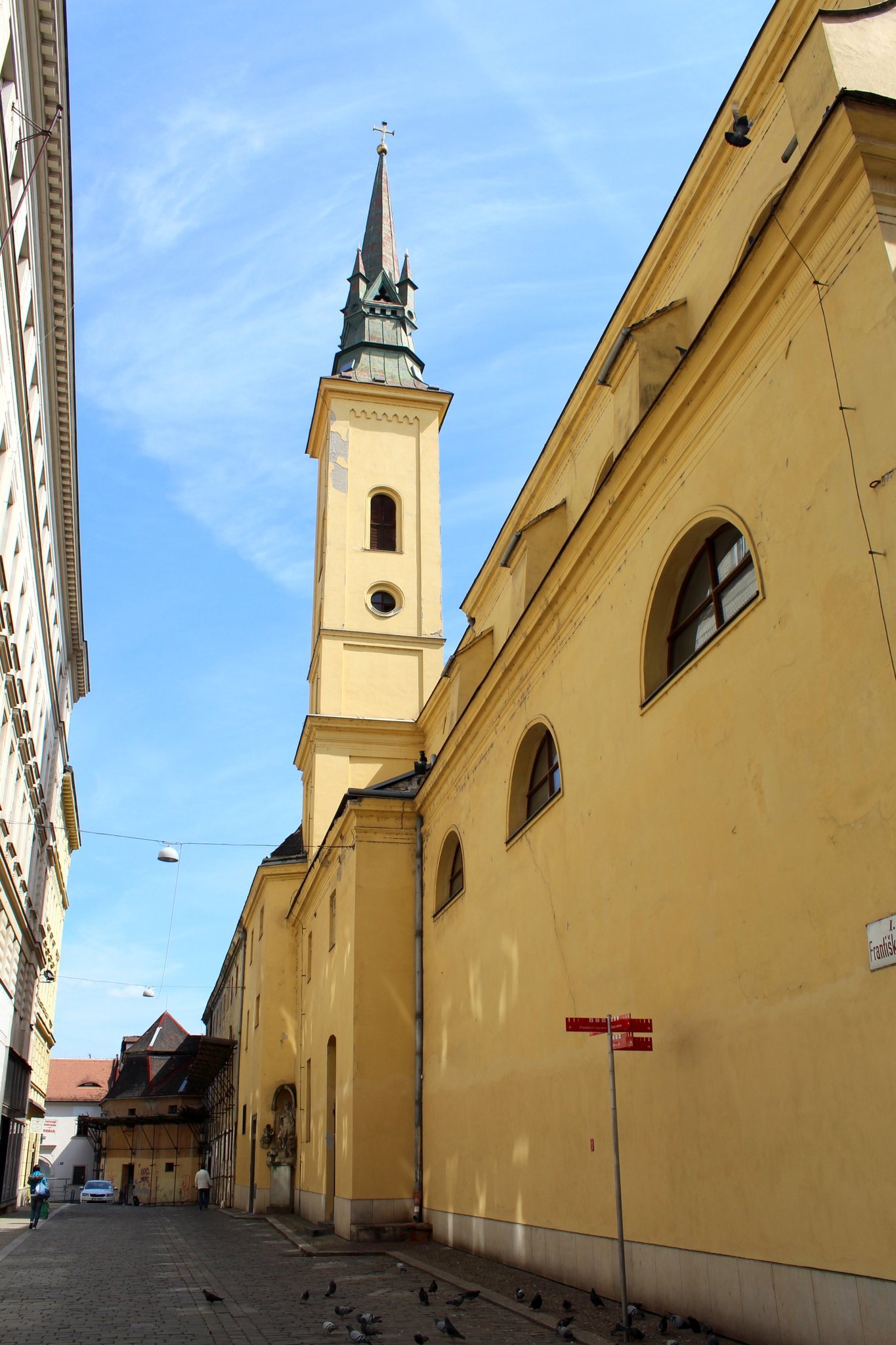
The church tower has a Neo-Romanesque helm dating from the rebuilding after the 1852 fire. Above the main entrance, a stone plaque carries the Latin inscriptions “Domum tuam decet SANCTITUDO,” dated 1851, and “Venite Adoremus,” dated 1912. The first refers to Psalm 92:5. The second probably refers to Psalm 95:6 and commemorates the beginning of the Eucharistians’ service at the church.
Facade sculpture and Saint Florian
Statues of Saint Nicholas of Myra and Saint Martin of Tours occupy the facade niches. They were transferred there in 1870 from the demolished Church of Saint Nicholas on present-day Freedom Square. The Brno sculptor Ondřej Schweigl made them around 1760.
A limestone statue of Saint Florian with two angels stands in a niche beside the church wall on Františkánská Street. Antonín Riga made it in the first quarter of the eighteenth century. The left angel pours water from a shell onto a burning house, while the right angel holds a millstone. Saint Florian was a Christian martyr traditionally invoked for protection against fire.
Synagogue wall and adjoining spaces
The exposed northern wall of the former synagogue runs along present-day Františkánská Street and forms part of the archaeological remains of the site. Sacristies and the Chapel of Saint Jude Thaddeus adjoin the sides of the church. A passage along the south side was bricked up in 1812, and a staircase to the organ gallery was built there in 1932.
Interior structure and furnishings
Nave and presbytery
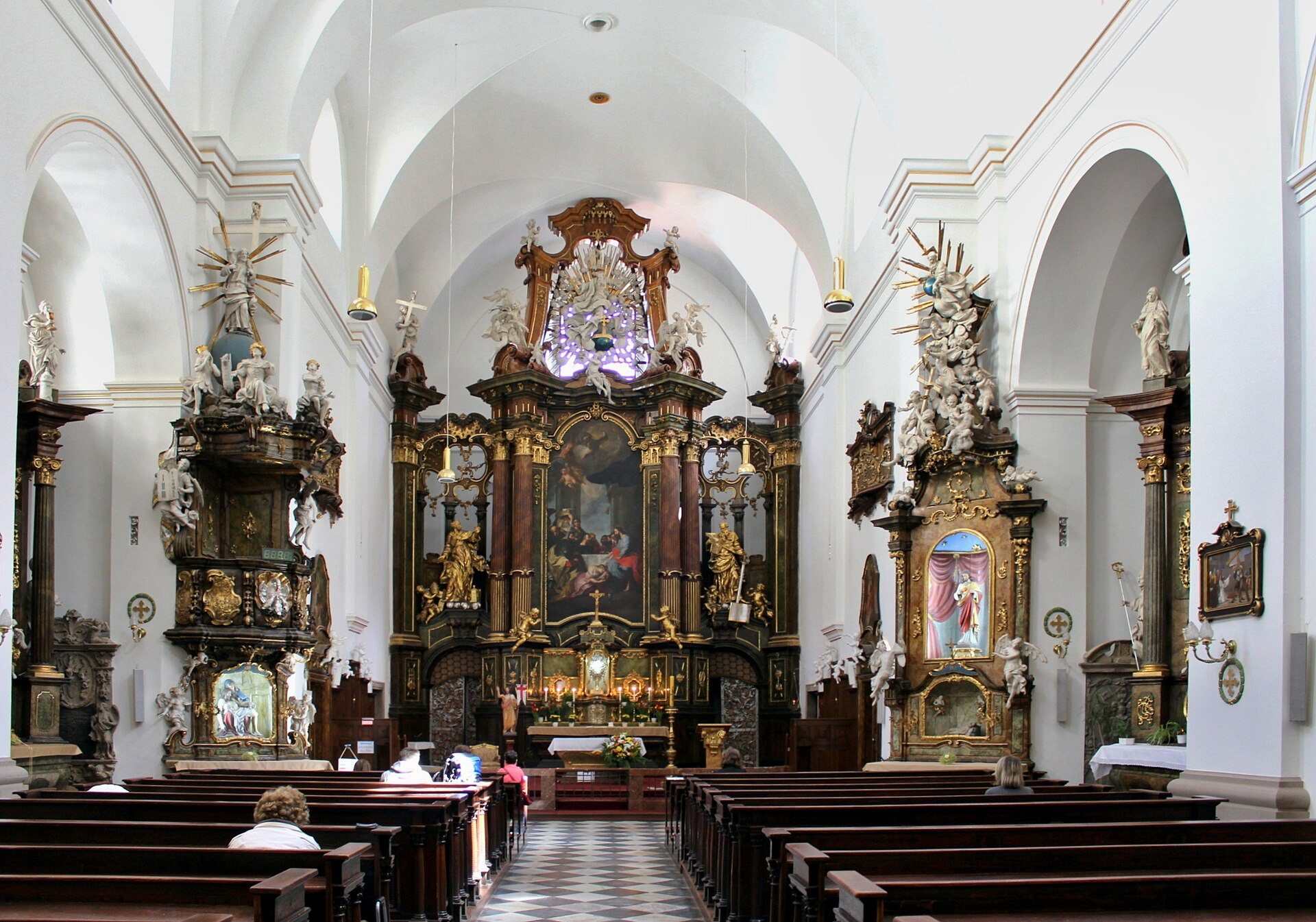
Inside, shallow chapels are separated by pilasters. The nave and presbytery have barrel vaults with lunettes, and a profiled cornice runs around the entire church. The elongated presbytery has entrances to side spaces, with oratories, or small spaces for private or restricted prayer, above them. The interior has no painted decoration. Most of the original decoration financed by Brno townspeople after the mid-seventeenth-century construction has not survived, while the earliest surviving furnishings date mainly from the first two decades of the eighteenth century.
Organ gallery and pews
The west end is occupied by the organ gallery inserted in 1932, with openings for the side altars. Its organ was made in 1935 by the František Rieger firm of Krnov. The church also contains a group of carved Baroque pews dating from around 1700.
High altar
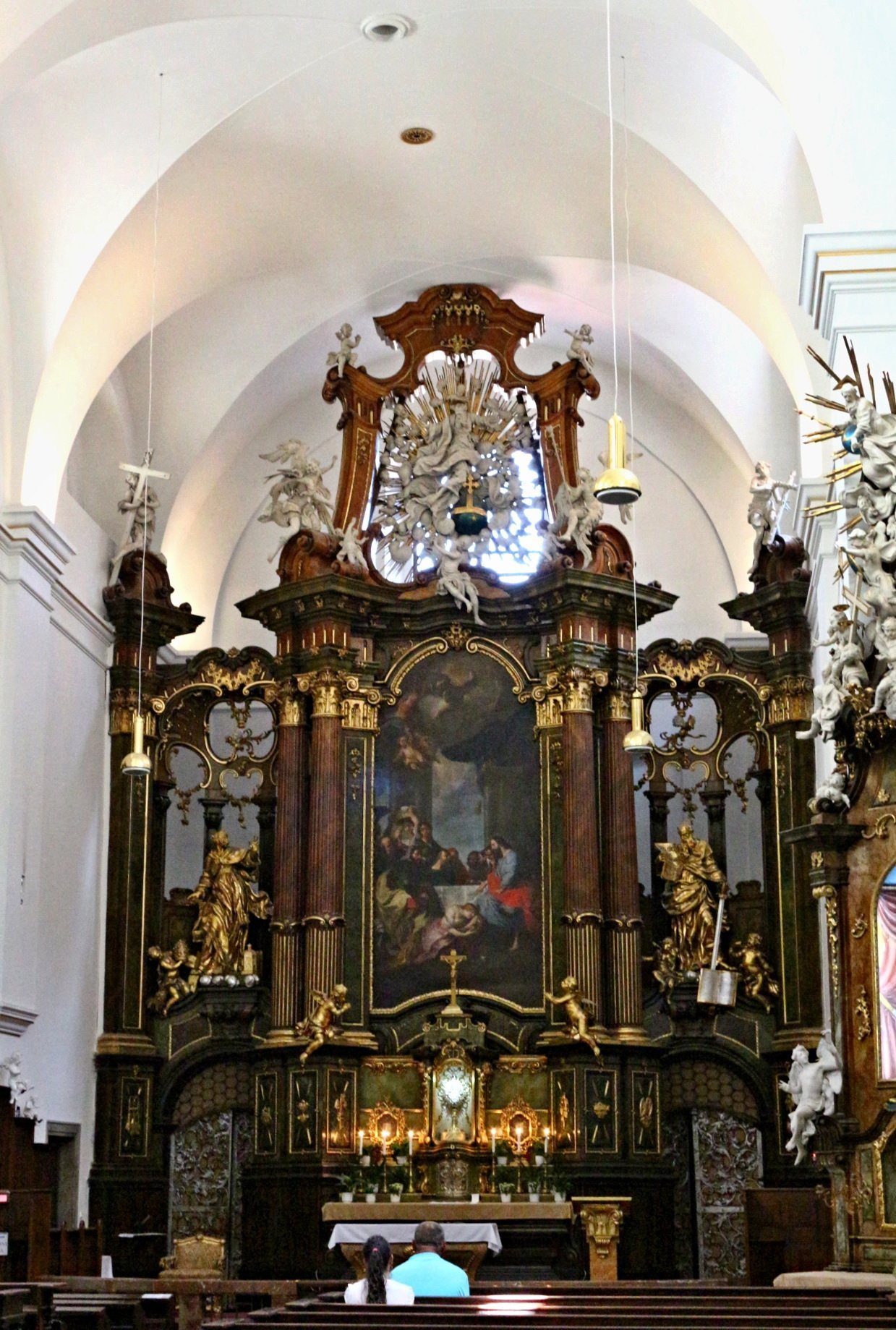
The high altar was made in 1763 by Ondřej Schweigl and Josef Stern. Its wooden, columned retable, the sculptural and architectural structure behind an altar, carries gilded wooden statues of Saints Peter and Paul, angels, cherubs, and a glory with God the Father. Pairs of penitents stand on voluted projections, and the tabernacle door bears a relief of the Sacrifice of Isaac.
Josef Stern painted the high-altarpiece canvas in 1763. It depicts the Feast in the House of Simon the Pharisee, in which Mary Magdalene washes Christ’s feet. Stern adapted the composition from a painting by Peter Paul Rubens, using a sketch then kept in Vienna. His vertically composed canvas omits several figures, and he received 400 florins for the work. The painting was removed from the altar after the structural emergency of 2019 and hung beneath the organ gallery.
Altar of the Sacred Heart of Jesus
The Altar of the Sacred Heart of Jesus originated as Jakub Scherz’s Ecce Homo altar of 1706, while its sculptures date from 1767. The original late Gothic statue of the Suffering Christ was replaced by a modern statue of the Sacred Heart. The upper section contains angels, an allegorical figure of Faith, the Archangel Michael, and God the Father. A newer statue of Christ in the Tomb, flanked by two angels, occupies the lower niche.
Altar of the Immaculate Conception
The Altar of the Immaculate Conception of the Virgin Mary is associated with Antonín Riga, Ondřej Schweigl, and Josef Stern and dates principally from 1761. Its central niche contains a statue of the Immaculate Virgin, probably from the early eighteenth-century Minorite monastery. Older statues by Riga, identified as Saints John the Baptist and Zacharias, flank the retable. The upper section includes Riga’s allegory of Hope and Saint Barbara.
Schweigl added an angel with a crescent moon and Marian monogram, as well as a tabernacle containing an anonymous early-eighteenth-century painting of Saint John of Nepomuk with adoring angels. Stern painted the cartouches of Saints Wenceslaus and Procopius on the mensa in 1761.
Altar of Saint Francis of Assisi
The Altar of Saint Francis of Assisi dates from 1759 and combines work by Antonín Riga, Ondřej Schweigl, and Josef Stern. Stern’s central painting, made in 1759, depicts the Vision of Saint Francis of Assisi. Older Riga sculptures accompany it, probably representing Saints Bonaventure and Louis of Toulouse, with Saint Elizabeth or Saint Agnes and Saint Clare above.
Schweigl made the tabernacle, which contains a modern 1912 painting of Saint Peter Julian Eymard, together with statues of adoring angels. Stern’s paintings of Saint Teresa and Saint Margaret of Cortona, dating from 1759 to 1761, occupy the cartouches.
Altar of Saint Joseph
The Altar of Saint Joseph is associated with Ondřej Schweigl, Jakub Scherz, and Josef Stern and dates from 1761. Stern painted the Holy Family in a Carpenter’s Workshop. Schweigl made sculptural groups of the Archangel Raphael with Tobias and the Guardian Angel with a child. He also created a grotto niche containing the plague saints Saint Rosalia, Saint Sebastian, and Saint Roch.
A glazed frame contains Saint Kinship, a late work by Jan Kryštof Handke. Scherz made the angels holding an axe and saw, symbols of Joseph’s carpentry.
Altar of Saint Anthony of Padua
Jakub Scherz made the Altar of Saint Anthony of Padua in 1758, with a painting by František Antonín Palko. The altar includes statues probably representing Saints Francis Solanus, Peter Aureolus, and Ivo of Kermartin, together with probable personifications of Faith and Charity. A glazed cabinet contains a copy of the Infant Jesus of Prague.
Altar of Saint John of Capistrano
The Altar of Saint John of Capistrano combines work by Ondřej Schweigl and Josef Stern and dates from 1761. Stern’s painting shows Saint John of Capistrano blessing the Moravian coat of arms. Schweigl made the accompanying statues of Saint James of the Marches and Saint Bernardine of Siena, as well as the angels with military attributes above.
A modern copy of the icon of Our Lady of Perpetual Help occupies another position on the altar. One of the two cartouches made in 1761, depicting Saints Catherine and Barbara, was stolen before 2000. The surviving painting was moved to storage.
Altar of the Holy Cross
The Altar of the Holy Cross combines work by Ondřej Schweigl and Josef Stern from 1760, with alterations made in 1770. Its centre contains an early-sixteenth-century late Gothic Crucifix accompanied by Schweigl’s statues of the Virgin Mary, Saint John the Evangelist, and angels.
Stern painted the Calvary with Saint Longinus as its background in 1760. He also painted the souls in purgatory being comforted by angels on the mensa. The figures in this work show the influence of Josef Winterhalder the Younger, who was then working in Stern’s studio.
Pulpit
The pulpit dates from 1701 and is associated with Antonín Riga and Jakub Scherz. Its breastwork bears a relief of a pelican feeding its young with its own blood. Four personifications of the continents stand on the canopy, which is crowned by Riga’s statue of Christ as the Good Shepherd from the 1720s.
Between 1767 and 1770, Scherz added reliefs of the Annunciation, the Adoration of the Shepherds, the Crucifixion, and the Resurrection of Christ. He also added angels holding the tablets of the Ten Commandments and a chalice. The lower niche originally contained adoring angels and now holds a Pietà from the second half of the nineteenth century.
Funerary monuments
Three funerary monuments or epitaphs remain in the church. The monuments of Count Kaspar Friedrich of Lamberg, who died on 28 July 1686, and Countess Franziska Theresa of Lamberg, who died on 14 March 1684, stand on either side of the Altar of the Immaculate Conception. The monument of the royal judge Jan Ignaz Schnoeller of Liechtenau, who died on 4 March 1664, stands to the left of the Altar of Saint Francis of Assisi.