Basilica di San Pellegrino Laziosi: A Servite Basilica in Forlì
Site at a Glance
- Rating
- 4.6
- Popularity
- Low
- Country
- Italy
- Primary era
- Medieval
- External website
- Open
- Eras represented
- Medieval, Early Modern, Modern
- Civilizations
- Papal States
- Site type
- Religious
- Remains
- Basilica
On this page14 sections
History
The Basilica di San Pellegrino Laziosi is a medieval church in Forlì, Italy, built and developed by the Servants of Mary, a Catholic order founded in the thirteenth century and closely associated with devotion to the Virgin Mary. Its earliest references date to 1275 and 1288, when the convent appears in records concerning a wax tribute and the repayment of money by a Florentine convent. Today the church is dedicated to Saint Peregrine Laziosi, a fourteenth-century Servite friar associated with miraculous healing, but it was long known as Santa Maria dei Servi and Santa Maria di Campostrino.
Origins of the Servite Complex
The name Santa Maria di Campostrino derived from Campo Ustrino, an area associated with an ancient Roman cremation ground. Before the Servants of Mary occupied the site, an earlier hermitage belonging to religious followers of Saint Bernard had stood there. That community was later abandoned, allowing the Servites to establish themselves on the edge of thirteenth-century Forlì near Borgo Cotogni. The relatively peripheral and isolated position suited a humble order whose life retained a semi-eremitical character.
The church and convent probably continued on the same site from the late fourteenth century onward. The arrangement of the facade and chapter room supports this continuity, although the original form and later extension of the choir remain uncertain. The original floor lay below the present level. Excavations made when the floor was replaced in 1914 reached 20 centimetres beneath the later surface without locating the earlier floor.
In 1463, thirty-two Observant Servite friars arrived at the convent. The term Observant refers to a reforming branch that sought stricter adherence to the order’s rule. Zaffira, the second wife of Pino III Ordelaffi, was buried in the church in 1473, although her burial has not survived. The funerary monument of Luffo Numai, made in 1502, remains in the building.
Sixteenth-Century Building and Decoration
The Forlì architect Cristoforo Bezzi shaped parts of the convent complex during the early sixteenth century. He constructed the cloister, a chapel, and a tomb in 1508, added another section of the cloister in 1523, and built a further chapel in 1515. His work inside the church has not survived, although part of his portico remains incorporated into the chapter area.
The chapter room had existed beside the church by the fourteenth century and acquired its present fifteenth-century form before Bezzi’s interventions. It later became an important setting for paintings and for the Crucifix associated with Peregrine’s healing. The church also retained a fourteenth-century wooden choir and early paintings that preserved links with its medieval foundation.
Baroque Transformation
Several side chapels were built during the seventeenth century. The most important was the chapel dedicated to Pellegrino Laziosi, then still a beatus, constructed by Cesare Pritelli between 1626 and 1639. By 1645 the church had taken on much of its present Baroque character and had lost most of its earlier Gothic appearance.
In 1700 the Albicini family considered rebuilding the high altar and placing there a painting of Pellegrino Laziosi made by Carlo Cignani in 1670. The plan was abandoned, and the painting remained in the family’s private collection. Francesco Antonio and Felice Andrea Bondi decorated the dome of Pellegrine’s chapel between 1715 and 1721. In 1719 Giuseppe Merenda enlarged the chapel and added stucco decoration, and in 1723 Peregrine’s body was placed there.
Peregrine was canonized in 1726. A new altar for his chapel was inaugurated in 1742, when his body was placed in a case and the decorative program was expanded. Angelo Piò’s statue of the Addolorata was acquired in 1751, and a new high altar was made in 1754. Gaetano Callido of Venice built the present organ in 1781, replacing an instrument made in 1625 by Antonio dal Corno, known as Colonna Veneziano.
Suppression, Restoration, and Continued Devotion
The convent was rebuilt in 1793 to a design by Ruffillo Righini of Forlimpopoli. Napoleonic suppressions, measures that dissolved religious institutions under French rule, forced the friars to leave in 1798. They returned in 1836 after repurchasing the convent, but another suppression in 1866 expelled them again. The former convent became a courthouse, and Peregrine’s cell was lost.
A plan to turn the church into a gymnasium led to the transfer of Marco Palmezzano’s Annunciation and Francesco Menzocchi’s Holy Family to the civic picture gallery. Giuliano da Rimini’s fresco in the chapter room was also removed, but it returned to its original position in 1966. The Servants of Mary resumed worship in the church in 1893 and obtained a small convent beside it in 1921, after temporarily living in a private house.
In 1880 Peregrine became a co-patron of Forlì through the initiative of Pope Leo XIII. A relief of the Madonna del Fuoco was brought into the church from the exterior of the municipal palace in 1898. Because of its artworks, the sanctuary was declared a national monument, and Pope Paul VI raised it to the rank of minor basilica in 1977. A minor basilica is a church granted a special honorific status because of its religious, historical, or artistic importance, distinct from a cathedral, which is the seat of a bishop.
Restoration directed by Francesco Graziani and Sergio Belacchi under the supervision of the Ravenna heritage authority began in 1982 and lasted about a decade. The work replaced the floor with Tuscan terracotta, repainted the interior, and adapted the electrical system before the church reopened for worship. Since 2009 the church has been administered by Servants of Mary from the Philippines, where devotion to Saint Peregrine is particularly strong. A relic carried there by Servite missionaries in 1984 helped generate devotion and was later kept in a parish dedicated to the saint.
The principal feast of Saint Peregrine takes place on 1 May. During the celebration, the square and nearby streets traditionally fill with market stalls, while cedars are sold as symbols of the saint because of their reputed healing power.
Remains
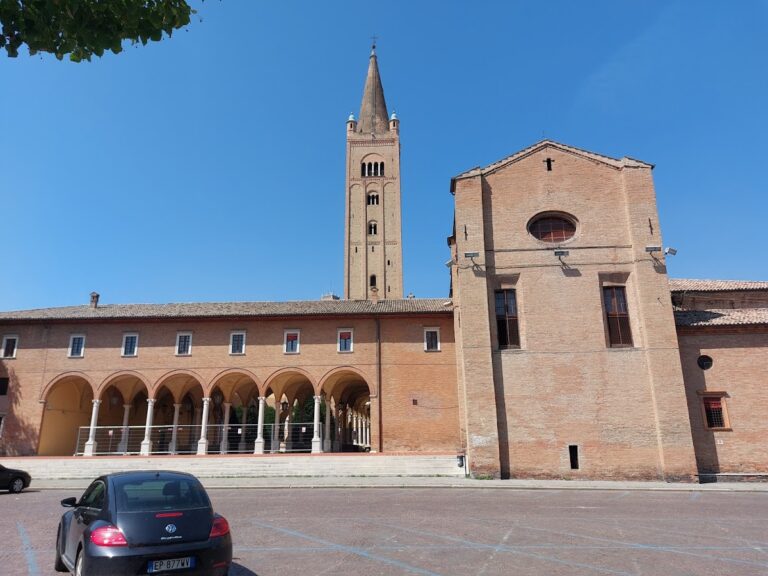
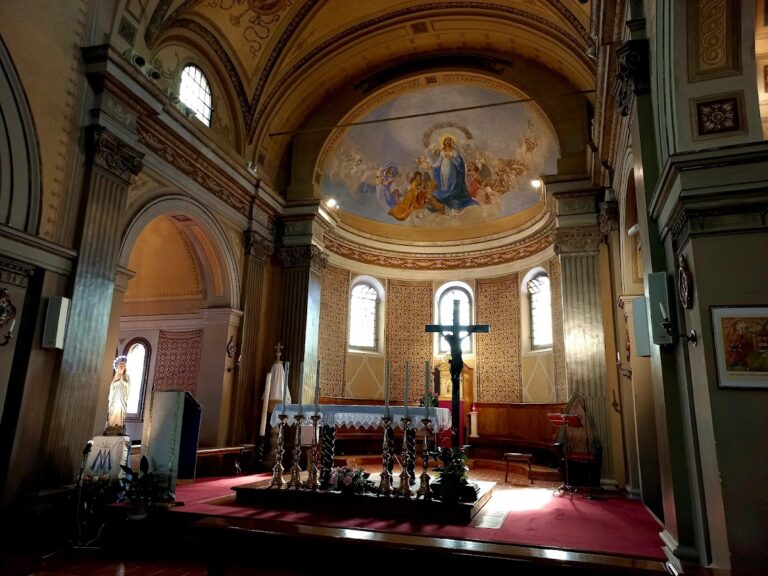
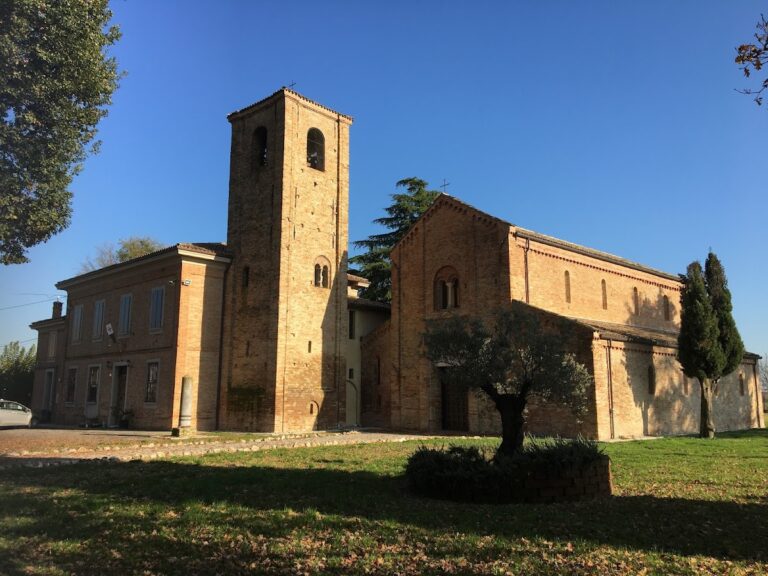
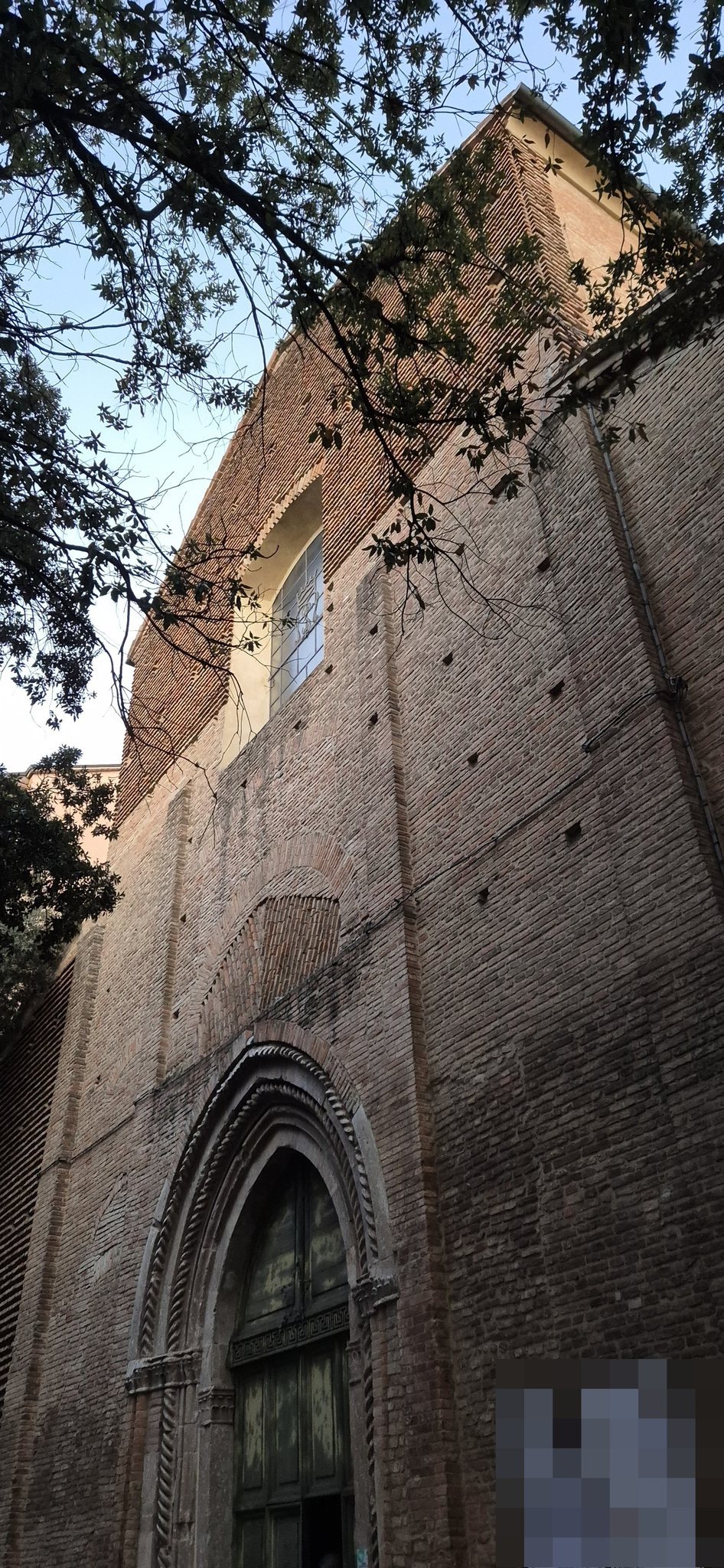
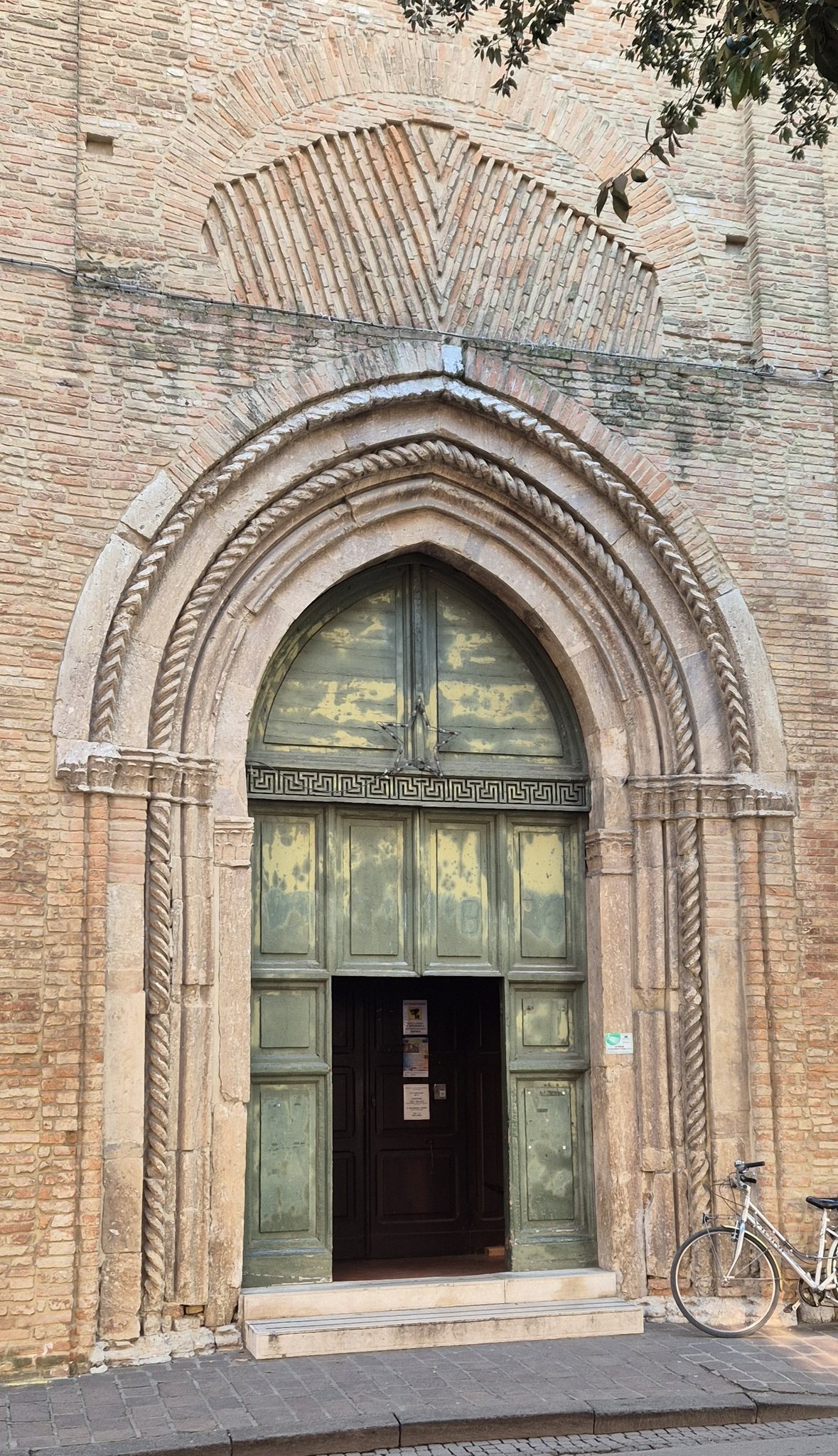
The basilica combines a Gothic exterior with a predominantly Baroque interior. Its brick facade is arranged in stepped sections and retains a Gothic portal from the earlier church, with a pointed arch and twisted ornamental mouldings. Other buildings adjoin the church, while a bell tower rises behind it. Giuseppe Cantoni designed and built the tower in 1856 and 1857. Inside, three naves lead toward the apse, and ten side altars line the church.
The Nave and Chapels
Right-Hand Altars
The funerary monument of Luffo Numai stands on the right side of the church. Tommaso Fiamberti and Giovanni Ricci sculpted it in 1502. The first altar contains Domenico Cresti’s 1624 painting of the Madonna della Ghiara with the blessed Andrea Avellino and Gioacchino Piccolomini. The image shows Mary kneeling before the Christ Child, with Saint Joseph behind them, while two angels draw apart a green curtain. Below them appear Gioacchino Piccolomini with a closed book and lily and Andrea Avellino as a priest holding a chalice. The gilded altarpiece has columns, foliage scrolls, cherub heads, a relief of a dove, and two flaming vases. The Serughi family, whose coat of arms is carved on the altarpiece, owned the altar.
The second chapel was commissioned by Marcello Nicolini and Giovanni Tolsi and is dedicated to the Madonna della Purification. Its former terracotta image of the Madonna was later moved to the passage leading to the chapter room. The third chapel contains the body of Saint Peregrine Laziosi, placed there in the eighteenth century. Its dome bears the Glory of Saint Peregrine by Francesco Antonio and Felice Andrea Bondi. The saint rises among cherubs toward the Virgin, while angels offer him a scapular and a book and others play musical instruments. The illusionistic painting uses bright colours.
Four yellowish monochrome frescoes in the apse basin show episodes from Peregrine’s life. They depict the dead saint rising to heal a blind man, the Virgin appearing to the young Peregrine, an angel showing him the way to the hermitage, and the saint saving a man who has fallen from a tree. The altar front has sculptures by the Ravenna artist Domenico Todeschini, including two cherub heads and two coats of arms belonging to Giorgio Viviani Marchesi, who donated the work.
Left-Hand Altars
The fifth chapel on the left contains a sixteenth-century wooden altar with a blue-painted altarpiece, gilded reliefs, and additional decoration. Its painting by Francesco Fiorentini, known as Il Prete di Sant’Antonio, shows the seven founders of the Servants of Mary kneeling below the Virgin and angels carrying instruments of the Passion. The fourth chapel is dedicated to Saint Anthony of Padua and contains a canvas by Felice Andrea Bondi showing the saint with the Christ Child and the Virgin.
The second chapel contains Bondi’s altarpiece of Saint Philip Benizi with the Annunciation, set within a gilded wooden frame. The frame and painting are too large for the chapel, suggesting that they may have been made for another location. The first altar formerly held Marco Palmezzano’s Annunciation. After that painting was transferred to the civic picture gallery in the nineteenth century, Angelo Piò’s statue of the Addolorata was placed there, later moved behind the high altar, and eventually replaced by a terracotta Madonna of the Purification dating from 1500.
The terracotta statue shows Mary holding the Child, who carries a small bird in his right hand. The position of his left hand suggests that a second bird may originally have been present. The imagery relates to the legend of the robin whose feathers were stained by Christ’s blood. Mary’s face combines sorrow on the left side with cheerfulness on the right, expressing grief and joy together. Beneath the statue stands a painted wooden image of Saint Giuliana Falconieri, made in the early twentieth century by Luigi Santifaller. Giuliana lived in the thirteenth century and founded the women’s branch corresponding to the Servants of Mary.
Peregrine’s Healing
Giovanni Pritelli’s painting of Saint Peregrine healed by the Crucifix shows the elderly saint supported by angels while Christ appears to reach from the cross toward Peregrine’s gangrenous leg. The figures and their gazes follow an ascending diagonal, strengthened by the direction of the light. The scene gives visual form to the healing tradition connected with the saint and the crucifix preserved in the chapter room.
Presbytery, Choir, and Organ
The wooden choir dates from the fourteenth century and is described as the only Gothic example in Romagna and possibly the oldest in the region. Made from carved and inlaid walnut, it occupies the perimeter of the apse near the high altar. Its upper level contains twenty-seven backed stalls with forms resembling bifora windows, and it includes a walnut lectern from the seventeenth century.
Eight paintings in the presbytery by Paolo Cignani depict the Seven Sorrows of the Virgin and an angel announcing indulgences. The eighteenth-century organ by Gaetano Callido stands in a masonry case in the rear gallery. It replaced the earlier instrument made by Antonio dal Corno in 1625.
The sacristy was entirely renewed in 1975 but retains solid walnut furnishings from the seventeenth and eighteenth centuries. Its principal artwork is Francesco Trevisani’s large 1719 canvas Glory of Saint Peregrine. The painting presents the saint in a Baroque manner, with an aged but noble face, outstretched arms, and the prominent black habit of the Servants of Mary.
Cloister and Chapter Room
The Cloister
Only part of the cloister survives. One side remains outside the church, later enclosed by railings and glass, while three arches adjoin the church body. One arch is blocked and another opens into the chapter room. The outer section was completed in 1508 and the part beside the chapter room in 1523. The remaining sides were demolished during eighteenth-century alterations to the convent.
Thirty-two lunettes painted in 1607 show episodes from the life of Saint Peregrine. The cloister was accessible to the public as well as to the friars. Several paintings survive in damaged condition, including a relatively well-preserved scene of the young Peregrine meeting Filippo Benizi. A fourteenth-century fragment from a Giotto-influenced workshop predates the cloister. It belonged to a larger Maesta, an image of the Virgin enthroned with the Child, and preserves the Virgin’s face and a lively angel holding drapery.
The Chapter Room
The chapter room, the meeting room of a religious community, is quadrangular and has a fifteenth-century sail vault ending in terracotta corbels. The Albicini family coat of arms occupies its centre. The room preserves Giuliano da Rimini’s 1308 fresco of Christ crucified with Mary and John, the miraculous Crucifix associated with Peregrine’s healing. Detached in 1888 for transfer to the picture gallery, it was later returned to its original position.
The Crucifix may once have formed part of a larger wall decoration that was later lost and replaced by partly surviving sixteenth-century frescoes. The original composition probably continued to the foot of the cross and included the bodies of Mary and John. Its Giotto-influenced character appears in the rounded treatment of Christ’s body and the three-dimensional effect of the cross. The gilding and punched decoration of the halo have disappeared. The background now contains an apparently later view of Forlì and was probably originally blue.
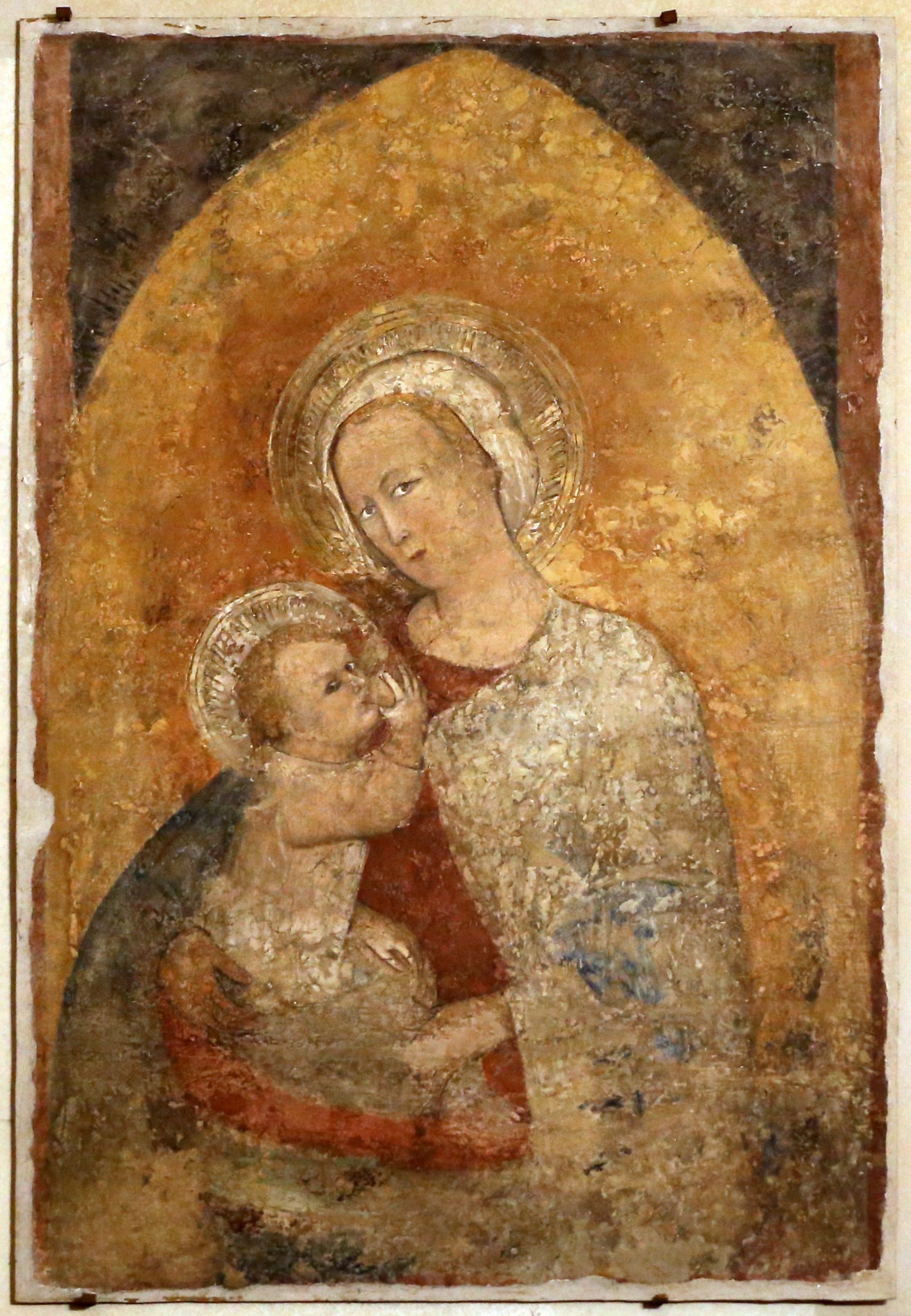
Two fourteenth-century Madonna of the Milk frescoes are also preserved in the chapter room. One, attributed to a Romagnolo painter of the Giotto-influenced school, shows Mary and the Child within a Gothic arch facing the viewer. It was formerly elsewhere in the convent before being detached and installed in the chapter room. The other originally decorated a wall in the sacristy and was moved there after its detachment.
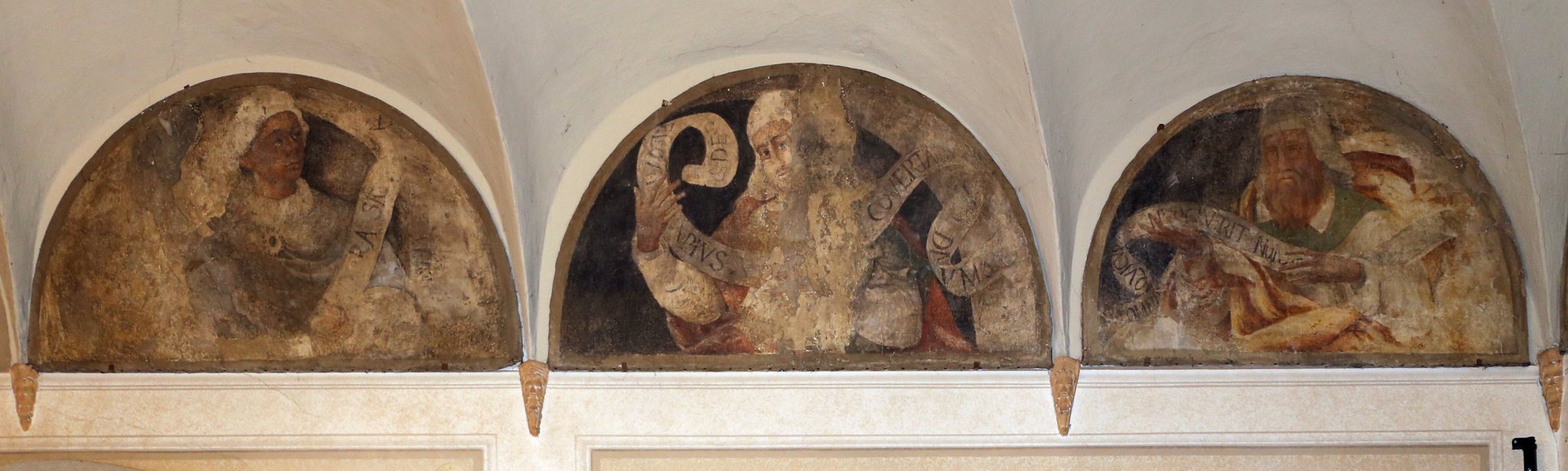
Several badly damaged frescoes in the room are attributed to Livio Agresti and date from 1535 to 1540. The best-preserved panels show Christ Meeting Veronica and the Lamentation of Christ with Peregrine Laziosi in Meditation. The lunettes contain prophets, while other surviving scenes include the Way to Calvary. The paintings use Agresti’s expressive Mannerist treatment of the human body, a style associated with elongated or deliberately artificial figures and compositions.