Església de Sant Genís dels Agudells: A Historic Parish Church in Barcelona
Site at a Glance
- Rating
- 4.4
- Popularity
- Low
- Country
- Spain
- Primary era
- Early Modern
- External website
- Open
- Eras represented
- Early Modern
- Civilizations
- Crown of Aragon, Spanish
- Site type
- Religious
- Remains
- Church
On this page18 sections
History
Església de Sant Genís dels Agudells is a historic Catholic parish church in Barcelona, Spain, whose foundation is traditionally placed in 931. The parish was established within a rural Christian landscape and is mentioned in records from 1017 and 1028. It is regarded as one of Barcelona’s ten oldest parishes. The present church dates from 1571, while its current form and pointed bell tower are associated with rebuilding in 1671.
Origins and medieval parish
The ecclesiastical reorganization begun under Bishop Aeci and formalized at the Synod of Barcelona in 1009 may have provided the institutional setting for Sant Genís dels Agudells. The church was dedicated to Sant Genís and served a rural parish whose territory had originally belonged to the jurisdiction of Sant Andreu de Palomar. Medieval records refer repeatedly to the parish and its lands between 1017 and 1060.
In the mid-eleventh century, Viscount Udalard, his wife Gilla, and their son Guislabert held land and property in Agudells. Guislabert later became Bishop of Barcelona. On 21 January 1056, Udalard and his family sold five mujades of vineyard, cultivated land, and other property with fruit trees in the parish to Ramió. A mujada was a historical Catalan land measure whose size varied according to locality.
Properties inherited by Guislabert may have housed Benedictine monks from Sant Ponç de Tomeres in 1087. Their abbot, Frotard, was a papal legate of Gregory VII and had summoned the monks to Barcelona to reform ecclesiastical structures. They remained in the city until the end of the eleventh century.
Parish boundaries and monastic administration
By the late twelfth century, the parish chaplaincy was attached to the dignity of canon-sacristan of Barcelona Cathedral. This office combined responsibility for the cathedral sacristy with related ecclesiastical administration. The medieval parish extended between the domains of Sant Cugat del Vallès, Sant Vicenç de Sarrià, Sant Pere de les Puel·les, and Sant Andreu de Palomar. Its territory included the Penitents valley, parts of the Vallcarca drainage basin, and the area around the Three Hills.
A judgment issued by Martí on 13 April 1237 settled competing parish rights between Sant Genís and Sant Andreu. Sant Genís received rights over marriage, childbirth, vigils, burials, procuration, and other parish services for several farmsteads. Sant Andreu retained the salpàs, tithes, and first fruits because those properties lay within its territory. The salpàs was a Catholic blessing custom in which salt and blessed water were used during visits to homes around Easter.
Hermits were living on the mountain of Agudells by 1313. In 1386, the hermit Ponç Astars received permission to gather them around a portable altar, and in 1391 the community acquired property under the direction of the priest Francesc Soler. Queen Violant of Bar visited the hermits in 1392 and decided to support the creation of a monastery.
A papal bull issued by Clement VII of Avignon on 28 June 1393 brought the hermits into the Hieronymite order. The Hieronymites were a Christian monastic order formed from hermits and organized under rules influenced by the Augustinian tradition. Their new convent was almost complete by 1398 and later became known as Sant Jeroni de Collserola or Sant Jeroni de la Vall d’Hebron. The monastery increased the importance of the parish, and its prior also served as rector of Sant Genís.
Pope Benedict XIII assigned the parish to the new monastery on 1 March 1396. The monastery took possession of the rectory on 20 March 1398 and administered the parish through perpetual vicars, clerics appointed to serve continuously under another ecclesiastical authority. Queen Maria of Castile supported the monastery with revenues and building materials. The complex also hosted Benedict XII, the Catholic Monarchs, and Emperor Charles I.
War, reform, and the loss of monastic control
In the seventeenth century, Sant Genís continued to dispute rights connected with the salpàs. In April 1633, the priest of Sant Gervasi brought a legal action against the Discalced Carmelites over the alleged inclusion of a particular place within Sant Genís. Important reforms and additions were also made to the church around the middle of that century.
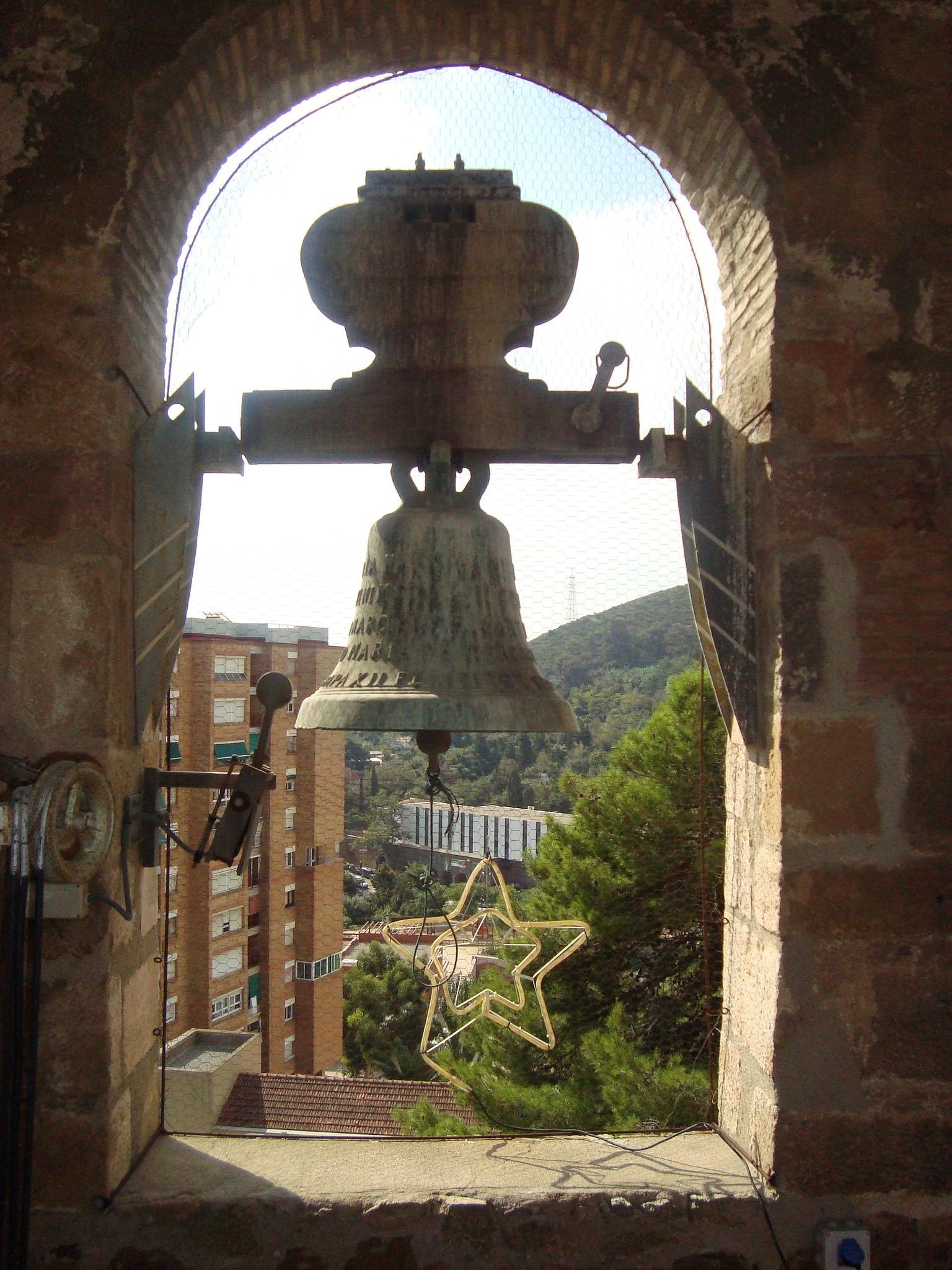
The sieges and wars that affected Barcelona brought death and physical damage to the parish. The church replaced its bells and repaired altars, chapels, and badly damaged roofs. French forces plundered it on 15 April 1698, taking altar cloths, money boxes, bells, candlesticks, ornaments, and confraternity chests. Forces of the Duke of Anjou attacked it again on 4 April 1706, and the siege of Barcelona in 1714 caused further damage.
Between 1770 and 1780, control of the parish passed from the friars back to the bishop. The monastery of Sant Jeroni de la Vall d’Hebron was burned by French forces on 12 August 1808, and Sant Genís was pillaged as well. French administration divided Barcelona and its territory into four cantons, splitting the parish. After the Peninsular War, the Hieronymites returned, but they were expelled during the Liberal Triennium. The monastery then became an infectious-disease hospital. The community was restored in 1824 and dispersed after the convent burnings of July 1835. The confiscations associated with Mendizábal and Madoz later divided the monastery’s properties.
Parish reorganization and the twentieth century
The constitutional reorganization following 1812 removed the Vallcarca settlement and its parish rights from Sant Genís. These territory rights and associated revenues were restored after absolutist rule returned. The parish reform of 1836 established Sant Joan d’Horta as a separate parish, and in 1867 Sant Genís was placed under Horta because its congregation had declined to a small number of farmsteads and scattered dwellings. Vallcarca finally separated in 1912, when the parish of Sant Jordi was established there.
Sant Genís regained full parish status under a new demarcation approved by Bishop Gregorio Modrego Casaus on 9 October 1945. A rector was appointed on 5 July 1946. On 29 March 1984, Cardinal-Archbishop Narcís Jubany signed a decree transferring the highest part of the territory to the parish of the Sacred Heart of Tibidabo and fixing the present boundaries.
The church and rectory were scorched during the violence of July 1936. Furniture, images, documents, and most of the contents were lost, although the architectural complex retains substantial traces of its eighteenth-century appearance. The parish and its buildings are protected as a cultural asset of local interest. The church belongs to the Archdiocese of Barcelona and remains a Catholic institution.
Dedication and cemetery history
The dedication combines two hagiographic identities: Genís the Comedian, a Roman martyr, and Genís the Scribe, a Provençal martyr. Medieval documents refer simply to sancti Genesii, and both commemorations take place on 25 August.
A parish cemetery stood in front of the church by at least 18 April 1060, when land described as two sagreres bordered the burial ground. A sagrera was a protected area around a medieval church where people and property received ecclesiastical protection. In 1386, an episcopal license allowed Ponç Astars to establish a cemetery linked to his hermit oratory while preserving the burial rights of the parish of Agudells.
Barcelona’s parish cemeteries were suppressed in 1775 on sanitary grounds under Charles III and Bishop Josep Climent i Avinent, but rural cemeteries such as Sant Genís were exempted. The cemetery remains separately administered from the municipal cemetery system and continues to receive burials. Manuel Carrasco i Formiguera, a member of Unió Democràtica de Catalunya executed in Burgos in 1938, was buried there until his remains were moved to Montjuïc Cemetery in 2001. Josep Vidal i Granés, a baker from Gràcia associated with the Sant Medir pilgrimage, remains buried there.
Remains
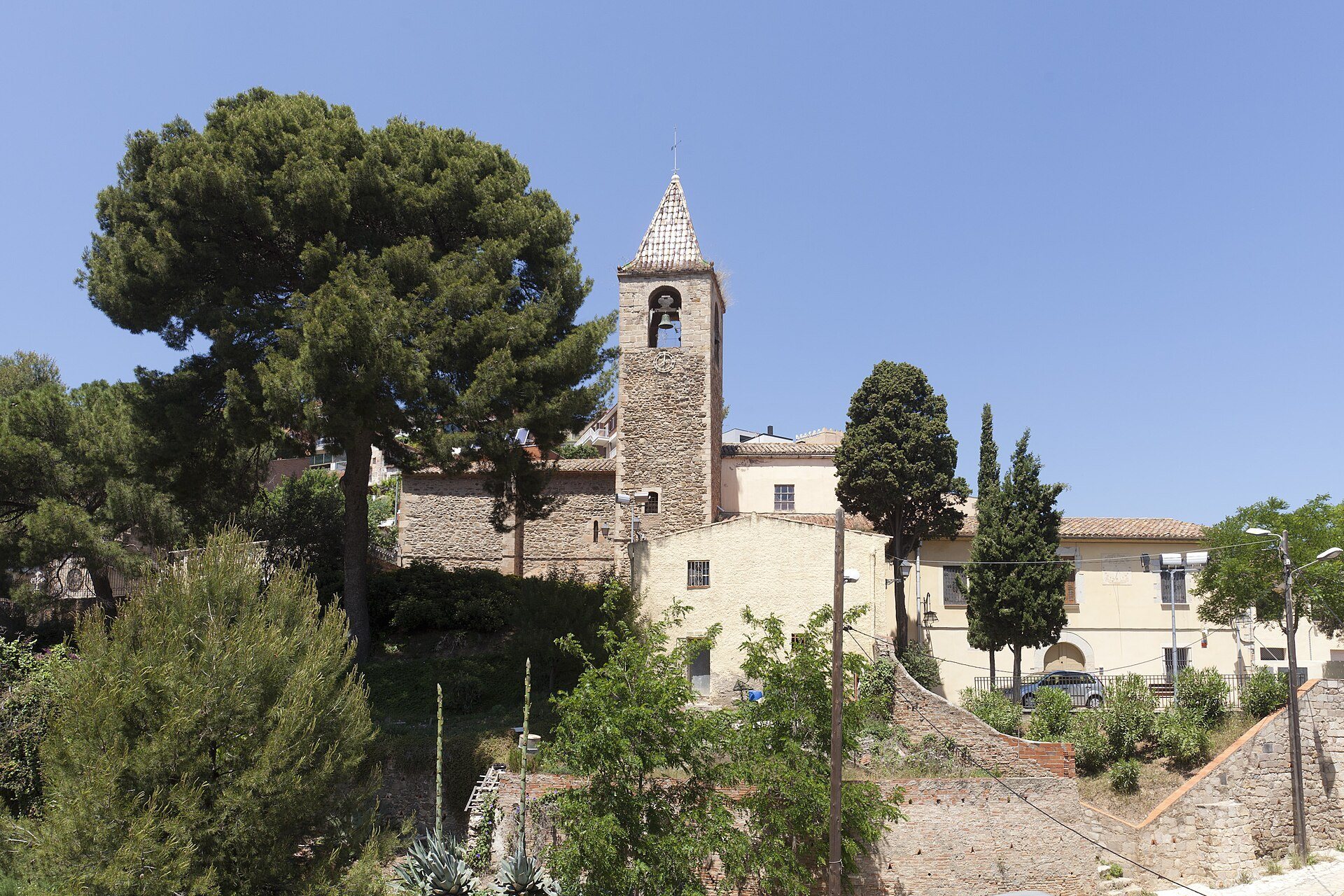
The complex occupies an elevated site beside the former rural parish area and consists of the church, adjoining rectory, parish cemetery, and Can Safont. A stepped passage between the sacristy wall and a neighboring shed leads to the upper level containing the cemetery, church, and bell tower. The shed formerly housed the sacristan and gravedigger. A second stepped path preserves part of the former route from Natzaret Street.
Church and bell tower
Church building
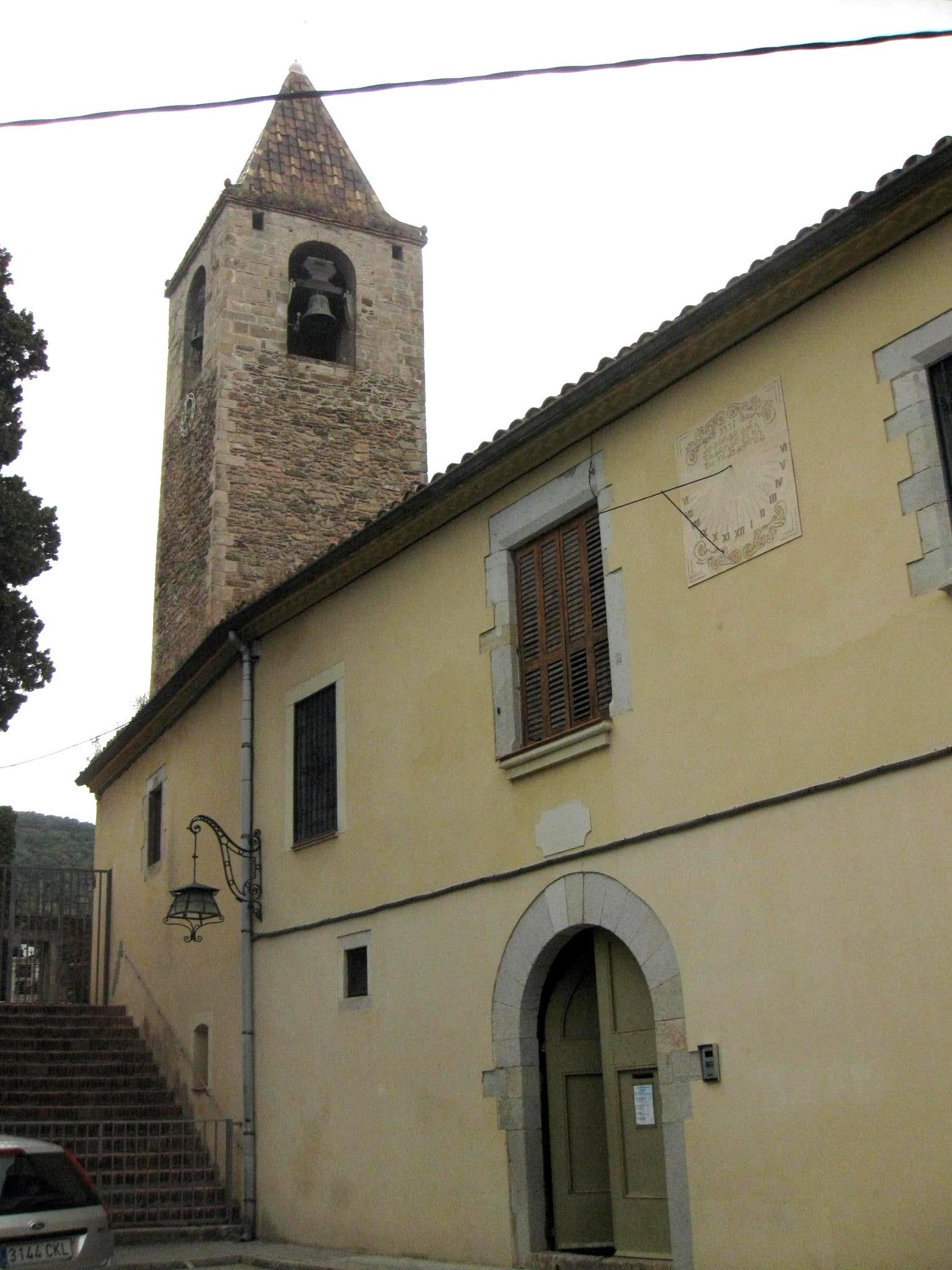
The present church building is dated to 1571, while the form visible today is linked to reconstruction in 1671. It has a single nave, a transept, several chapels, and an entrance formed by wedge-shaped stones, known as voussoirs, arranged in an arch. The facade doorway is surmounted by a stone block carved with a Gothic cross. A sacristy window has the date 1731 carved into its lintel.
Beside the entrance is a roughly carved stone bearing an incision of an ichthys, the fish symbol used by early Christians and traditionally associated with Jesus Christ. Its origin is uncertain, and it has supported theories that a religious settlement occupied the site as early as the third or fourth century. The church’s original furnishings, ornaments, and statuary were largely destroyed in the 1936 fire. An image of Francesc Palau i Quer, the nineteenth-century Catholic priest and founder associated with the Penitents, is preserved in the church.
Bell tower
The square bell tower rises approximately 22 metres and has the distinctive pointed form attributed to the rebuilding of 1671. It is crowned by a slender pyramidal roof covered with glazed ceramic tiles in several colors.
Rectory and access structures
The rectory is a two-storey building with a double-pitched roof, a voussoired portal, and a small forecourt. It stands within a perimeter enclosure that includes a garden and faces a double open square on its south side. The rendered walls contain carefully worked stone around the rectangular windows, including their lintels, jambs, and sills. A projecting roof is supported by an exposed-tile eave and covered with curved Arabic tiles.
Parish cemetery
Cemetery enclosure
The cemetery lies beside the church and contains approximately 1,000 burial niches. It is one of Barcelona’s two surviving parish cemeteries, together with Vallvidrera, and the only one of the two that continues to receive burials while remaining outside municipal ownership. A white-marble piece above the cemetery portal bears the inscription MCCCXXIX. Its workmanship is much later than the date indicated, and it may have been intended to give the cemetery an archaic appearance and distinguish it from the burial ground associated with the Hieronymites.
Burial places and commemorations
The cemetery includes the former burial niche of Manuel Carrasco i Formiguera and the grave of Josep Vidal i Granés. The parish holds an annual November mass for people buried there, followed by a meeting of holders of burial concessions. These practices continue the cemetery’s role as a parish burial ground within the surviving historic complex.
Can Safont and water features
Can Safont
Can Safont is a farmhouse known from the thirteenth century. It has been heavily altered and restored and forms part of the access area to the rectory and school grounds. The building currently houses an apprentice school dependent on the Diocese of Barcelona.
Can Safont spring
The Can Safont spring is the only living spring identified at Sant Genís dels Agudells. It was known from the thirteenth century and was partly owned by the monastery of Sant Jeroni during the seventeenth and eighteenth centuries. It later supplied the neighborhood. Other associated water features include seepage springs, mine springs, and wells, most of them dating from the nineteenth and twentieth centuries.
Lost devotional object
The small wooden image known as Our Lady of the Good Death was probably carved in the thirteenth or fourteenth century and was venerated in the church until it disappeared in the 1936 fire. The dressed figure had lost its original crown, held a skull in its right hand, and carried an added figure of the Christ Child on its left arm.