Esterházy Mansion, Tata: A Baroque Noble Residence in Hungary
Site at a Glance
- Rating
- 4.8
- Popularity
- Medium
- Country
- Hungary
- Primary era
- Early Modern
- External website
- Open
- Eras represented
- Early Modern
- Civilizations
- Hungarian
- Site type
- Domestic
- Remains
- Elite Residence
On this page11 sections
History
Esterházy Mansion is a Baroque residence in Tata, Hungary, built for the Esterházy family between 1760 and 1776 on the site of a former castle. The major Hungarian noble family owned estates in Tata, and the mansion later became the setting for imperial negotiations, military headquarters, a royal detention, and successive institutional uses.
Construction for the Esterházy family
In the early 1760s, Count Miklós Esterházy commissioned the architect Jakab Fellner to design a large new mansion. Fellner prepared four versions of the plans, but the death of Count Esterházy in 1764 and a lack of funds prevented their complete realization. The building reached its present form in 1776. Stone from the adjacent fortress was used during construction.
Imperial residence and military headquarters
From 22 August to 21 November 1809, Emperor Francis I of Austria and King of Hungary stayed at the mansion with Queen Maria Ludovika while retreating from Napoleon. On 14 October, Francis I signed the Treaty of Schönbrunn, the peace settlement between Austria and Napoleonic France, in a room in the northern tower.
The mansion again became associated with military events during the Hungarian Revolution and War of Independence of 1848–49, the conflict in which Hungarian forces sought independence from Habsburg rule. Field Marshal Alfred Windisch-Grätz and General Julius Jacob von Haynau, senior commanders of the imperial forces opposing the revolution, stayed there. On 2 May 1849, General Artúr Görgei used the mansion as a headquarters from which troops were sent to recapture Buda.
During an imperial military exercise held from 10 to 15 September 1897, the mansion served as a headquarters. Emperor Franz Joseph I of Austria and German Emperor Wilhelm II visited the building. An acetylene lighting system was installed for the occasion. Acetylene, a gas capable of producing a bright flame, was used in early lighting systems, and the installation was first illuminated on the evening of 24 July 1897. It was described as the first of its kind in the world.
The 1921 royal detention
The mansion played a role in King Charles IV’s second attempt to return to Hungary in October 1921. Charles IV and his retinue reached Tata railway station on 22 October and continued towards Budapest after soldiers swore allegiance to him. Count Ferenc Esterházy accompanied them.
After the royal group was defeated at Budaörs, it returned to the mansion at noon on 24 October. The National Army detained Charles IV, Queen Zita, Count Gyula Andrássy the Younger, István Rakovszky, Gusztáv Gratz, István Zichy, and Count Gyürky there. Charles IV and Queen Zita remained at the mansion with their close entourage on 25 October. Only the superior of the Capuchin monastery at Tóváros was permitted to enter and celebrate Mass in the mansion chapel. The royal couple left Tata-Tóváros at dawn on 26 October and reached Tihany that afternoon.
Postwar use and restoration
After 19 March 1945, Soviet troops destroyed the mansion’s furnishings, while local residents dispersed the remaining furniture. On 26 July 1945, part of the Budapest Lipótmező State Institute for Mental and Nervous Diseases was transferred to the mansion after Lipótmező was requisitioned for Soviet military use. The mansion and its associated buildings then came under the administration of the City Hospital.
Psychiatric use continued from the postwar period until 1999. After the institution moved out, the mansion stood empty. Restoration began in 2018. The state-owned complex now houses the permanent exhibition The Island of Peace, devoted to the life of the Esterházy family, and is maintained by the National Heritage Protection Development Nonprofit Ltd.
Remains
Principal building
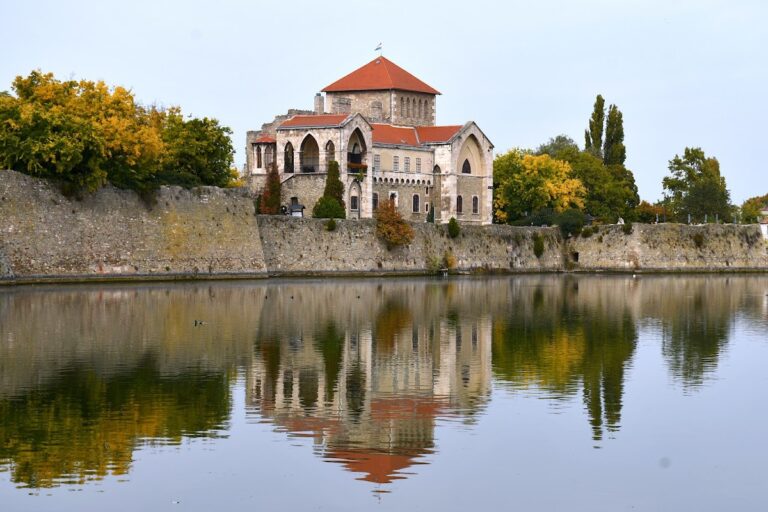
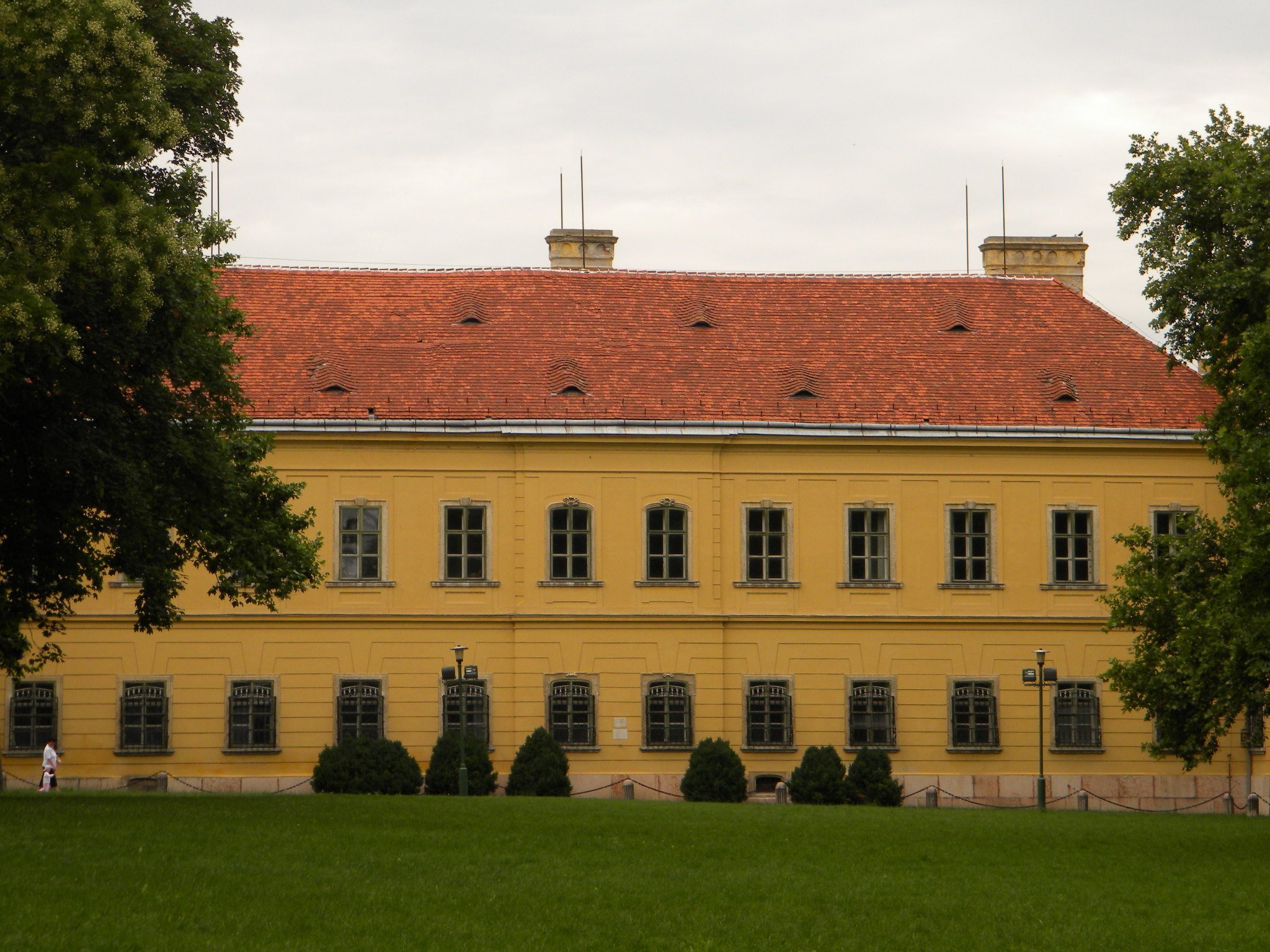
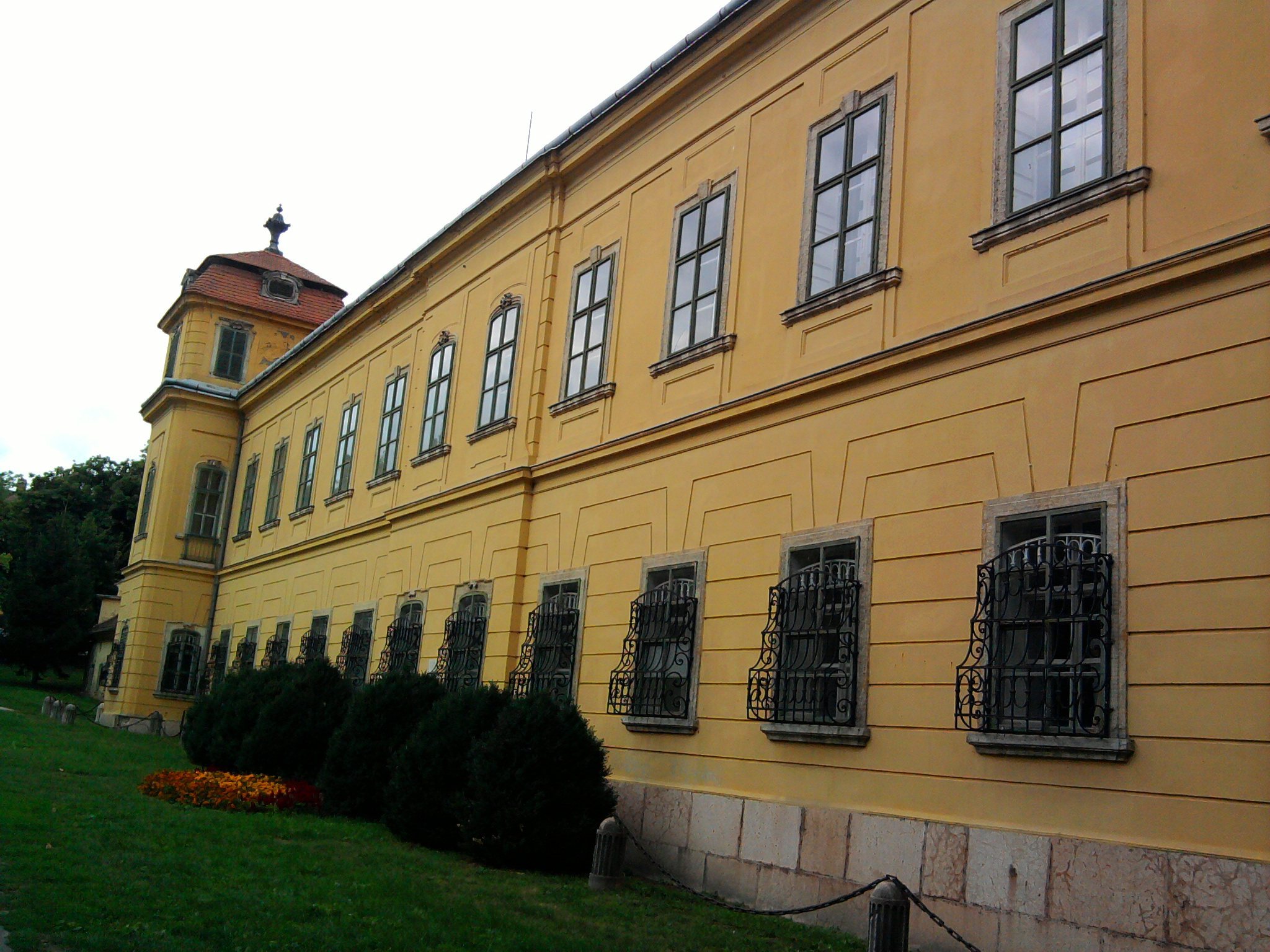
Esterházy Mansion forms part of a Baroque complex beside the former castle and near the shore of Old Lake. The principal building is a well-proportioned, one-storey block. Its symmetrical facade has low square projecting sections, or risalits, at the corners. A risalit is a portion of a facade that extends outward from the main wall. The two-towered southern facade faces the Esterházy Promenade along the lake, while decorative gates on both sides connect the main building with the surrounding parts of the complex.
Courtyard and associated buildings
Courtyard ensemble
The surrounding buildings create an irregular, trapezoidal courtyard, with the mansion, stables, and other subsidiary structures forming a roughly quadrangular arrangement around the internal space. Their combined layout preserves the character of an extended residential and service complex rather than a single isolated building.
Western group and coach house
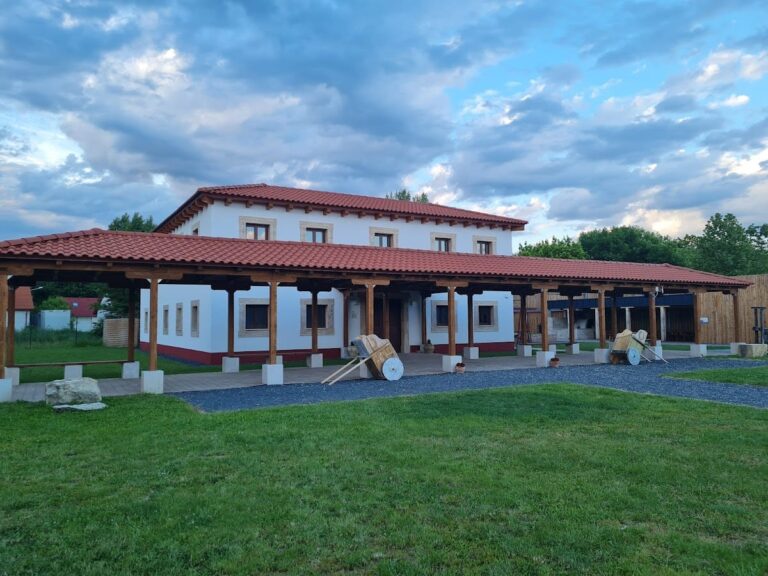
On the western side, the so-called small mansion and adjoining subsidiary buildings form a curved group. This section connects the main ensemble with the residence built in 1751 by Jakab Fellner for Ferenc Balogh, the estate governor born in Galanta. A small coach house is also part of the complex and displays characteristic features of Fellner’s architecture.
Chapel and park
A chapel formed part of the mansion and was used for Mass during the detention of Charles IV and Queen Zita in October 1921. In the park in front of the building stands Tatai Diana, an equestrian statue by Béla Tóth erected in 1989. The renewed complex also contains the permanent exhibition The Island of Peace, which presents the history of the Esterházy family.