Kloster Murrhardt: A Benedictine Abbey in Germany
Site at a Glance
- Rating
- 4.6
- Popularity
- Very Low
- Country
- Germany
- Primary era
- Medieval
- External website
- Open
- Eras represented
- Medieval
- Civilizations
- Carolingian, Holy Roman Empire
- Site type
- Religious
- Remains
- Monastery
On this page18 sections
History
Kloster Murrhardt is a former Benedictine abbey in Murrhardt, Germany, founded around 750 and rebuilt over the following centuries in the medieval Romanesque tradition. Dedicated to Saint Januarius, it became one of the oldest monasteries in Württemberg, alongside Ellwangen and Hirsau. The institution existed as a Catholic monastery from about 750 to 1556, was briefly restored between 1635 and 1648, and continued afterward as an evangelical monastery office until secularization in 1806.
Roman and Carolingian beginnings
The site began as a Roman cohort fort that the Franks took over after subduing the Alamanni. The former frontier post later became a royal estate. Around 736, probably on the instructions of Karlmann, the Austrasian mayor of the palace, Saint Pirmin founded a small wooden parish church dedicated to Saint Mary. Measuring about 6 by 4 metres, it stood beside the preserved remains of a Roman sanctuary of Mithras, a cult associated with a Roman god. Excavations in 1963 identified remains of this early church at the site now occupied by the Walterich Church.
In the middle of the eighth century, the Waltrich noble family sought to connect its possessions in the Rhine-Neckar region with those in western Bavaria. King Pippin the Younger founded a religious settlement at Murrhardt around 750 and dedicated it to the Holy Trinity. Bishop Megingaud of Würzburg probably assisted the foundation and may have been related to the family. A charter issued by Charlemagne in 788 described the settlement as the small monastery or priory called Murrahart, belonging to the bishops of Würzburg. Foundations and wall traces found beneath the east choir of the present town church belong to this early community.
The first foundation probably ceased to function by the beginning of the ninth century. Pippin died in 768, and Megingaud resigned as bishop in 769, removing two of the settlement’s principal supporters. Around 814, Walterich, formerly the second abbot of Neustadt am Main, requested permission from Emperor Louis the Pious to establish a Benedictine monastery at Murrhardt. In 817, Louis founded the new abbey with Walterich as abbot and twelve monks from Reichenau. A Benedictine monastery followed the Rule of Saint Benedict, while its abbot governed the monastic community.
Louis endowed the abbey with the royal forest between Sulzbach an der Murr and Laufen am Kocher, the parish of Fichtenberg, and estates at Oßweil and Erdmannhausen. When he visited Murrhardt in 839, he gave Walterich a fragment of a bone of Saint Januarius. After the emperor’s death, his mummified heart was placed on the Januarius altar in a valuable silver vessel on 19 September 840. It remained there with a later memorial monument until the sixteenth century, when Duke Ulrich of Württemberg removed the silver urn to Stuttgart and had it melted with other ecclesiastical treasures. Walterich died around 840 on 29 November and was buried that day in the parish church of Saint Mary.
Imperial monastery and medieval reform
The Waltrich family retained decisive influence over the abbey for about a century after Walterich’s death. By the late ninth century, Murrhardt effectively had the standing of an imperial monastery, although no surviving document records direct royal involvement in the appointment of its abbots. During the early tenth century, Hungarian incursions and the resulting loss of income weakened the institution. Much of its building fabric deteriorated, and fire substantially destroyed the church. Whether the fire resulted from a Hungarian attack remains uncertain.
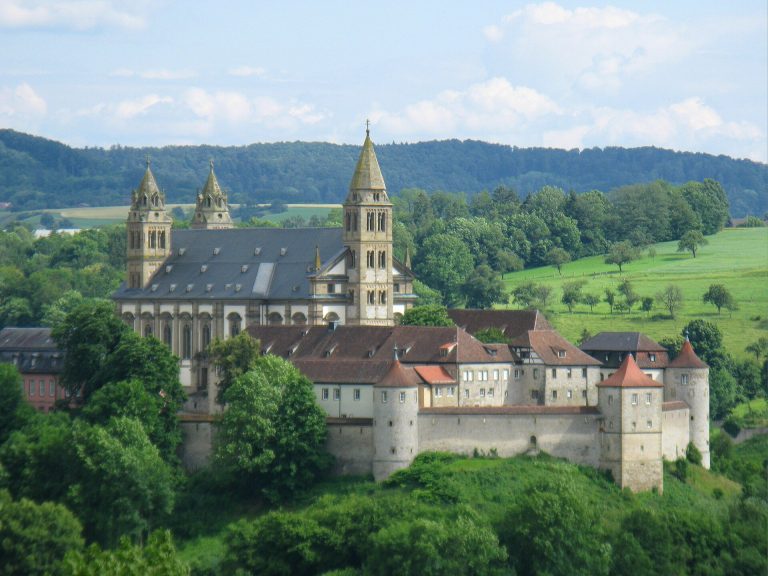
The change from the Carolingian to the Ottonian dynasty also removed the abbey from the protection of its earlier royal patrons. In 993, Bishop Bernward of Würzburg used forged documents to take control of Murrhardt, and charters issued in the name of Emperor Otto III confirmed the transfer. Around 1000, Bernward’s successor Heinrich introduced the Gorze Reform, a movement seeking stricter discipline and renewal in Benedictine monasteries. The ruined Carolingian church was demolished and replaced by a Romanesque church dedicated to Saint Januarius.
Imperial grants in 1027, 1054, and 1064 restored the abbey’s economic position. Its possessions expanded toward the Schwäbisch Hall region and Jagsthausen. During the Investiture Controversy, the medieval struggle over whether secular rulers or the papacy controlled the appointment of bishops and other church officials, Murrhardt supported Adalbero, the later canonized bishop of Würzburg. After his expulsion from Würzburg, Adalbero relied on monasteries in the southwestern part of his former diocese, including Murrhardt.
Under Adalbero’s influence, the abbey joined the Hirsau Reform, another movement for stricter observance and institutional renewal, and maintained close relations with major reform monasteries in southern Germany. A prayer fraternity connected its community with the monks of St Blasien in the Black Forest. Around 1130, the monastery was rebuilt or substantially enlarged according to the Hirsau architectural tradition. It also held the right to mint coins and issued the so-called Murrhardt pennies.
Financial difficulties returned in the second half of the twelfth century. Emperor Frederick Barbarossa’s military expeditions to Italy and the replacement of the Murrhardt penny by the heller reduced the abbey’s resources. To pay its debts, the monastery sold estates, including the village of Kirchenkirnberg. It later freed itself in practice from Würzburg’s authority through a forged foundation charter. Secular protection and administration were then exercised mainly by the counts of Wolfsölden, whose family burial place had been in the monastery for almost two centuries.
Imperial support connected with the relationship between Frederick II and Richina of Wolfsölden encouraged new building around 1225. The church was transformed into a three-towered complex, probably through the work of the monk Gottfried, who also built at the neighbouring monastery of Comburg. After Walterich was beatified and his grave opened, his relics were transferred to the newly built Walterich Chapel. The late Romanesque buildings encouraged pilgrimage to his tomb, and remnants of that practice continued on Good Friday even after the Reformation.
Advocacy, town rights, and late medieval change
The abbey largely survived the conflicts in the Murr valley during the interregnum that followed Frederick II’s deposition. Its abbots were repeatedly commissioned by the pope to settle disputes in other monasteries. In 1281, King Rudolf I of Habsburg acquired the Calw branch of the county of Löwenstein, whose counts held the monastery advocacy. An advocate was a secular protector and administrator who could exercise political and legal authority over a monastery. Murrhardt consequently came increasingly under Habsburg influence.
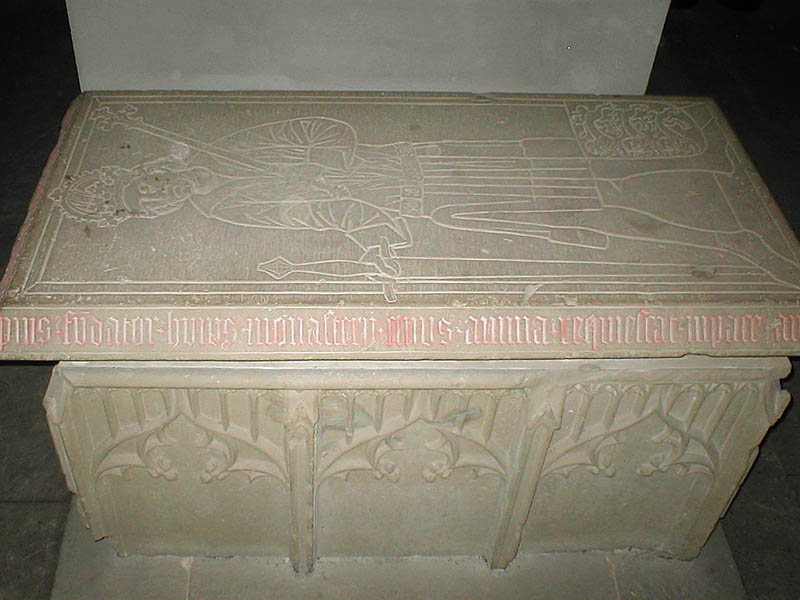
Rudolf’s illegitimate son, Count Albrecht I of Löwenstein-Schenkenberg, became advocate and granted Murrhardt town rights in 1288 with the support of his younger half-brother, Albrecht I of Habsburg. Count Albrecht was buried before the Marian altar of the monastery church in 1304. Around 1325, his son Nikolaus remodelled the east choir as a family burial place. Nikolaus’s grave slab, inscribed with the words Nicolaus comes de Löwenstein, survives.
The monastery suffered another severe economic crisis in the middle of the fourteenth century under the last Löwenstein advocate, Albrecht II. The plague epidemic that began in 1348, the collapse of the medieval economic system, and warfare between imperial cities and territorial princes all contributed to the decline. In 1388, the indebted county of Löwenstein could no longer meet its obligations, and the advocacy and lordship over Murrhardt passed to Count Eberhard II of Württemberg.
The monastery church was extensively rebuilt between 1424 and 1450. Under Württemberg rule, the abbey had to provide troops and materials during the conflict between Count Ulrich V and Elector Frederick of the Palatinate. It also contributed to Ulrich’s ransom after his capture in 1462. Abbots Wilhelm Egen and Johannes Schradin led a final late-medieval religious and cultural flourishing, expanding both the town and its walls. By 1508, however, the convent had entered complete decline.
Reformation, restoration, and secularization
The Peasants’ War struck Murrhardt severely. On 25 April 1525, peasants from Limpurg plundered the abbey and destroyed its library, including the books and archival records preserved there since the early Middle Ages. After Duke Ulrich of Württemberg was expelled, the monastery supported the Habsburg Austrian regency. When Ulrich returned from exile, the Reformation was introduced in Württemberg. The new advocate, Jakob Hofsess, dissolved the convent and expelled most of the monks, leaving only Abbot Martin Mörlin and three monks.
During the Schmalkaldic War, a sixteenth-century conflict between the Protestant Schmalkaldic League and Emperor Charles V, imperial troops occupied Württemberg. Spanish troops were quartered at Murrhardt in the summer of 1548, and Abbot Mörlin and his reduced community were reinstated. The Augsburg Interim, an imperial attempt to regulate religious practice after the Protestant defeat, remained in force at Murrhardt until 1552.
After Abbot Thomas Carlin died in 1552, Duke Christoph of Württemberg arranged for Otto Leonhard Hofsess to become abbot. Hofsess was the son of the monastery advocate and had recently entered the abbey as a Catholic monk, but he immediately converted to Protestantism and became Murrhardt’s first evangelical abbot. From 1556 to 1634, the institution existed as an evangelical monastery office. In 1574, Jakob Hofsess was convicted of embezzling 7,000 guilders and publicly executed by beheading at Murrhardt.
After the Protestant defeat at the Battle of Nördlingen on 6 September 1634, the monastery returned to Benedictine possession. Under Abbot Emmerich Fünkler and his deputy, Prior Adam Adami, the Benedictines attempted to restore the Catholic monastery for thirteen years, including through armed force, but without lasting success. From 1644, Adami represented the monasteries at the peace negotiations in Münster. He signed the Peace of Westphalia on 24 October 1648, the treaties that ended the Thirty Years’ War and reshaped the religious and political settlement of the Holy Roman Empire.
After the war, the convent was finally dissolved under its last abbot, Joseph Huff. This ended the Catholic monastery of Murrhardt after almost nine centuries. The evangelical monastery office was restored and continued until secularization in 1806, when ecclesiastical institutions and property were transferred into secular control. Archaeological and architectural research later clarified the site’s successive phases. Excavations in 1952 and 1963 examined the Walterich Chapel and located Walterich’s grave in the former Marian church, now called the Walterich Church. Investigations in 1973 explored earlier church phases and burial sites.
Remains
Early churches and Carolingian remains
Saint Mary’s Church
The earliest Christian building was a small wooden parish church dedicated to Saint Mary. It measured approximately 6 by 4 metres and stood beside the ruins of a Roman Mithraic temple. Excavations in 1963 identified remains of the building at the site of the present Walterich Church. Walterich was buried there in about 840, and his grave was found during later investigations.
Early monastery church
The earliest known monastery church was a hall church about 14 metres long and 7.5 metres wide, with a rectangular east choir 3.5 metres wide. Two side rooms of different sizes flanked the hall and contained raised altar areas. At the east end, a three-sided chancel screen enclosed an area of approximately 4 by 4 metres. The choir stood one step above the main floor, and a cross altar occupied its western end.
A rectangular external crypt, measuring about 3 by 4.4 metres, was attached directly to the east end of the church. It served as a burial place for the monastic community because Carolingian church regulations prohibited burials inside churches. Archaeological evidence indicates that the crypt had a barrel vault. A separate burial lay immediately north of the church between the choir and the northern side chapel. Its position near the altar suggests that it belonged to a high-ranking person, although it was not Walterich’s grave.
A monastic enclosure building for the convent was added to the western part of the church during the ninth century. Foundations and wall traces of the early community were found beneath the east choir of the present town church during the 1973 excavation.
Romanesque basilica and monastic complex
Romanesque basilica
The eleventh- and twelfth-century rebuilding created a three-aisled, double-choir pillar basilica approximately 38 metres long and 11.9 metres wide. A basilica is a church with a central nave and lower side aisles. The building had a six-arcade nave, a main choir, and two subsidiary choirs ending in apses, or polygonal or semicircular terminations. A rectangular choir stood west of the transept, the cross arm of the church, and a small hall crypt lay beneath it in the tradition of Ottonian four-support crypts.
The rebuilding shifted the liturgical centre westward, unlike the eastward orientation of the earlier Carolingian plan. Ceramic and coin finds from burials examined in 1973 place the basilica’s construction in the early or middle decades of the eleventh century. A burial on the main axis probably belonged to a person important in the church’s building history, possibly Abbot Adalof or Abbot Wizo, although the identification remains uncertain.
Choir-flanking towers
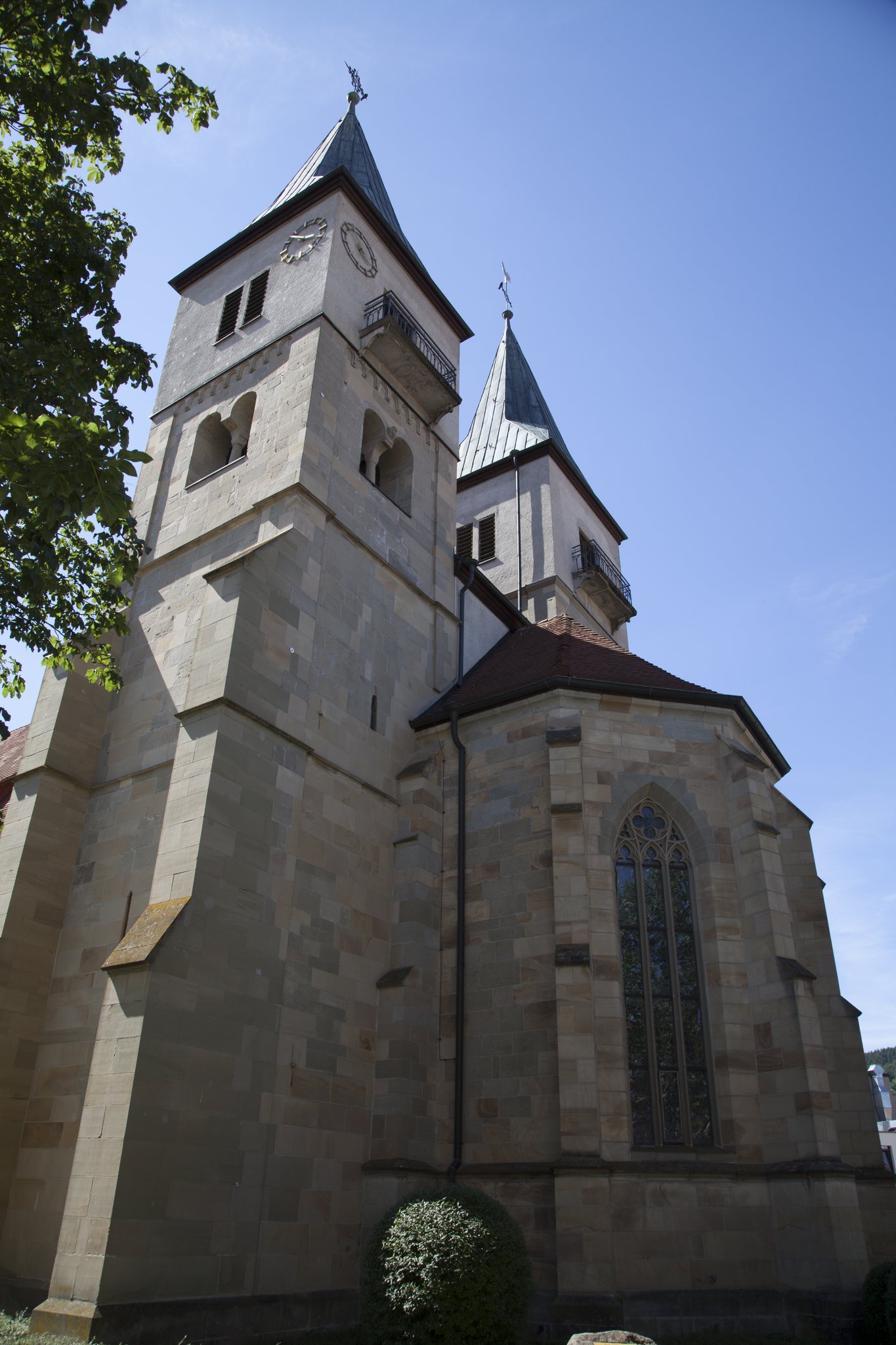
Around the middle of the twelfth century, the two eastern subsidiary choirs were replaced by towers built alongside the choir. Each was approximately 19 metres high. These Romanesque towers survive and are among the earliest examples of this type of construction. A new four-wing monastic complex was built near the southern arm of the basilica’s transept at about the same time.
Wolfsölden burial vault
A family burial vault for the first monastery advocates, the counts of Wolfsölden, lay before the altar of the northern aisle. It was used until the middle of the 1130s. The final burial was a man just under thirty who had died violently from four sword blows to the forehead. Anthropological evidence and the political circumstances suggest that he may have been Count Gottfried of Wolfsölden.
Walterich Chapel and west tower
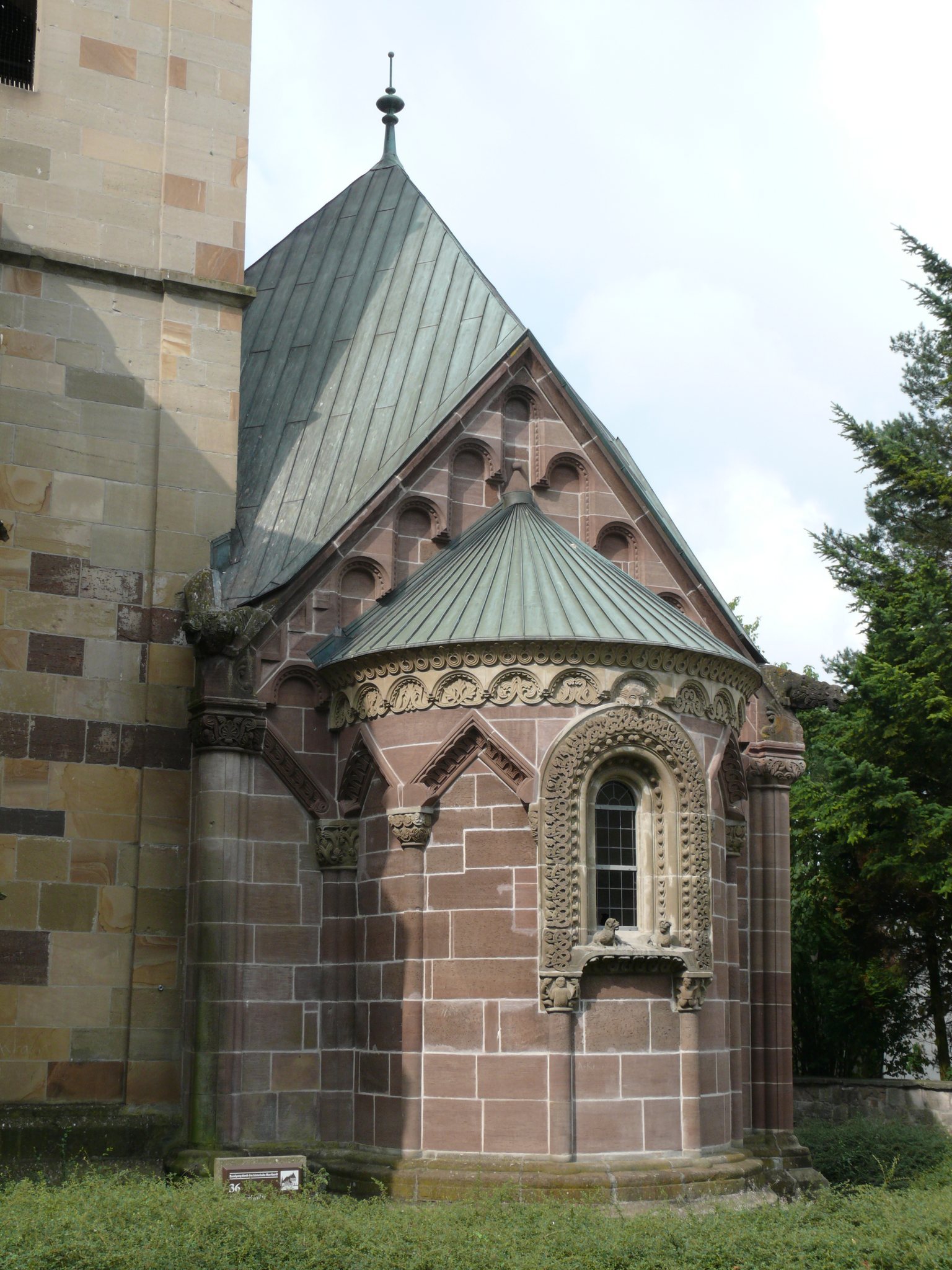
The Walterich Chapel was built between 1230 and 1240 to honour Walterich and accommodate the pilgrimage that developed around him as a locally revered miracle-working holy man. Excavations in 1952 and 1963 disproved the earlier interpretation of the building as Walterich’s burial chapel. It is instead understood as a memorial building or oratory, a chapel commemorating a person without necessarily containing the grave. Walterich’s grave lay in the Marian church, now known as the Walterich Church.
A west tower approximately 20 to 25 metres high was added during the same general building phase. It stood above the western crypt and completed a three-towered church modelled on the church of Saint Nicholas at Comburg. Architectural similarities suggest that the Comburg builder, the monk Gottfried, may also have designed or enlarged the Murrhardt church.
Later church and surviving buildings
Polygonal east choir
In the early fourteenth century, the former east apse was replaced by the polygonal choir that survives today. The rebuilding was associated with the use of the church as a dynastic burial place for the Löwenstein family. Albrecht I of Löwenstein was buried in 1304 between the two choir-flanking towers, before the Marian altar. His son and successor, Nikolaus of Löwenstein, was buried farther east in the choir in 1339.
A crucifixion group probably dating from the same period included wooden sculptures of Mary and John. The sculptures survive in the collection of the Württemberg State Museum. Nikolaus’s grave slab, bearing the Romanesque inscription Nicolaus comes de Löwenstein, also survives.
Fifteenth-century reconstruction
Beginning in the fifteenth century, the church underwent a final major transformation from the west. The Romanesque transept and prominent west tower were replaced by a transept enlarged only by the thickness of its walls and by a two-bay west choir. A Marian chapel was added on the south. The nave was then rebuilt as a three-aisled basilica, with three bays in each side aisle and five in the central nave.
A fragment from a fifteenth-century lamentation group is preserved in the Württemberg State Museum. The western buildings were severely damaged during the military conflicts of the Schmalkaldic War in the mid-sixteenth century. The west wings of the Old Abbey were consequently abandoned and later demolished.
Monastic buildings
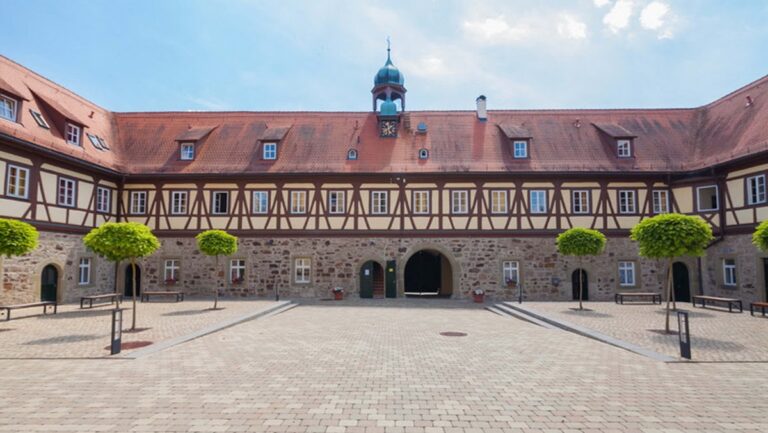
From the middle of the thirteenth century, the surviving buildings of the Old Abbey, the Fürstenbau, and the refectory were constructed. A new cloister was also built, although its remains do not survive. The surviving or documented components of the former monastery complex include the Romanesque church towers, the polygonal east choir, the Walterich Chapel, the Old Abbey buildings, the Fürstenbau, and the refectory.