Church of Saint Eustache: A Historic Parish Church in Paris
Site at a Glance
- Rating
- 4.7
- Popularity
- Medium
- Country
- France
- Primary era
- Early Modern
- External website
- Open
- Eras represented
- Early Modern, Modern
- Civilizations
- French
- Site type
- Religious
- Remains
- Church
On this page14 sections
History
The Church of Saint Eustache is a historic parish church in Paris, France, whose present building was begun in 1532 in a deliberately hybrid combination of Flamboyant Gothic structure, Renaissance decoration, and classical architecture. Standing beside the former Les Halles market district, it became closely connected with the religious, commercial, and civic life of central Paris.
From Saint Agnes to Saint Eustache
The church’s origins lie in the early thirteenth century, when a chapel dedicated to Saint Agnes was built beside the Coquillière and Montmartre gates of the enclosure constructed under Philippe Auguste. Tradition connects the chapel with the Parisian bourgeois Jean Alais, who was said to have received permission from the king to collect one denier from each basket of fish entering Les Halles, Paris’s historic central food market.
In 1223, the chapel became a parish and adopted the name Saint Eustache, probably after a relic of the martyr Saint Eustace was transferred from the Abbey of Saint-Denis. The church was enlarged and altered repeatedly as the population around the market grew. Royal protection, especially in connection with the confraternities of Saint Mary Magdalene, was maintained by Philippe VI and confirmed by Louis XI in letters issued shortly before the king’s death in August 1483.
The sixteenth- and seventeenth-century church
By 1532, the earlier parish church could no longer accommodate the central Parisian district. The decision was therefore taken to construct the present building, and Jean de la Barre, provost of the merchants, laid the first stone on 19 August. Boccador, Nicolas Le Mercier, and Charles David, Le Mercier’s son-in-law, were involved in the work. Jean Delamarre, Pierre Le Mercier, and Domenico da Cortona have also been proposed as contributors.
Construction advanced through several campaigns and was interrupted by financial difficulties, the challenging building site, and the Wars of Religion, a series of conflicts between Catholics and Protestants in France. René Benoist, parish priest from 1569, sought financial assistance in 1578. The funds appear to have allowed work on several nave piers and windows. The church was completed in 1633 and consecrated on 26 April 1637 by Jean-François de Gondi, Archbishop of Paris.
The parish’s associations extended across the political and cultural life of the capital. Richelieu, Molière, Jean-François Regnard, Eugène de Savoie-Carignan, Louis Armand de Brichanteau, and Madame de Pompadour were baptized at Saint-Eustache. Louis XIV received his first communion there around 1649. Marriages included those of Sully and Anne de Courtenay, Pomponne and Catherine Ladvocat, and Lully and Madeleine Lambertet.
Saint-Eustache also hosted funerals and burial ceremonies for prominent figures, including Queen Anne of Austria, Turenne, La Fontaine, Anna Maria Pertl, the mother of Mozart, and Mirabeau. After Mirabeau’s death, his body lay in the church while Joseph-Antoine Cerutti delivered the funeral oration, before the remains were transferred to the Panthéon. Colbert, Vincent Voiture, Vaugelas, Scaramouche, Admiral de Tourville, Madame de Tencin, Marivaux, Rameau, François de Chevert, the Marquis de Marigny, and Marie de Gournay were buried there or associated with funerary ceremonies. Fléchier delivered Turenne’s funeral oration in 1676, while Jean-Baptiste Massillon preached his sermon on the small number of the elect at Saint-Eustache in 1704.
Rebuilding, revolution, and restoration
The western facade and the first bay of the nave and aisles were rebuilt after two chapels commissioned in 1665 by Jean-Baptiste Colbert, a parishioner and church warden, had weakened the earlier facade. Louis Le Vau prepared an earlier design, but construction began on 22 May 1754, when the Duke of Chartres laid the foundation stone. Jean Hardouin-Mansart de Jouy directed the project, later continued by Louis-Pierre Moreau. Financial constraints prevented the completion of the intended two-storey towers and connecting gallery, leaving the south tower unfinished.
Saint-Eustache was a gathering place during the women’s march on Versailles on 5 October 1789 and was one of the 51 urban parishes of the Diocese of Paris in 1790. During the French Revolution, the church was desecrated, looted, closed to Catholic worship, and used for a time as a grain store or agricultural depot. Catholic worship resumed after the Revolution, and the building was formally returned to the Church in 1803.
A fire in 1844 destroyed the first three bays. Victor Baltard supervised a major restoration from 1842 to 1860, creating a new high altar, organ case, and pulpit and repairing the paintings. The fighting of the Paris Commune in May 1871 caused further damage to the attic, buttresses, and south facade. The facade was modified in 1928 and 1929. Saint-Eustache was classified as a French historic monument in 1862, and in 1922 the parish was entrusted to the Society of the Oratory of Jesus and Mary.
Later conservation included work on the great roof in the 1980s, the south facade in the early 2000s, and the south transept gable and doorway in the 2010s. The 2016 intervention aimed to restore the gable, mechanize the south door as a principal entrance from the garden, and improve access for people with reduced mobility. After the 2019 fire at Notre-Dame, Saint-Eustache hosted major religious services, including Easter and Christmas Masses, while Notre-Dame was being restored. It remains an active Catholic parish of the Archdiocese of Paris.
Music has also formed part of the church’s history. Berlioz conducted the first performance of his Te Deum there on 30 April 1855, and Liszt conducted a performance of his Messe solennelle at Saint-Eustache in the nineteenth century.
Remains
Plan, structure, and exterior
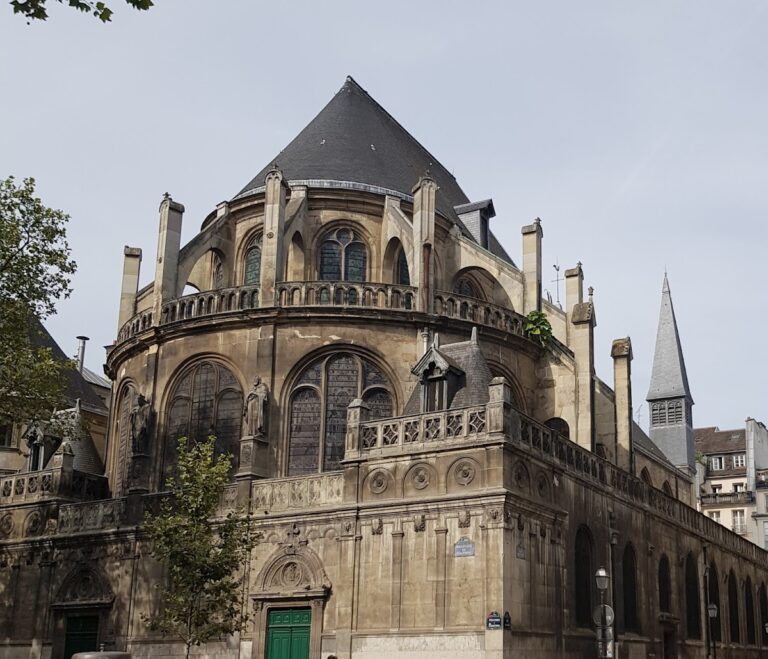
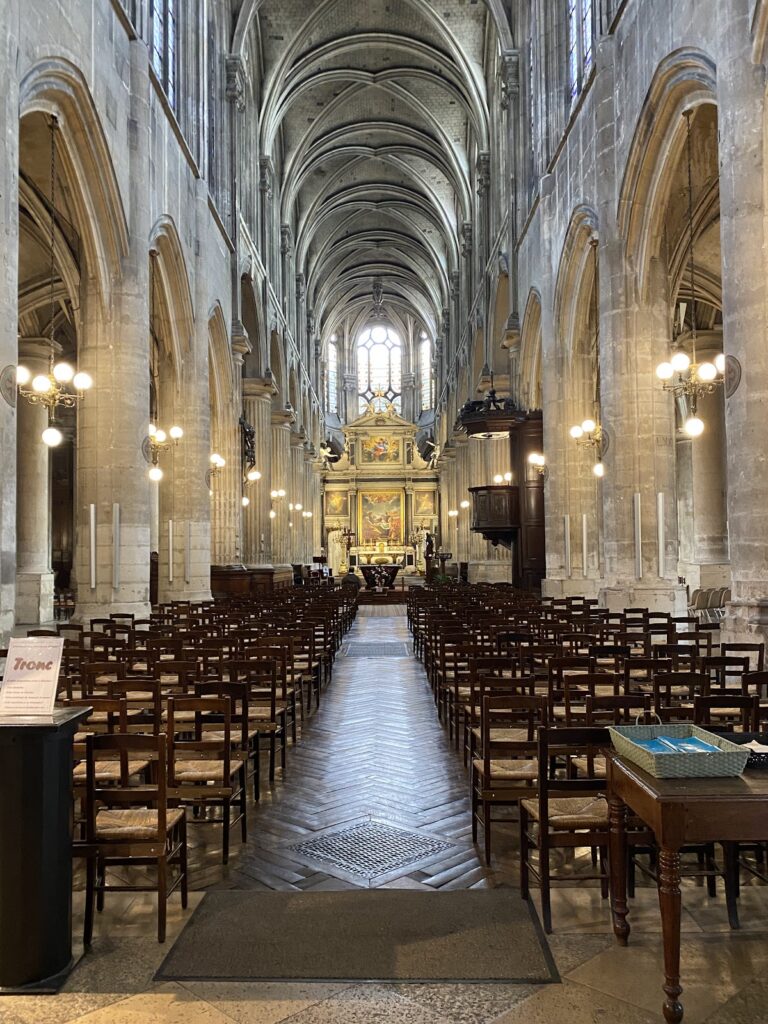
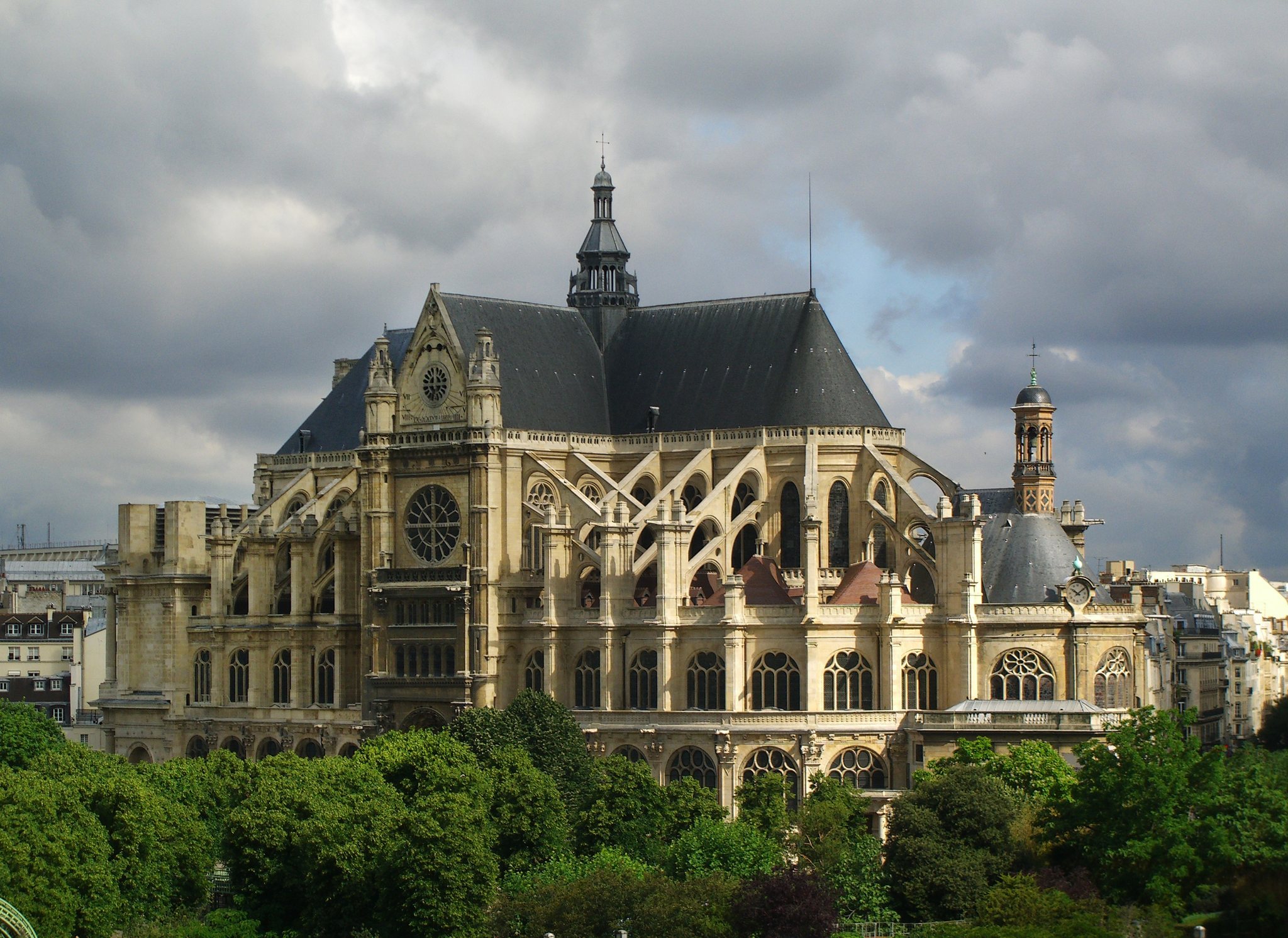
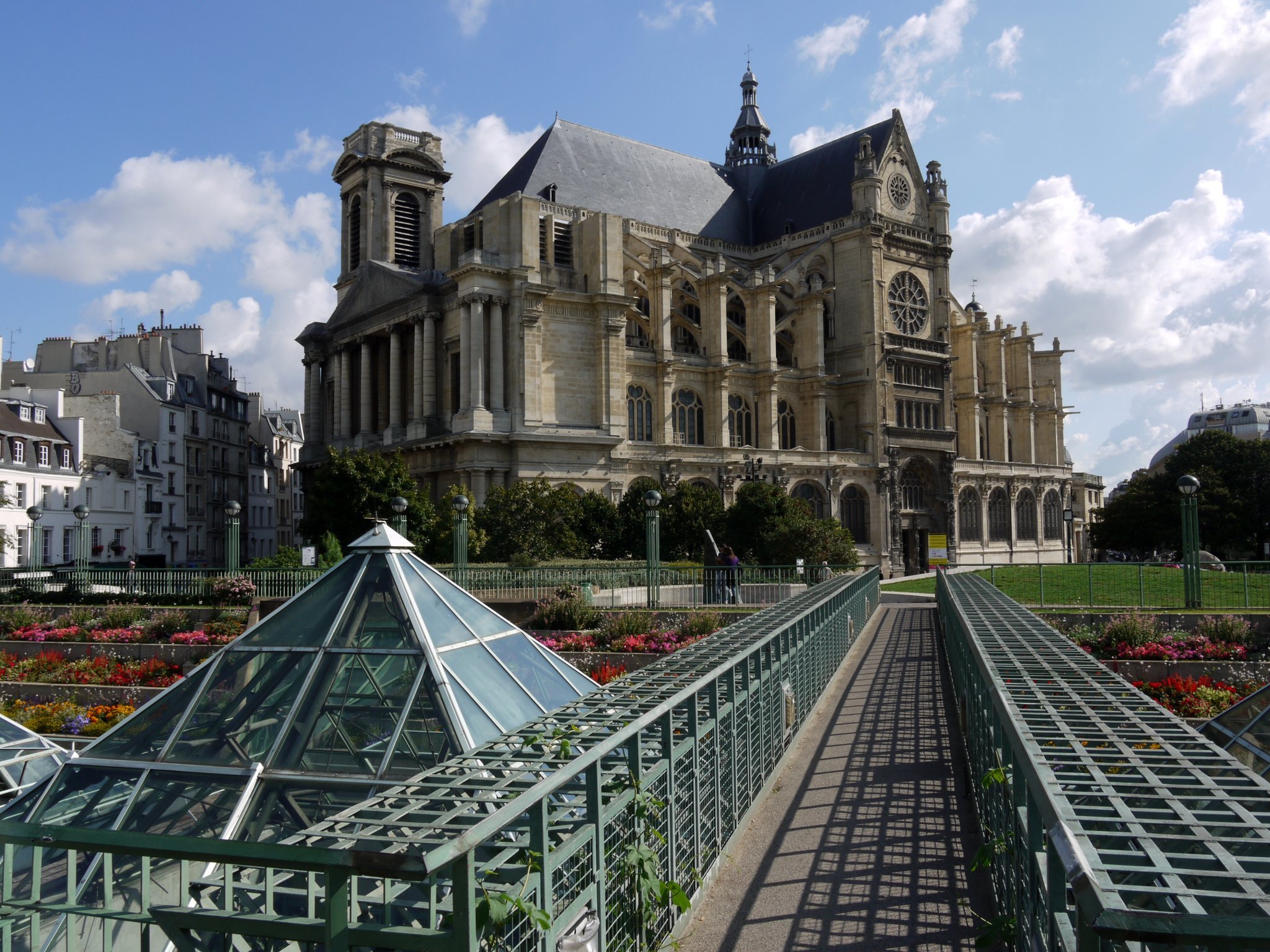
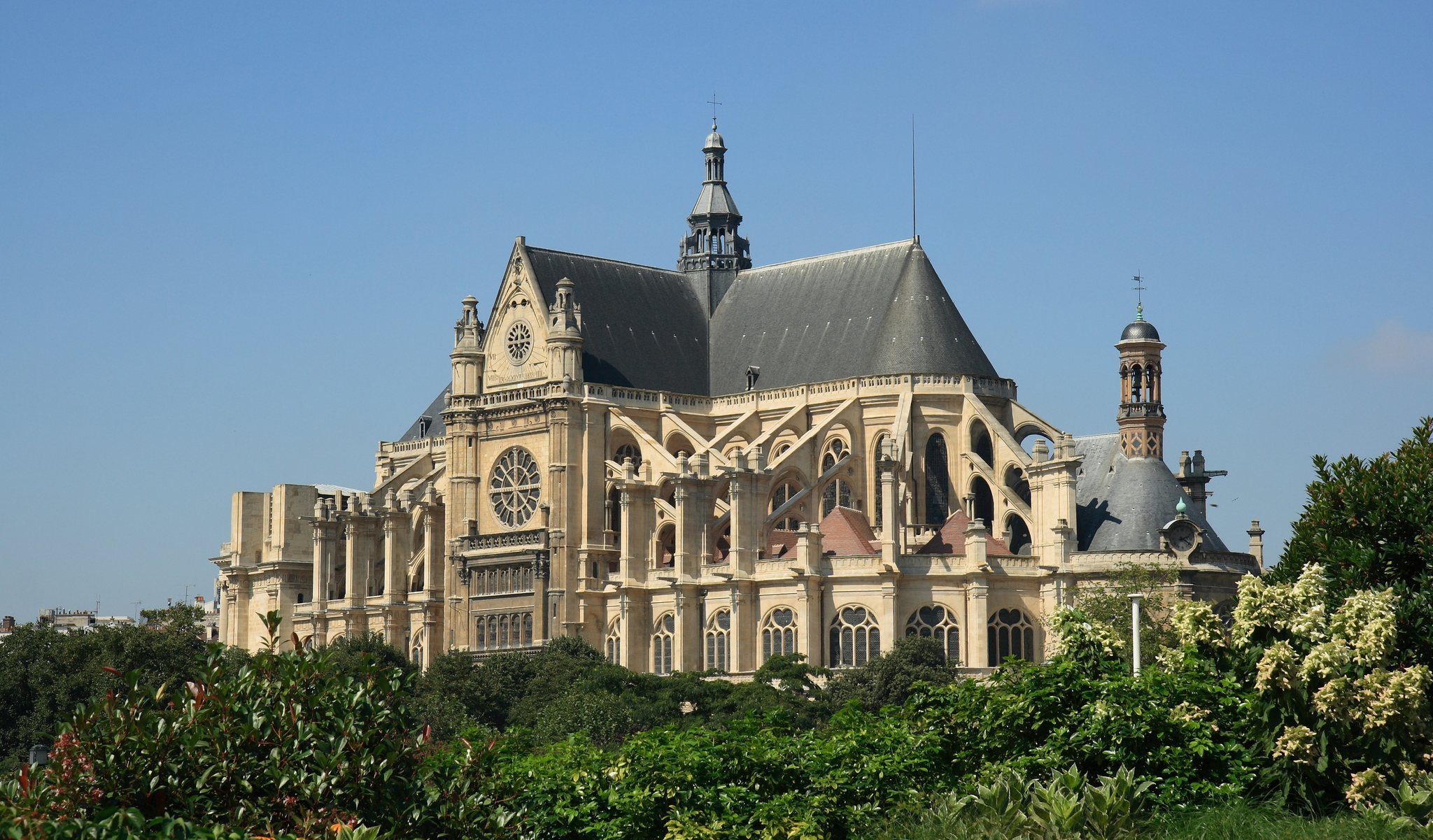
Saint-Eustache is a large west-facing parish church measuring approximately 105 metres externally. Its width is about 43.5 metres across the transept, and the interior vault rises approximately 33.45 to 33.46 metres. The building combines a Gothic structural system with Renaissance ornament and a classical French west facade. Pointed arches, rib vaults, rounded Romanesque arches, classical orders, and Renaissance decoration appear together, producing an architectural character that attracted criticism from observers including G. Brice and Eugène Viollet-le-Duc.
The nave is bordered by double collateral aisles and chapels. On the south side, the chapels grow deeper toward the east to follow the line of the former Rue Trainée, now Place René-Cassin. The transept projects only slightly beyond the outer walls, while the choir is encircled by a double ambulatory and a ring of chapels. Around the eastern apse, elaborate flying buttresses, exterior supports that transfer the outward pressure of vaults to separate piers, surround the semicircular group of chapels.
West facade and south portals
The predominantly classical west facade remains asymmetrical because its south tower was never finished. It has paired Ionic columns, Doric elements on the lower level, a heavy pediment, and Renaissance ornamental sculpture. The south portals carry rich foliage and shell decoration. Symbols associated with Saint Eustace appear on the transept gables, exterior decoration, and interior pedestals. They include the interlaced letters S and E, a hunting horn, and a stag carrying a cross between its antlers. Saint Eustace was traditionally identified with Placidus, a Roman general and hunter who converted to Christianity after seeing a cross between a stag’s antlers.
Vaults, supports, and astronomical instruments
Inside, the vertical supports combine Gothic and Renaissance features. Rib vaults use intersecting structural ribs, ornamental ribs, and hanging keystones, which are projecting decorative stones at the meeting points of ribs. The piers and pilasters employ successive Doric, Ionic, and Corinthian forms, while capitals and other surfaces are carved with angels, foliage, bouquets, and related Renaissance ornament.
A sundial on the south transept stands more than 30 metres above ground and measures approximately 6.5 by 2.5 metres. Its pointer is positioned below the centre of the rose window. A separate meridian above and to the left of the south portal measures about 3 metres in height and marks the quarter-hours between 11 a.m. and 1 p.m.
Chapels and devotional spaces
Twenty-five chapels extend from the rear of the west facade along the north side, around the ambulatory behind the choir, and back along the south side. Their dedications include the Redemption, the Baptismal Fonts, Notre-Dame-des-Sept-Douleurs, Saint Joseph, Saint Eustache, Ménardeau, Saint Louis, Saint Genevieve, Saint Vincent de Paul, Saint Mary Magdalene, Saint Peter the Exorcist, Saint Louis of Gonzaga, the Catechisms, Mercy, the Pork Butchers, the Holy Angels, Saint Anne, Saint Agnes, the Sacred Heart, the Souls in Purgatory, the Holy Innocents, Saint Cecilia, the Calvary, and the City of Paris. A crypt bearing the name of Saint Agnes adjoins the east side of the church.
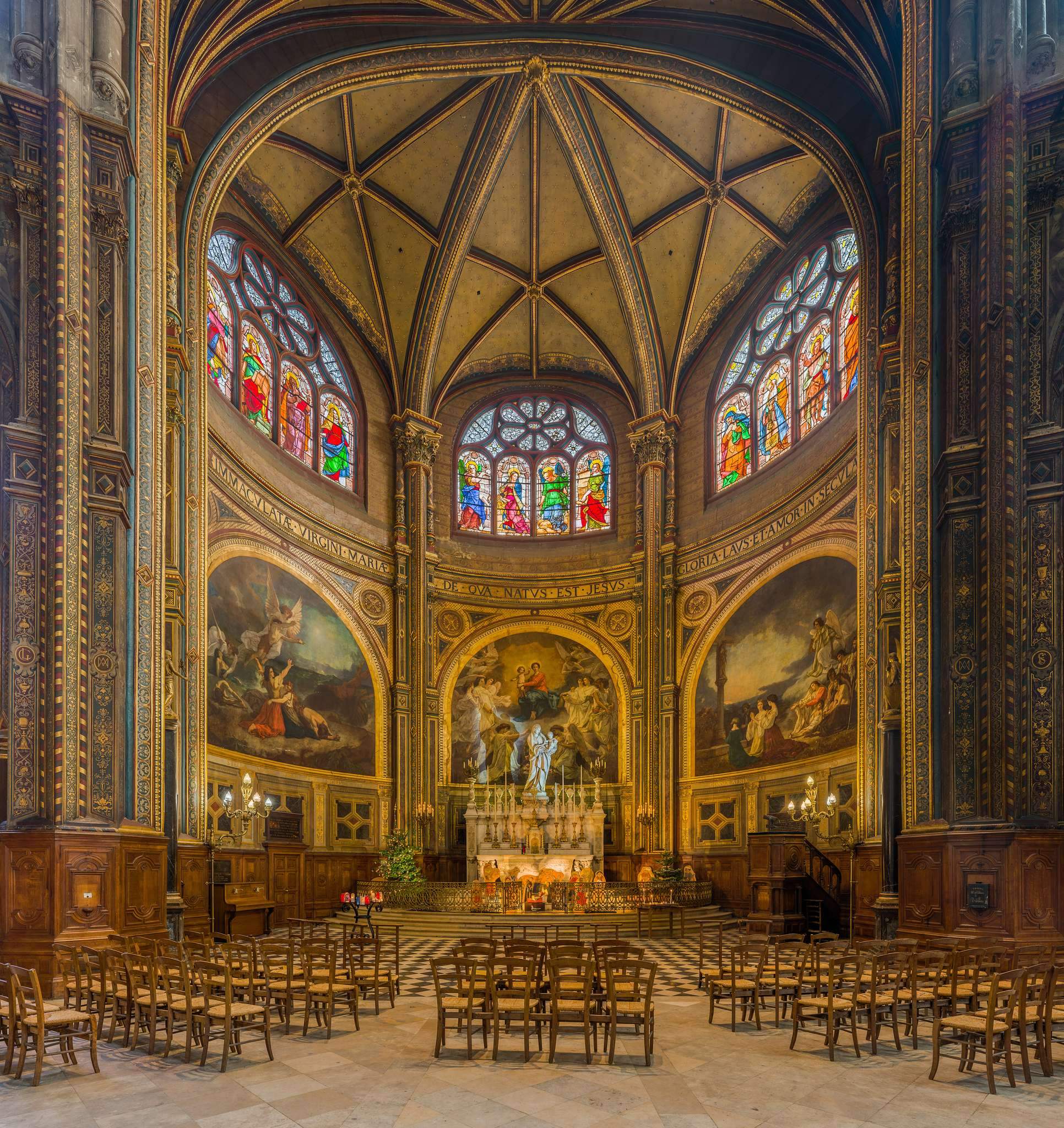
Chapel of the Virgin
Built in 1640 and restored from 1801 to 1804, the Chapel of the Virgin has a ribbed semi-domed vault, nineteenth-century stained glass, and a central Virgin and Child by Jean-Baptiste Pigalle. Three large paintings by Thomas Couture show the Virgin as guide of sailors, triumphant among angels, and comforter of the afflicted. Pope Pius VII inaugurated the chapel on 22 December 1804 during his visit to Paris for Napoleon’s coronation.
Choir windows and high altar
The choir contains nine prominent colored windows made in 1631 by the glass painter Antoine Soulignac from cartoons attributed to Philippe de Champaigne. Their subjects include saints and apostles, among them Saint Jerome and Saint Ambrose, Saint Philip and Saint Matthew, Saint Thomas and Saint Simon, and Saint Eustace with Saint Agnes and Christ. Prosper Lafaye restored the windows after 1871.
The original seventeenth-century high altar was financed by Claude de Bullion and was one of the largest in Paris. Simon Vouet supplied its central paintings, The Martyrdom of Saint Eustace and The Apotheosis of Saint Eustace. The altar was destroyed in the eighteenth century, and the paintings were separated during the Revolutionary confiscations. The Apotheosis was sent to Nantes in 1809, while The Martyrdom was sold in 1810 and recovered by the Prefecture of the Seine in 1855. It now hangs high on a pillar in the transept. The painting shows Eustace turning away from a pagan deity whom the emperor Trajan orders him to worship, while Eustace, his wife, and their two sons are condemned to death in a brazen bull. Angels with laurel wreaths signify divine recognition.
Parish furnishings and tombs
Between the nave piers stands the monumental banc d’oeuvre, a designated seat or enclosed bench for the lay committee responsible for parish administration. Pierre Lepautre made it in 1720 from designs by Jean-Sylvain Cartaud. Its portico-like structure has four fluted Ionic columns, a medallion held by angels and containing a Crucifix, and a crowning representation of the Apotheosis or Triumph of Saint Agnes. A Revolutionary Phrygian cap appears in the central medallion.
The tomb of Jean-Baptiste Colbert was commissioned in 1685 by his widow, Marie Charron. Designed by Charles Le Brun and executed by Antoine Coysevox and Jean-Baptiste Tuby, it includes a kneeling statue of Colbert wearing the mantle of the Order of the Holy Spirit, a black-marble sarcophagus, and allegorical figures of Fidelity and Faith or Abundance. Colbert was a principal minister of Louis XIV and a major administrator of royal finances. The tomb was dismantled during the Revolution, and its principal surviving elements were displayed in the Museum of French Monuments. Returned in 1817, they were reassembled in the Chapel of Saint Louis of Gonzaga. The original angel holding an open Bible was lost.
Paintings, sculpture, and stained glass
The Chapel of Saint Vincent de Paul contains one of nine versions of Keith Haring’s The Life of Christ, a bronze triptych covered with a white-gold patina. It is installed beneath a seventeenth-century painting by Simon Vouet concerning the triumph of the Church over evil. The Chapel of Saint Mary Magdalene contains Rutilio Manetti’s The Ecstasy of Mary Magdalene, an oil painting from about 1625 measuring approximately 130 by 160 centimetres. In the Chapel of Saint Genevieve, Santi di Tito’s Tobias and the Angel, dated 1575, came from the sacristy of the Basilica of San Marco in Florence. It was sent to Vienna in 1792 and 1793, seized in 1809, and deposited at Saint-Eustache in 1811.
The church also contains The Pilgrims of Emmaus, authenticated in 2019 and 2020 as a work by Peter Paul Rubens and his workshop after previously being treated as a copy. Other paintings include a workshop copy of Luca Giordano’s The Deposition of Christ, François Lemoyne’s Saint John the Baptist, Tintoretto’s The Adoration of the Shepherds, Étienne de La Vallée-Poussin’s The Adoration of the Shepherds, and Alexandre-François Caminade’s partial copy of Domenichino’s The Martyrdom of Saint Agnes. Caminade’s painting was purchased for Saint-Eustache in 1808, while Domenichino’s original is now in Bologna.
Nineteenth-century decoration includes paintings and sculptures by numerous artists in the side chapels. Among the notable works are Antoine Étex’s Ecce Homo of 1856, Albert Magimel’s The Transfiguration of 1855, and Léon Brunel-Roque’s Marriage of the Virgin of 1858. Several chapels retain or reveal seventeenth-century wall paintings, including scenes of Christ’s appearances after the Resurrection, the Resurrection, the Assumption, and the family of Charles du Val. Some paintings were covered with whitewash in the eighteenth century, uncovered and partly repainted under Victor Baltard in 1850, and restored in the twenty-first century.
The church also has nineteenth- and twentieth-century stained glass representing the Education of Louis IX, the Nativity, the Annunciation, and the Crucifixion. A 1945 window commemorates the Society of French Charcuterie and includes imagery connected with its trade. Contemporary works include Raymond Mason’s The Departure of the Fruits and Vegetables from the Heart of Paris on 28 February 1969, restored in 2023, and works by John Armleder.
Organs
Saint-Eustache has two organs. The great organ at the rear of the nave has 101 stops distributed across five keyboards and a pedalboard, with nearly 8,000 pipes. Its original case and some ranks survive from earlier instruments, while the organ was almost entirely rebuilt in 1989 by the Dutch firm Van den Heuvel.
The earlier great organ was modified in the early nineteenth century, destroyed in the 1844 fire, rebuilt between 1849 and 1854, restored in 1879, and altered again during the 1920s and 1930s. Some of its surviving nineteenth-century components date from 1854. The choir organ, built by Abbey in 1842 and later modified, has 16 stops, two keyboards, and a pedalboard. The power of the great organ helped make possible the first performance of Berlioz’s Te Deum at Saint-Eustache in 1855.