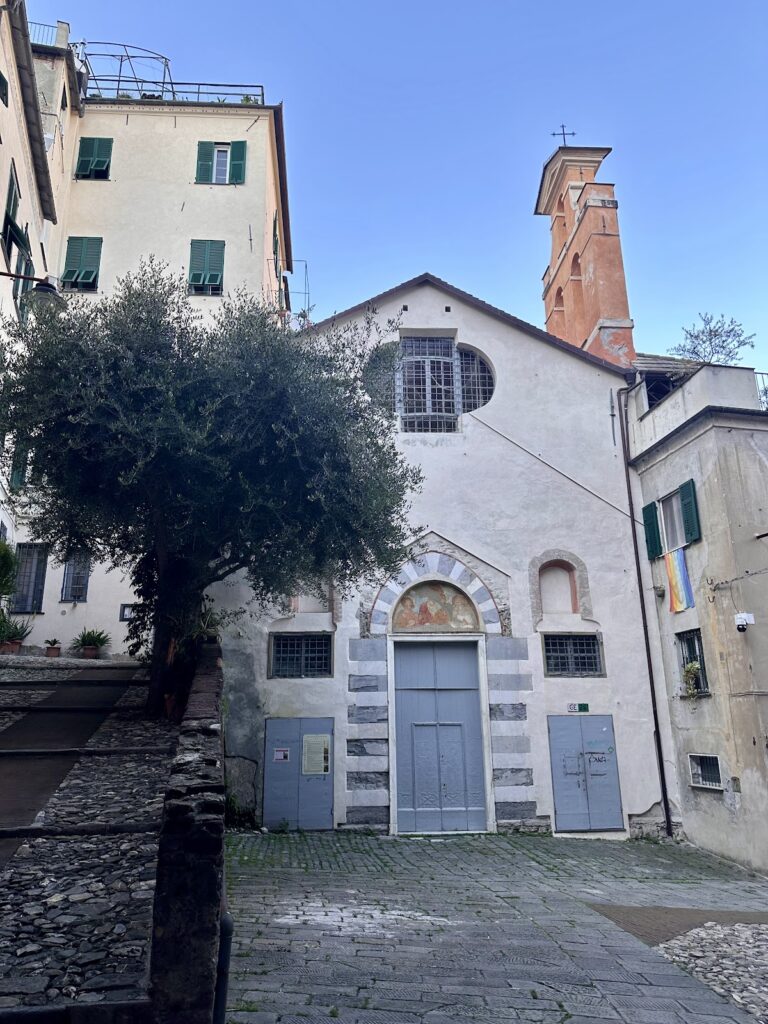
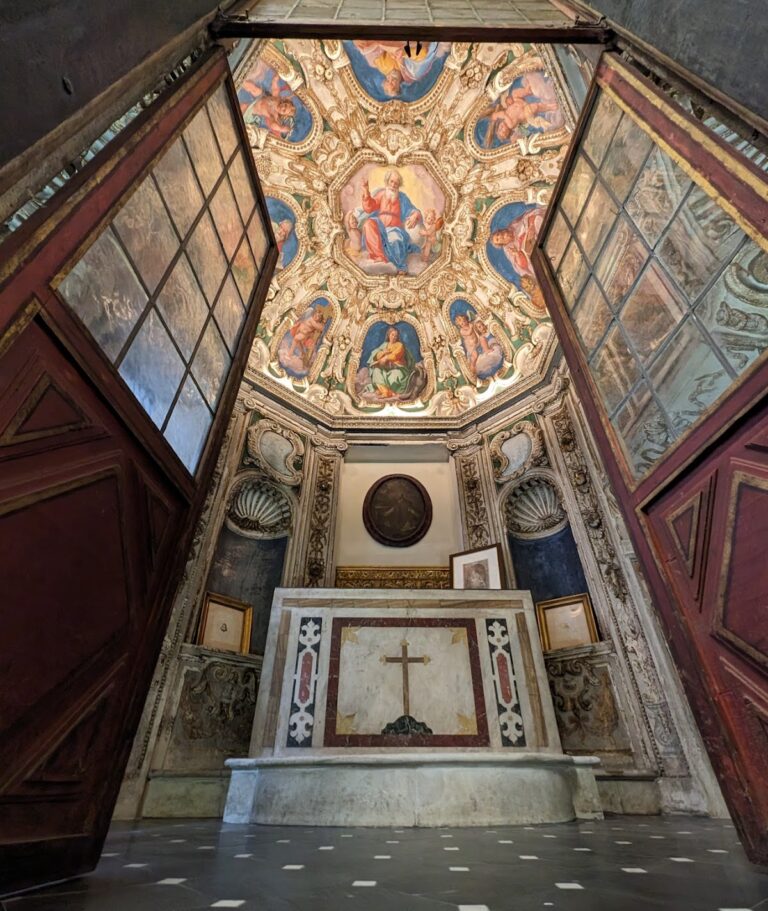
Basilica della Santissima Annunziata del Vastato: A Roman Catholic Parish Church in Genoa
Site at a Glance
- Rating
- 4.7
- Popularity
- Medium
- Country
- Italy
- Primary era
- Early Modern
- External website
- Open
- Eras represented
- Early Modern, Modern
- Civilizations
- Genoese, Italian, Kingdom of Sardinia
- Site type
- Religious
- Remains
- Church
On this page19 sections
History
The Basilica della Santissima Annunziata del Vastato is a Roman Catholic parish church in Genoa, Italy, whose present form reflects construction from the sixteenth century and a major seventeenth-century transformation in late Mannerist and early Genoese Baroque styles. Although commonly called a basilica, it does not formally hold that title; the Italian Ministry of Culture lists it as the Church of Santissima Annunziata del Vastato.
Medieval origins and the Franciscan foundation
The site lay beyond Genoa’s medieval walls, in an area cleared for defence after the Barbarossa walls were built in 1155. The name Vastato probably refers to this demolished or cleared defensive belt. In 1228, the Humiliati, a northern Italian religious movement whose communities combined religious life with activities such as textile production, established a convent and the small church of Santa Marta del Prato. The nearby Carbonara and Vallechiara watercourses supported the community’s choice of location. During the seventeenth century, both streams were channelled through underground galleries.
In 1508, the Franciscan Conventuals of San Francesco di Castelletto received the Humiliati complex after fortification works affected their former church. They began replacing Santa Marta with a larger church suited to Franciscan worship and preaching. The foundation stone was ceremonially laid on 20 July 1520 in the presence of Giuliano Cybo, bishop of Agrigento. Initially dedicated to Saint Francis as San Francesco del Guastato, the new church was built in a deliberately late-Gothic manner associated with the Franciscan mother church at Assisi.
Work stopped before the building was complete. By 1537, its load-bearing walls and roof had been finished, while the façade and most interior decoration remained unfinished. The Conventuals returned to San Francesco di Castelletto, and Franciscan Observants displaced from Santissima Annunziata di Portoria took over the church. They transferred their former dedication to the building, establishing the name Santissima Annunziata del Vastato.
Post-Tridentine rebuilding
Francesco Bossi, bishop of Novara, visited the church in 1582 during the reforms associated with the Council of Trent, the Catholic Church’s response to the Protestant Reformation. His visitation called for the unfinished building to be completed and adapted to current liturgical needs. In 1591, the Observants transferred patronage of the principal chapel to the Lomellini family. The family agreed to finance and direct the works in return for using the church as a family chapel.
Taddeo Carlone directed the first major rebuilding under Lomellini patronage. He extended the presbytery, added an apse for the choir, and replaced the crossing’s tiburium, a tower-like structure above the crossing, with a dome on a high drum. From 1615, Giovanni Domenico Casella, known as Scorticone, and Giacomo Porta directed further work. This included an extension toward Piazza della Nunziata and the principal marble, stone, stucco, and gilded decoration.
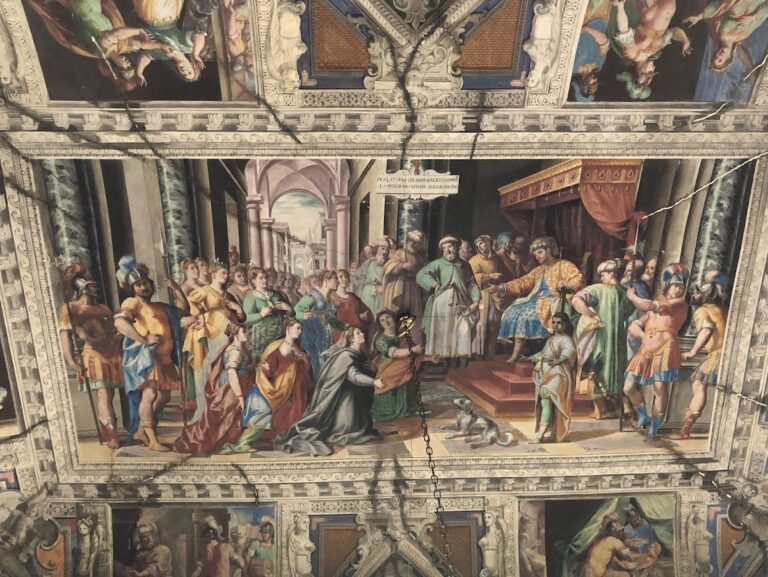
The resulting transformation made the church a major expression of late Mannerism and early Genoese Baroque. Its imagery responded to post-Tridentine Catholic priorities, presenting the Virgin Mary, Christ, and the saints while addressing themes challenged by Protestant reformers. Giovanni Carlone began the fresco cycles in the 1620s, working in the first three bays of the central nave and in parts of the transept and side aisles. After his death in 1631, his brother Giovanni Battista Carlone completed the unfinished work. Gioacchino Assereto, Domenico Fiasella, Andrea Ansaldo, and Giulio Benso also contributed substantially.
Ansaldo worked on the dome for three years before his death in 1638. His perspective scheme combined fresco, gilded sculpture, painted architecture, and illusionistic painting. Giulio Benso subsequently decorated the apse and presbytery, probably beginning around 1640 and continuing until 1648. During the seventeenth and eighteenth centuries, Genoese noble families with patronage over the side chapels financed extensive additions of marble, sculpture, and painting. The church became one of Genoa’s most richly decorated religious buildings, and Montesquieu described it in the first half of the eighteenth century as the city’s most beautiful church.
Parish church, suppression, and restoration
In 1783, Agostino Lomellini secured recognition of the church as a noble parish of the Lomellini family. The arrangement ended after his death in 1794 and the extinction of the family. Napoleonic suppression laws forced the Franciscans to leave the convent in 1810, although they returned in 1815. Pope Pius VII celebrated the Feast of the Ascension there on 4 May 1815 and Pentecost on 14 May.
A general nineteenth-century renovation followed in 1834. Carlo Barabino designed a new Neoclassical façade that year, Giovanni Battista Resasco revised the project in 1841, and the façade was completed in 1867. Further suppression laws issued by the Savoy government in 1861 again removed the Franciscans from the church and convent.
Archbishop Tommaso Reggio established the church as a parish in 1898 and entrusted it once more to the Friars Minor, who returned on 30 May 1901. Conservation began in the 1930s and continued until the Second World War. Allied bombing repeatedly damaged the building, with especially severe destruction on 29 October 1943. The structure largely survived, while infill walls, vaults, marble altars, and many chapel frescoes were damaged or destroyed.
Postwar repairs were initially partial. From 1988, the Ministry of Culture supported further restoration, including structural consolidation and the reconstruction of lost fresco, stucco, and marble decoration. In 1995, Raimondo Sirotti painted a new Encounter of Saints Joachim and Anne, reinterpreting Giulio Benso’s destroyed seventeenth-century apse painting. In 2023, Timothy Schmalz’s sculpture Whatever You Do was installed. It depicts a beggar representing Christ, with a wounded hand marked by a crucifixion-nail wound.
Remains
Plan, entrance, and exterior
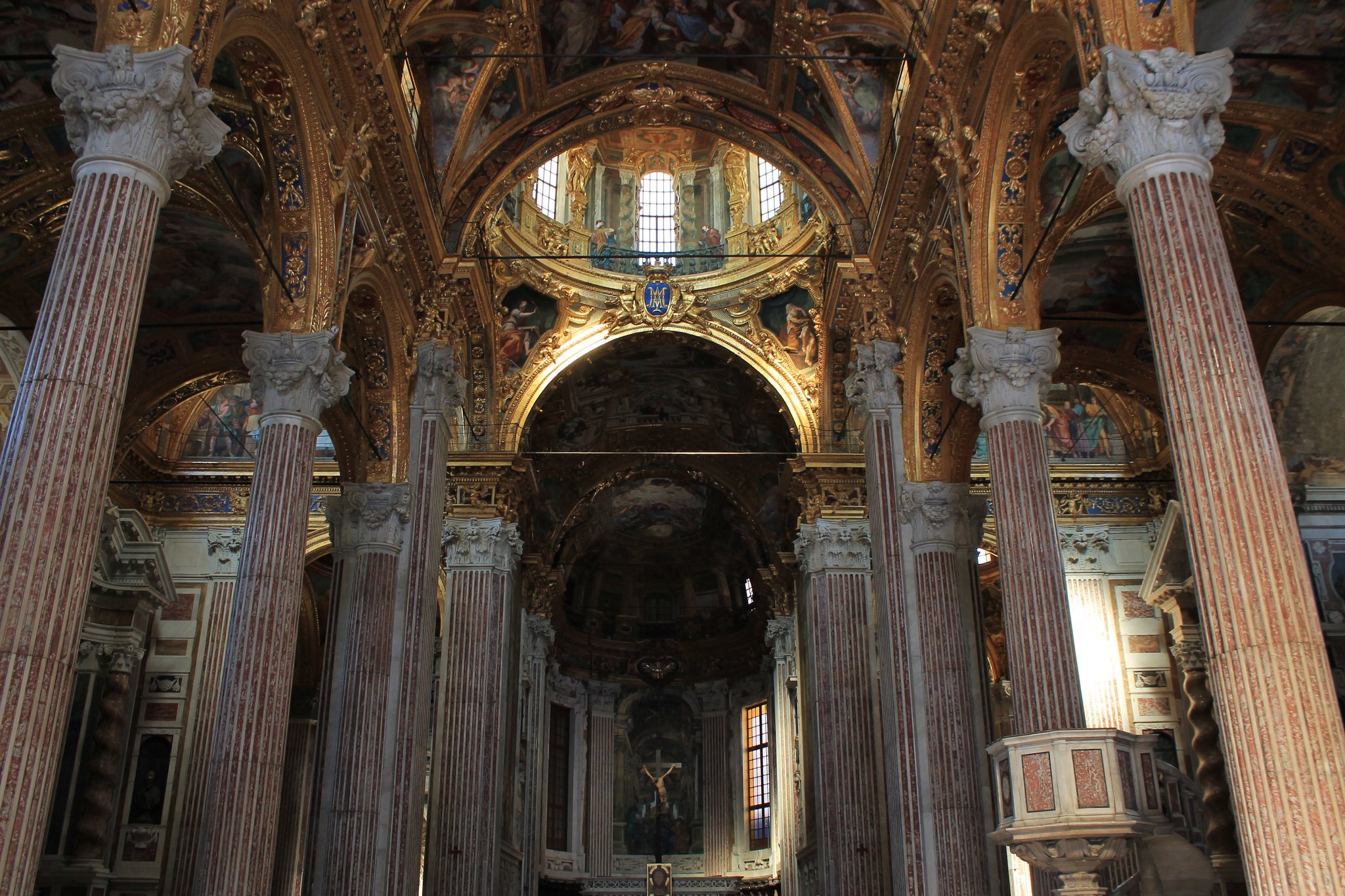
The church has a basilical Latin-cross plan, approximately 33 by 54 metres, with a broad central nave, two side aisles, a transept, a square-based presbytery, an apse, and rows of chapels along the aisles. The original interior had three naves separated by delicate white-and-black stone columns. Single-light windows illuminated the side-aisle chapels, while large triforium openings, upper openings above the arcades, brought light to the transept. The original entrance stood in the right-hand wall, opposite the Santa Marta hospice and the San Tommaso oratory.
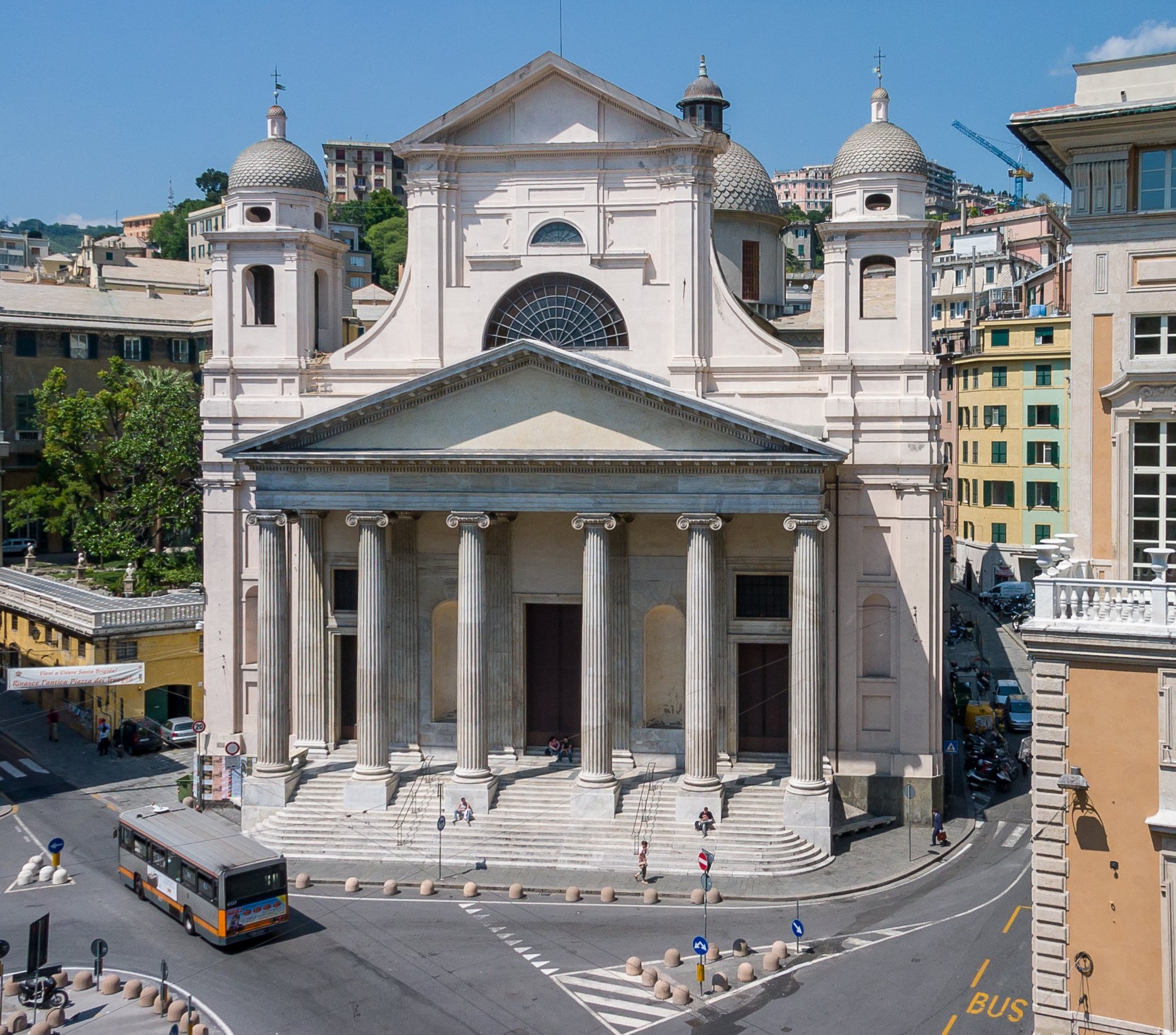
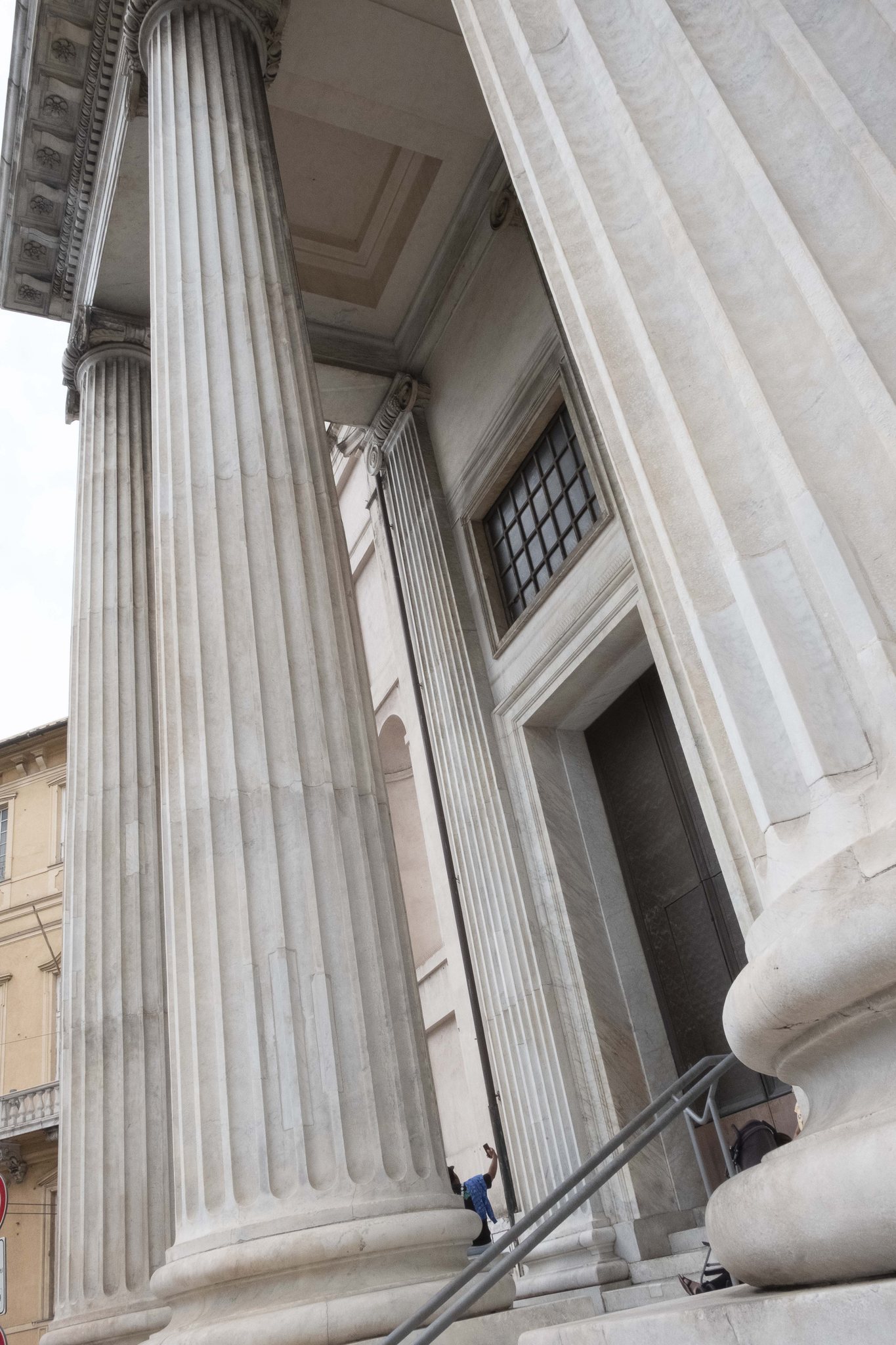
The building was extended by one and a half bays toward Piazza della Nunziata after the friars acquired the Balbi family granary, the San Tommaso oratory, and the Santa Marta inn. This enlargement made possible a provisional façade with three portals before the present exterior was constructed. The current façade is Neoclassical, with two symmetrical campaniles, or bell towers, and a monumental pronaos, a columned entrance porch. Resasco built the pronaos and its staircase in the nineteenth century, and the façade was completed in 1867.
Central spaces and painted decoration
Dome and crossing
A central dome on a high drum rises above the crossing. Andrea Ansaldo’s decoration extends across the pendentives, the drum, the dome, and the lantern. Pendentives are curved triangular surfaces that allow a dome to rest above a square or polygonal crossing. Here they contain the four Evangelists, while gilded three-dimensional figures, painted twisted columns, balustrades, and trompe-l’oeil architecture create an illusion of expanded space. The central subject is the Assumption of the Virgin, ending with God the Father in the small cupola.
Nave and interior façade
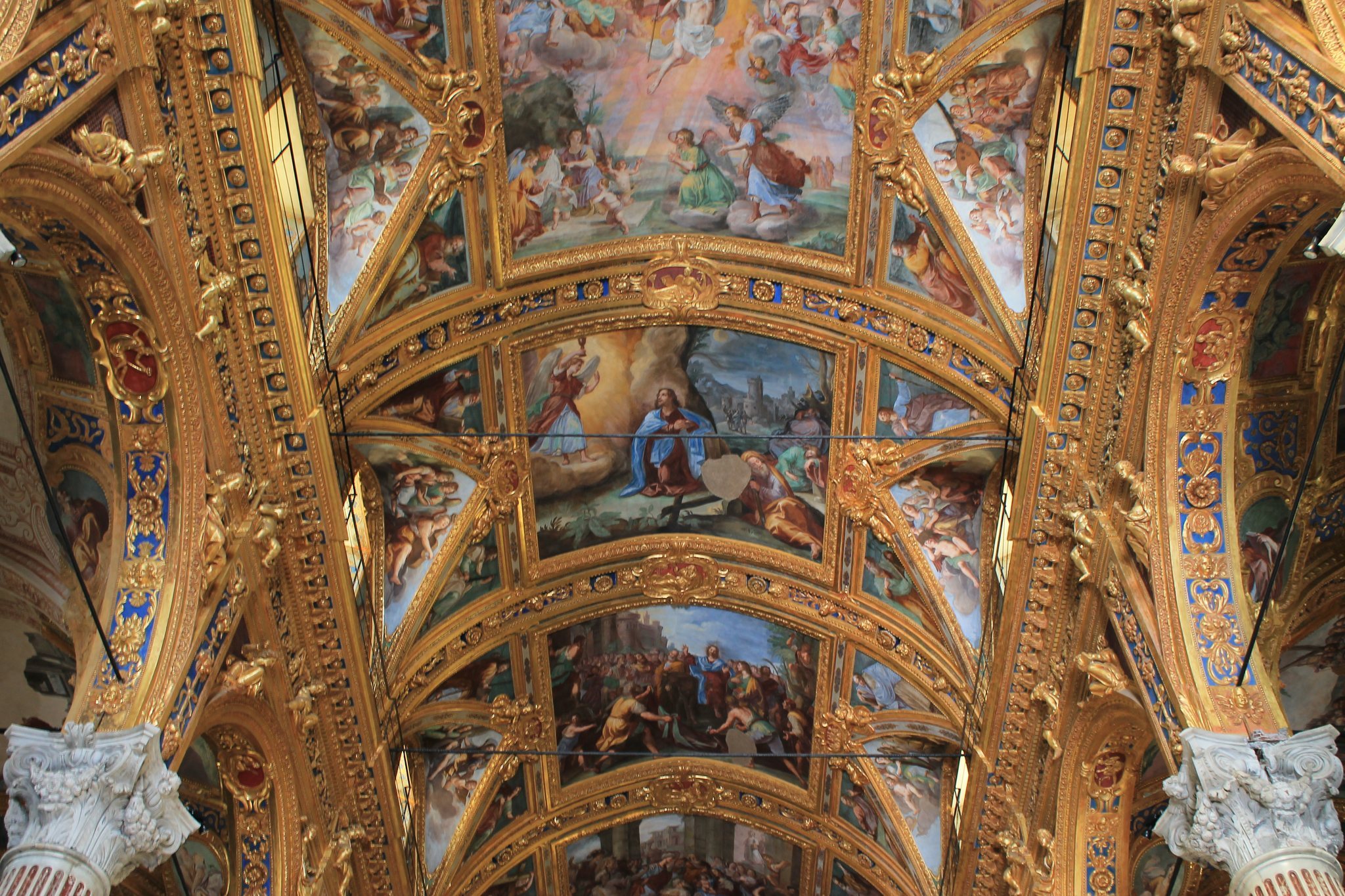
The large, luminous interior combines frescoes, paintings, inlaid marble, and gilded stucco. Giovanni Carlone painted the Epiphany, Christ’s Entry into Jerusalem, and the Prayer in the Garden in the central nave. Giovanni Battista Carlone painted the Resurrection, Christ Appearing to His Mother, and the Coronation of the Virgin. On the interior façade wall, Procaccini’s large Last Supper, originally made for the monastic refectory, is flanked by two Prophets attributed to Assereto, Ansaldo, or Benso.
Presbytery and apse
The presbytery contains a main altar decorated by Giacomo Porta and Domenico Scorticone. Its altarpiece is attributed to Francesco La Croix, and a sculpture of the Crucifix is by Giacomo Antonio Ponsonelli. Benso’s frescoes include the Annunciation, the Immaculate Conception, and the Presentation of Jesus in the Temple. Giovanni Battista Carlone painted the Dispute with the Doctors after a design by Benso. Raimondo Sirotti’s modern Encounter of Saints Joachim and Anne occupies the apse in place of Benso’s destroyed fresco.
Side chapels
Annunciation and Saint Peter of Alcantara
The Chapel of the Annunciation was commissioned by Tommaso Gentile and received marble decoration from Carlo Solaro in 1678. Its paintings include Domenico Piola’s Annunciation, Giovanni Andrea Carlone’s Presentation of the Virgin and Visitation, a Prophet, and Gioacchino Assereto’s Saint Peter Healing the Lame. The original ceiling decoration by Giovanni Andrea Carlone was destroyed during the war.
The Chapel of Saint Peter of Alcantara was acquired by Giovanni and Giacomo Grimaldi in the late sixteenth century and later completed with marble decoration by the Lazzaro Cosso family. It contains Giovanni Battista Carlone’s Saint Peter of Alcantara Adoring the Cross, a Blessed Joan of Signa attributed to Daniele Crespi, paintings by Anton Maria Piola and a work attributed to Bernardo Strozzi, and Domenico Fiasella’s Saint Paul Preaching.
Saint Louis IX and Saint John the Baptist
The Chapel of Saint Louis IX was acquired from the French nation in 1772. Pierre Puget made its marble decoration. The altarpiece shows Saint Louis Adoring the Cross by Giovanni Bernardo Carbone, accompanied by the Charity of Saint Louis and Saint Louis Healing Plague Victims, attributed to Beaumont. Domenico Fiasella painted Saint Andrew Adoring the Cross on the outer vault.
The Chapel of Saint John the Baptist was built in 1669 by Francesco Macetti and Carlo Solaro for the Morando family and completed during the nineteenth-century restoration. It contains a polychrome wooden Christ Stripped of His Garments attributed to Anton Maria Maragliano, paintings by Simone Barabino, Gioacchino Assereto, Domenico Piola, and Giovanni Battista Croce, and Giovanni Battista Carlone’s Saint James Baptizing a Pagan.
Saint Bonaventure and Saint Bernardino of Siena
Carlo Solaro built the Chapel of Saint Bonaventure in 1678 and 1679 for the Aronio family. It was heavily damaged by wartime bombing. Its works include Domenico Piola’s Pentecost, Nicolò Carlone’s Miracle of Saint Bonaventure, a Blessed Joan, and Giovanni Battista Carlone’s Saint Matthew Catechizing the Crowd.
The Chapel of Saint Bernardino of Siena was commissioned by the Passaggi family in the seventeenth century. Wartime bombing destroyed its marble decoration, which was reconstructed in 1955. The chapel contains Giovanni Battista Carlone’s Miracle of Saint Bernardino and Episodes from the Life of Saint Bernardino, Guglielmo Caccia’s Nativity with Saint Francis, Giovanni Andrea De Ferrari’s Hagar and Ishmael, and a fresco of Saints Simon and Jude Evangelizing the Persians.
Our Lady of the Angels and the Crucifix
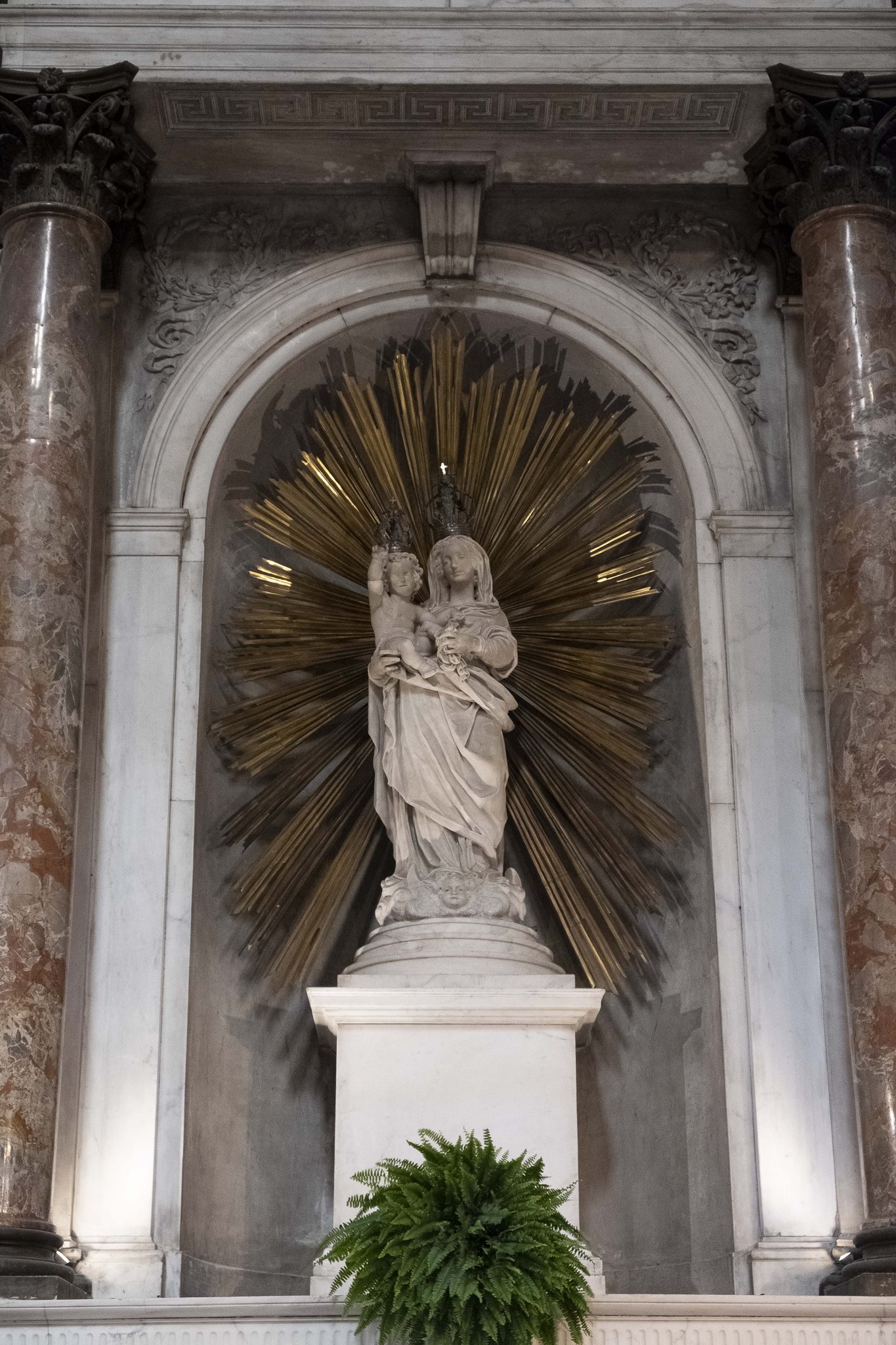
The Chapel of Our Lady of the Angels, linked to the Chapel of the Crucifix, belonged to the Spinola family and was rebuilt for the Serra family between 1840 and 1842. Angelo Diaz designed its Neoclassical decoration. A marble Madonna and Child, Luciano Borzone’s Adoration of the Shepherds, and Santo Varni’s marble relief of the Madonna with Saints form its principal works.
The adjoining Chapel of the Crucifix contains Francesca Scotto’s Crucifixion and Our Lady of Sorrows, Luca Saltarello’s Wedding at Cana and Flagellation, Bernardo Strozzi’s Saint Peter Denying Christ and Joseph Explaining Dreams, and other paintings by Giuseppe Isola.
Saint Paschal Baylon and Saint Francis of Assisi
The Chapel of Saint Paschal Baylon was commissioned from Giacomo Antonio Ponsonelli in 1709 and completed by Gaetano Quadro in 1734. Its monumental altar has paired Solomonic columns, whose shafts spiral upward, made of alabaster, together with yellow-marble ornament, angel heads, and large candelabra. Anton Maria Maragliano’s polychrome wooden Saint Paschal Adoring the Blessed Sacrament, completed in 1713, occupies the centre. Giovanni Carlone painted the Ascension and Supper at Emmaus.
The Chapel of Saint Francis of Assisi passed from the Lomellini family to the Chiavari family in the first half of the seventeenth century. Daniele Casella executed its marble decoration in 1622 and carved the Madonna, Queen of Genoa, above the altar. Anton Maria Maragliano carved the altar group, Saint Francis Receiving the Stigmata, around 1715 to 1720, while Gioacchino Assereto painted Abraham Offering Bread and Wine to Melchizedek.
Saint Didacus and the Immaculate Conception
The Chapel of Saint Didacus of Alcalá passed from the Pinelli family to Francesco Assereto after 1696 and was restored by Domenico Piola and Giacomo Antonio Ponsonelli. Piola’s works include Saint Didacus Healing the Sick, Saint Didacus Preaching, Purity, Obedience, and the Dove of the Holy Spirit. The latter frescoes survived the wartime destruction.
The Chapel of the Immaculate Conception, associated with the Invrea family, was designed and executed by Domenico Piola, with sculpture by Carlo and Daniele Solaro dating from 1673 to 1683. Bombing destroyed Piola’s frescoes, while his altarpiece of the Immaculate Virgin and God the Father survives.
Our Lady of Mercy and Saint Clare
The Chapel of Our Lady of Mercy was decorated in the eighteenth century for the Congregazione dei Mercenari by Francesco Maria Schiaffino. Its decoration was destroyed by bombing. The chapel retains a wooden Crucifix attributed to Francesco La Croix and Luca Cambiaso’s panel painting of the Crucifixion.
The Chapel of Saint Clare of Assisi was decorated for the Frugoni family and suffered extensive wartime damage. Its surviving or recorded works include Giovanni Battista Paggi’s Dormition of Saint Clare, Tommaso Clerici’s Martyrdom of the Franciscan Martyrs of Gorkum, and Giovanni Battista Carlone’s Saint Francis Solano Baptizing the Moors.
Saint Clement
The Chapel of Saint Clement was built in 1618 and later patronized by the Spinola family. Giacomo and Giuseppe Gaggini executed its sculptural decoration, which was almost entirely destroyed by bombing. The surviving recorded paintings include Giovanni Battista Carlone’s Martyrdom of Saint Clement and Saint Clement Struck by a Red-Hot Blade, Gregoria De Ferrari’s Saint Stephen, and another scene showing Saint Clement attacked with iron hooks.
Together, the chapels and major spaces preserve a high concentration of seventeenth- and eighteenth-century paintings and sculptures by Genoese and foreign artists. Among them are Pierre Puget, Anton Maria Maragliano, Leonardo Mirano, Leonardo Ferrandina, Tommaso Clerici, Domenico Piola, Giulio Benso, Giovanni and Giovanni Battista Carlone, Bernardo Strozzi, Domenico Fiasella, Luca Cambiaso, Luciano Borzone, and Santo Varni.