Great Tower Neuwerk: A Medieval Sea Mark and Lighthouse in Germany
Site at a Glance
- Rating
- 4.5
- Popularity
- Low
- Country
- Germany
- Primary era
- Medieval
- External website
- Open
- Eras represented
- Medieval
- Civilizations
- Holy Roman Empire
- Site type
- Military
- Remains
- Tower
On this page8 sections
History
Medieval origins and Hamburg administration
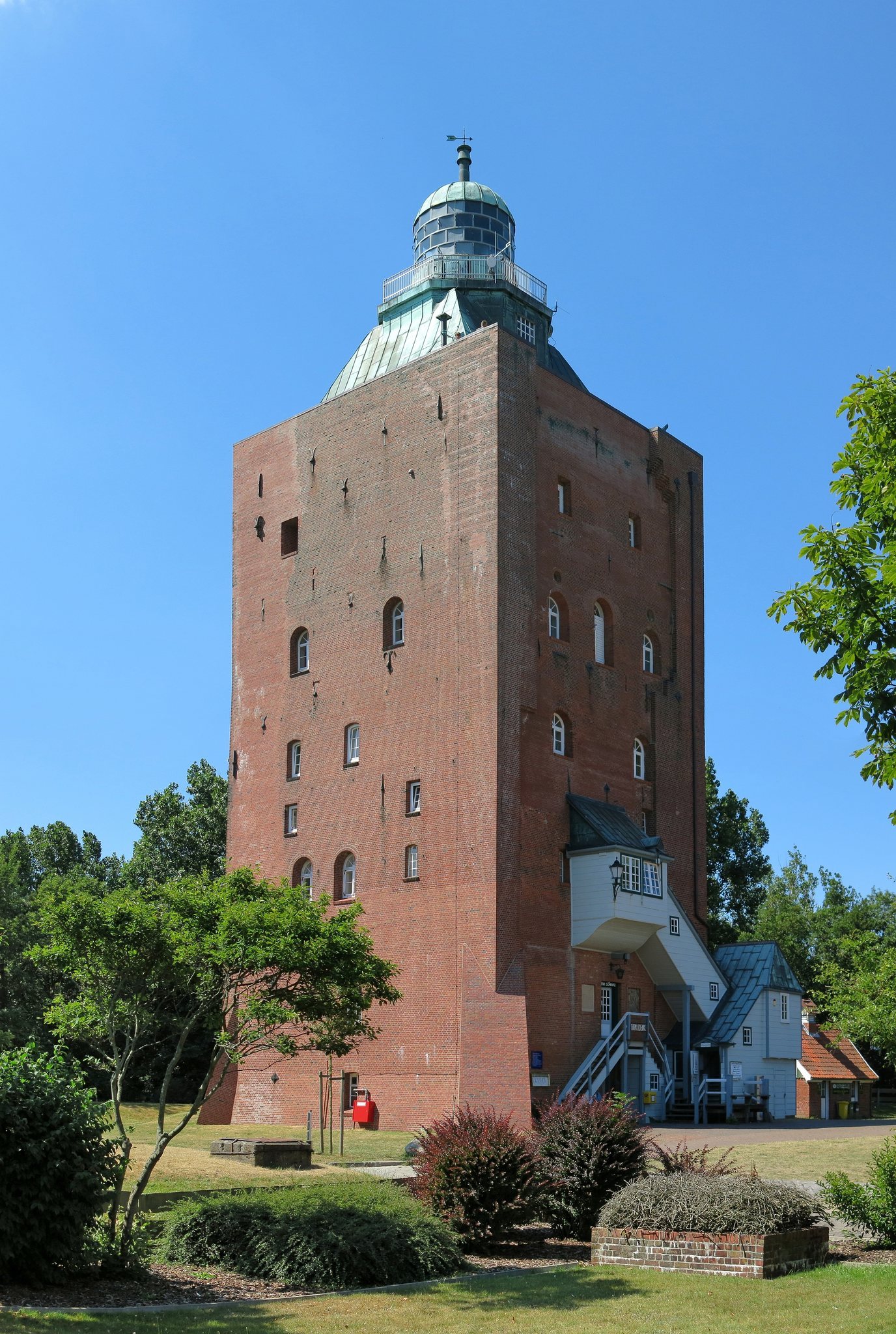
Great Tower Neuwerk is a medieval brick tower on Neuwerk Island in Hamburg, Germany. Authorized in 1286 as a sea mark and defensive outpost, it was built between 1300 and 1310 in the form of a Norman tower house, a fortified medieval tower combining defensive and residential functions. Its position at the southern end of the island allowed it to serve both as a visible reference for shipping and as a strongpoint against raiders approaching by sea or across the beach.
The obligation to maintain a permanent light at Neuwerk was reaffirmed in 1299 by John and Albert, dukes of Saxe-Lauenburg. The tower originally housed troops who protected vessels entering and leaving the Elbe estuary from maritime and coastal raiders. It also became the residence and administrative seat of the captain, an outpost of Hamburg’s authorities, and a customs station. That customs role continued until Hamburg conquered Ritzebüttel, a settlement and territory on the lower Elbe, in 1393.
A major fire around 1370 destroyed most of the tower’s wooden elements, after which the building was extensively rebuilt. In later centuries, the tower repeatedly provided refuge for island residents during storm surges and for survivors of shipwrecks. Its elevated position and durable construction allowed it to retain these protective functions while its maritime role developed.
Beacons and navigation
The beginning of the lighting tradition is uncertain, although a fire beacon on Neuwerk appears on the Carta Marina of 1539. An open coal beacon, known as a Blüse, was in operation by 1644. From 1761 it burned throughout the year and required about 1,000 tons of imported Scottish coal annually. The higher bitumen content of that coal produced a brighter flame than German coal.
Great Tower Neuwerk also served as a navigational bearing point in the outer Elbe. Bearing lines, or leading-light alignments in which visible marks guide vessels through a hazardous channel or around shoals, used it together with beacons, buoys, and other lights. These included the Scharhörn beacon and Rothe Tonne, the Blüse and Nordbake beacons and Schartonne, the small lighthouse and Schartonne, and the Werkbalger beacon and Buttertonne.
After the tower became a lighthouse, the open beacon was replaced by a small lighthouse. The two lights operated as leading lights for the safe passage northwest over the Vogelsandsteert, a hazardous shallow area in the outer Elbe. The small lighthouse was demolished in 1909, and its light had already been extinguished in 1885, leaving Great Tower Neuwerk as the island’s only remaining lighthouse.
The lighthouse from 1814
The tower was converted into a lighthouse on 20 December 1814 and remained an official maritime light until 10 February 2014, nearly two centuries later. Its first lighthouse apparatus consisted of 21 hollow-wick Argand lamps with parabolic reflectors. Argand lamps used a hollow wick and surrounding airflow to produce a brighter, steadier flame than earlier oil lamps. The lamps initially burned rapeseed oil, which was replaced by kerosene in 1870.
A five-wick clockwork kerosene lamp and a 700-millimetre Fresnel lens were installed in 1892. A Fresnel lens concentrates and directs lighthouse light through concentric optical sections, allowing a powerful beam from a relatively compact apparatus. The lamp was improved in 1908 and electrified in 1942. Propane was added in 1949 because the lighthouse had no emergency electrical supply. In autumn 2007 the conventional electric lamp was replaced by a halogen lamp, and on 10 February 2014 the light was changed to LED.
Electricity allowed the light to be extinguished quickly during the Second World War. In 1952, its stated luminous intensity was 5,700 Hefner units, or 13,200 toward the sea, with 1,000 for the red light and 550 for the green light. A Hefner unit was a historical measure of luminous intensity. The 1,000-watt lamp had an approximate range of 30 kilometres and could be seen as far as Heligoland in favourable weather.
Hamburg owned the lighthouse, while the Cuxhaven Waterways and Shipping Authority operated it as the body responsible for navigation in the Elbe estuary. Since the tower was no longer essential to through shipping, responsibility passed to the Hamburg Port Authority on 1 January 2014. After the official light was discontinued, Hamburg continued to operate it as a private light. Its former three-colour characteristic was replaced by a fixed white light with a range of about 3 nautical miles, so the tower’s lighthouse function continued in private rather than official navigational use.
Surveying, protection, and reuse
In July 1825, Great Tower Neuwerk served as the northernmost surveying point in Carl Friedrich Gauss’s triangulation of the Kingdom of Hanover. Gauss was a German mathematician and surveyor whose triangulation method used interconnected angles and measured points to map large territories. The tower and its place in the triangulation network later appeared on the reverse of the final series of German 10-mark banknotes, issued from 1989 to 2001.
The tower has been protected as cultural heritage since 1924, while the surrounding tower mound, an artificially raised mound supporting a structure above flood-prone ground, has been protected since 1971. It is officially regarded as Hamburg’s oldest building, the oldest secular building on the German coast, and one of the oldest surviving structures in the world to have served as a lighthouse.
The building has also been reused as a guesthouse and restaurant. In 1920, the former island teacher Heinrich Gechter initiated its use as a school hostel for pupils from Winterhude. That function moved to the attic of the neighbouring state barn in 1924. For many years, the attic also accommodated the bird warden of the Jordsand Association, a German organization concerned with protecting birds and their habitats.
Remains
The brick tower
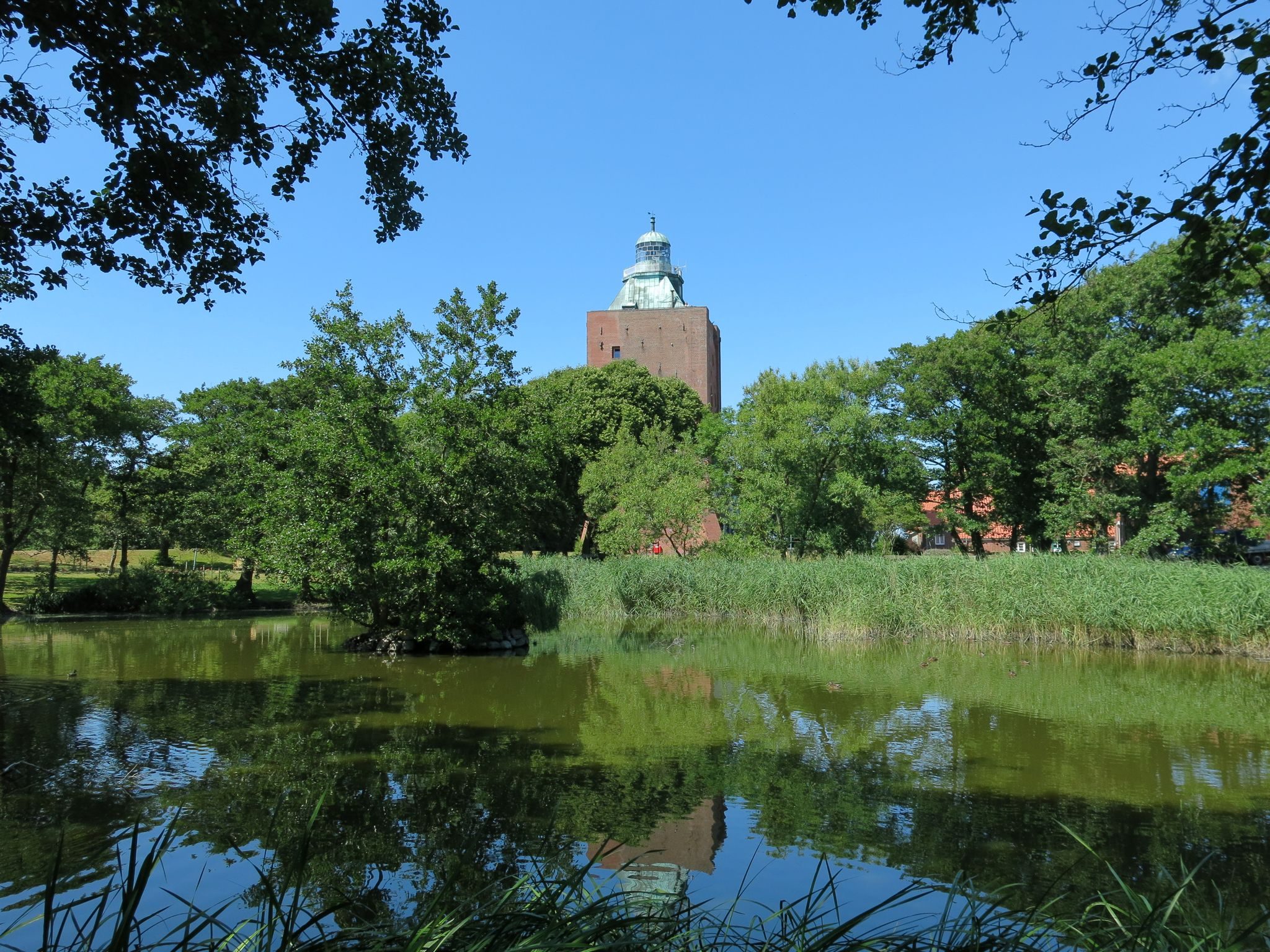
Great Tower Neuwerk is a square brick keep approximately 39 metres high, with a focal height of about 38 metres. Its form follows the Norman tower-house type used during the period of construction. The tower contains a gallery, incorporated keepers’ quarters, and three guesthouse floors. An observation platform stands at about 40 metres and is reached by 138 steps. The building occupies the southern end of Neuwerk on its raised tower mound, where its height makes it visible across a wide area and supports its use as a navigational bearing point.
The roof is a square pyramid carrying a lantern at its centre. The original covering was lead. It was replaced with copper in 1474, changed to red roof tiles in 1558, and later replaced by another copper roof. The copper roof was requisitioned for military use in 1916 and subsequently renewed. The tower remains the principal surviving landmark of Neuwerk, with its defensive, residential, administrative, and lighthouse functions incorporated into one tall structure.
Light and observation equipment
The 700-millimetre Fresnel lens installed in 1892 remains in use. The present fixed white LED light has a stated range of about 3 nautical miles. Before the official light was discontinued, the lighthouse had a nominal range of 16 nautical miles in white, 11 in green, and 12 in red. The surviving optical equipment preserves the connection between the medieval sea mark and the later technical lighthouse.
The observation platform looks across Neuwerk, toward Scharhörn, and over shipping on the outer Elbe and outer Weser. In suitable weather, views extend across the German Bight toward Cuxhaven and the industrial areas of Bremerhaven and Wilhelmshaven. The tower’s height, square brick mass, central lantern, and elevated setting together explain its long use as both a visible landmark and a working aid to navigation.