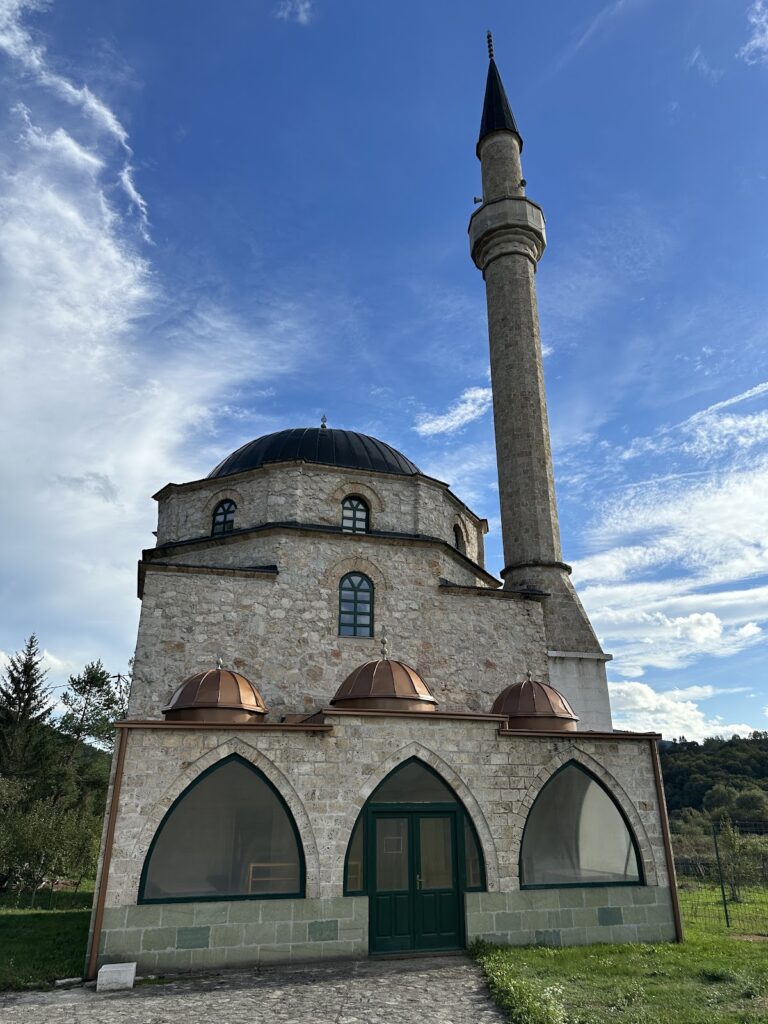
Lovnica Monastery: A Serbian Orthodox Monastery in Bosnia and Herzegovina
Site at a Glance
- Rating
- 4.9
- Popularity
- Low
- Country
- Bosnia and Herzegovina
- Primary era
- Early Modern
- External website
- Open
- Eras represented
- Early Modern, Modern
- Civilizations
- Ottoman, Serbian
- Site type
- Religious
- Remains
- Monastery
On this page12 sections
History
Lovnica Monastery is a Serbian Orthodox monastery near Šekovići in Bosnia and Herzegovina, dedicated to Saint George and belonging to the Zvornik-Tuzla Eparchy. Also known as Lomnica Monastery, it stands in Donji Birač beside the Lovnica stream. The present church was probably built in the 1560s or 1570s, during the renewed building and painting of Serbian Orthodox churches after the restoration of the Peć Patriarchate in 1557.
Early traditions and evidence
Tradition attributes the foundation of Lovnica to King Stefan Dragutin Nemanjić, the Serbian medieval ruler who reigned from 1284 to 1321. One account places his foundation in a hunting area, while another says that hunters discovered the site after the church miraculously moved there. The name is also connected with an old Slavic agricultural term for a small haystack or sheaf. Both Lovnica and Lomnica remain in use, although Lovnica is the locally accepted form.
The monastery is sometimes assigned to the thirteenth century, and one account says that a church stood there before 1301. The earliest written evidence is an inscription dated 1301, found at Kijevci near Gradiška, whose writer identified himself as a priest from Lomnica. This demonstrates an institutional or personal connection with Lovnica at that date, but it does not securely date the surviving church. A ruined church near the monastery and the later Ottoman authorization for rebuilding have also supported the view that an earlier church or monastery existed before the Ottoman conquest. The earliest phase remains uncertain because the area has not undergone archaeological investigation and earlier repairs were not adequately documented.
Sixteenth- and seventeenth-century rebuilding
The present church probably arose during the 1560s or 1570s, when the restored Peć Patriarchate encouraged renewed Orthodox construction and ecclesiastical organization under Ottoman rule. Mehmed Sokolović, an Ottoman grand vizier of Serbian origin, and his brother Makarije, who became Serbian patriarch, were important figures in this wider renewal. Lovnica’s secluded position beneath the mountain and beside the stream was associated with the need to protect the monastery from Ottoman violence.
Two entries in a manuscript typikon place activity at Lovnica on 6 November 1577/78. They name Arsenije and Akakije as senior monastic figures, whose title was apparently “elder” rather than abbot. The church’s donor portrait shows the monks Genadije and Akakije holding a model of the building. Their precise identities are uncertain, but they are thought to have been prosperous merchants, craftsmen, or landowners who used their wealth to build and furnish the monastery before entering monastic life.
In 1578, the painter and Peć monk Longin produced the iconostasis and began the fresco decoration. Other painters, including Jovan, Nikola, and Georgije, completed the wall paintings around 1608. An inscription dated 1607/08 names the hieromonk and abbot Prohor as commissioner of the frescoes. Prohor is the first person explicitly called an abbot in the monastery’s records, and this has led some historians to suggest that Lovnica may then have depended on nearby Papraća Monastery rather than functioning as a fully independent institution.
Lovnica also belonged to a wider Orthodox religious and cultural network. A Gospel written there in 1592 by the monk Grigorije mentioned the elder Akakije, Patriarch Jovan of Peć, Metropolitan Aksentije, and other contemporaries. The Gospel remained at Bešenovo Monastery until its destruction during the Second World War. A 1603 psalter preserved at Žitomislić records connections with Orthodox monasteries across the Serbian religious sphere, although it is uncertain whether the psalter itself was copied at Lovnica.
Ottoman rule and the change to a parish church
In the first centuries of Ottoman rule, insecurity and neglect affected the monastery buildings. After the Great Turkish War, the cells and dormitory were burned and the church was looted, although the church itself did not burn and was not described as suffering major structural destruction. The monastic community then departed and did not return. By 1705, the church had become a parish church serving the surrounding villages.
During the eighteenth century, monks and clergy from monasteries in Pljevlja, Rmanj, Herzegovina, Serbia, Kosovo, Montenegro, and occasionally Hilandar came to Lovnica mainly to collect donations. Many visitors scratched inscriptions into the frescoes and other surfaces. These marks damaged the painted decoration but also preserved evidence of the monastery’s later history. Services were held chiefly on religious holidays, and a house beside the church provided lodging for visitors.
Nineteenth century to the Second World War
During the nineteenth century, priests began keeping church books systematically rather than writing informal records on the walls. The church received a new wooden-shingle roof in 1823 and again in 1884. Secular priests from nearby parishes conducted services in 1883. In 1880, thieves robbed the church despite supervision by a committee of local priests and prominent villagers and the presence of an armed guard paid by the committee.
A landslide during the middle of the nineteenth century partly covered the northern wall. Soil retained against the wall allowed moisture to damage the frescoes, while supporting walls were built to the east and south to prevent the church from sliding toward the stream.
The Second World War brought further destruction and a new use for the complex. The dormitory and church roof burned, while a Partisan field hospital operated beside the monastery from September 1941. By early 1943, the hospital had about 100 beds in the monastery, with additional patients accommodated in nearby villages. A cemetery for fallen fighters was later established beside the monastery and arranged in 1961. The rebuilt dormitory housed a museum devoted to the National Liberation War, and the cemetery became part of a display concerning the Sixth East Bosnian Proletarian Brigade.
Conservation and restored monastic life
Conservation of the frescoes and iconostasis began in 1952. The dormitory was rebuilt, a new dormitory was erected on the site of the old one, and the area around the church was reorganized. A community of nuns returned in 1979, when Bishop Vasilije of the Zvornik-Tuzla Eparchy brought three nuns from Tavna Monastery. Anastasia Markovic became abbess, assisted by Evgenija Cvijanovic and Stefanida Stevic. Their arrival restored continuous monastic life at Lovnica.
Lovnica Monastery was designated a National Monument of Bosnia and Herzegovina in 2005. Since 2009, its abbess has been Jovana Solaja, assisted by the sisterhood and by the hieromonk Jovan Radic as spiritual father. The surrounding Donji Birač region contains medieval necropolises with stecak tombstones, large carved stone funerary monuments, including examples decorated with vine motifs. It also formed part of an Ottoman communication route from the Spreca valley toward Sarajevo.
Remains
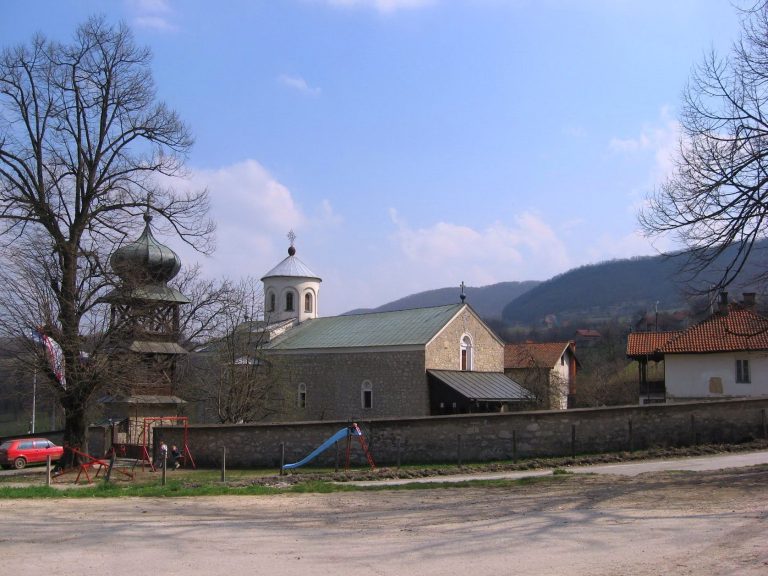
The monastery occupies a narrow, level area on a hillside beside the Lovnica stream, near its source. The church and dormitory stand close to the water, with the church positioned beneath the mountain. The surviving complex combines a small, plainly built stone church with an exceptionally rich interior of frescoes, painted icons, carved wood, old books, and decorated furnishings.
Church of Saint George
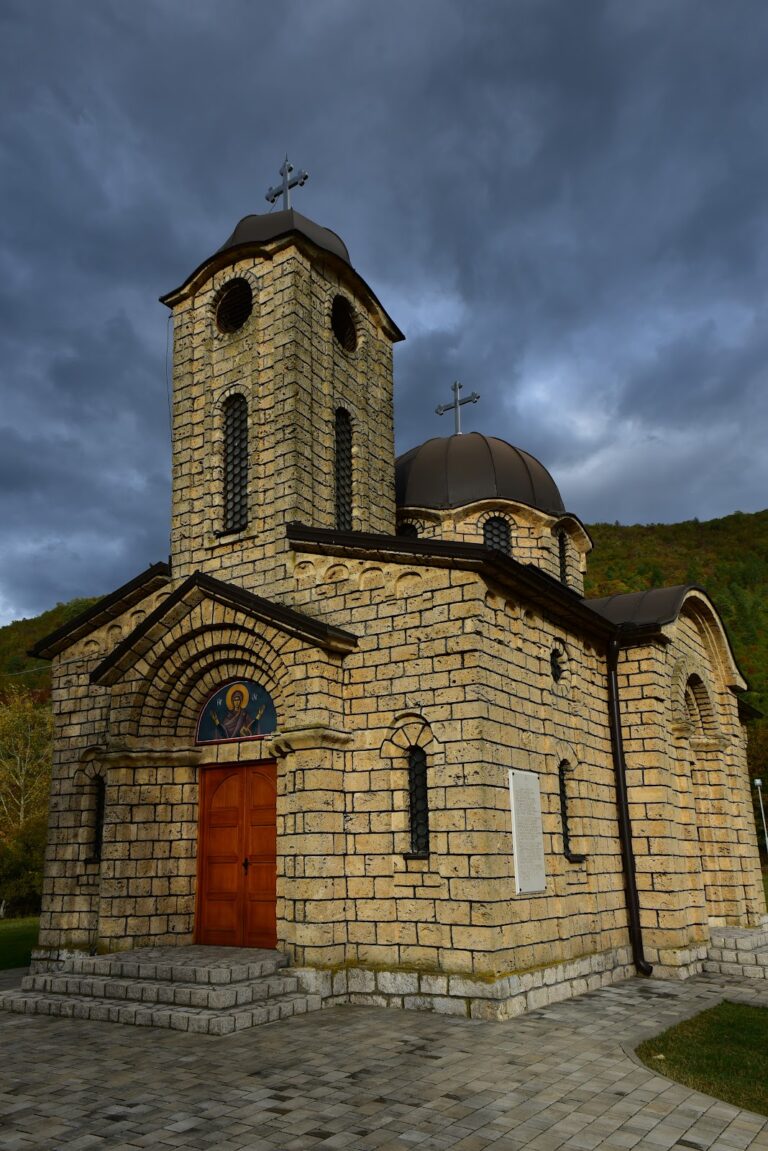
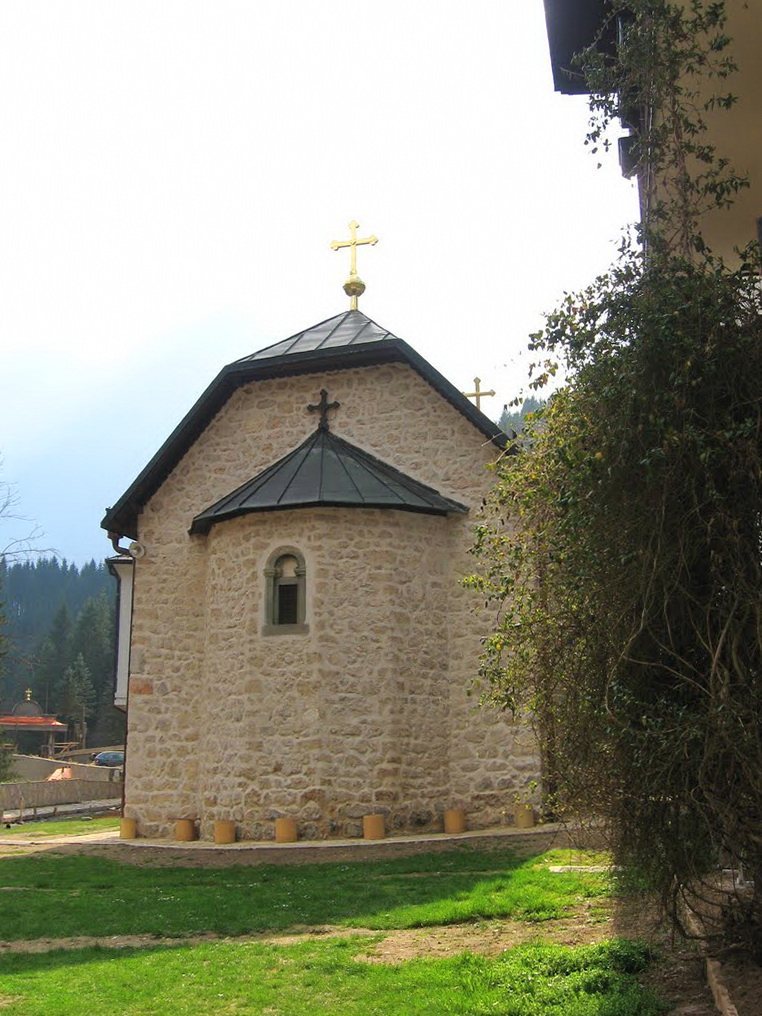
The Church of Saint George is a simple single-nave building with a narrower narthex, or entrance hall, and a five-sided apse. Its plan forms a compressed inscribed cross. The exterior measures approximately 15.00 by 7.00 metres, while the interior is about 8.50 by 5.50 metres. A semi-barrel vault covers the building, which is divided into narthex, nave, and sanctuary. A partition separates the narthex from the nave, while pilasters and columns mark the nave, solea, and altar area. The walls are made of rough, broken stone; dressed stone was used for the portals and window sills. The construction has been compared with churches at Gomionica, Rmanj, Krka, and Krupa, although Lovnica’s exterior is notably plain.
Frescoes and painted decoration
Fresco cycle
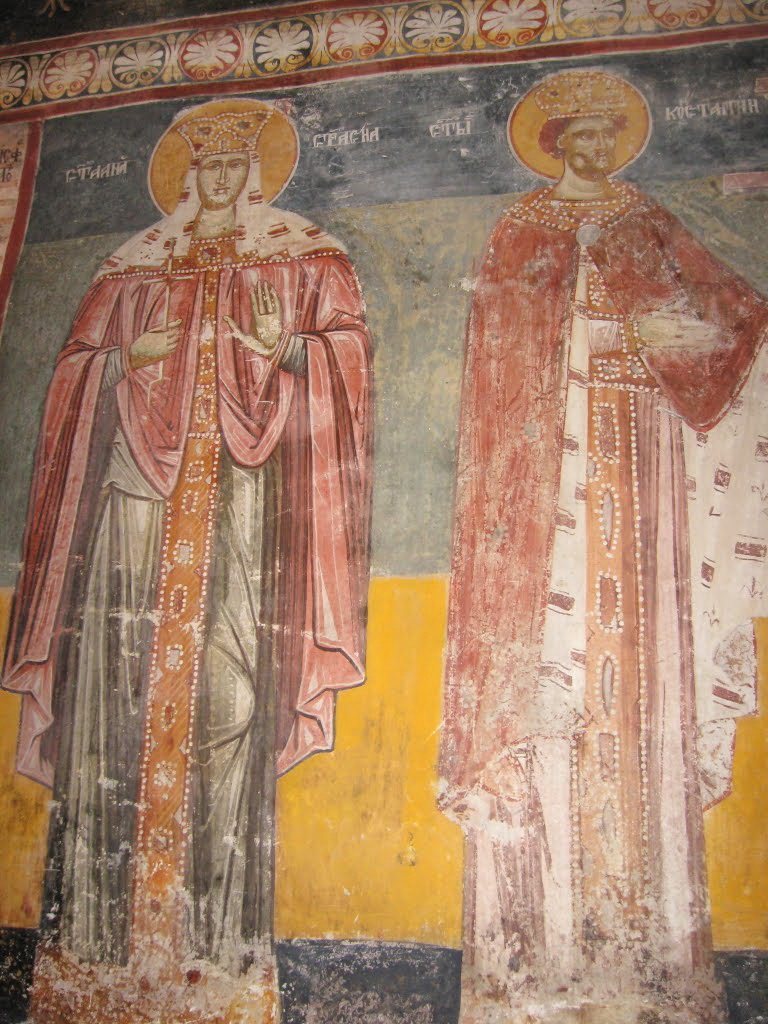
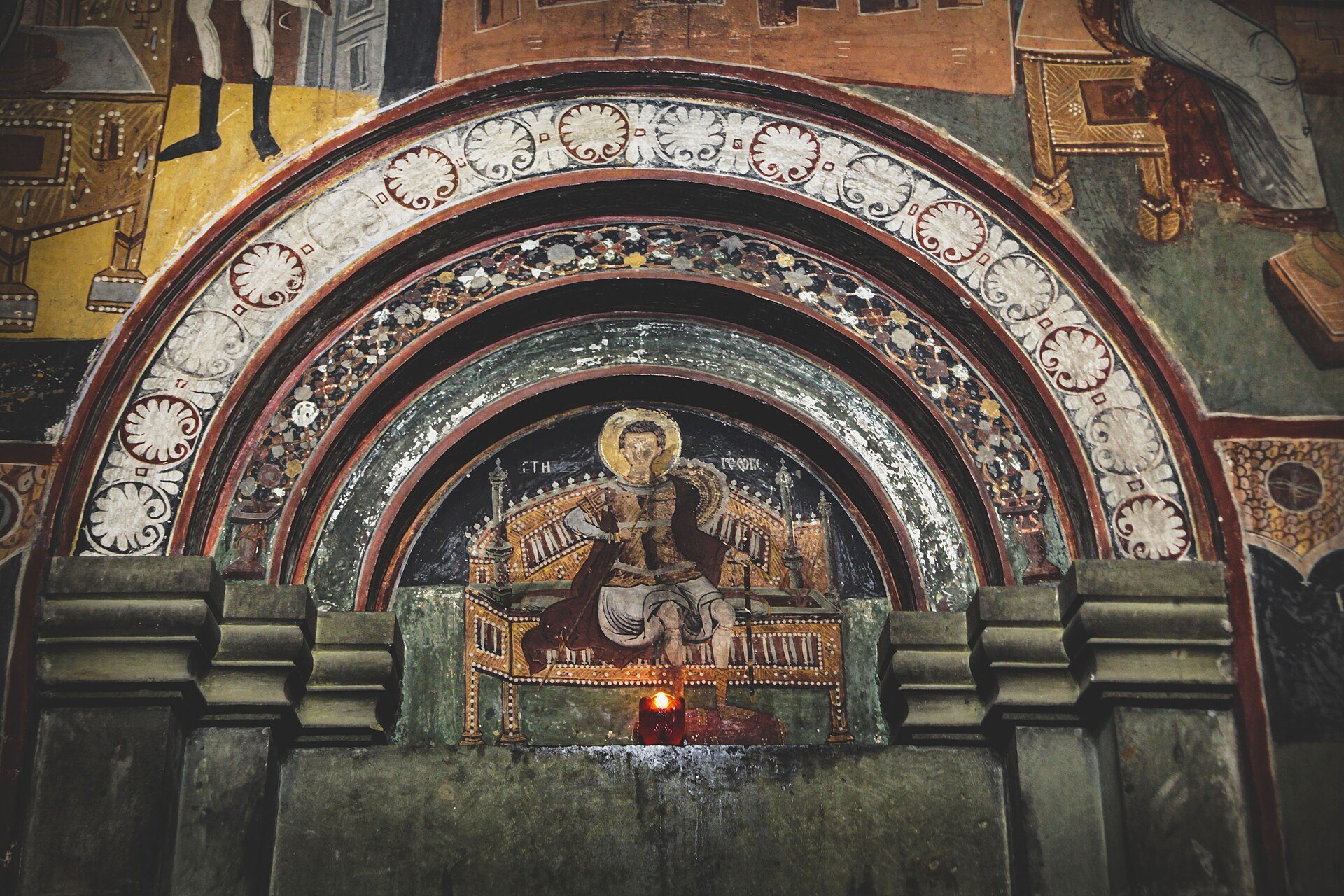
The interior frescoes are largely preserved, although the northern wall suffered moisture damage after the nineteenth-century landslide. Later graffiti and scratched inscriptions damaged additional portions of the painted surface. Longin’s work reflects the mature style associated with the restored Peć Patriarchate through carefully ordered compositions, elongated figures, soft modelling, and strong colour. The program includes the Heavenly Liturgy in the dome, scenes from Christ’s life such as the Nativity, Transfiguration, Resurrection, Ascension, Pentecost, the Myrrh-Bearing Women, the Descent into Hades, and the Entry into Jerusalem. The altar apse shows the Virgin surrounded by angels, while prophets, Old Testament scenes, figures beneath the triumphal arch, and other sacred compositions complete the decoration.
Later painters continued the program in a less accomplished style. Their work shows influences from the painting tradition of the Ohrid Archbishopric and, in parts of the narthex, possible Greek influence. The donor composition depicts Genadije and Akakije holding a model of the church. Other painted figures include Saint George the New and Saint Peter of Korisa, a local hermit. Greek inscriptions appear beside some monastic figures and on scrolls held by archangels.
Iconostasis
Longin painted the complete iconostasis, the screen of icons separating the sanctuary from the nave, in 1578. It originally contained 30 icons, including two throne icons that rank among the largest surviving wooden icons from the former Yugoslavia. Longin’s three painted rows survive alongside a later section made by an unidentified woodcarver and icon painter, who added the gilded royal doors and the large Crucifixion at the top. The royal doors depict the Annunciation. Longin’s surviving icons include the Virgin and Child with angels and prophets, Christ with the Virgin, John the Baptist, and the apostles, as well as Saint George and Saint Demetrius.
Seven of the former twelve Great Feast icons survive: the Annunciation, Baptism, Raising of Lazarus, Entry into Jerusalem, Crucifixion, Ascension, and Pentecost. Four standing apostles remain from the former Deesis row: Bartholomew, John the Theologian, James, and Matthew. An icon of the Unblinking Eye is placed above the royal doors. The throne icon of the Virgin is regarded as one of the finest Marian icons in the Serbian church tradition, while an icon of Saint George, the church’s patron, stands beside the throne icon of Christ.
Books, icons, and carved furnishings
The monastery retains a smaller collection of icons, books, and craft objects. Its old books include an octoechos, an Orthodox liturgical book arranged around the eight tones of church hymnography, printed by Bozidar Vukovic in Venice in 1537, parts of handwritten chronicles, and several eighteenth-century Russian printed books. Other objects formerly associated with Lovnica were dispersed to institutions and monasteries in Vlasenica, Kladanj, Bešenovo, Žitomislić, Belgrade, and elsewhere.
Two decorated choir desks are distinguished by marquetry. One uses circles, rosettes, and hexagons in its ornament, while the other combines rosettes with a band of small six-pointed stars. Both incorporate turned wooden latticework alternating with rows of turned wooden posts.