Sümela Monastery: A Historic Greek Orthodox Monastery in Türkiye
Site at a Glance
- Rating
- 4.2
- Popularity
- Very High
- Country
- Turkey
- Primary era
- Medieval
- External website
- Open
- Eras represented
- Medieval, Early Modern, Modern
- Civilizations
- Ottoman
- Site type
- Religious
- Remains
- Monastery
On this page14 sections
History
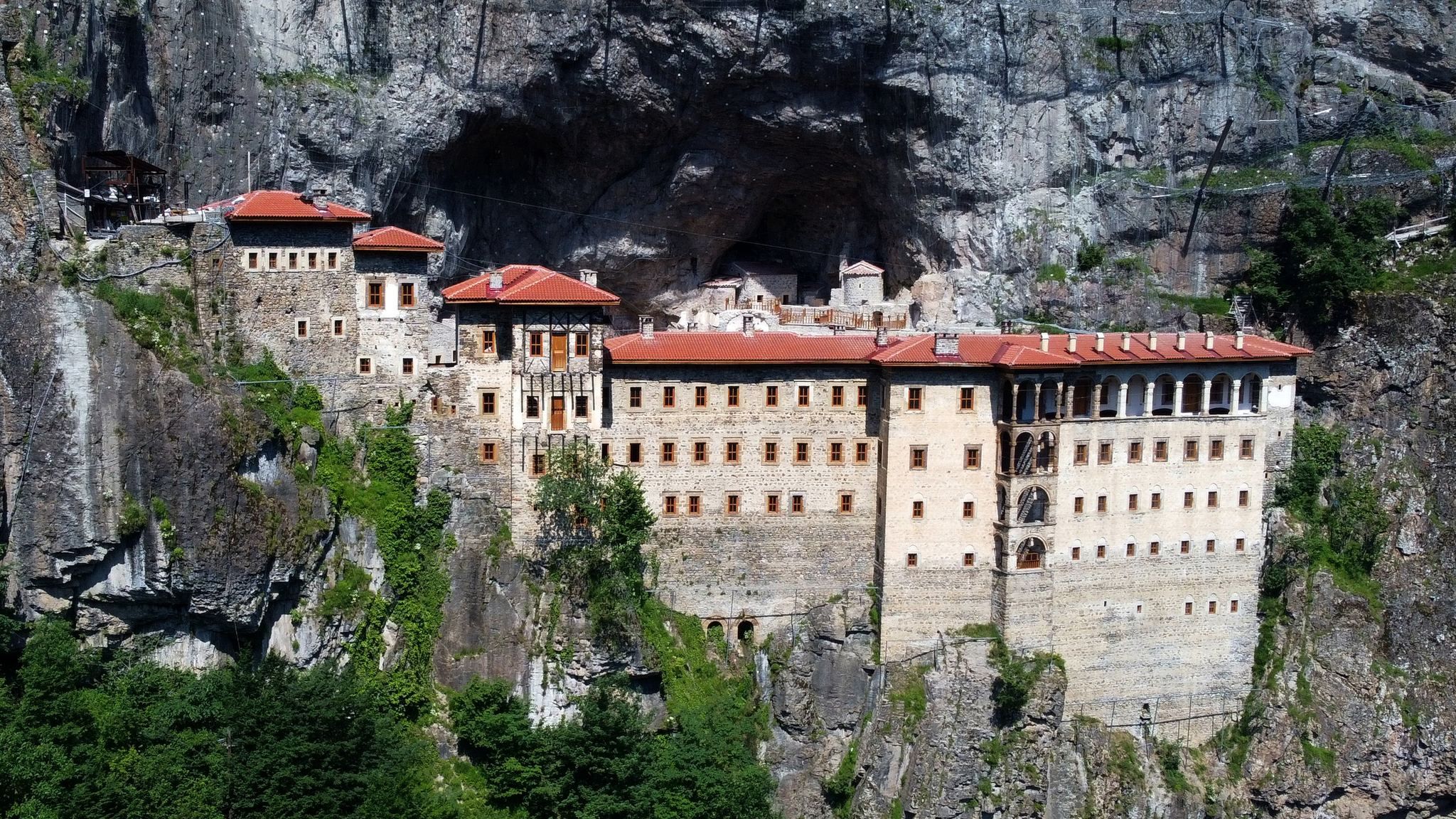
Sümela Monastery is a former Greek Orthodox monastery in Türkiye, built into the Pontic Mountains above the Altındere Valley in Trabzon Province. Its foundation is traditionally placed around AD 386, during the reign of Emperor Theodosius I, although the oldest buildings currently known archaeologically date no earlier than the thirteenth century. The monastery remained in use until the 1923 population exchange between Greece and Turkey and is now principally a museum.
Origins and Byzantine traditions
The foundation date remains uncertain because the cave and its surroundings have not yet been fully excavated. Monastic tradition attributes the establishment of Sümela to the Athenian monks Barnabas and Sophronios. According to the story, a vision of the Virgin Mary led them to the cliff, where they founded a settlement around an icon associated with miraculous powers. Several versions describe how this icon reached the site from Athens.
Sümela experienced repeated destruction and rebuilding during the Byzantine period. In the sixth century, after the monastery had been sacked and burned, the general Belisarius restored and enlarged it on the orders of Emperor Justinian. Further damage and reconstruction followed in the seventh century. The monastery survived the eighth- and ninth-century disputes between iconophiles, who supported the veneration of religious images, and iconoclasts, who opposed such images.
Patronage under Trebizond
Sümela acquired its present scale and prominence during the thirteenth century, especially under the rulers of the Empire of Trebizond. This Greek successor state was established on the southern Black Sea coast in 1204, and its Komnenian rulers became major patrons of the monastery.
Emperors John II and Basil gave Sümela substantial wealth. Its most extensive medieval patronage came under Alexios III. A chrysobull, an imperial charter bearing the ruler’s golden seal, issued in 1365 confirmed the monastery’s autonomy, hereditary lands, and dependents. It also granted major tax exemptions, listed 40 exempt dependents, and assigned an annual payment from imperial funds. Later rulers, including Manuel III, made further grants.
Monastic tradition also remembers Alexios III as a major benefactor. It relates that the Theotokos, the Christian title for Mary meaning “Birth-Giver of God,” saved the emperor during a storm. In gratitude, he promised to restore Sümela, and the story became part of the monastery’s account of its imperial patronage.
Ottoman protection and later development
After Sultan Mehmed II conquered Trebizond in 1461, Sümela came under Ottoman protection. Later sultans renewed its rights and privileges, allowing the monastery to continue its religious and institutional life. From 1682, it housed the Phrontisterion of Trebizond for several decades. This Greek educational institution made the monastery a centre of learning as well as worship.
During the second half of the eighteenth century, Wallachian voivodes financed improvements and extensions. In the nineteenth century, Orthodox Greek communities throughout Anatolia supported further reconstruction and decoration. The monastery remained active during the Russian occupation of Trabzon from 1916 to 1918 and continued to receive both Christian and Muslim visitors.
Abandonment and modern conservation
The monastery was abandoned in 1923 when the population exchange required its monks to leave. They were not permitted to take the monastery’s property with them. The wooden sections were destroyed by fire in 1930, and later years brought further damage and looting. Treasure hunters apparently removed frescoes with considerable skill.
In the same year, Greeks displaced by the exchange founded a New Panagia Sümela Monastery on Mount Vermion near Kastania, close to Veria in Macedonia, Greece. Treasures carried from the original monastery were preserved there, and the buried principal icon was later secretly recovered.
The Turkish state permitted the Ecumenical Patriarchate of Constantinople, the senior institutional centre of the Eastern Orthodox communion, to celebrate the Divine Liturgy at Sümela on 15 August 2010. This was the first such service there in 88 years. The requested service in August 2024 was refused, and the celebration was moved to 23 August.
Sümela was registered as a first-degree archaeological site under Turkish heritage law in 1972 and entered the UNESCO Tentative World Heritage List in 2000. This list identifies places considered suitable for possible future World Heritage nomination, but inclusion is not the same as World Heritage inscription. The monastery also lies within Altındere National Park, where environmental protections regulate construction and alterations around the site.
Increasing rockfalls led to the monastery’s closure in 2015. Restoration and safety work began in 2016 and included archaeological and conservation investigations. The 2015–2017 programme combined multidisciplinary surveys, material analysis, rock stabilization, and conservation of the buildings and frescoes. A secret tunnel and previously unseen frescoes were discovered during the work, and the site reopened in May 2019.
Remains
Cliffside layout and monastic buildings
Sümela occupies a natural cave on an almost vertical cliff at about 1,200 metres above sea level and approximately 250 metres above the Meryemana Dere stream. Dense forest surrounds the monastery, which overlooks the Altındere valley. The complex brings together the Rock Church, chapels, kitchens, study rooms, a guesthouse, a library, a sacred spring, and other monastic buildings.
A large aqueduct runs against the cliff at the entrance. Its water channel rests on numerous arches, most of which have been restored. Entry continues along a long, narrow, steep staircase. A guard room stands beside the entrance, while further stairs descend from it to the inner courtyard. Several buildings stand on the left in front of a cave, and the library is situated on the right.
Nineteenth-century guesthouse
A four-storey guesthouse and related service buildings were constructed during the nineteenth century. The large cliffside building with a projecting balcony contains monks’ cells and accommodation for guests and bears the date 1840. Its surviving form belongs to the later period of the monastery’s development, when Orthodox Greek communities across Anatolia supported reconstruction and decoration.
Water installation and sacred spring
The monastery’s water system includes a sacred spring revered by Orthodox Christians and Muslims. The surrounding buildings preserve Ottoman-period artistic elements, including cupboards, fireplaces, and other interior details. The spring has pointed arches, while dark-red painted designs imitate eighteenth-century Ottoman brickwork.
The Rock Church and painted interiors
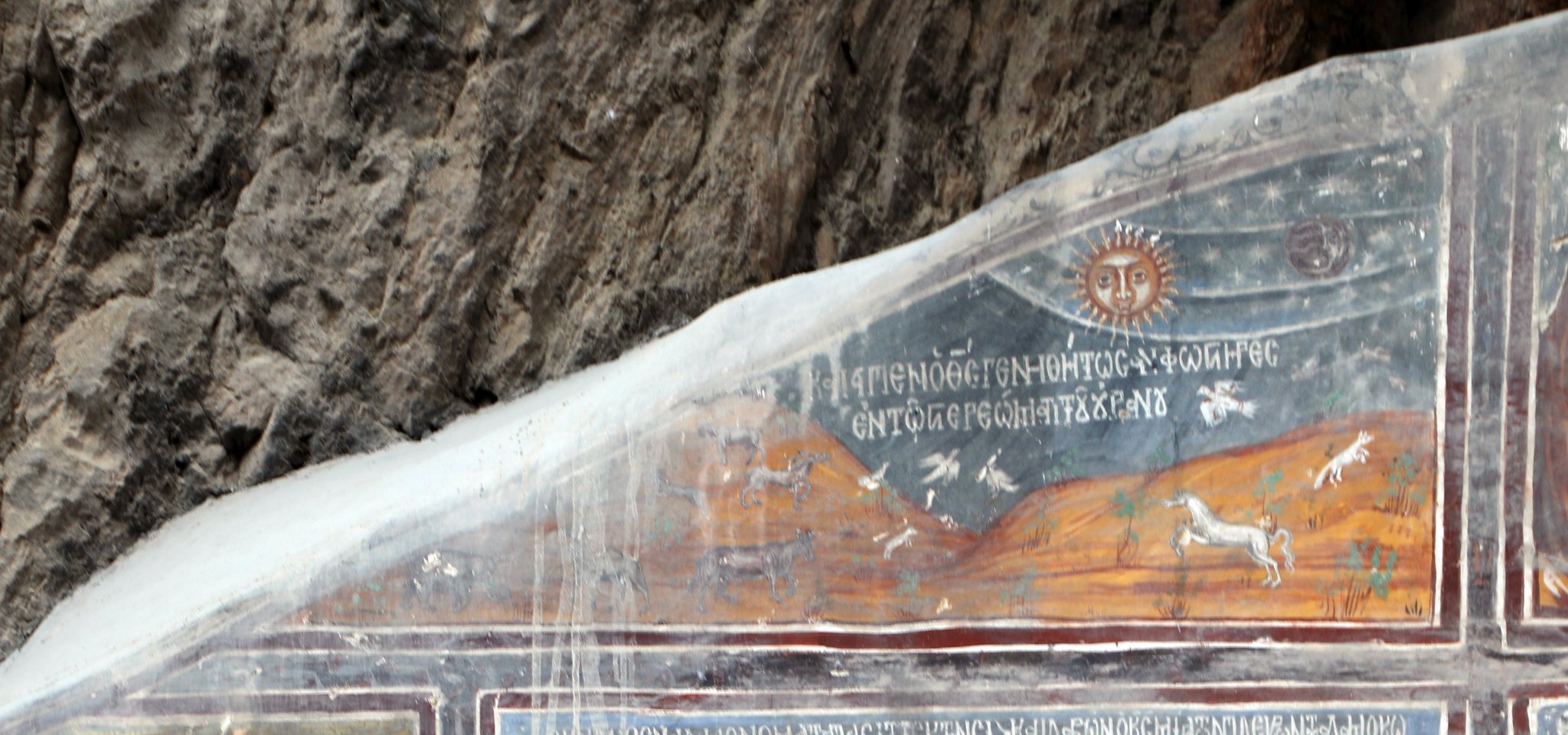
The Rock Church occupies a natural cave that was enlarged and smoothed inside. A straight masonry wall closed its entrance, and the church forms the architectural centre of the monastery. The cave church, the adjacent chapel, and other buildings contain frescoes painted in successive layers. In some areas, three layers can be distinguished, and inscriptions indicate that much of the visible work was executed in 1710 and 1732.
Rock Church frescoes
Frescoes are wall paintings applied to wet plaster, allowing the pigment to become integrated with the surface as it dries. On the inner wall of the Rock Church facing the courtyard, paintings made during the reign of Alexios III originally showed the emperor with his sons Manuel III and Andronikos. Those particular paintings no longer survive.
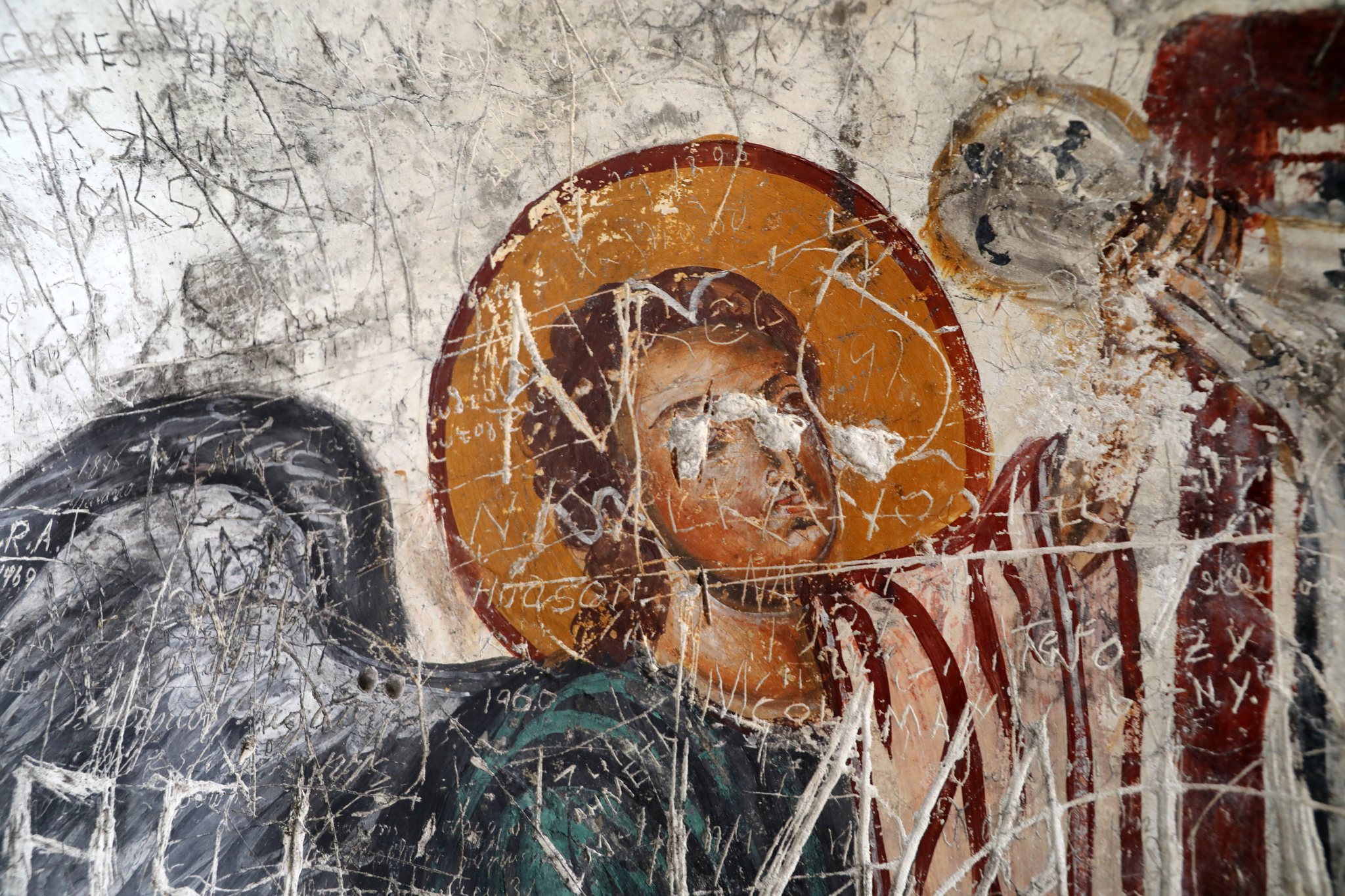
An exterior fresco depicting a scene from the Apocalypse survives in its upper sections. Peeling plaster exposes earlier painted layers. Across the monastery, frescoes have suffered from vandalism, graffiti, smoke, cracks, and areas of loss. Conservation work cleaned the surfaces and reintegrated some damaged figures and motifs without repainting the frescoes wholesale.
Adjacent chapel paintings
The adjacent chapel contains representations of a dragon, Saint George, and Saint Demetrius. Older painted layers show diademed figures and the Transfiguration of Jesus. Additional paintings survive in older parts of the monastery and in a cave about 100 metres north of the complex. Previously unknown frescoes found during modern restoration depict heaven, hell, life, and death.
Collections and surviving movable remains
The monastery’s library formerly held valuable documents and ancient manuscripts. In 1868, the researcher Savvas Ioannidis reportedly found there the first Greek manuscript of Digenes Akrites. Manuscripts and treasures from Sümela are now dispersed among institutions outside the original monastery.
A museum in Ankara holds 66 seventeenth- and eighteenth-century manuscripts. Byzantine Gospel books and printed books are preserved in the Hagia Sophia Museum in Istanbul, while church treasures and documents are held by the Byzantine and Christian Museum in Athens. Additional objects are in the Benaki Museum, the National Gallery of Ireland, and a private collection in Oxford.
Objects removed from Sümela include a silver cross containing relic wood attributed to Emperor Manuel III, a silver medallion depicting the Holy Trinity, a 1438 altar cloth, and an icon known as “Our Lady of the Roses.” Silver candlesticks donated by Sultan Selim I were stolen in 1877. The principal icon, traditionally associated with the Theotokos and believed to possess miraculous powers, was hidden in the chapel of Saint Barbara before the monks departed in 1923 and was later transferred to the New Panagia Sümela Monastery in Greece.
Restored historic fabric
Recent conservation repaired roofs, windows, doors, and walls with wood and stone compatible with the historic materials. Reused original materials were retained where possible, while replacement materials were made distinguishable from the older fabric. These interventions addressed both the monastery’s cliffside buildings and the painted surfaces that preserve evidence of its long religious and artistic history.