Krzeszów Abbey: A Baroque Cistercian Monastic Complex in Poland
Site at a Glance
- Rating
- 4.7
- Popularity
- Medium
- Country
- Poland
- Primary era
- Early Modern
- External website
- Open
- Eras represented
- Medieval, Early Modern
- Civilizations
- Habsburg, Holy Roman Empire, Kingdom of Prussia
- Site type
- Religious
- Remains
- Monastery
On this page21 sections
History
Krzeszów Abbey is a former Benedictine and Cistercian monastery in Poland, founded in 1242 and transformed into a major Baroque religious complex during the seventeenth and eighteenth centuries. Its history includes dynastic patronage, agricultural expansion, war and secularization, and a later revival as an important Marian shrine and centre of Silesian religious art.
The Benedictine foundation
Anna of Bohemia, widow of Henry II the Pious, founded the monastery on 8 May 1242 to fulfill her husband’s wishes. Benedictine monks from Opatovice in Bohemia settled the new foundation, which was initially a provostry, a monastic establishment governed by a provost rather than an abbot. It was dedicated to Saint Lawrence. Pope Innocent IV formally confirmed the foundation in 1249.
The monks received extensive forested lands for clearance and cultivation. In 1256, Anna’s son Bolesław Rogatka granted the foundation about 200 Frankish hides, equivalent to approximately 5,000 hectares. The Benedictines left in 1289, probably because the estates were developing too slowly. Political circumstances and the failure to raise the provostry to independent abbey status may also have played a part. On 29 June that year, the abbot sold the Cressowe possessions to Duke Bolko I for 240 marks, approximately 120 kilograms of pure silver.
The Cistercian abbey and Piast necropolis
Bolko I replaced the Benedictines with Cistercians from Henryków, with the approval of the Cistercian General Chapter at Cîteaux and the abbot of Henryków. Twelve monks led by the founding abbot Theodoric arrived on 9 August 1292. The foundation document was drawn up on 7 and 8 September under the dedication Gratia Sanctae Mariae. Bishop Jan Romka of Wrocław consecrated the church and its high altar.
The Cistercians first occupied the earlier site at Krzeszówek, then moved the monastery about 2 kilometres to Krzeszów. The new location probably offered better use of the fast-flowing Zadrna stream. Its broad valley was suited to an abbey with agricultural estates, a grange, and systems for managing water. The foundation served religious, economic, political, and frontier purposes. The monks cleared woodland, created settlements, cultivated grain, peas, beans, vines, and hops, and raised cattle and sheep. They also managed fishponds and forests and operated breweries, distilleries, mills, weaving enterprises, and other workshops.
The abbey acquired numerous villages, the town of Lubawka, vineyards and hop gardens near Bolków and Lwówek Śląski, and rights to operate crafts and sell manufactured goods. Its estates later expanded to almost 40 villages and the monastic towns of Lubawka and Chełmsko Śląskie. Under Abbot Innocent Fritsch, the territory comprised 42 villages and two towns with approximately 30,000 inhabitants.
Krzeszów also became a religious and political centre and a burial place for its founders. It developed into the dynastic necropolis of the Świdnica-Jawor Piasts, a branch of the Piast dynasty that ruled Silesian duchies. Bolko I was buried in the presbytery on 9 November 1301, and his sarcophagus was installed in the church around 1350. Other rulers interred there included Bolko, Henry I of Jawor, Henry II of Świdnica, Bernard the Steadfast, and Bolko II the Small.
The monastery maintained an important archive and library. Its historical writing included the larger Krzeszów Annal, covering 1230–1306, and the smaller Krzeszów Annal, covering 1292–1312. In 1318, Pope John XXII confirmed the community’s privileges.
War, decline, and rebuilding
After the Świdnica-Jawor Piast line became extinct in 1392, the duchy and the abbey passed under the Bohemian Crown, beginning a period of decline. In 1403, Cistercians from Krzeszów established a filial foundation and parish at Cieplice. There they developed a thermal spring and helped establish a spa.
Hussite forces devastated Krzeszów in 1426, burning the church and monastery. A miraculous Marian icon from the high altar was hidden beneath the sacristy floor. It was rediscovered in a chest on 18 December 1622, after almost two centuries. The monks returned after the Hussite wars and completed reconstruction in 1454. The restored complex included the chapter house, refectory, dormitory, cloisters, and churchyard.
The monastery suffered further attacks and fires during conflicts over the Bohemian throne in the second half of the fifteenth century. The Protestant Reformation then reduced the community from 60 members in 1520 to 12 in 1600 and caused religious unrest among people living on the monastic estates. In 1547, Pope Paul III granted the abbots the privilege of wearing the mitre and episcopal insignia.
The Thirty Years’ War brought further destruction. Saxon-Brandenburg troops plundered the abbey in 1632, and Swedish troops burned the buildings on 4 June 1633. The fire destroyed the church and a library of about 1,000 volumes. The church of Saint Andrew, parts of the monastic church interiors, and a mill survived.
The Baroque renewal
After the war, Krzeszów became a major centre of Catholic renewal and the Counter-Reformation in Silesia. This movement responded to the Protestant Reformation by strengthening Catholic worship, pilgrimage, confraternities, education, and religious art. Pilgrimage revived, and the abbey expanded its activities through new churches, chapels, processions, devotional associations, and pilgrimage landscapes.
Abbot Bernard Rosa, who governed from 1660 to 1696, initiated the abbey’s cultural and religious golden age. With the support of Angelus Silesius, the literary name of the Silesian physician, mystic, and religious poet Johann Scheffler, and the painter Michael Willmann, he promoted the idea of transforming Krzeszów into a “New Jerusalem.” Rosa founded the Confraternity of Saint Joseph in 1669, established a Latin school for 70 poor but gifted pupils, founded the Confraternity of Saint Anne in 1686, and sponsored the church of Saint Joseph.
Under Rosa, the Calvary, the Bethlehem complex, the church of Saint Joseph, a Loreto chapel, and other religious buildings were built or begun. The abbey supported Marian processions and pilgrimage, while its monks increasingly served parishes throughout the surrounding estates.
Abbot Dominicus Geyer, who led the monastery from 1696 to 1726, reorganized the estates and strengthened the abbey’s finances. In 1703, the Cistercians acquired Bolków Castle and enlarged their territorial holdings. Under Innocent Fritsch, the estates were divided into five administrative districts, and Krzeszów became an important administrative and domestic textile centre.
The eighteenth-century church and Prussian rule
Because the old church had become structurally unsafe, Fritsch ordered its demolition in 1727. Construction of the present Baroque church began in 1728 and continued until 1735. Specialists from Silesia, Bohemia, Austria, and Moravia took part, including 41 masons, 12 stonecutters, and 10 sculptors. Cardinal Philipp Ludwig Sinzendorf, bishop of Wrocław, consecrated the new church in July 1735. Construction of a new monastery began in 1738, but the planned monumental reconstruction was never completed.
After the First Silesian War, Krzeszów passed with most of Silesia to Prussia in 1742. A Prussian force of 800 soldiers occupied the abbey for six months in 1741, and taxation later consumed as much as 80 percent of its income. The monastic church became a parish church, part of the old cloister was demolished, and other buildings were converted into a school, residences, and a forestry administration.
Prussia secularized the abbey during the Napoleonic Wars. The decree was issued on 30 October 1810, and the convent was dissolved on 23 November. The estate then comprised 42 villages and two towns, with approximately 30,000 inhabitants and 48 resident religious. The church continued as a parish church, while monastic buildings and artworks suffered extensive damage, dispersal, and confiscation.
Nineteenth- and twentieth-century changes
The complex deteriorated during the nineteenth century. The copper roof of the Piast mausoleum was replaced with clay, the western and southern cloister wings were blown up in 1873, and the church of Saint Anne burned in 1884. A fire destroyed the helmet of the northern church tower in 1913, and the tower was reconstructed in 1930 and 1931.
German Benedictines from Emmaus Abbey in Prague settled in the former monastery in 1919 after being forced to leave Czechoslovakia. Pope Pius XI raised the community to abbey status in 1924. The Benedictines promoted Gregorian chant and liturgical and theological education and undertook extensive conservation work.
Nazi authorities confiscated the monastic buildings in 1940. The complex became a resettlement centre for ethnic Germans from Bukovina, a transit camp for Jews deported to concentration camps, and later accommodation for displaced Germans from Lorraine, Alsace, and Hungary. From 1943, it also held museum collections evacuated from cities threatened by air raids, including important holdings of the Prussian State Library in Berlin.
After the Second World War, the German community was expelled in May 1946 and relocated to Bad Wimpfen, where it established a new Grüssau Abbey. Polish Benedictine nuns expelled from Lviv settled at Krzeszów in 1946 and 1947. Polish authorities took over the evacuated collections, and much of the Berlin library material became part of the Berlinka collection at the Jagiellonian Library, whose wartime ownership and status remain disputed.
Pastoral responsibility passed successively to Benedictines from Tyniec, diocesan clergy, Cistercians from Wąchock, and, from 2006, diocesan clergy again. In 1992, Krzeszów became the principal Marian shrine of the newly created Diocese of Legnica. Pope John Paul II crowned the miraculous image of Our Lady of Grace on 2 June 1997. The church of the Assumption of the Blessed Virgin Mary became a minor basilica in 1998, and the abbey was designated a Polish Historic Monument in 2004. It is also presented as a candidate for UNESCO World Heritage inscription.
Remains
The basilica and its Baroque furnishings
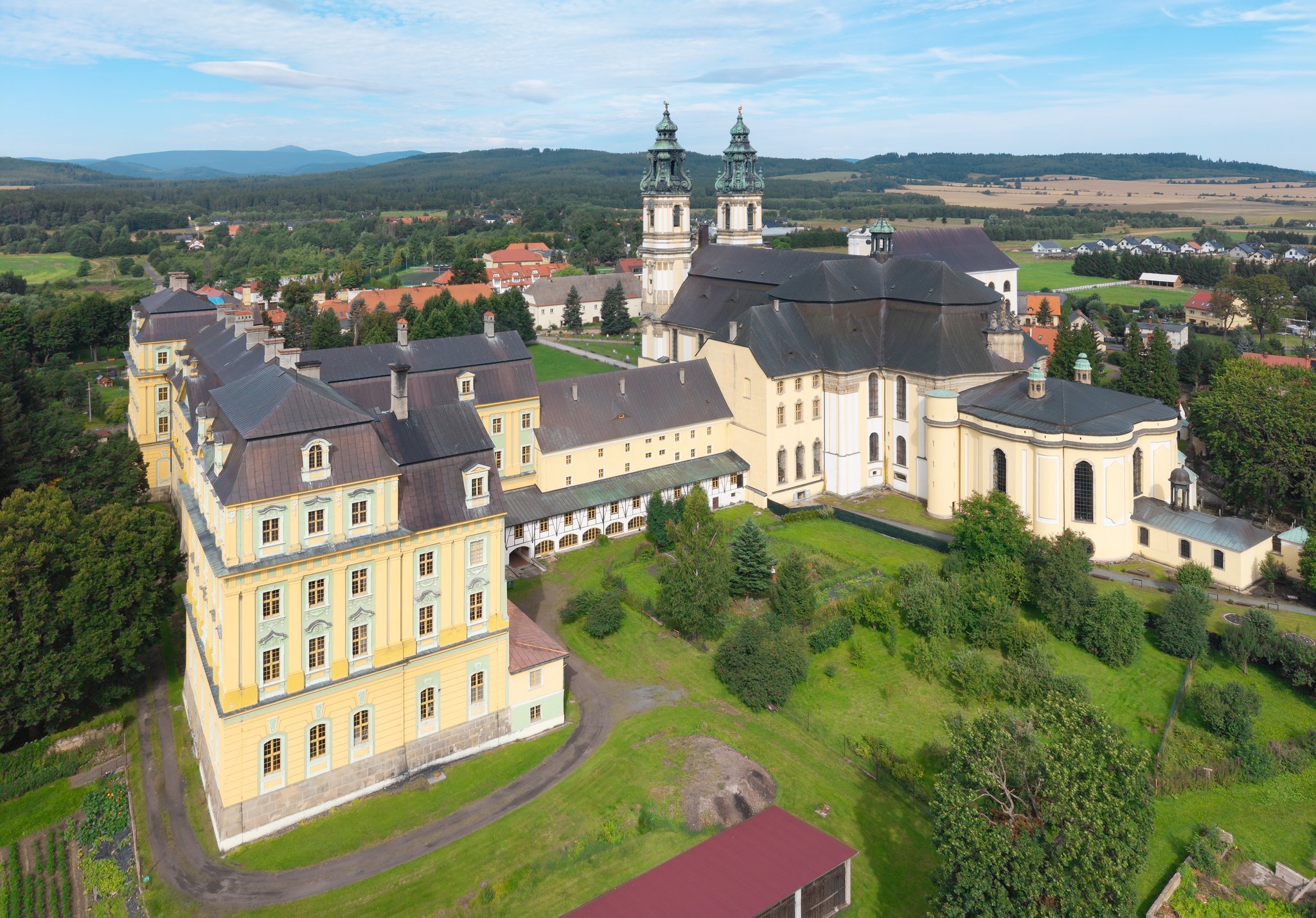
The Basilica of the Assumption of the Blessed Virgin Mary occupies the site of the medieval church. Built between 1728 and 1735, it is a two-towered High Baroque basilica influenced by the circle of Kilian Ignaz Dientzenhofer. Joseph Anton Jentsch directed the construction, while Ferdinand Maximilian Brokoff designed the sculptural facade. Anton Dorazil and later Joseph Anton Lachel continued the work after Brokoff’s death.
Facade and interior
The facade is arranged in three horizontal storeys but stresses a strong upward movement. Six over-life-size sandstone statues represent Saint Scholastica, Saint Benedict, Moses, Pope Gregory the Great, Saint Bernard of Clairvaux, and Saint Lutgardis. Brokoff carved Moses and Gregory, while Dorazil’s workshop produced the four figures of monastic patrons.
Inside, three naves follow a plan formed by intersecting ellipses. Six shallow chapels contain twelve altars, with galleries above them. Compressed vaults are divided by transverse bands, and two choir chapels dedicated to Saint Bernard and Saint Benedict served the religious community. The main altar combines a Gothic panel of the Madonna of Krzeszów, associated with the pilgrimage tradition and dated no later than the second half of the thirteenth century, with white-painted wooden sculptures from Brokoff’s workshop and Peter Johann Brandl’s painting of the Assumption of the Virgin Mary.
The altar’s architecture and sculpture were produced by Brokoff and Dorazil. Brandl also painted Saint John Nepomuk distributing alms for a southern side altar. The high altar represents the Adoration of the Cross by choirs of angels. Georg Wilhelm Neunhertz painted the fresco cycle, including the Good Shepherd, the Sermon on the Mount, and the Parable of the Pharisee and the Publican. Portraits in the entrance hall show Abbots Bernard Rosa, Dominicus Geyer, Innocent Fritsch, and Benedict II Seidel.
Altars, organ, and liturgical furnishings
The church contains altars and devotional features dedicated to the Holy Cross, the Fourteen Holy Helpers, Saint Joseph, Christ Emmanuel, the Christ Child, the Blessed Sacrament, Saint Anne, Saint Benedict, Saint Bernard of Clairvaux, Saints Peter and Paul, Saint Nicholas, Saint Catherine of Alexandria, Saint John Nepomuk, Saints John the Baptist and John the Evangelist, Saint Matthew, and Saint Francis Xavier.
The Blessed Sacrament altar includes Michael Willmann’s paintings of the Jesse Tree, the Twelve Prophets, and the Twelve Sibyls. The Saint Joseph altar has a painting by Felix Anton Scheffler and figures of Saint Alberic of Cîteaux and Saint Teresa of Avila from Lachel’s workshop. Other altars contain paintings by Scheffler and Brandl and sculptures by Lachel, Dorazil, and Ignatz König.
Anton Stenzel made the pulpit in 1736, and Lachel decorated it in 1761 with figures of the Holy Trinity and reliefs of the Church Fathers. Brokoff and Dorazil created the choir stalls between 1730 and 1735, decorating them with saints and prophets. The organ gallery holds a case whose figures were designed by Brokoff and executed by Dorazil. Dorazil also made the two angels with holy-water bowls beneath the gallery. Richly decorated Baroque inlaid cupboards survive in the sacristy.
Michael Engler the Younger of Wrocław built the basilica’s organ between 1732 and 1737. Nineteenth-century alterations were largely reversed during restoration and reconstruction in 2008, leaving the instrument substantially in its original condition.
Princes’ Chapel and associated chapels
Princes’ Chapel
The Fürstenkapelle, or Princes’ Chapel, was built between 1735 and 1747 as a Baroque mausoleum. Its dome has a diameter of 9.4 metres. Neunhertz painted frescoes illustrating the abbey’s history, Dorazil produced the sculpture, and Ignaz Albrecht Provisore made the stucco. Scheffler painted the altar pictures of All Saints, Saint Wenceslaus, and Saint Hedwig.
Gothic sarcophagi for Bolko I and Bolko II stand against the west wall. A Renaissance tomb for Ladislaus von Zedlitz-Nimmersatt was transferred there from the former monastic church.
Loreto Chapel
Martin Schuppert built the Loreto Chapel in 1728. Its altar sculptures came from Dorazil’s workshop, while Georg Schrötter carved the black Madonna of Loreto in 1676 for an earlier chapel. A Loreto chapel reproduces or evokes the Holy House associated with the Marian shrine of Loreto.
Chapel of Mary Magdalene
The Chapel of Mary Magdalene was built east of the Princes’ Chapel in 1738. It contains frescoes by Neunhertz, an altar with figures of Mary of Egypt and Saint Pelagia, and Scheffler’s painting of Mary Magdalene in religious ecstasy. A life-size metal figure of Christ, made by Georg Schrötter in 1678, stands in the burial chamber.
Church of Saint Joseph
The church of Saint Joseph stands northwest of the abbey church. Bernard Rosa founded it for the Confraternity of Saint Joseph, a lay religious association organized around shared devotion and charitable or devotional activity. Built between 1692 and 1695 on the site of the medieval parish church, it is a single-nave High Baroque building without towers. Its two-storey facade is crowned by copper-covered wooden figures of the Holy Kinship, the extended family of Jesus and Mary.
Michael Willmann, his son Michael Willmann the Younger, his stepson Johann Christoph Lischka, and the Cistercian Jacob Arlet created the fresco cycle. The eastern side chapels represent the Seven Sorrows of Saint Joseph, while the western chapels show his Seven Joys. Willmann included a self-portrait in the scene of the Search for Lodging in Bethlehem.
Joseph Anton Lachel carved the main altar, and Ignatz König painted the side altarpieces. The pulpit, attributed to Georg Schrötter, is decorated with reliefs from Saint Joseph’s life and a figure of God the Father. Willmann painted the Flagellation and Ecce Homo on the southern wall of the gallery. The church’s organ, made at the end of the seventeenth century by an unknown maker, has one manual with eight stops and an independent pedal with two stops. It was restored between 1993 and 1995.
Monastic buildings and cemetery
The older monastic buildings adjoin the abbey church on the south. Martin Schuppert rebuilt and enlarged them in 1662. Their ground floor contains a late Gothic chapter house from the mid-fifteenth century, while the eastern projection contains a two-storey library with a classical interior.
Around 1770, Johann Georg Feller prepared plans for a new four-wing monastery arranged around two courtyards in a G-shaped layout. The proposed western wing was to have 23 window axes and an almost 70-metre belvedere. Only the three-storey southern wing was substantially built, between 1774 and 1782. A simplified connecting wing followed between 1788 and 1792, but secularization in 1810 halted the larger project.
The monastic cemetery occupies two terraces connected by a stairway with a Crucifixion group by Johann Georg Gode. Renaissance epitaphs are incorporated into the cemetery wall. West of Saint Joseph’s Church stands a Baroque, three-storey guesthouse for abbots, built in 1734, probably to designs by Joseph Anton Jentsch. A stone pillory column in front of the southern garden wall dates from the early eighteenth century.
Devotional landscape
Calvary
The Krzeszów Calvary is a devotional landscape representing episodes of Christ’s Passion through chapels, statues, and stations. Bernard Rosa began it with wooden chapels between 1675 and 1678. Dominicus Geyer rebuilt it in stone between 1703 and 1721. The complex presents the Way of the Capture of Jesus and the Way of the Cross. It is described as containing 32 devotional stations and, in another enumeration, 38 sculptural station groups. A Passion book for meditation at the stations was printed in 1682.
Bethlehem complex
The Bethlehem complex lies about 2 kilometres west of the abbey. It includes a Nativity sculptural group and a summer pavilion.
Saint Anne Chapel and grounds
The ruined chapel of Saint Anne stands on a rise east of the abbey. It was built in 1722 and rebuilt after a fire in 1884. The wider complex includes gardens, boundary walls, gates, paths, and the Zadrna stream. A statue of Saint John Nepomuk stands on a bridge over the stream.
The principal artistic decoration of Krzeszów belongs to the Silesian and Central European Baroque. Contributors included Dientzenhofer, Brokoff, Dorazil, Brandl, Lachel, Willmann, Lischka, Neunhertz, Scheffler, and Schrötter. Seven new bells were cast for the abbey church in 1935 by Petit and Gebrüder Edelbrock. They were removed during the Second World War for melting; three of the largest were recovered from a confiscated-bell depot in Hamburg but were sold in 1952 to Saint Cecilia’s Catholic Church in Mosbach because they were too large for the towers at Bad Wimpfen.