Mor Hananyo Monastery: Syriac Orthodox Patriarchal Centre in Türkiye
Site at a Glance
- Rating
- 4.6
- Popularity
- Medium
- Country
- Turkey
- Primary era
- Medieval
- External website
- Open
- Eras represented
- Bronze Age, Classical, Medieval, Early Modern, Modern
- Civilizations
- Byzantine, Ottoman, Roman
- Site type
- Religious
- Remains
- Monastery
On this page17 sections
History
Mor Hananyo Monastery, also called the Monastery of Saint Ananias, is a Syriac Orthodox monastery in Türkiye, about 3 km east of Mardin in the Tur Abdin region. The Syriac Orthodox Church is an Oriental Orthodox Christian tradition whose worship and scholarship use Syriac, a form of Aramaic. Founded as a Christian monastery in 493, Mor Hananyo became a spiritual, cultural, intellectual, and ecclesiastical centre for Syriac Orthodox communities.
Before and after the Christian foundation
The site stands on a place traditionally associated with an Assyrian sanctuary dedicated to Shamash, the ancient Mesopotamian sun-god. This interpretation places the sanctuary around 2000 BC, although both its identification and date remain uncertain. In late antiquity, the site became a Roman citadel and later a Byzantine fortress.
After the Romans abandoned the site in the late fifth century, the monk Mor Shlemon, also known as Solomon, converted it into a Christian monastery in 493. Persian forces raided and destroyed the monastery in 607, after which it remained deserted for a period.
The monastery and the patriarchate
Mor Hananyo, a metropolitan bishop of Mardin and Kafartut, restored and refounded the ruined community in 793. A metropolitan was a senior bishop responsible for a major ecclesiastical centre. The monastery took its present name from him. Mor Hananyo established a substantial manuscript library, and the community grew to about 80 monks. His disciple Ignatius I succeeded him in 816 and enlarged both the monastery and its library.
The monastery was temporarily abandoned before Yuhanon, bishop of Mardin, renovated it between 1125 and 1148. It then became the residence of the patriarch, the senior bishop of a major Christian jurisdiction, of the Syriac Orthodox Church. Michael the Great was enthroned there in 1166, beginning nearly eight centuries in which Mor Hananyo served as the seat of the Syriac Orthodox Patriarchate of Antioch. The patriarchate remained there until it was relocated from Türkiye in 1924.
During this period, the monastery was the setting for at least 21 Syriac Orthodox synods, ecclesiastical assemblies dealing with church affairs. The last was held on 30 November 1916, when Ignatius Elias III was elected patriarch. Burial chambers at the monastery contain the remains of 53 patriarchs, metropolitans, and saints.
Attacks, rebuilding, and refuge
From the thirteenth century onward, Mor Hananyo and neighbouring communities endured repeated attacks, looting, desecration, and neglect. Mongol forces devastated the monastery in 1394, and Tamerlane attacked it in 1396. Kurdish raids, notably in 1516, caused further damage. Walls, monastic cells, and the main door were destroyed or damaged during these assaults.
Patriarch Ignatius II rebuilt the monastery between 1696 and 1699 and added the Church of the Patriarchal Throne for synods and patriarchal elections. Later patriarchs continued to repair the complex. Peter IV renovated the mausoleum in 1884 and was buried there in 1894.
During the violence against Assyrian Christians that began in 1895, the monastery was repeatedly occupied and abused. It also became a refuge for hundreds of displaced women, children, and elderly people, while nearby Christian villages were devastated. Manuscripts preserved at Mor Hananyo contain eyewitness accounts of these events in Syriac, Arabic, and Garshuni, a form of Arabic written in Syriac script.
During the massacres of 1915 and the wider Assyrian genocide, Kurdish tribes besieged the monastery while refugees from surrounding villages sheltered inside. Food was reportedly smuggled past the besiegers in disguise. The monastery and its community were directly affected by killings, forced conversions, abductions, and the displacement of Assyrian Christians across the region.
Printing, scholarship, and later use
The monastery acquired a printing press in England in 1874. It was transported to Aleppo and installed at Mor Hananyo in 1881, while a separate printing house was built in 1882. The first book printed there appeared in 1888, and the press remained active until 1917. It produced the periodical Hikmet in 1913 and 1914, and during the Turkish Republic it printed official documents because it was the only printing facility in the region. Publications continued until 1969, and Oz Hikmet was printed there until 1953.
The monastery’s library, established under Mor Hananyo in the late eighth century, suffered major losses through attacks and looting. Manuscripts were at times used as rifle wadding and kindling, yet more than 300 Syriac and Arabic manuscripts remain. The oldest date from the ninth century, and the collection includes works on theology, scripture, law, grammar, philology, asceticism, ritual, history, and related religious and scientific subjects. In 1928, Metropolitan Yuhanon Dolabani compiled a Syriac facsimile catalogue of the manuscripts, later translated into Arabic and English. The monastery has also been associated with Iwannis, metropolitan of Dara; Patriarch Ignatius Aphrem I Barsoum; Metropolitan Mor Philoxenos Yuhanon Dolabani; and Mor Philoxenos Saliba Ozmen.
In 1924, following the establishment of the Turkish Republic, Patriarch Ignatius Elias III was expelled from Türkiye. The patriarchate moved first to Homs and later to Damascus, where its seat remains. Mor Hananyo continues as a Syriac Orthodox monastic and liturgical centre associated with the Mardin diocese. Services are held in Classical Syriac, the upper floor accommodates guests including the patriarch, and a boys’ boarding school teaches Aramaic and Syriac liturgy alongside state education. Extensive renovation has taken place in recent decades.
Remains
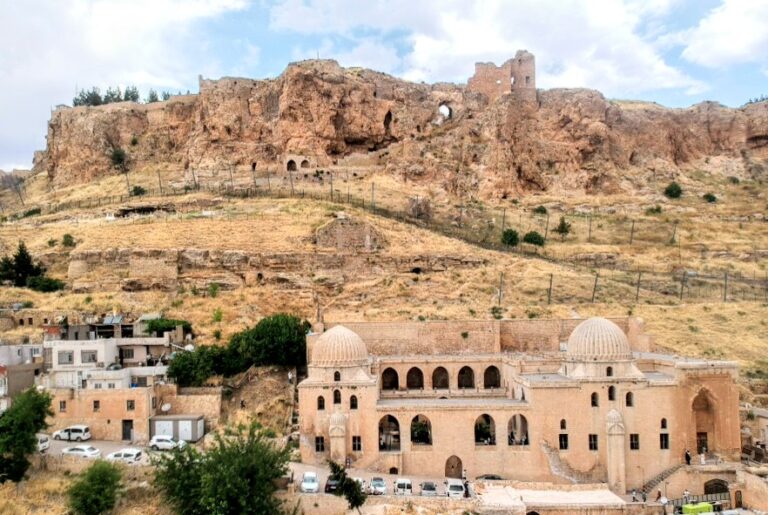
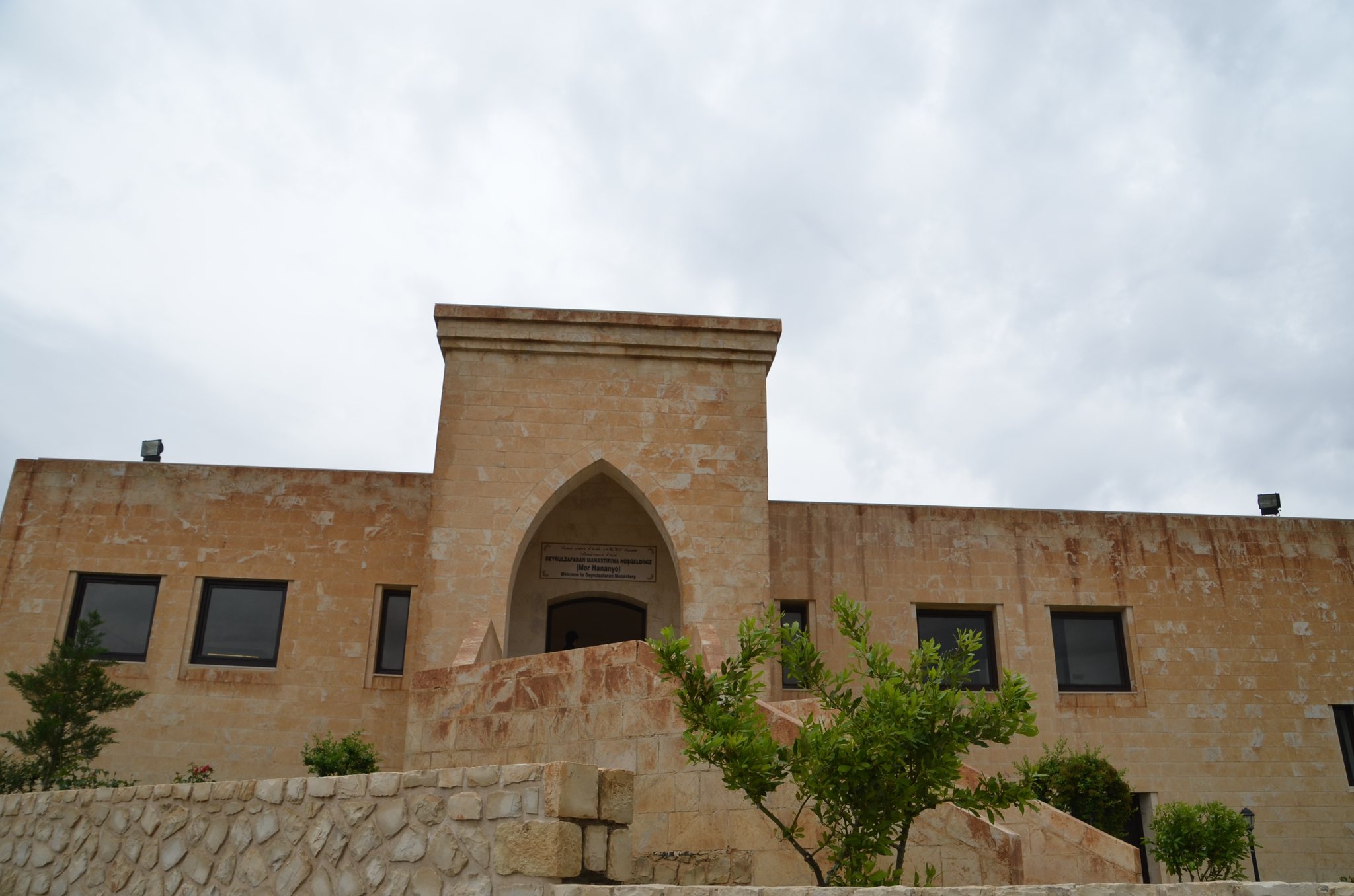
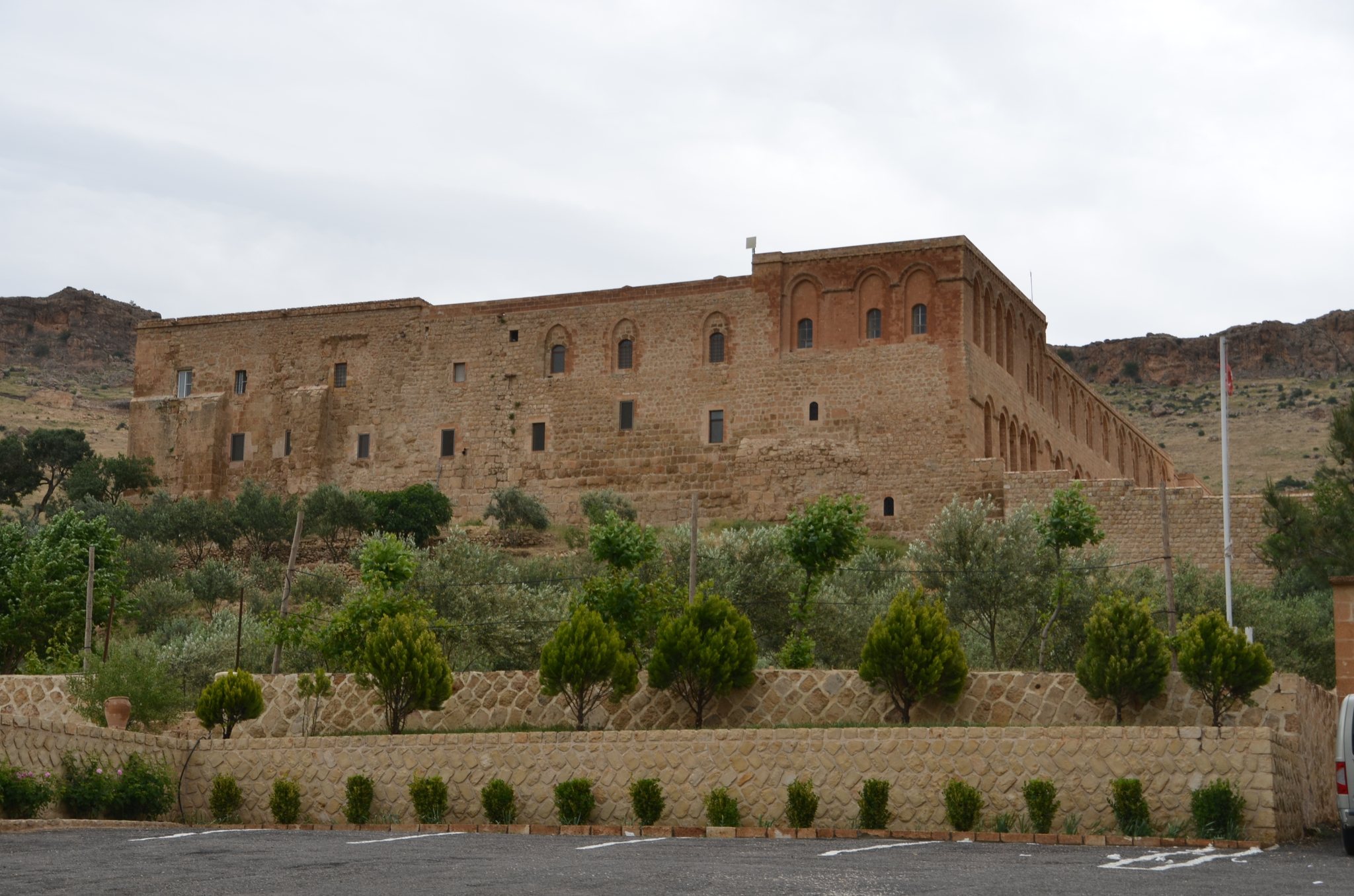
Mor Hananyo occupies an irregular complex measuring about 71 by 63 m on a mound at the edge of the Mesopotamian plain. A strong enclosing wall surrounds buildings added and rebuilt over many centuries. Most of the complex has two storeys, while the southern section has three. Higher levels contain patriarchal apartments and monks’ cells, and large carved stones and bricks from early building phases remain visible in churches and lower-storey vaults. Channels and aqueducts carry water from nearby springs or the surrounding mountains.
Courtyard and early sanctuary
Courtyard and water system
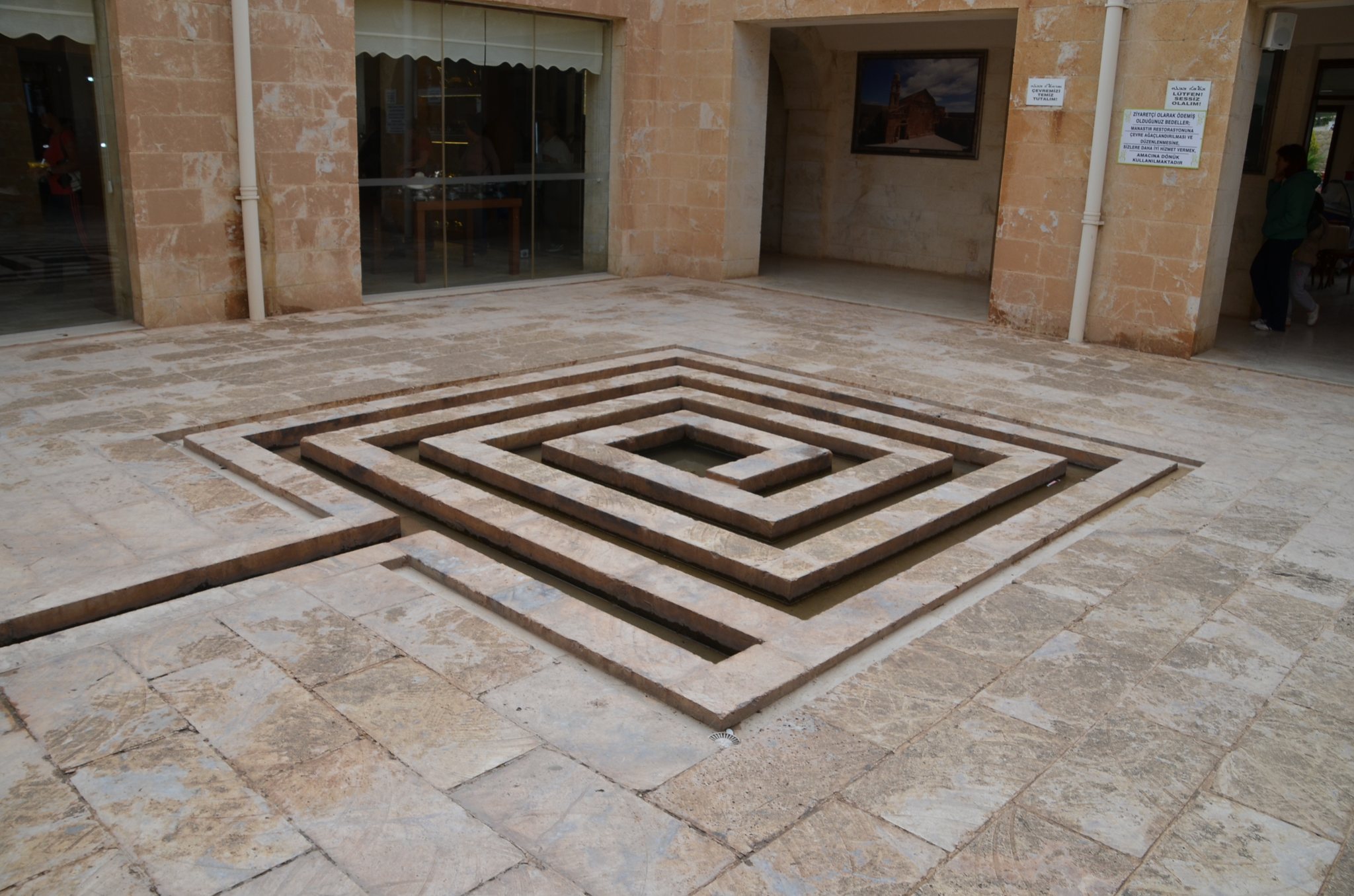
The central courtyard is enclosed by porches on all four sides. Two large cisterns, constructed reservoirs for storing water, hold fresh water brought from nearby springs, especially during winter and spring. The monastery is traditionally said to contain 365 rooms, one for each day of the year.
Underground sanctuary
Beneath the main courtyard, near the mausoleum, is an underground sanctuary consisting of two rooms. It is traditionally identified as a temple of Shamash dating to around 2000 BC, but this identification and date remain uncertain because the chamber has not been scientifically investigated. Massive stone vaults and blocks are fitted together without mortar by interlocking construction. Some blocks are about 2 m high and weigh approximately 500 to 1,000 kg, while a central keystone locks the structure together. An opening to the east admits the first rays of sunrise toward the altar. This orientation is consistent with possible solar ritual use, but does not by itself prove that the chamber was used for solar worship or sacrifice.
Churches and burial spaces
Domed Church of Mor Hananyo
The Domed Church occupies the eastern wing. One tradition attributes it to Byzantine Emperor Anastasius I and names the Assyrian architects Theodosius and Theodore, while another connects its construction with Mor Hananyo’s restoration between 793 and 816. The church has a cross-shaped plan measuring approximately 17.7 by 12.3 m, with an area of about 271 square metres and an interior height of 17.7 m.
Its cross-shaped dome, six gates, and exterior animal motifs are among its defining features. The southern gate carries inscriptions about the life of Jesus and the Alpha and Omega symbols. A tall, narrow image of Saint Ananias survives from the church’s former fresco decoration, and another portrait of Ananias is preserved in the southern section. Wooden service platforms on the northern and southern sides date from 1699. A central platform was destroyed by fire in 1941, leaving two columns. Patriarch Ignatius Abded Mshiho II ordered the walls to be plastered in 1903, covering some earlier decoration.
Church of the Virgin Mary
The Church of the Virgin Mary, also called Sayyida, stands in the northern part of the monastery and dates from the fifth or sixth century. Measuring approximately 10.75 by 14.25 m, it is regarded as the original church of the complex. Its baked-brick ceilings and walls incorporate Byzantine-period apse mosaics. Four altars have carved wooden sanctuaries dating from 1699, and three wooden doors are from the same year. Syriac inscriptions and Psalm verses remain within the church, whose octagonal adult baptismal font continues in use.
Church of the Patriarchal Throne
The Church of the Patriarchal Throne stands above the Church of the Virgin Mary on its southern side. Patriarch Jirjis II built it between 1696 and 1699 in honour of Saint Peter. Measuring approximately 17.5 by 9.25 m, it was designed for patriarchal synods and elections. Patriarchs Shukr Allah, Jirjis IV, and Jirjis V carried out later work in 1727, 1773, and 1830 respectively.
The church contains an altar front inscribed in Estrangelo, an early formal Syriac script, and a nearby Serto inscription, using a later cursive Syriac script, referring to saints’ relics. A marble patriarchal throne with carved ornament stands on the eastern side.
Mausoleum of the Fathers
The Mausoleum of the Fathers, or Beth Qadisheh, meaning House of Saints, stands on the southeastern facade of the Domed Church. It measures approximately 10.5 by 5.4 m and has walnut double doors about 300 years old. Seven burial niches and several chambers contain the bones of 53 patriarchs, metropolitans, and saints, including Saint Hananya. Three niches are reserved for patriarchs.
Carved grape clusters, vases, rods, seashells, and a cross surrounded by dolphins decorate the mausoleum. Inscriptions in Estrangelo and Serto include a statement that the remains of saints are entombed there. Patriarch Peter IV renovated the building in 1884 and was buried inside it in 1894.
The Paradise
The Paradise, or Dayr al-Firdaws, adjoins the eastern side of the Church of the Virgin Mary. This chamber measures approximately 6.5 by 5.7 m and contains six arched stone graves for bishops and other dignitaries. Carved crosses and geometric designs cover its walls, while Byzantine-style mosaics remain in the floor. A Syriac inscription records its dedication as a burial place for the righteous. Eighteenth-century renovations strengthened the chamber while preserving its earlier appearance. The nearby Jroun Spring and mulberry trees form part of this sacred area, which tradition associates with ascetics of high spiritual standing.
Manuscripts, decoration, and printing house
The monastery’s walls have a warm yellow or saffron-coloured appearance. One tradition attributes this colour to saffron mixed into lime mortar during rebuilding, while another links the name Deyrulzafaran to saffron cultivated in the surrounding region. Sculpture and decoration survive throughout the complex, although some has faded, been plastered over, or been destroyed.
The collection includes a historically valuable Bible, a sacred stone traditionally associated with the foundation of the region’s first medical school, and the Lectionary of Deir ez-Zafaran. Copied in the mid-thirteenth century by Dioscorus Theodorus, the lectionary contains twenty miniatures, circular, star, and cross ornaments, full-page decorative crosses, a gold-backed frontispiece, and interlaced red, blue, and yellow borders influenced by Byzantine models. Another codex, copied in 1308 and 1309, contains a Syriac translation of Ptolemy’s Tetrabiblon and Severus Sebokht’s Treatise on the Constellations.
The library’s more than 300 Syriac and Arabic manuscripts cover religious, scientific, legal, linguistic, ritual, and historical subjects, including works by Greek and Syriac authors from different traditions. The former printing house is a separate building constructed in 1882. Works printed at Mor Hananyo survive in displays within the monastery, while other examples are exhibited at Kırklar Church in Mardin.
Associated buildings
The wider complex includes patriarchal and clerical accommodation, a library, and the former printing house, as well as the Domed Church, the Church of the Virgin Mary, the Church of the Patriarchal Throne, the Mausoleum of the Fathers, the Paradise, and Saint Peter’s Church. Three smaller monasteries north of the main complex are dedicated to the Theotokos, a Christian title meaning God-bearer and traditionally applied to Mary, the mother of Jesus, as well as to Mor Ozoziel and Jacob of Serug.