Church of St Mary and All Saints: The Parish Church of Little Walsingham
Site at a Glance
- Rating
- 4.9
- Popularity
- Very Low
- Country
- United Kingdom
- Primary era
- Medieval
- External website
- Open
- Eras represented
- Medieval
- Civilizations
- English
- Site type
- Religious
- Remains
- Church
On this page16 sections
History
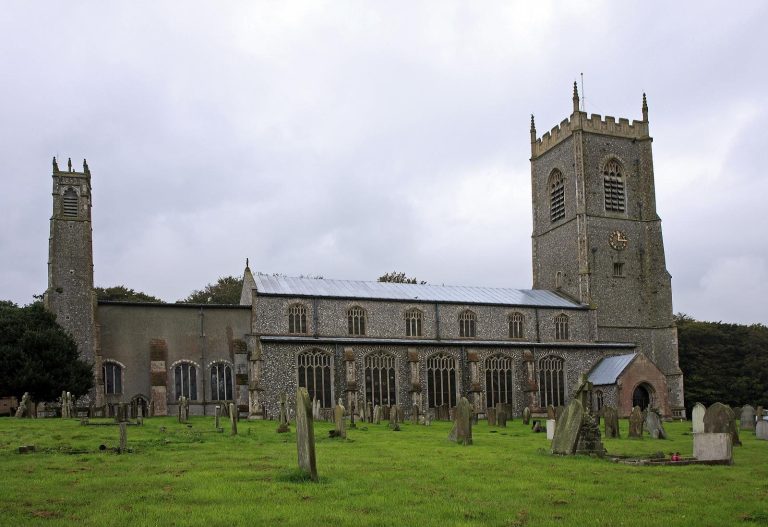
Church of St Mary and All Saints is the parish church of Little Walsingham in the United Kingdom. Founded in the eleventh century, it was originally dedicated to All Saints and developed into a mainly fourteenth- and fifteenth-century church. Its present dedication dates from 1921, when Alfred Hope Patten became vicar and added St Mary to the name.
Medieval origins and parish life
The church belongs to the Church of England and has an Anglo-Catholic tradition, a form of Anglican worship that emphasizes Catholic ceremonial, sacramental devotion, vestments, incense, candles, music, and processions. It now forms one parish with St Peter’s at Great Walsingham and St Giles’ at Houghton Saint Giles. These churches, together with the parish of Barsham, make up the Benefice of Walsingham, Houghton and Barsham. The consolidation took place during the incumbency of Edgar Lee Reeves, who served from 1904 to 1920.
Little Walsingham was the home of the medieval shrine of Our Lady of Walsingham. The shrine was destroyed during the Dissolution, the sixteenth-century suppression and confiscation of England’s monasteries and other religious foundations under Henry VIII. Its destruction ended the medieval pilgrimage tradition, but devotion associated with Walsingham later returned through the parish church.
Anglo-Catholic revival and the restored pilgrimage
George Ratcliffe Woodward became vicar in 1882 and introduced weekly Communion, a surpliced choir, plainsong, vestments, candles, and frequent Communion. Edgar Lee Reeves later added incense and installed a statue of Our Lady. These changes brought Catholic forms of worship into the parish church and prepared the way for a renewed Walsingham devotion.
On 6 July 1922, Alfred Hope Patten unveiled a copy of the medieval throned and crowned image of Our Lady of Walsingham in a side chapel. The image had arrived in a procession from the south porch. The first Whitsuntide pilgrimage followed in 1923, organized by the League of Our Lady, which later joined the Confraternity of Our Lady to form the Society of Mary.
In 1930, Bertram Pollock, Bishop of Norwich, required Patten to remove the image from the church. With financial support from Sir William Milner, Patten acquired land elsewhere in the village, outside the bishop’s control, and established a new Holy House and shrine. A Holy House represents the house associated with the Virgin Mary, especially the Holy House of Nazareth. The new shrine opened in 1931 as a replica of the medieval shrine. On 15 October that year, the image was transferred there in a procession half a mile long after a High Mass and Benediction.
Patten died on 11 August 1958, shortly after the first episcopal pilgrimage to the revived shrine. On the day of his death, he had replaced the Blessed Sacrament in the tabernacle of the gallery chapel before collapsing.
Organ, fire, and rebuilding
In 1862, the incumbent Septimus Lee-Warner installed an organ, replacing the local church band. On Bonfire Night in 1866, a gunpowder charge placed beneath the instrument exploded. The blast scattered the organ and destroyed the south-transept window, although the swell organ survived. Thomas Casson installed a replacement in 1890, but that instrument was lost in the fire of 1961.
On 14 July 1961, fire, probably caused by arson, destroyed most of the church. The tower and porch survived, as did the church plate and Reeves’s statue of Our Lady, while the rest of the building and its contents were lost. The church was rebuilt under Laurence King. The south transept became St Catherine’s Chapel, recalling the chapel at Houghton Saint Giles where medieval pilgrims stopped before walking the final mile to Walsingham barefoot. The north transept became the Guilds’ Chapel, recalling the guilds that had built a chapel there in the sixteenth century.
School and heritage status
From 1944 to 1956, the church ran the Sanctuary School, a private preparatory school for boys. The school began as Quainton Hall School, founded by Agnes Eyden in Harrow in 1897. During the Second World War it moved to Walsingham after Patten accepted it. The vicarage served as its boarding house, later supplemented by Friary House.
Church of St Mary and All Saints is listed at Grade I, while the churchyard walls and gates have separate Grade II listings. These designations recognize the church and its associated historic fabric within the protected heritage of Little Walsingham.
Remains
Plan and surviving medieval fabric
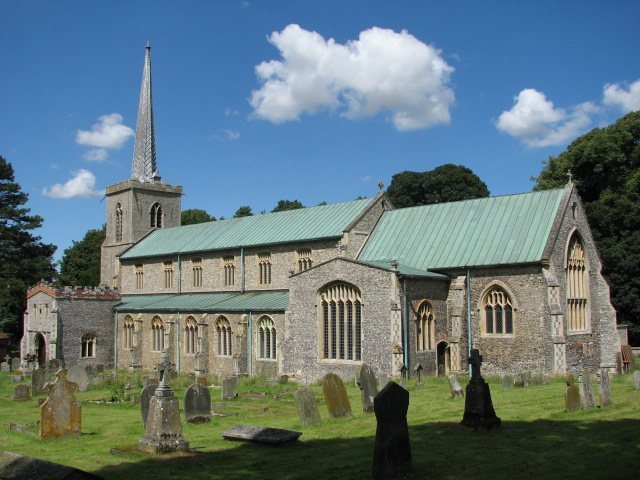
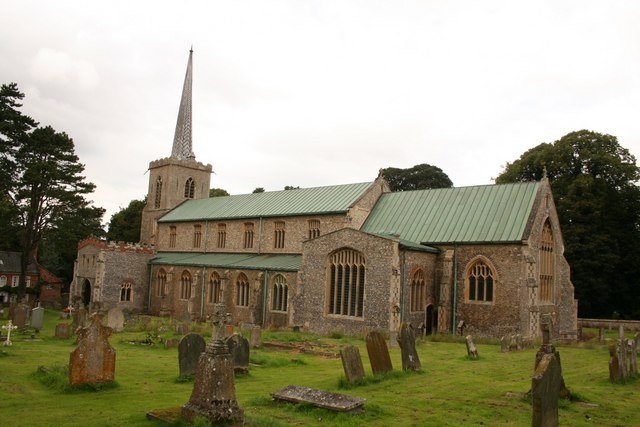
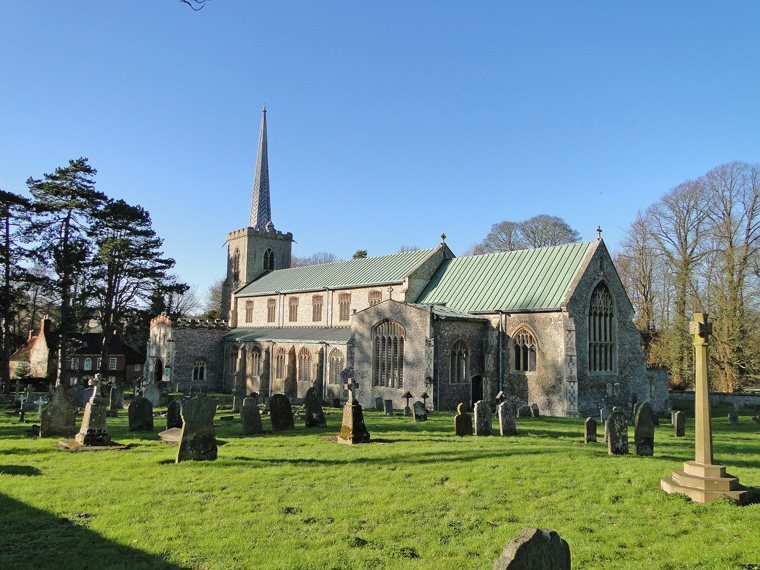
The church is principally a fourteenth- and fifteenth-century building of flint with stone dressings. Its plan contains a nave, chancel, north and south aisles, and north and south transepts. The west tower belongs to the pre-1961 church and carries a lead needle spire. The earlier spire had become crooked and was replaced in the 1920s. The porch also survived the fire, while the remainder was rebuilt in Ancaster stone.
Transept chapels and memorials
St Catherine’s Chapel
The south transept serves as St Catherine’s Chapel. Its name recalls the chapel at Houghton Saint Giles associated with medieval pilgrims who paused there before continuing to Walsingham.
The Guilds’ Chapel
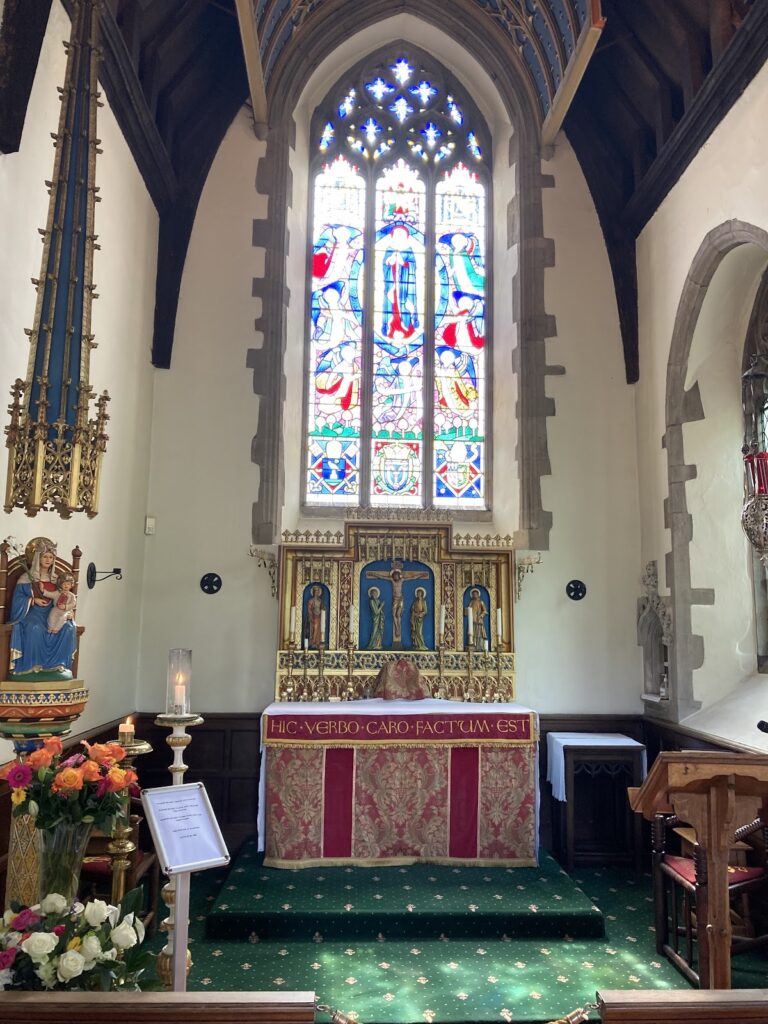
The north transept is the Guilds’ Chapel, named for the guilds that built a chapel there in the sixteenth century. It contains a reredos, an ornamental panel behind an altar, by George Frederick Bodley. The design depicts the Virgin and Child with two angels.
Memorials
Several memorials survive within the church. The elaborate monument to Henry Sydney and his wife Jane, formerly in the north transept, now stands at the rear of the building. The north transept also contains the Lee-Warner family memorial, a large structure with a tall canopy decorated with crockets and cusps, together with carved figures.
Font, windows, and interior fittings
The medieval font
The fifteenth-century font depicts the Seven Sacraments and the Crucifixion. The Seven Sacraments are baptism, confirmation, the Eucharist, penance, anointing of the sick, ordination, and marriage in Catholic tradition. The font survived the 1961 fire, but its seventeenth-century cover was destroyed. John Hayward made the present cover in 1964 as a replica. A picture of the font by William James Müller is held by Birmingham Art Gallery; a copy stands in St Joseph’s Roman Catholic Church in Sheringham, and a plaster cast was exhibited at the Great Exhibition of 1851.
The east window
John Hayward remade the east window after the fire, incorporating surviving stained glass where possible. Its tracery depicts the Trinity. The middle section shows the saints with the church’s altars and places an image of Our Lady of Walsingham at the centre. The lower section presents the history of the shrine and the church.
The porch windows
The porch windows survived the fire. Made by Powell in 1890, they depict the Annunciation.
Organ and bells
Rebuilding brought a new two-manual organ by Cedric Arnold, Williamson and Hyatt. Holmes and Swift restored and modified it in 1999.
The church has six bells. Two were cast by John I Brend in 1569, one by Edward Tooke in 1675, and two by James Bartlet of the Whitechapel Bell Foundry in 1691. The treble was made by Alan Hughes of the same foundry in 1987. The five bells cast before 1961 survived the fire. They were removed in 1985 while a new frame was built and were reinstalled in 1987.