Lanercost Priory: A Medieval Augustinian Religious House in England
Site at a Glance
- Rating
- 4.5
- Popularity
- Medium
- Country
- United Kingdom
- Primary era
- Medieval
- External website
- Open
- Eras represented
- Medieval, Early Modern, Modern
- Civilizations
- British, English
- Site type
- Religious
- Remains
- Monastery
On this page18 sections
History
Lanercost Priory is a medieval religious house in Lanercost, England, United Kingdom, founded for Augustinian canons between 1165 and 1174, probably in 1169. Robert de Vaux established the priory during the reign of Henry II, and dedicated it to Mary Magdalene, an unusual dedication in the region. Its position near the Scottish border later placed it directly in the path of warfare, while its surviving church and records preserve an important history of medieval northern England.
Foundation and Endowment
Robert de Vaux endowed the priory with the land of Lanercost, territory between Hadrian’s Wall and the River Irthing, and land between Burth and Poltros. His grants also included the vill of Walton within defined bounds, Walton church, the chapel of Treverman, and the churches of Irthington, Brampton, Carlatton, and Farlam. The foundation charter associated the benefaction with Henry II and with prayers for Robert’s parents, Hubert and Grace.
The foundation arrangements were already well advanced when the charter was issued. Soon afterwards, Robert de Vaux granted the canons the right to elect their prior, allowing the successor to be chosen by the canons or by a majority of them. The priory also developed close and lasting connections with nearby Naworth Castle. Its monks compiled the Lanercost Chronicle, a thirteenth-century history of England and the Wars of Scottish Independence, the conflicts between the English and Scottish kingdoms over Scottish independence.
Border Warfare and Royal Visits
Lanercost’s proximity to Scotland made it vulnerable during the Wars of Scottish Independence. In 1296, a Scottish army camped at Lanercost after burning Hexham Priory and Lambley nunnery. It later withdrew through Nicolforest, burning some monastic houses but leaving the church at Lanercost untouched. Further raids associated with William Wallace followed in the next year and led to English demands for reprisals.
Edward I visited Lanercost in autumn 1280 while travelling with Eleanor of Castile towards Newcastle, and returned in 1300 during his journey to the siege of Caerlaverock Castle. On the earlier visit he hunted 200 stags and hinds in Inglewood Forest. His final visit began at Michaelmas in 1306, when age and illness required him to travel in a horse litter. He remained at Lanercost until the following Easter, for approximately six months, placing a heavy demand on the priory’s resources.
During Edward’s prolonged stay, the brothers of Robert de Brus and other Scottish captives were sent to Carlisle for execution on the king’s orders. The canons later sought compensation for the expense of the royal visit. A proposed acquisition of the church of Hautwyselle, valued at about 100 marks a year, did not proceed. Instead, Edward granted Lanercost the appropriation of the churches of Mitford and Carlatton. He connected this generosity with his devotion to Mary Magdalene, his illness-related stay, and his wish to compensate the priory for damage caused by the Scots.
Decline During the Scottish Wars
Robert Bruce, later Robert I of Scotland, used Lanercost as his headquarters for three days in August 1311. His army caused extensive damage and imprisoned some of the canons before releasing them. In 1328, after the treaty between Bruce and Edward III, Lanercost and Kelso Abbey agreed to provide mutual assistance concerning their shared revenues from the church of Lazonby.
The damage continued. In 1346, David II of Scotland ransacked the conventual buildings and desecrated the church after the capture of Liddel. In 1386, the Scots captured a prior and released him for a fixed ransom and eighty quarters of corn. Lanercost had been relatively prosperous before the Scottish wars, with an annual income assessed at £74 12s 6d in the 1291 valuation of Pope Nicholas IV. By the 1318 taxation, its value had fallen almost to nothing, reflecting the effects of warfare and repeated border raids.
Dissolution and Later Restoration
Henry VIII dissolved Lanercost Priory in 1538 during the Dissolution of the Monasteries, the sixteenth-century suppression of England’s monasteries and transfer of their property. Ownership passed to the Dacre family and, in the early eighteenth century, to the Howard family. The conventual buildings were stripped of their roofs, while the church continued in use as the parish church. By the late seventeenth century, deterioration of the nave had led the congregation to use only the re-roofed north aisle.
The nave was re-roofed in 1747. In 1847, the roof over the east end collapsed, but the church returned to use in 1849 after major restoration by Anthony Salvin. Further restoration followed in the 1870s under the Carlisle architect C. J. Ferguson. The ruins entered public ownership in 1929 and are managed by English Heritage. Lanercost is a Grade I listed property.
Parish registers for Lanercost St Mary Magdalene survive from 1684, while bishop’s transcripts survive from 1666. The registers continue through the late twentieth century. The surviving original records are held at Carlisle Record Office, and the current registers were transcribed and published in 1908.
Remains
Church and Eastern Buildings
Nave and North Aisle
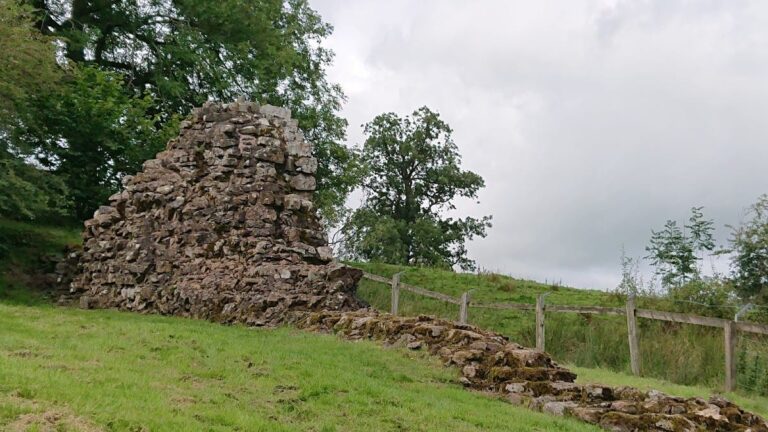
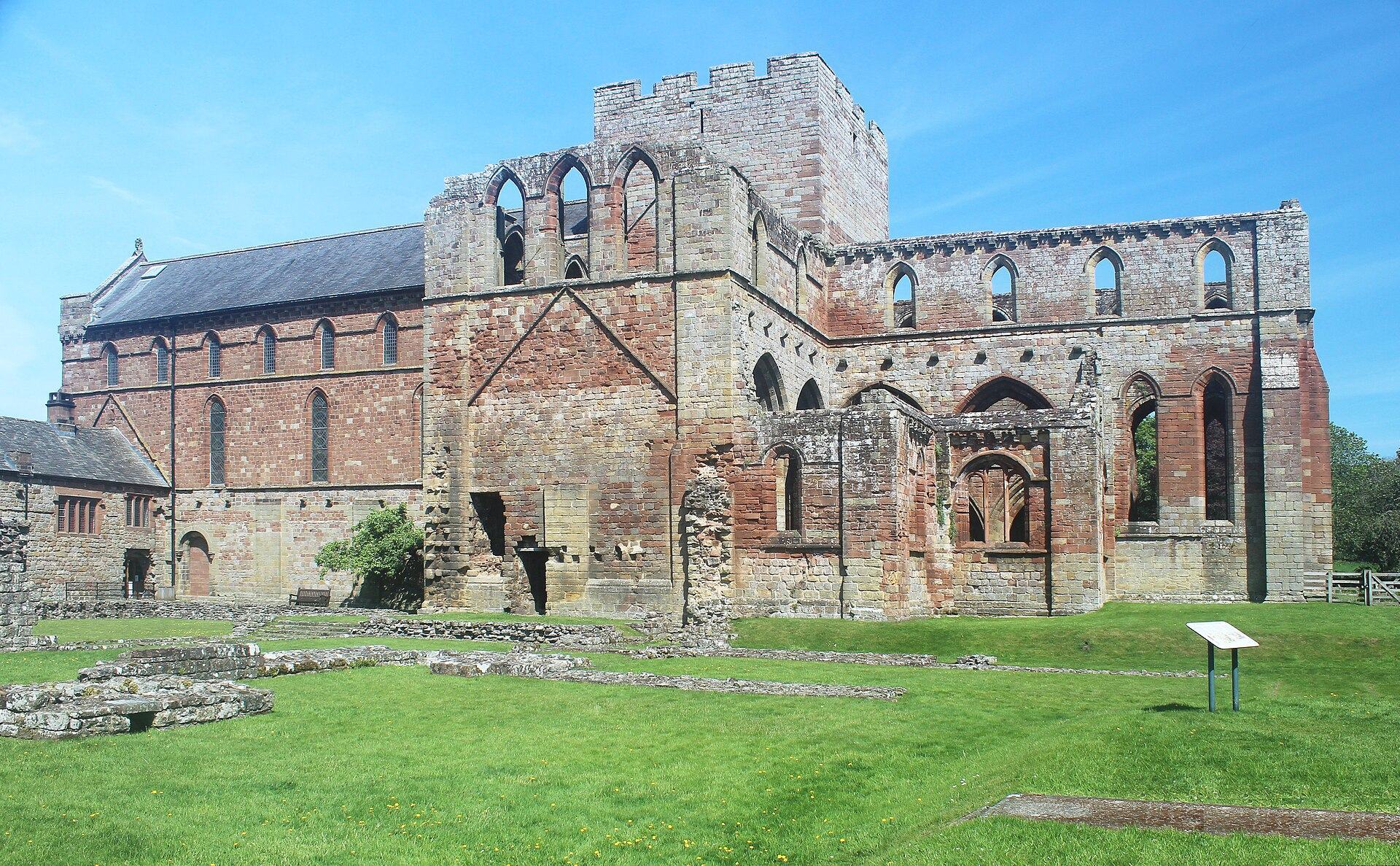
The medieval buildings stand in Lanercost village near the River Irthing and Hadrian’s Wall. Roman stones taken from the nearby wall were reused in the priory, and some carry Roman inscriptions. The church has a nave, a north aisle, and a solid south wall adjoining the cloister. The nave remains the parish church, while the east end survives as substantial ruins.
Chancel and Crossing
The chancel, the eastern part of the church containing the principal altar, and the crossing date approximately from 1220 to 1230. They survive to about eaves level in good condition, although their roofs and windows have been lost. The oldest masonry is in the south transept, an arm projecting across the main axis of the church, and dates from the late twelfth century. Most of the church fabric belongs to the late thirteenth century, alongside earlier work.
Chapel Vaults and Interior Furnishings
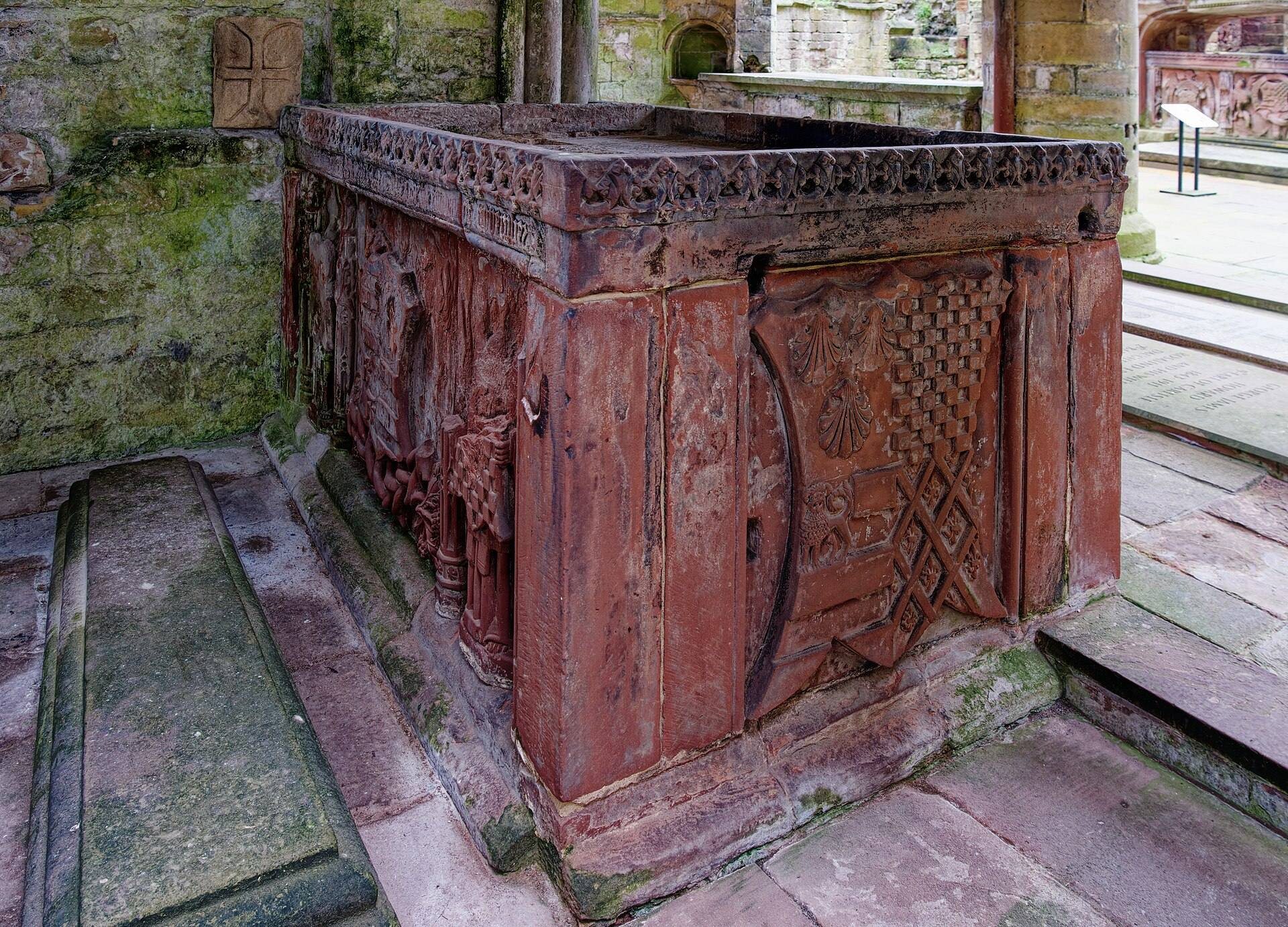
The chapels north of the chancel retain their stone vaults, which cover the Dacre tombs. The vaults south of the chancel were replaced by timber ceilings during the later Middle Ages, and those ceilings have disappeared. A statue of Mary Magdalene given by Edward I remains in a high niche on the west front. Behind the altar hangs a dossal, a decorated wall hanging, designed by William Morris in 1881 and restored and rehung in 2013-14.
Three octagonal church chandeliers hang beneath the vaults of the central aisle and chancel. Each is approximately 2 metres in diameter and can hold 32 candles. They are used for major Christian festivals and special occasions, while their pulley ropes remain visible when the chandeliers are removed.
Monastic Buildings and Gateways
West Range and Kitchen Tower
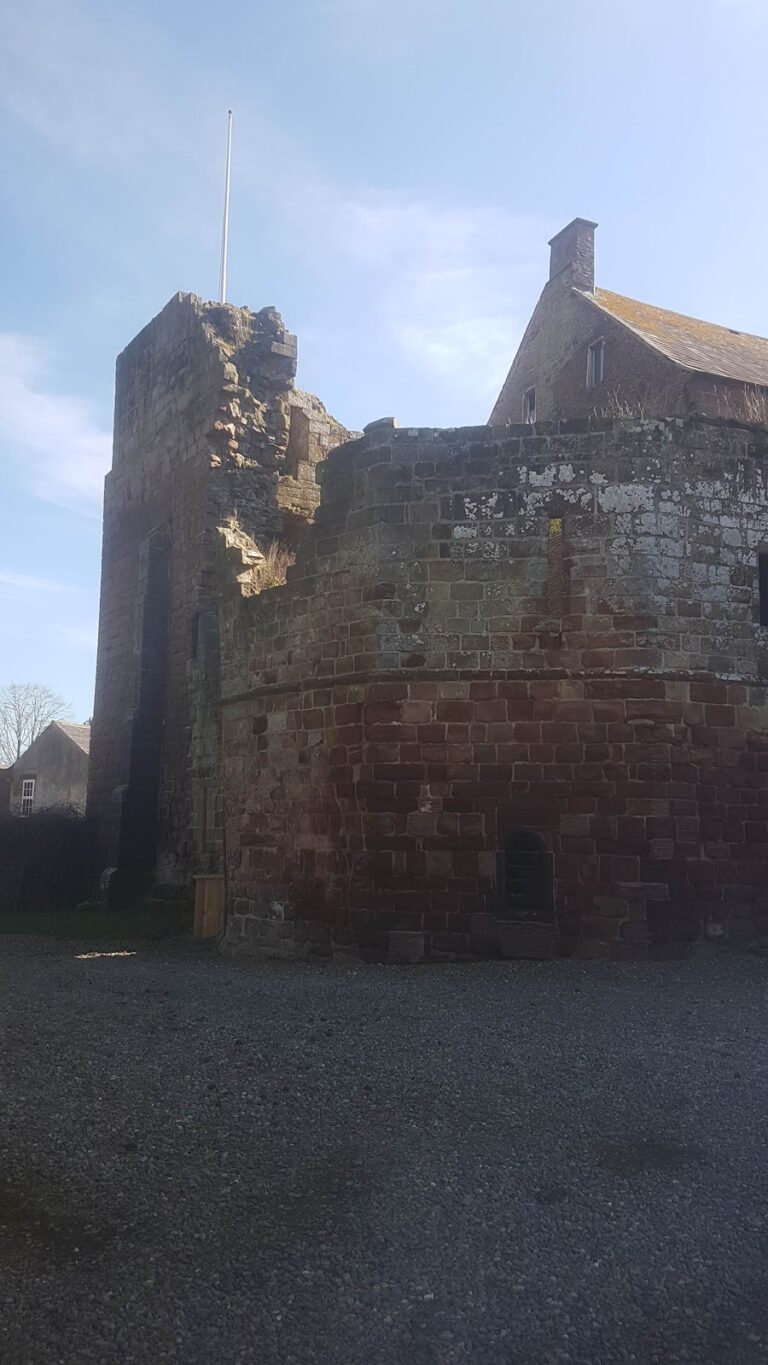
The cloister and most of the monastic buildings were dismantled or destroyed. The surviving west range was converted into a house by Sir Thomas Dacre in the sixteenth century and is now used for parish purposes. During the conversion, the monastic kitchen was rebuilt and heightened as a pele tower, a fortified tower house characteristic of the Anglo-Scottish border.
South Range and Vicar’s Pele
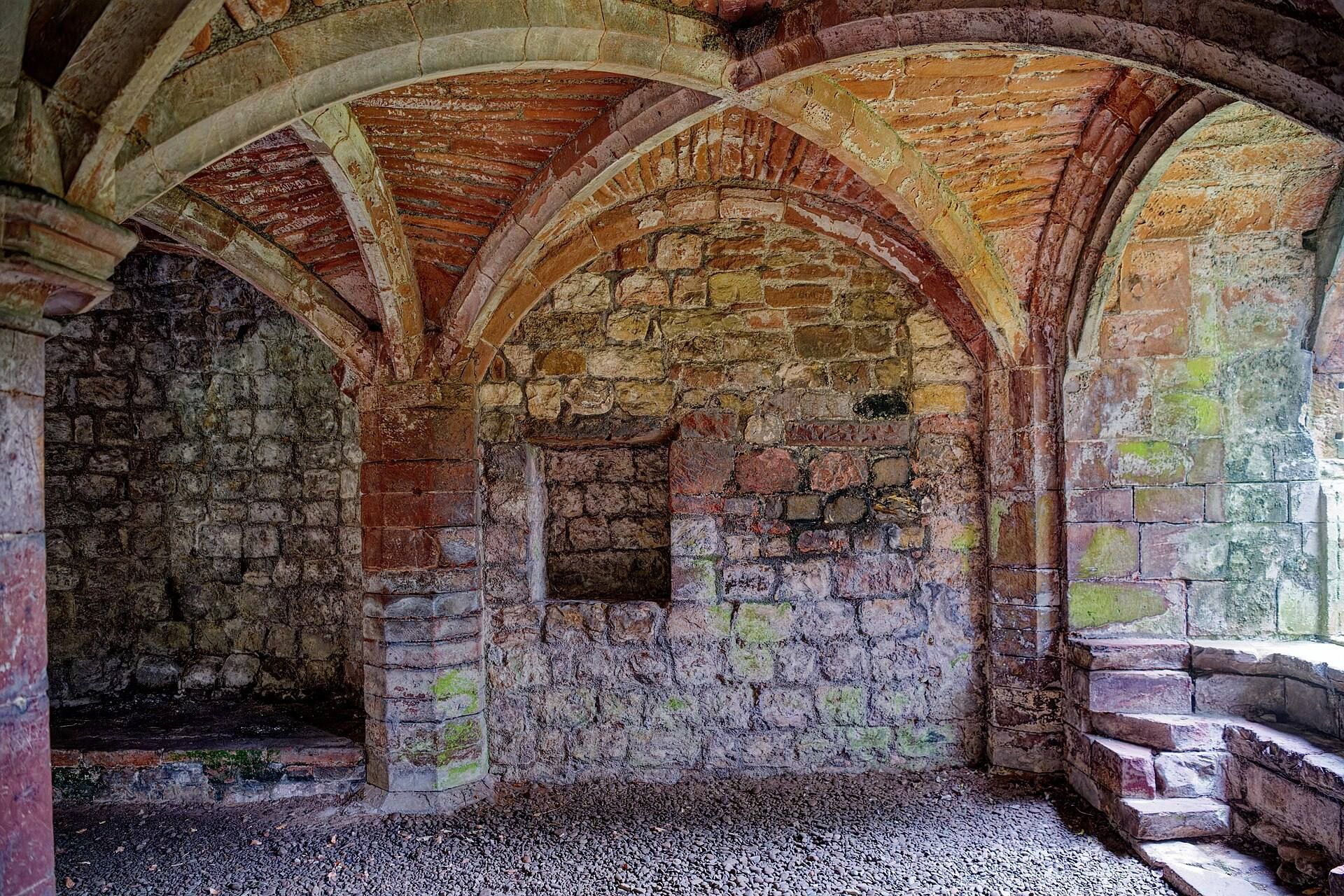
The undercroft of the south range survives with its ribbed vault and may have served as the canons’ warming room. An undercroft is a vaulted lower room. Beyond the cloister stands the so-called vicar’s pele, which was substantially altered in the nineteenth century.
Principal Gatehouse
West of the church, the inner arch of the principal gatehouse survives together with the remains of its passage vault. The gatehouse formed part of the priory’s approach and surviving monastic enclosure.
Cross, Burials, and Graveyard
Lanercost Cross
The Lanercost Cross is a medieval carved stone bearing an inscription dated 1214. It originally stood immediately outside the church entrance. Its stump remains in that position, while the principal shaft is kept inside the priory.
Memorials and Burials
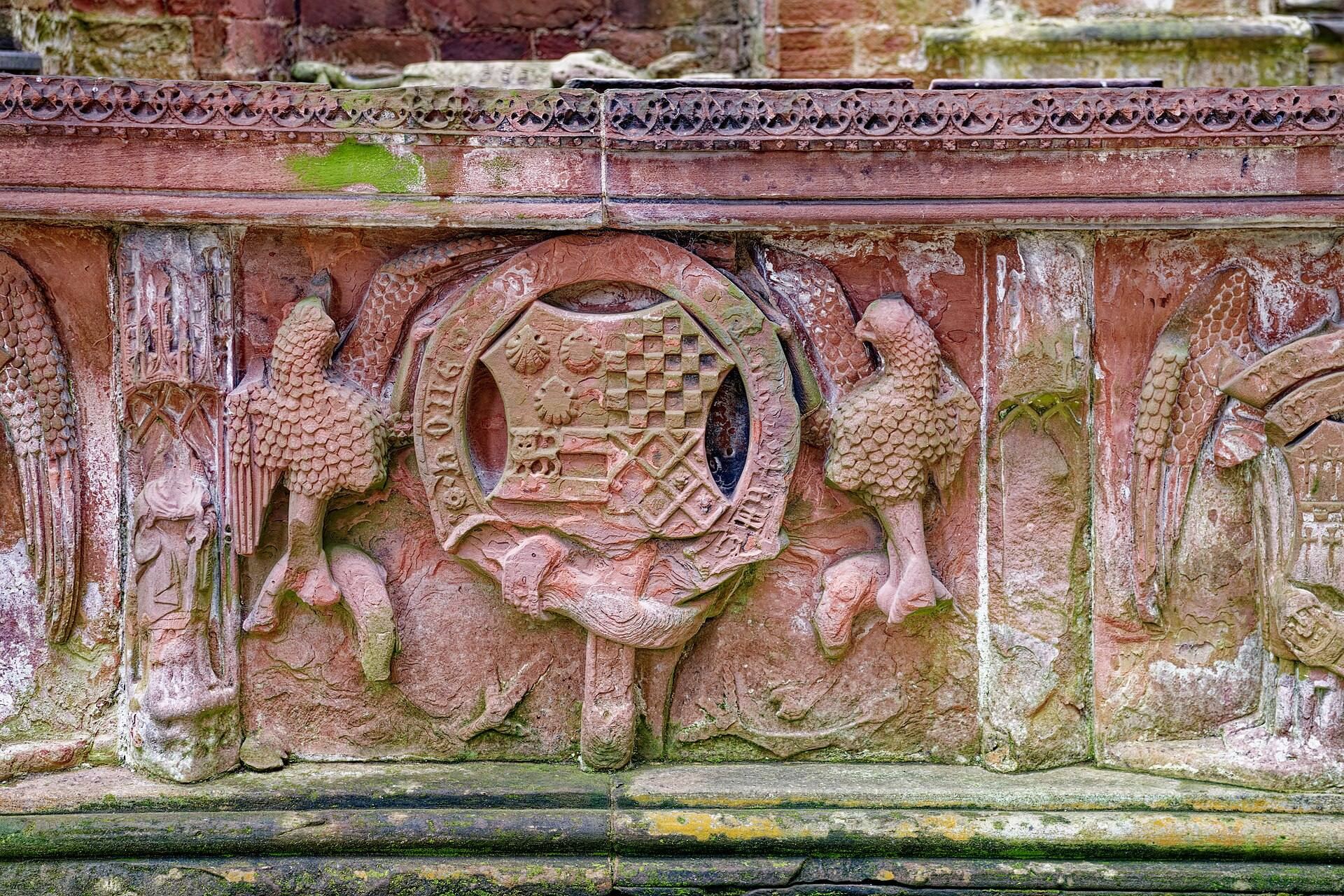
The churchyard contains the tomb of Thomas Addison, while the nave contains a memorial to the Reverend Henry Whitehead. Humphrey Dacre, 1st Baron Dacre, and his wife Mabel were buried at the priory in the fifteenth century. Other recorded burials include Ralph Dacre, Hugh Dacre, William Dacre, Thomas Dacre, Philippa de Neville, George Howard, Rosalind Howard, and Charles Howard.
Northeastern Graveyard
A large graveyard lies northeast of the priory. Its earliest recorded burial dates from 1665, although it may have been used earlier. Many gravestones date from before 1800, and the stones in each row face west.