Riseberga Abbey: A Cistercian Nunnery in Sweden
Site at a Glance
- Rating
- 4.4
- Popularity
- Low
- Country
- Sweden
- Primary era
- Medieval
- Eras represented
- Medieval, Modern
- Civilizations
- Swedish
- Site type
- Religious
- Remains
- Monastery
On this page13 sections
History
Riseberga Abbey is a former Cistercian nunnery near Fjugesta in Sweden, founded in the late twelfth century by a community belonging to a reform branch of Western Christian monasticism that emphasized enclosure, prayer, manual work, and austere architecture. Its existence is confirmed from around 1180, and its foundation was probably promoted by King Sverker II, who supported the Cistercian order in Sweden. The abbey later became a major landowner and an important religious institution in central Sweden.
Foundation and expansion
An undated charter by the magnate Birger Brosa, who died in 1202, records his gift of part of his landholdings to the nuns. Birger had helped Sverker II gain the throne and had arranged the king’s marriage to his daughter Ingeborg. Birger’s wife, Birgitta Haraldsdotter, was the daughter of the Norwegian king Harald Gille and the widow of King Magnus Henriksson of Sweden. She later entered Riseberga and spent her final years there as a nun.
In 1212, King Erik X granted Riseberga the right to receive property confiscated from people convicted of crimes within his territory. Pope Innocent III issued a letter of protection for the abbey in 1216. The letter already mentions an abbess, indicating that the community had become relatively large and prosperous by that time.
Royal and aristocratic donations greatly increased the abbey’s resources. Riseberga eventually held 224 farms, mills, quarries, and churches across Närke, Södermanland, Värmland, Västergötland, Östergötland, and Öland, together with land in Örebro. The entire parish of Edsberg came under the abbey’s jurisdiction. Riseberga appointed the parish priest, who also served as confessor to the nuns, while monks from Alvastra managed the institution.
Male lay brothers lived outside the enclosure and helped with farming and the management of ponds. Some members of the community also lived at times as hermits in the surrounding wilderness. Iron ore formed part of the abbey’s income, and a forge stood at the edge of the monastic grounds. The lay brothers therefore probably worked with iron as well as agriculture and water management.
Religious community and wartime disruption
In 1341, Ulf Gudmarsson and his wife, Birgitta Birgerdotter, brought their daughter Ingeborg to Riseberga as a novice, meaning that she entered an introductory period before taking full religious vows. Their other daughter, Catherine of Vadstena, lived at the abbey for several years as a pupil before her marriage. The family gave Riseberga a farm and a mill to support the girls. Birgitta Birgerdotter is better known as Saint Bridget of Sweden, the fourteenth-century religious figure and visionary.
In 1384, a German mercenary army supporting Albrecht of Mecklenburg in his attempt to regain the Swedish crown occupied and plundered Riseberga. The nuns left until the army withdrew. Bishop Thord of Strängnäs responded to the crisis by incorporating the parish of Hackvad into the abbey, allowing Riseberga to receive its tithe and gain financial support.
Dissolution and later history
During the Swedish Reformation, the sixteenth-century transition in which Sweden adopted Protestantism and brought religious institutions under royal control, the Crown confiscated Riseberga’s property in 1527. The remaining nuns sought admission to a convent abroad and left in 1534. The nunnery then ceased to function.
A fire destroyed the convent buildings in 1546. The estate changed hands through later gifts and sales, while the ruined abbey became a source of building material. In 1650, stone from the abbey church was used to enlarge the twelfth-century church at Edsberg, and the church portal was transferred there. The ruins continued to be quarried afterward.
A lime kiln was installed among the ruins during the 1820s. In the 1830s, the tenant Nils Gabriel Roth exposed and secured the surviving remains, ending the active destruction of the site. Beer barrels containing still-drinkable beer were found at Riseberga during the nineteenth century.
Tradition and archaeological study
Riseberga is associated with the ballad Fair Elisif, first published in 1732. It was long attributed to Bishop Nils of Linköping, who died in 1391, and was once regarded as the oldest Swedish poem by a known author. The work is now considered a forgery by the priest Nils Rabenius. Its story concerns the nun Elisif, who was abducted by the German knight Bernhard the Long with the help of King Albrecht of Mecklenburg. After Bernhard died in a shipwreck, Bishop Nils returned Elisif to Riseberga, where she died soon afterward.
Elisif’s father has been identified with the marshal Erik Kettilson Puke, who supported Queen Margarethe I against Albrecht from 1388. A surviving charter states that Puke transferred all his property in Värmland to Riseberga in 1369. Carl Georg Starbäck first questioned the ballad’s authenticity in 1885.
The association Riseberga Rediviva, founded in 1989, works to preserve the ruins and investigate the abbey’s past. Archaeological excavations begun in 2023 have revealed traces of an earlier church and a herb garden, adding new evidence about the development of the monastic site.
Remains
The surviving remains consist chiefly of the foundations of the monastic buildings, arranged around the former abbey church and its cloister. The church was a plain, vaulted Cistercian structure built of limestone, while the conventual buildings stood to its south. Part of the former monastic grounds is occupied by a later open-air theatre, and archaeological work has identified additional traces within the site.
Church and convent
Abbey church
The abbey church was built in limestone during the thirteenth century, replacing an earlier wooden church. It had three aisles and vaulted interiors, with a small recessed choir ending in a three-eighths termination, a polygonal end formed from three sides of an imagined eight-sided figure. Instead of a full tower, the roof carried a roof rider, a small structure mounted above the building that could hold a bell.
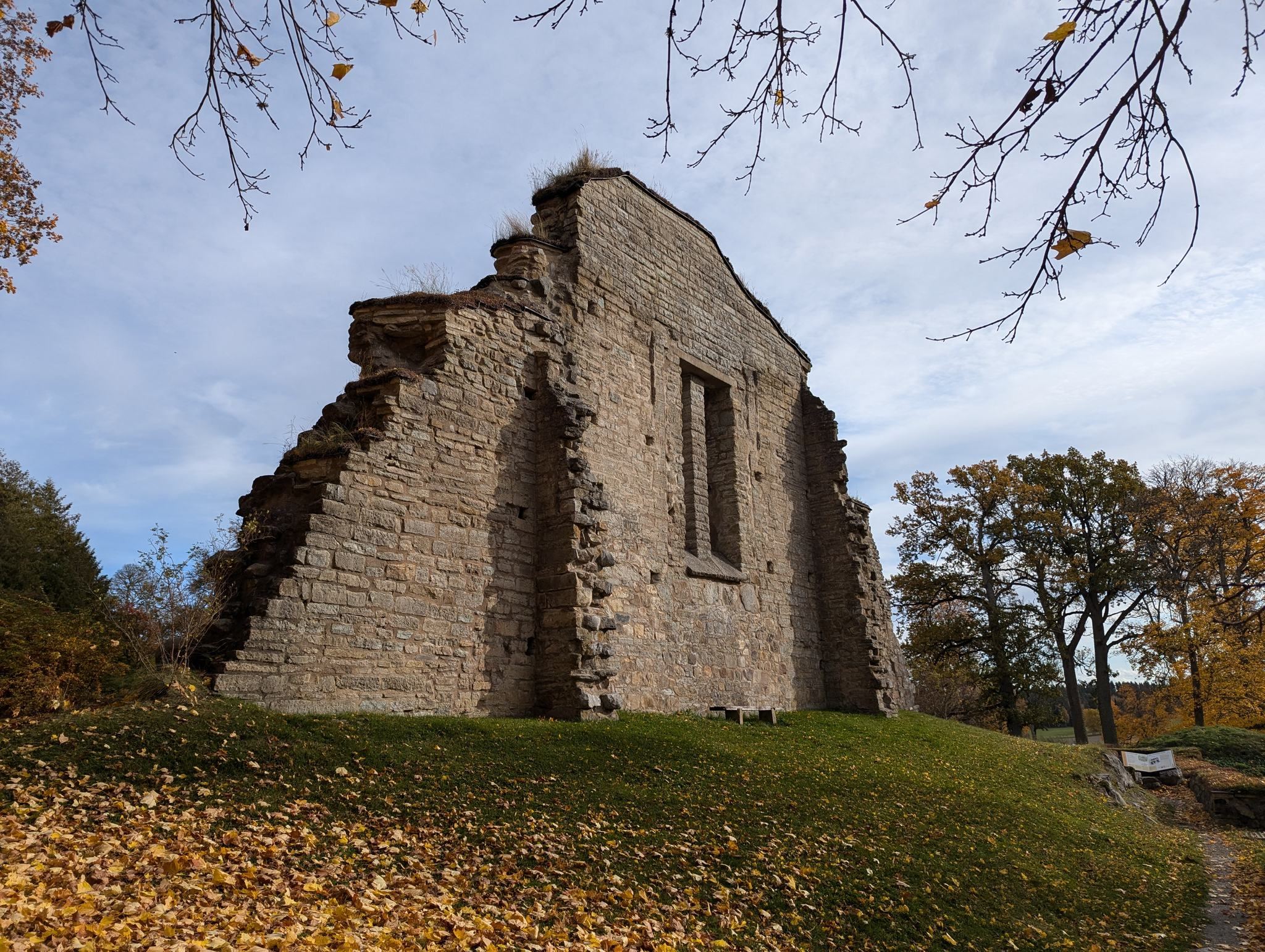
A surviving section of the west gable contains a Gothic pointed-arch window. Part of the window has been bricked up to strengthen the structure. The church portal and building stone were moved to Edsberg in 1650, and the portal is now incorporated into that church.
Conventual buildings
The nuns’ buildings stood south of the church around a cloister, a covered walkway enclosing an open courtyard and linking the principal monastic buildings. The nuns could enter the church directly from the convent. The surviving foundations preserve the physical position of these buildings within the former monastic complex.
Working area and later theatre
Forge
The remains of a forge were found at the edge of the monastic grounds. Its position relates to the abbey’s receipt of iron ore as part of its revenues and to the work carried out by the lay brothers, who combined agricultural duties with activities connected to ironworking.
Woodland theatre
An amphitheatre was built on part of the former monastic grounds in 1937. The woodland theatre has seating for 1,216 spectators and continues to occupy a section of the abbey site.
Earlier church and herb garden
Excavations begun in 2023 have identified traces of a predecessor church building and a herb garden. These features add to the surviving foundations and help define earlier phases of activity within the monastic enclosure.