Holy Trinity Cathedral, Brailiv: An Orthodox Monastery Church in Ukraine
Site at a Glance
- Rating
- 4.8
- Popularity
- Low
- Country
- Ukraine
- Primary era
- Early Modern
- External website
- Open
- Eras represented
- Early Modern, Modern
- Civilizations
- Polish–Lithuanian Commonwealth, Russian
- Site type
- Religious
- Remains
- Church
On this page17 sections
History
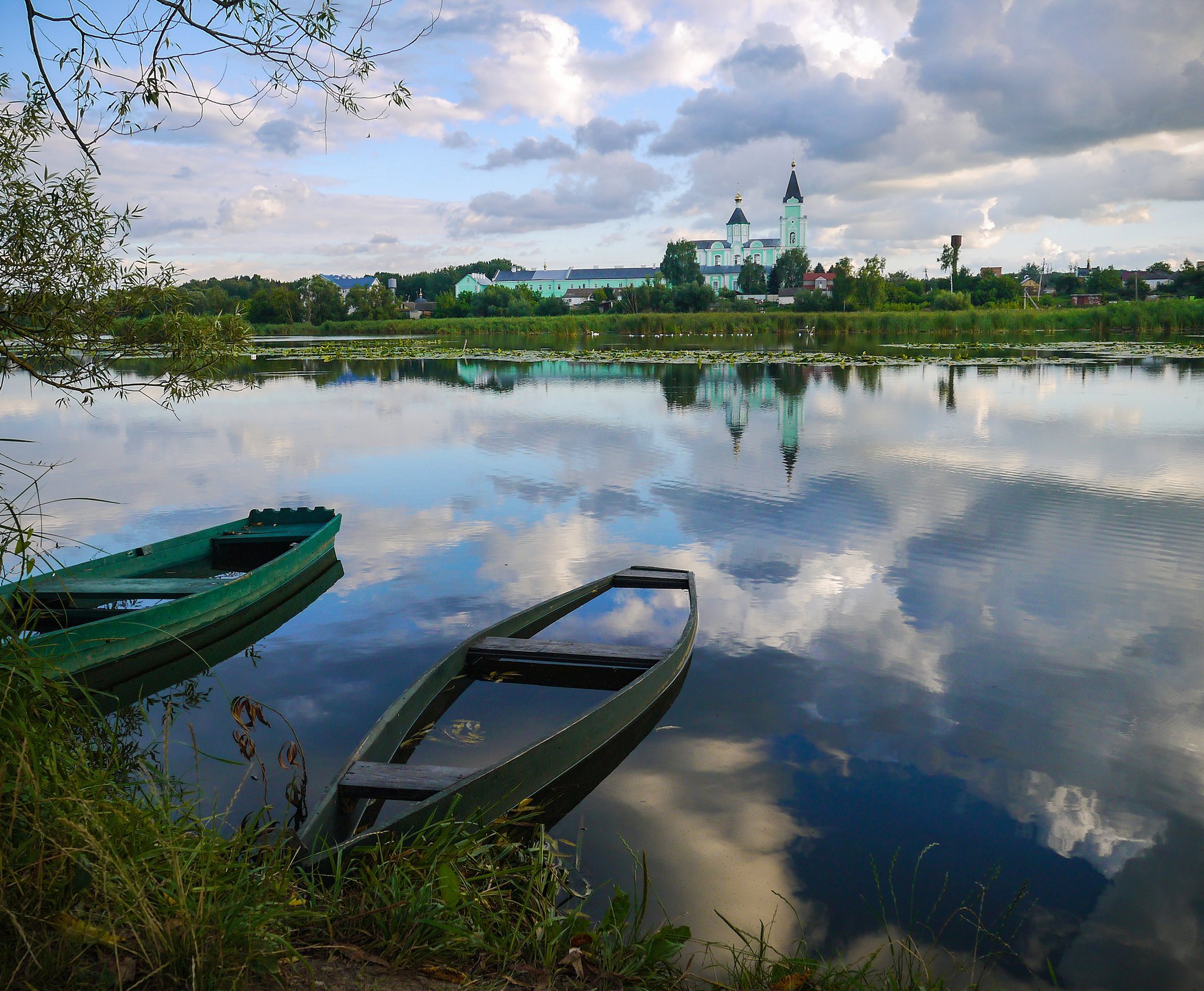
Holy Trinity Cathedral is an eighteenth-century Baroque church in Brailiv, Ukraine, and the central building of the Holy Trinity Brailiv Women’s Monastery. The present complex was begun in 1767 for the Catholic Trinitarian order and completed in 1778. The Trinitarians were a Catholic religious order especially associated with redeeming Christians held in captivity. The monastery later became an Orthodox women’s community and is now recognized as a nationally important architectural and urban-planning complex.
From the Vinnytsia foundation to the Trinitarian monastery
The women’s monastery was founded in Vinnytsia in 1635 by Mikhail Kropyvnytskyi, a Bratslav judicial official and royal secretary. Tradition attributes royal approval to King Wladyslaw IV. The community was initially dedicated to the Annunciation of the Virgin. It later entered the Union with Rome, by which Eastern Christian communities retained Byzantine worship while recognizing the authority of the pope. In 1723, its church was consecrated by Athanasius Sheptytskyi, a Uniate metropolitan, or senior bishop responsible for an ecclesiastical province.
Financial difficulties led to the monastery’s abandonment in 1780. Four Basilian nuns, members of an Eastern Catholic monastic tradition associated with the Order of Saint Basil the Great, settled there in 1786. The monastery returned to the Orthodox Church in 1795. Abbess Palladia governed it until 1798, followed by Abbess Vera from 1798 to 1814. After Vera’s death, treasurers administered the community until 1832.
The Brailiv complex was created during this period of religious change. Franciszek Salezy Potocki financed construction for the Trinitarian order, while his son Stanislaw Szczesny Potocki helped bring the work to completion. The Trinitarian monastery was dissolved in 1832, and its buildings subsequently served an Orthodox parish.
Transfer to Brailiv and nineteenth-century development
In 1845, the Orthodox women’s monastery moved from Vinnytsia to the former Trinitarian buildings in Brailiv. The transfer took place under Abbess Taisia and Arseny, Archbishop of Podolia. On the night of October 12 to 13, 1845, the nuns travelled from Vinnytsia to Brailiv in a religious procession, after which work began to establish the community at its new site. The monastery received the official rank of a first-class monastery, an administrative category within the Orthodox monastic system.
The community developed educational and charitable institutions. It operated a school for girls, an orphanage for girls from clerical families, an almshouse, and a women’s Sunday school. During the First World War, the monastery housed a 50-bed hospital for wounded soldiers. From April 1895 to June 1898, the senior priest Ignatius Lototskyi served there. He researched the history of the Vinnytsia and Brailiv women’s monastery and its sacred objects, producing a work that was published after his death in 1900.
Soviet closure and wartime reopening
Soviet authorities confiscated the monastery’s land and most of its buildings. The community retained only one residential building and had to pay rent for it. In 1925, 145 sisters lived there. Fifty-three were considered able to work, while the others were elderly or otherwise unable to work. Sewing and agricultural labor supported the community after the loss of its land.
The monastery was closed in December 1932. Its closure was also connected with grain hidden there by villagers from Moskalivka and Kozachivka during the Holodomor, the catastrophic famine imposed in Soviet Ukraine in 1932 and 1933. The monastery reopened in 1942 under the Romanian administration during the wartime occupation. After the Nemyriv monastery closed in 1951, its nuns were transferred to Brailiv.
Late twentieth-century restoration and religious life
A major repair campaign took place from 1953 to 1955. The monastery closed again in 1962, when its cells were converted into a dormitory for the Brailiv vocational school. The complex was later also used as a tourist base. It was returned to the Orthodox Church in 1989 and reopened around the same time.
In 1990, Metropolitan Agafangel of Vinnytsia and Bratslav consecrated the chapel of Saints Anthony and Theodosius of the Caves. That year, the first Divine Liturgy after the closure was celebrated in the damaged church. The entire complex and monastery courtyard were restored during the 1990s. Abbess Antonia, also known as Stetsenko, has served as superior since 1995. The monastery remains active under the Ukrainian Orthodox Church associated with the Moscow Patriarchate and the Vinnytsia Diocese.
Remains
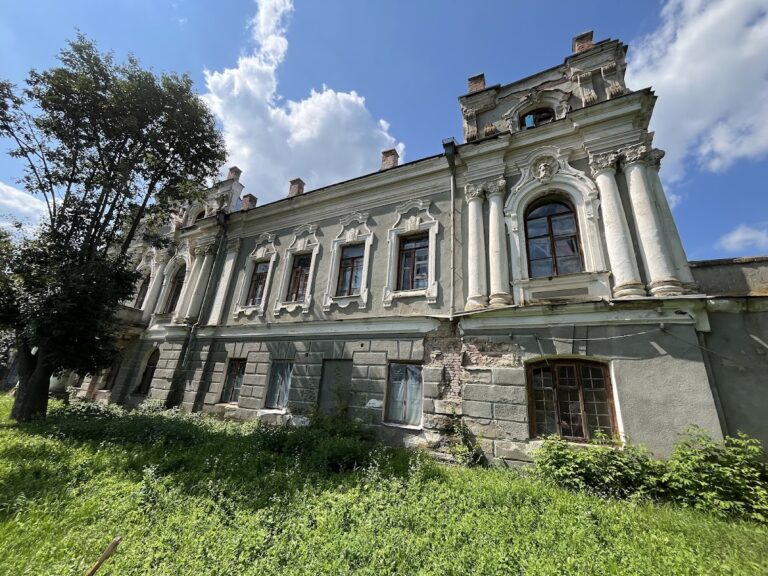
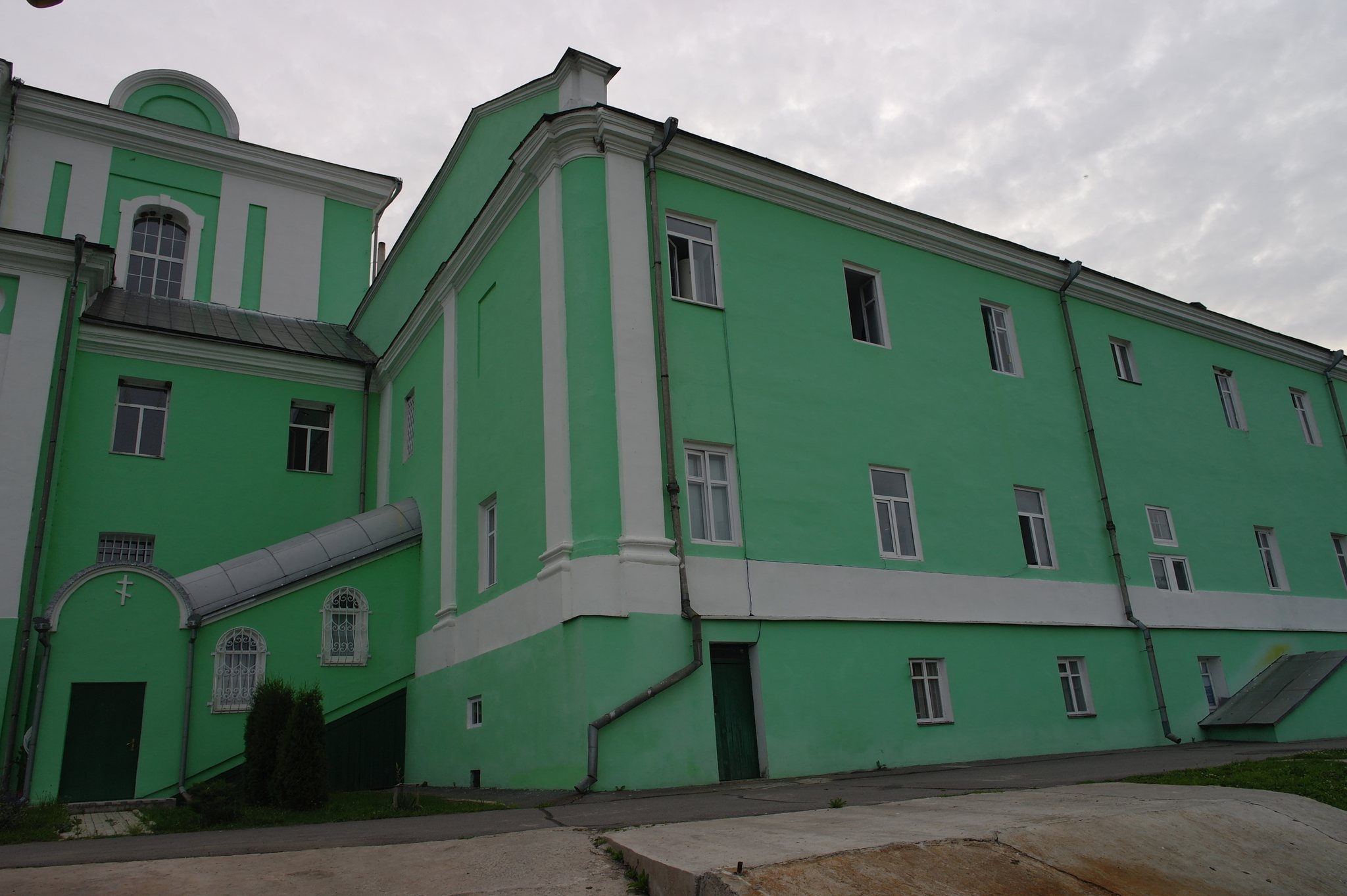
The surviving complex combines a Baroque church, attached residential structures, a quadrangle of monastery buildings, a bell tower, a nineteenth-century gate, and later Orthodox worship spaces. The original arrangement joined the church to a two-storey brick residential wing on the choir side. The church and cells were built in the Baroque style, while later additions and alterations reflect the monastery’s Orthodox use.
Church and bell tower
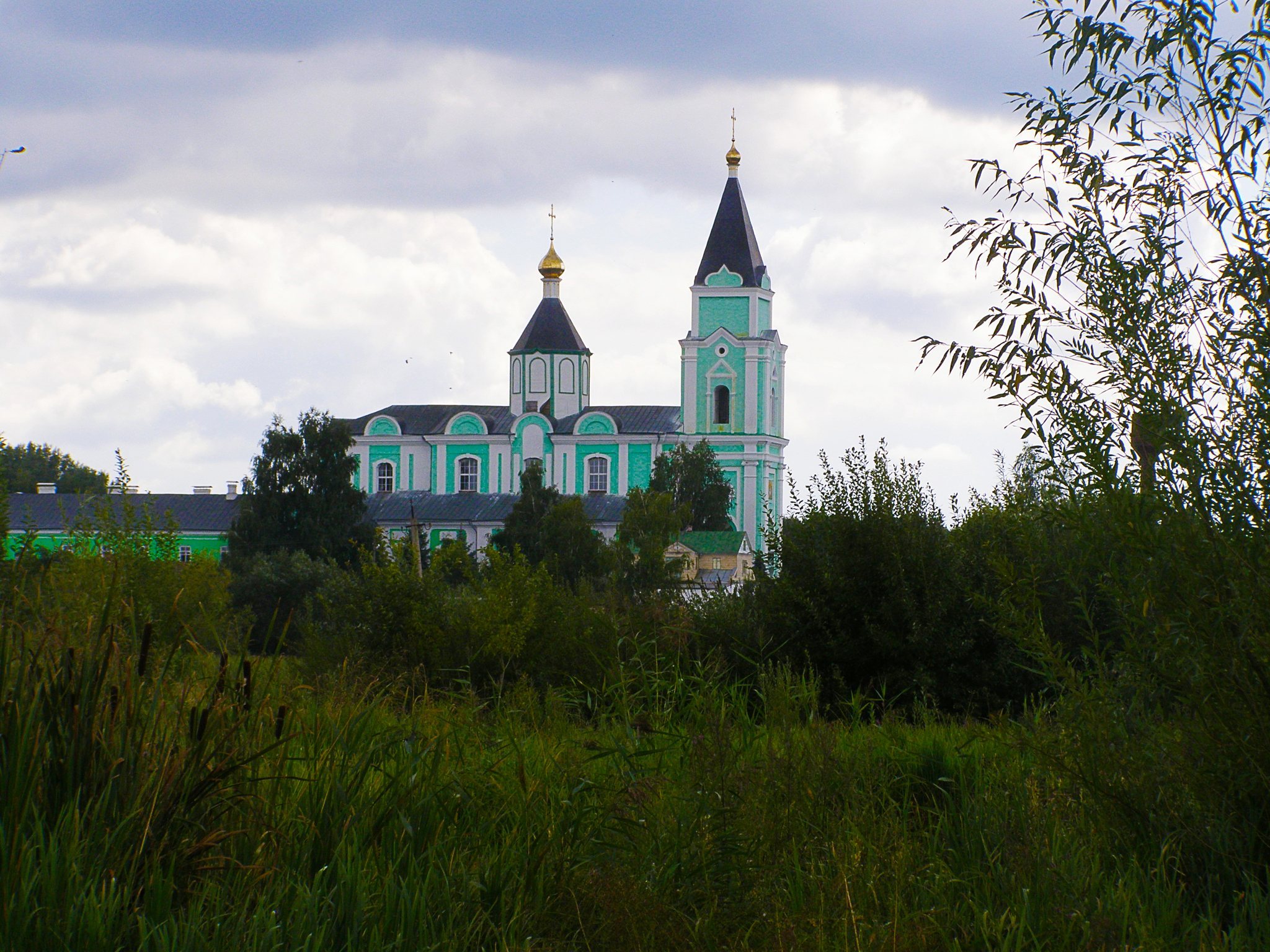
Holy Trinity Cathedral
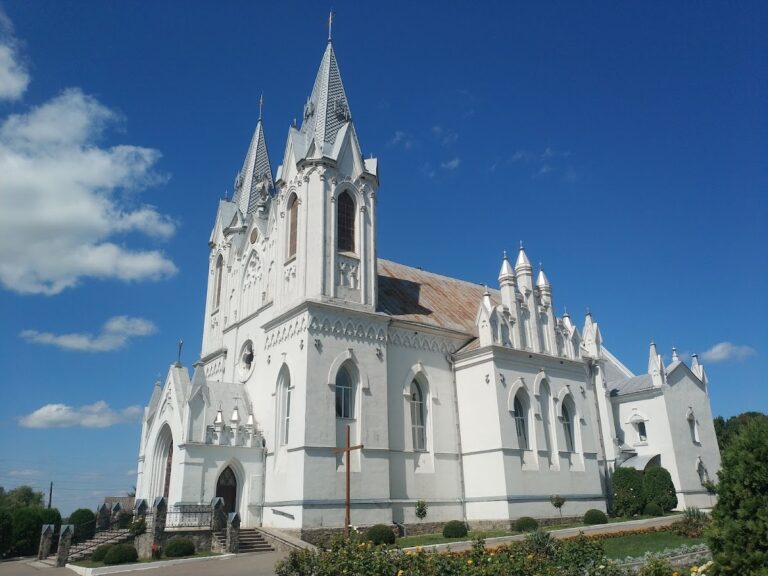
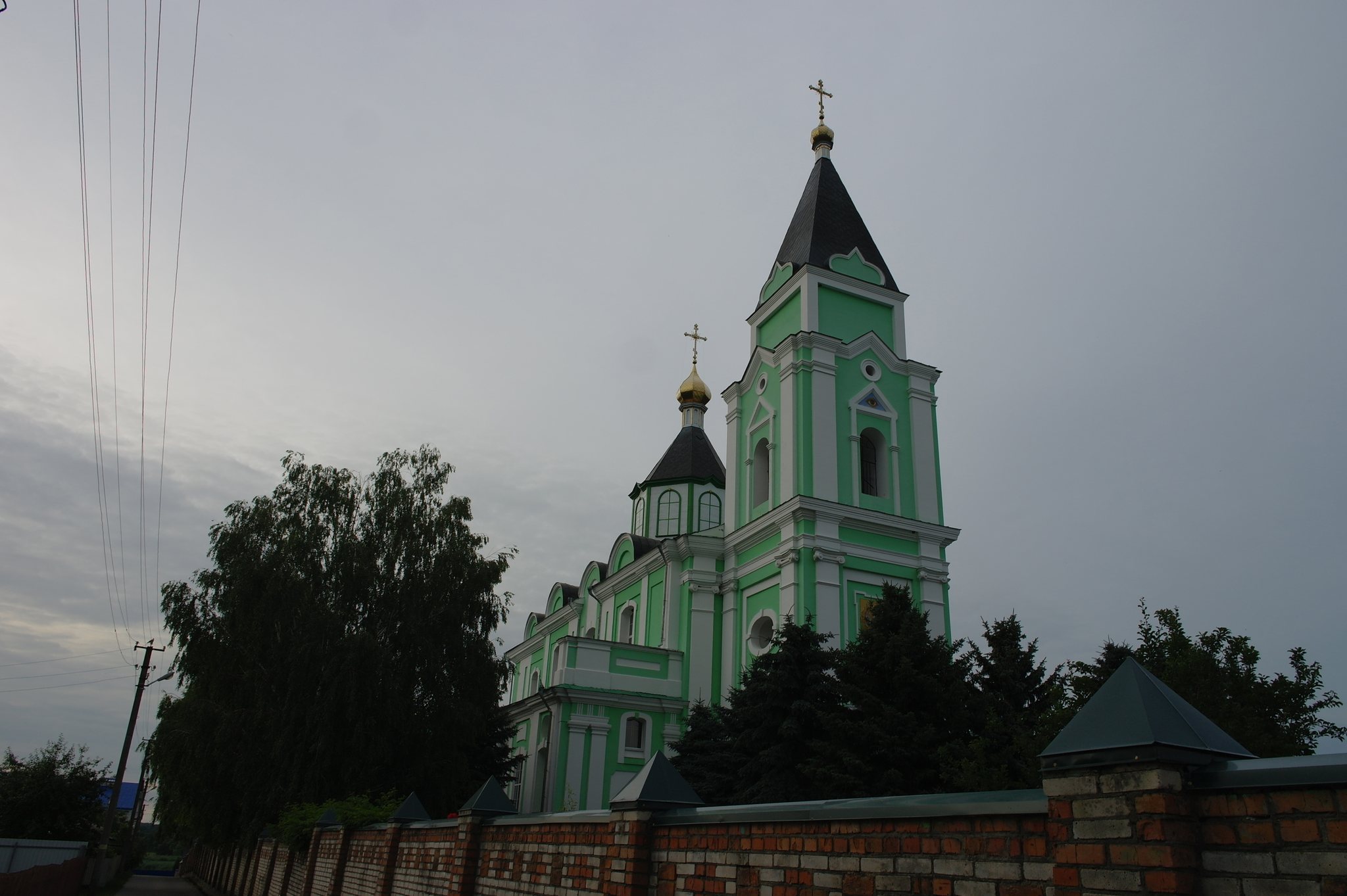
The cathedral is a three-nave basilica, meaning that its long central space is accompanied by side aisles. Its central nave has vaulted ceilings and lucarnes, windows that open through a roof or vault. The building has complex, multi-planar volumes, while its facade decoration is comparatively restrained. Side altars are dedicated to the Annunciation of the Virgin on the right and the Great Martyr Barbara on the left. A quadrangle of monastery buildings adjoins the church at the altar end.
Baroque bell tower
A two-tier Baroque bell tower forms one of the cathedral’s principal visual features. It has rich sculptural ornament and large openings. Local tradition attributes the distinctive sound of its bells to oval openings in the vault coverings. The second tier contains an image of a cross with two equal double crossbars, one single crossbar, and a crown above. This represented the Pilawa coat of arms of the Potocki family and was altered in the nineteenth century into an eight-pointed Old Believer cross. Old Believers are members of traditionalist Russian Orthodox communities that rejected seventeenth-century reforms to church rites and texts.
Monastery buildings and chapels
Entrance gate
A gate with service rooms was built in the nineteenth century. It stands on the same axis as the cathedral and is treated as a separate architectural monument within the monastery complex.
Chapel of Saints Anthony and Theodosius
A crypt beneath the church contains the chapel of Saints Anthony and Theodosius of the Caves. A crypt is a chamber beneath a church, often used for worship or burial. The chapel was consecrated in 1847 and was reconsecrated in 1990 during the monastery’s return to religious use.
Winter Church of Saint Nicholas
The northern part of the monastery quadrangle contains the winter Church of Saint Nicholas, which was consecrated in 1860. Its position within the quadrangle reflects the expansion of the complex after the Orthodox women’s monastery moved to Brailiv.
Interior decoration and sacred objects
Painted decoration
The interior was painted in 1787 by Joseph Prechtl, a Viennese artist and monk. His narrative and ornamental compositions used tempera on dry plaster in the Rococo style, a lighter and more delicate form of eighteenth-century decoration. After the complex became Orthodox, Yevhen Osmolovsky painted the wall niches. These paintings were damaged during the Soviet period, and the remaining wall paintings were whitewashed at the end of the twentieth century.
Icons and relics
The monastery’s honored sacred objects include the Brailiv Czestochowa Icon of the Mother of God, the Brailiv Pochaiv Icon of the Mother of God, the Icon of the Mother of God of the Three Hands, and a reliquary containing saints’ relics. The Czestochowa icon is a copy of the Czestochowa icon, and tradition states that Mikhail Kropyvnytskyi donated it to the Vinnytsia Annunciation Monastery in 1635.
The Pochaiv icon came from the Pochaiv Lavra. In 1887, Professor A. Khoynatsky found it there and identified it as a copy of a miraculous Brailiv icon that had disappeared after the Ottoman capture of the town in 1672. Silver-gilt coverings placed on the icon in 1890 disappeared after 1917, while the icon remains at the monastery. The Icon of the Mother of God of the Three Hands was painted on Mount Athos, a self-governing monastic peninsula in Greece, at the beginning of the nineteenth century.
Tradition of Christ the Nazarene
Local tradition recalls a life-sized statue of Christ the Nazarene wearing a crimson tunic and holding his hands tied across his chest. It was said to commemorate Christians redeemed from captivity by the Trinitarians. Tradition variously placed its origin in Turkey or Madrid, and later associated it with the new Catholic church after it was moved there.