Memleben Abbey: An Ottonian Royal Monastery in Germany
Site at a Glance
- Rating
- 4.6
- Popularity
- Low
- Country
- Germany
- Primary era
- Medieval
- External website
- Open
- Eras represented
- Medieval
- Civilizations
- Holy Roman Empire
- Site type
- Religious
- Remains
- Monastery
On this page10 sections
History
Memleben Abbey is a former Benedictine monastery in Germany, at Memleben in present-day Saxony-Anhalt, founded under the Ottonian dynasty in the late tenth century beside an important royal residence. The site became closely associated with the deaths of King Henry I in 936 and Otto I in 973, and its monastery was intended to serve both as a dynastic memorial and as a centre for Christian mission in Slavic settlement areas.
Early settlement and the royal palace
Memleben lies on the Unstrut River and is now part of the municipality of Kaiserpfalz. Medieval records called the settlement Mimilebo or Mimileba. An early register linked with Archbishop Lullus of Mainz and a tithe register compiled between 881 and 899 placed it in the Saxon shire of Friesenfeld, west of Hassegau. The settlement named in these records is generally identified with the abandoned site of Klein- or Wenigen-Memleben north of the Unstrut, rather than with the modern village south of the river.
The foundation date and exact position of the Memleben royal palace remain uncertain. A fortified establishment probably existed by the early tenth century, since the bishop and historian Liutprand of Cremona described a castellum, or fortified site, there. The palace could accommodate and provision rulers with their entourages. Its location is now chiefly sought at Wendelstein Castle, although the Altenburg at Wangen has also been proposed.
Memleben under the Ottonian rulers
Memleben became an important residence of the Ottonian dynasty, the ruling family that supplied East Frankish and later German kings and emperors during the tenth and early eleventh centuries. Several rulers stayed there between 936 and 994, while a royal court and its surrounding possessions were still recorded in 1033.
Henry I, also known as Henry the Fowler, became gravely ill while hunting at Bodfeld in the Harz, probably suffering a stroke. After arranging the succession of his son Otto at an imperial assembly in Erfurt, he travelled to Memleben and died there on 2 July 936, probably after another stroke. His body was taken to Quedlinburg and buried in the predecessor church of St. Servatius.
Otto I, later known as Otto the Great, stayed at Memleben at least four times and issued documents there in 942, 948-949, 950, and 956. During his reign, parts of the surrounding estates passed to ecclesiastical institutions, including the bishopric of Zeitz. A transfer of two churches at Imilebe, probably originating under Otto I, was recorded in 976-977.
Otto I apparently intended to celebrate Pentecost at Memleben in 973 and arrived shortly before the feast. He died there on 7 May. Widukind of Corvey and Thietmar of Merseburg recorded the event. Otto’s body was taken to Magdeburg and buried beside his first wife, Eadgyth, while his internal organs were buried at Memleben during the following night in a church dedicated to St. Mary. A later tradition also connected his heart with the site.
Foundation of the Benedictine monastery
By early 979, Otto II and his consort Theophanu had founded a Benedictine monastery near the royal palace in memory of Otto I. Benedictine communities followed the Rule of Saint Benedict, which regulated communal monastic life. The foundation may also have been intended as a memorial for the ruling dynasty.
Otto II endowed the monastery with extensive estates, rights, and tithes in areas corresponding to parts of present-day Thuringia, Saxony-Anhalt, Saxony, Brandenburg, and Hesse. Its possessions included properties formerly held by Hersfeld Abbey, tithes in Friesenfeld and Hassegau, and castles with associated territories in the lands of the Hevelli and the Saxon Eastern March. Holdings north and east of the Elbe were partly lost during the Slavic uprising of 983. The monastery was also expected to support Christian mission in Slavic settlement areas.
Otto II issued documents at Memleben in 974, 975, and 980. After his early death, his son Otto III visited the royal court several times, including in 987 and 994. In 994 he granted Abbot Reginolt and the monks market, minting, customs, and ban rights in the Memleben territory. In 998 he granted them the civitas, or civic settlement, castle, lordship, and surrounding villages of Wiehe. Otto III also planned to make Memleben the centre of a projected bishopric of Thuringia, but died in Italy at the age of twenty-two before the plan could be implemented.
Subordination and decline
In 1002, Henry II confirmed Abbot Reinhold’s possessions, privileges, immunity, and free election of the abbot and advocate. An advocate was a lay official who represented and protected a church institution in legal and administrative affairs. These privileges placed Memleben legally alongside the imperial abbeys of Fulda, Corvey, and Reichenau, which had a direct relationship with the ruler rather than ordinary subordination to a local lord.
In 1015, Henry II withdrew the monastery’s rights and made it a provostship dependent on Hersfeld Abbey. A provostship was a monastic institution administered by a provost rather than operating as an independent abbey. In return, possessions were assigned to the newly founded bishopric of Bamberg. Conrad II, the first ruler of the Salian dynasty and Holy Roman Emperor from 1027, was the last documented German king to stay at Memleben, issuing a charter there in 1033. The monastery declined after its subordination to Hersfeld.
Dissolution and modern interpretation
The monastery was plundered during the German Peasants’ War in 1525. After a prolonged decline associated with the Protestant Reformation, it was dissolved in 1548. In 1551, the Elector of Saxony confiscated its estates and granted them to the recently re-established school at Pforta, which retained them until the end of the Second World War.
After the war, the former monastery complex was substantially altered when it was transferred during the East German period to an agricultural collective. Since October 2008, the surviving remains have belonged to the municipal Foundation of Memleben Abbey and Imperial Palace, with additional endowments from Saxony-Anhalt. Archaeological excavations took place across the complex between 2017 and 2021. The site is now presented as the Museum Abbey and Imperial Palace Memleben, with exhibitions on royal and monastic history, Benedictine life, and medieval book production. Benedictine monks from Münsterschwarzach Abbey also returned temporarily in 2011, with related religious and educational activities continuing in 2012 and 2013.
Remains
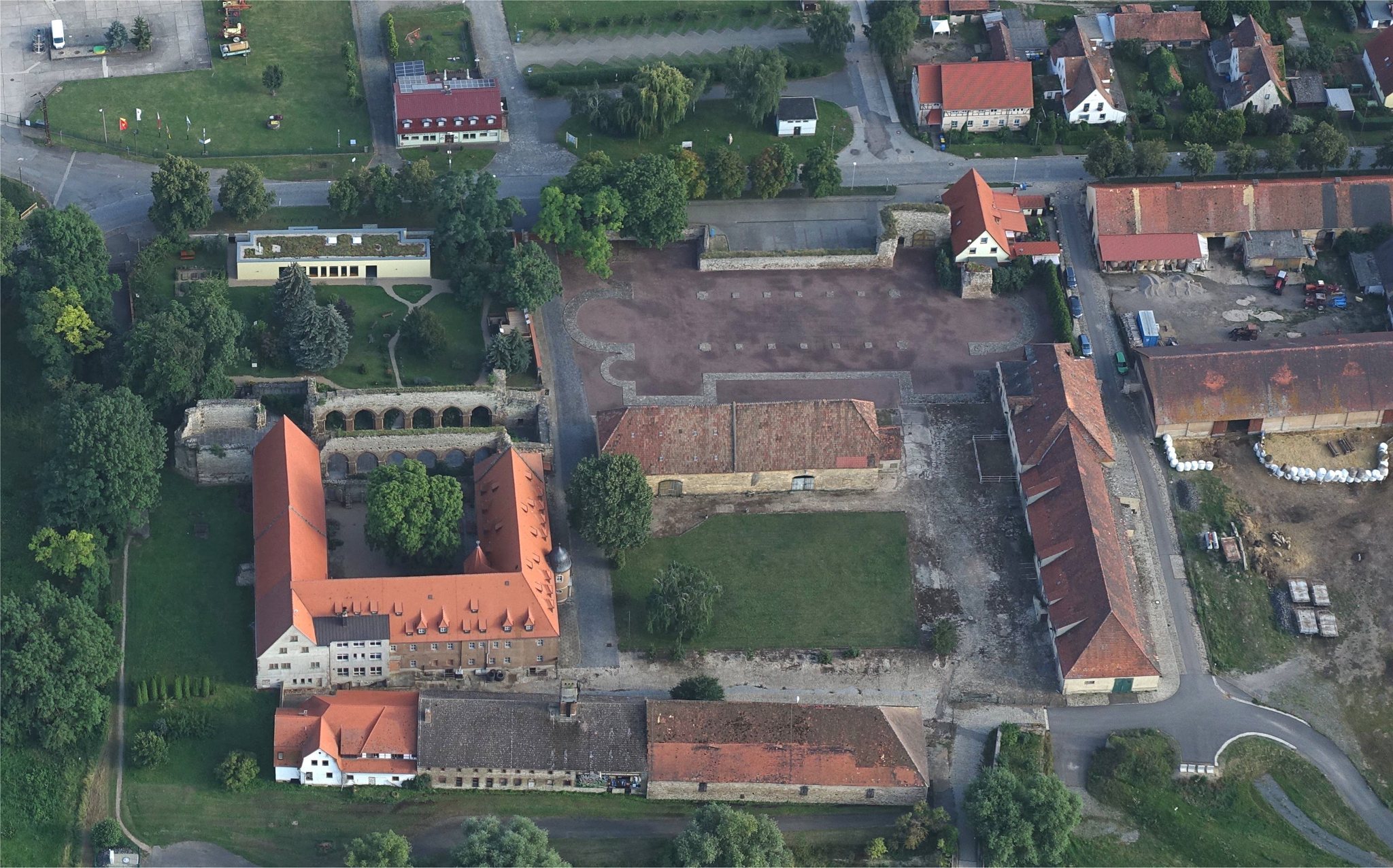
The surviving complex brings together the foundations and walls of a monumental tenth-century abbey church, the remains of a later monastic church and buildings, and preserved elements associated with medieval religious life. The older church was a double-choir building, meaning that it had liturgical choir areas at both ends of its main axis. Its ground plan has been established archaeologically and is marked on the site through paving.
Tenth-Century Abbey Church
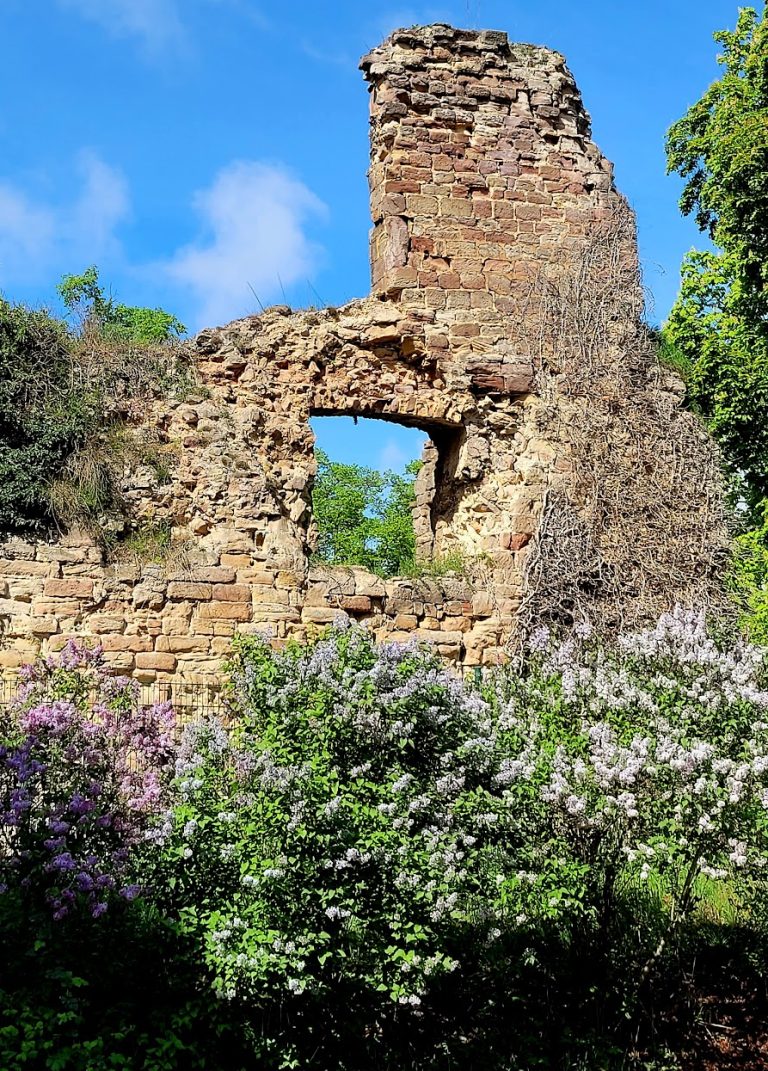
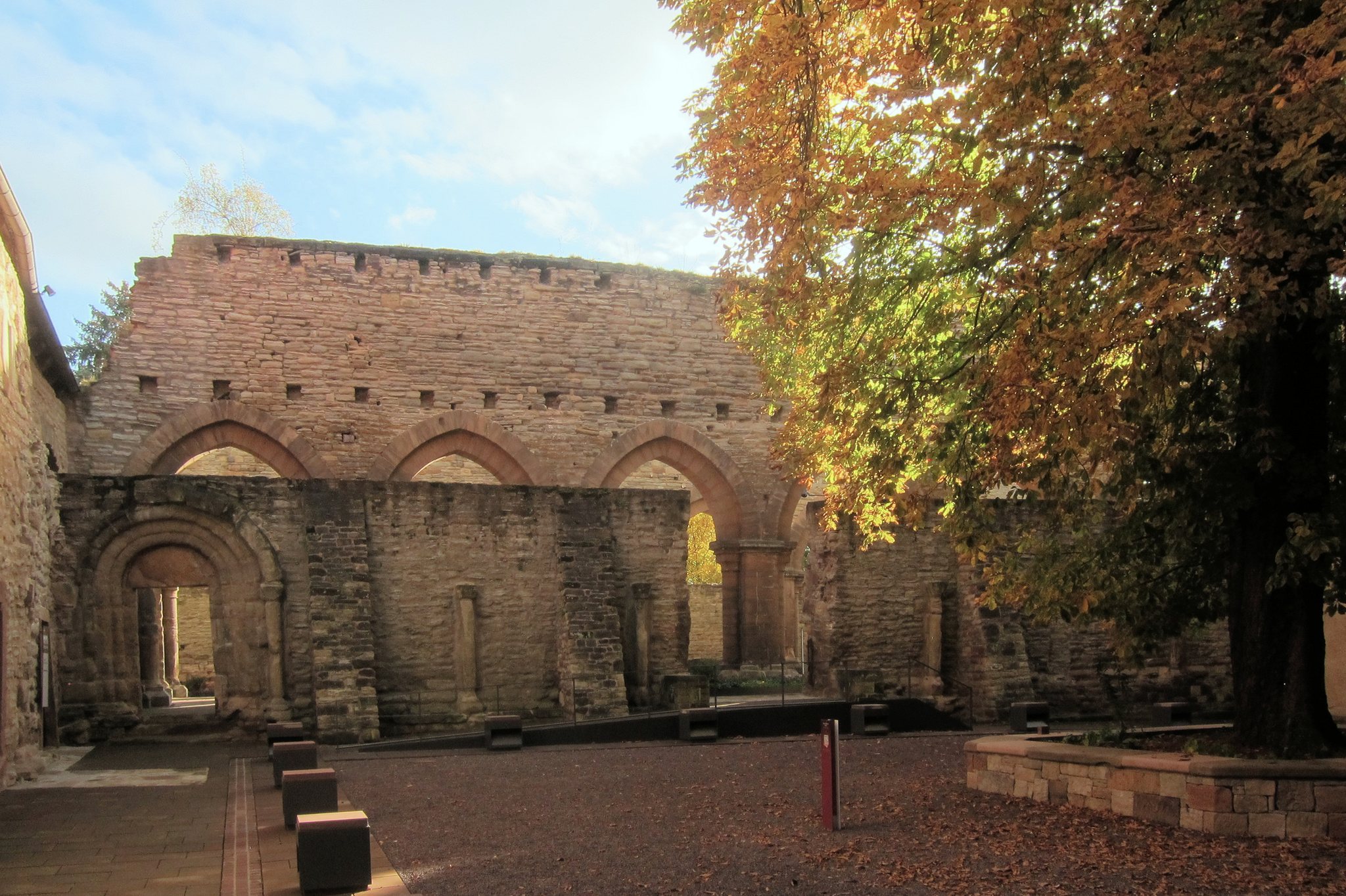
The tenth-century abbey church measured approximately 82 metres in length and 39.5 metres in width. Surviving elements include the southwestern transept, the southern wall of the nave, substantial sections of the southwestern crossing pier, other crossing piers, and foundations. These remains were incorrectly identified as parts of the royal palace until well into the twentieth century. Lightning destroyed the church roof in 1722, after which attempts were made to demolish the building. The church now survives as a ruin, with its tenth-century walls, foundations, and crossing supports forming the principal remains of the earlier monument.
Later Monastic Complex
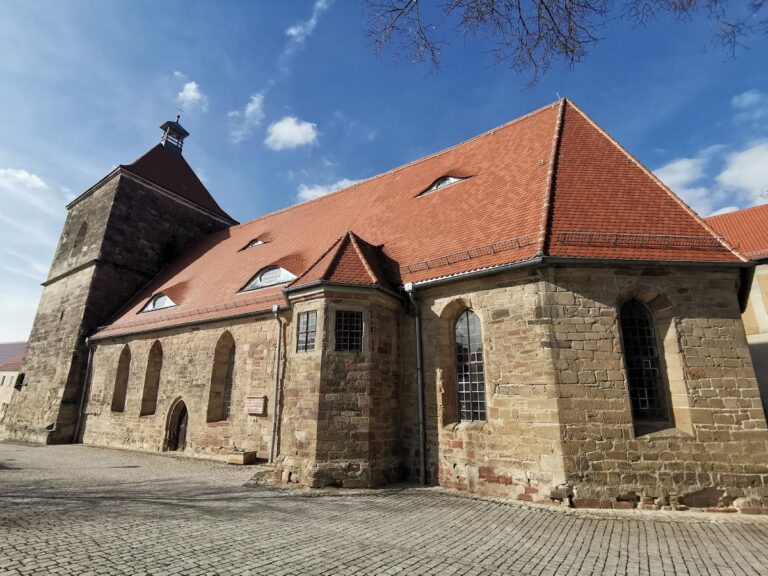
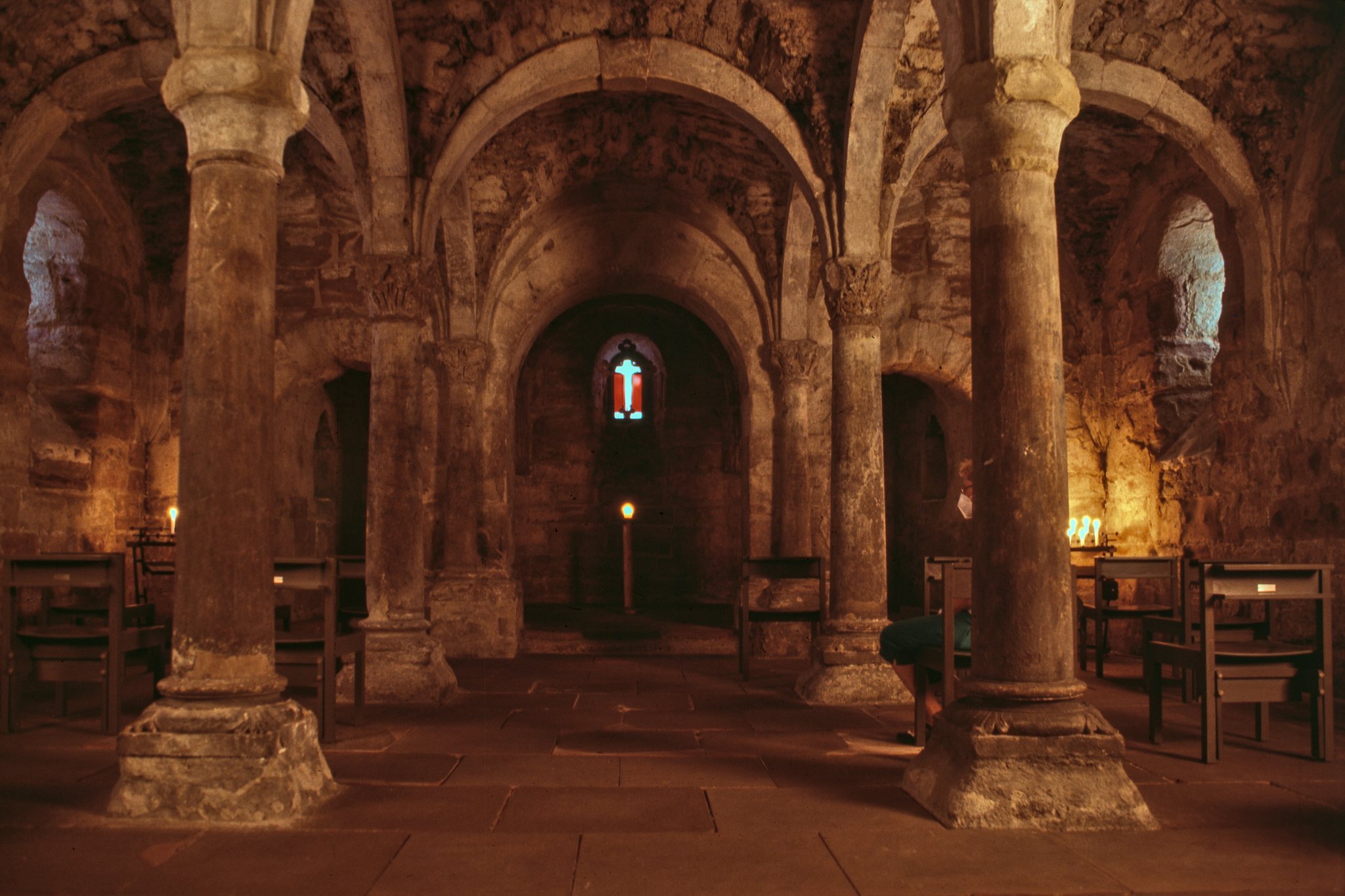
Construction of a smaller monastic complex began in the twelfth century, and its church was completed during the first half of the thirteenth century. The later church contains a Late Romanesque crypt, a vaulted chamber beneath the church choir used for religious purposes or burial. It is the only room in the monastic complex preserved in its original condition. Early Gothic nave arcades, associated with the later development of pointed and more vertically articulated forms, occur within a complex whose overall character remains Romanesque. Life-sized shadow images are visible on the nave pillars.
Surviving monastic buildings and presentations
The former monastic buildings contain museum exhibition areas, while the surviving church and monastery remains preserve the later crypt, nave arcades, crossing piers, and other structural evidence. A reconstructed medieval-style monastery garden and a scriptorium presentation form part of the complex. A scriptorium was a monastic room used for writing and producing manuscripts, and the presentation relates this activity to the history of Benedictine life at Memleben.