St Paul’s Church, Covent Garden: A Church of England Parish Church and Actors’ Church
Site at a Glance
- Rating
- 4.6
- Popularity
- Medium
- Country
- United Kingdom
- Primary era
- Early Modern
- External website
- Open
- Eras represented
- Early Modern, Modern
- Civilizations
- English
- Site type
- Religious
- Remains
- Church
On this page12 sections
History
St Paul’s Church, Covent Garden, is a Church of England parish church in London, United Kingdom, designed by Inigo Jones and completed in 1633 in the classical style. It forms part of Covent Garden Piazza and is also known as the Actors’ Church because of its longstanding connections with London’s theatre community. The building is Grade I listed for its exceptional architectural and historical importance.
Creation of Covent Garden Piazza
In 1630, the 4th Earl of Bedford received permission to demolish buildings on his land north of the Strand and redevelop the area. The resulting Covent Garden Piazza became London’s first formal square. St Paul’s was placed at its western end between two matching houses, while the southern side was left open.
In 1631, the earl commissioned Jones, an English architect and stage designer who introduced influential Italian Renaissance and classical forms into England, to create houses and buildings suitable for affluent residents. Jones has long been credited with the church and the piazza’s design, although firm documentary proof of his authorship is lacking. Construction was finished in 1633 at a cost of £4,886 to the Bedford estate.
The building was not consecrated until 1638 because of a dispute between the earl and the vicar of St Martin-in-the-Fields. It first functioned as an auxiliary chapel within that parish. In 1646, when Covent Garden became a separate parish, the church was dedicated to St Paul and became its parish church. It was the first entirely new church built in London after the Reformation, and an Act of Parliament made the Precinct of Covent Garden parochial in 1660.
Parish, plague, and restoration
Thomas Manton, a Puritan minister, served at St Paul’s until the Great Ejection, the removal in 1662 of many Puritan and other nonconforming ministers from Church of England livings after the Restoration. On 23 September that year, Simon Patrick became rector, the priest responsible for the parish church. Patrick later became Bishop of Ely and served at St Paul’s during the plague.
Margaret Ponteous, regarded as the first known victim of the plague outbreak that affected England in 1665 and 1666, was buried in the churchyard on 12 April 1665. The church itself underwent major restoration under Thomas Hardwick in 1789. In September 1795, workmen repairing the roof accidentally started a fire that burned out the interior. The outer walls remained structurally sound, but the portico required rebuilding, although the extent of that work is uncertain. After further restoration directed by Hardwick, the church was reconsecrated on 1 August 1798. The parish records and Grinling Gibbons’s carved wooden pulpit survived the fire.
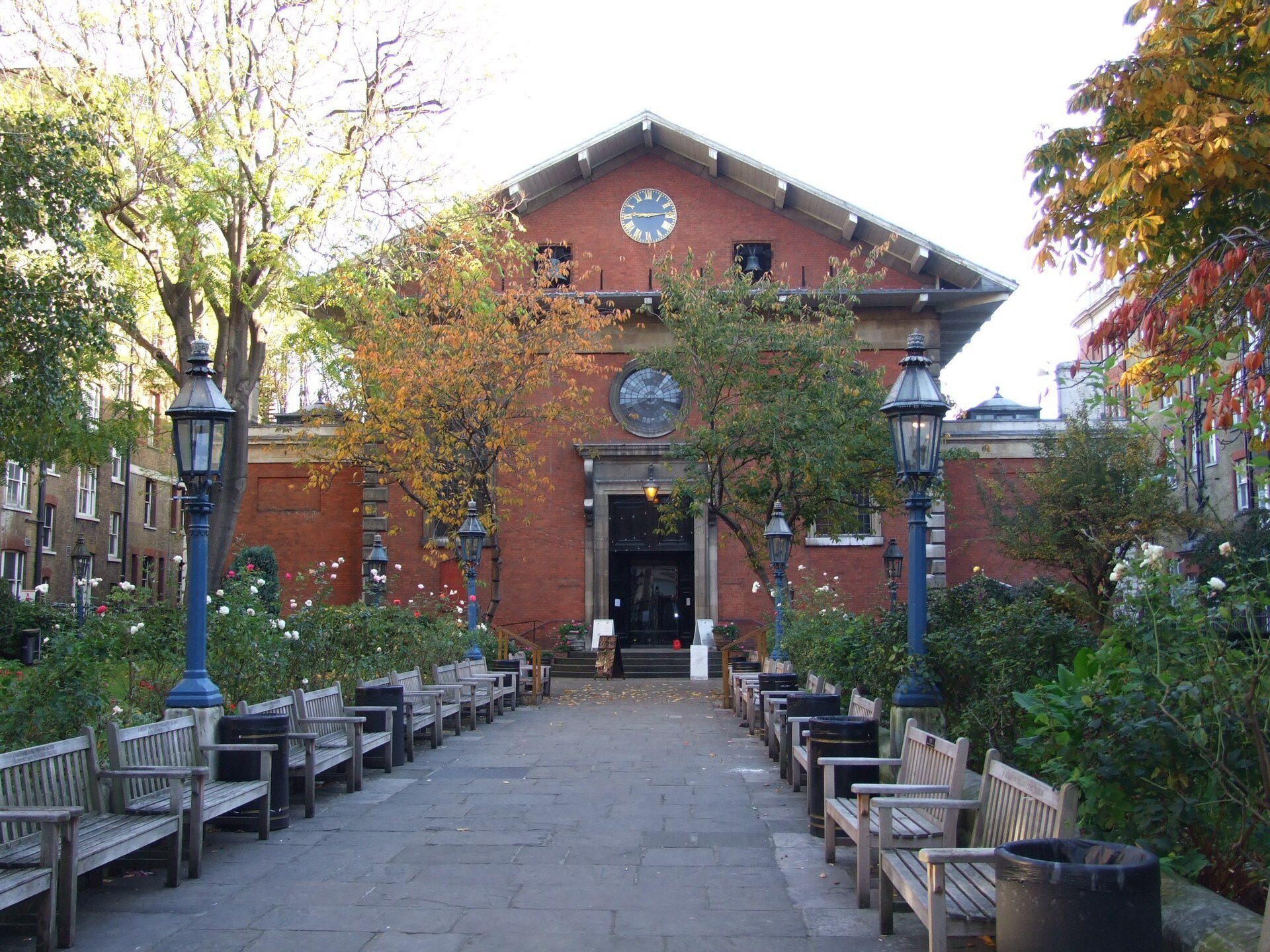
William Butterfield carried out further alterations in 1871 and 1872, followed by Henry Clutton’s restoration between 1878 and 1882. Hardwick’s stone facing was removed in 1888 after it was found to be a thin, poorly bonded layer over the brickwork, and the church was reclad in the unrendered red brick seen today. The churchyard closed to burials in 1852.
The Actors’ Church
St Paul’s theatrical connections developed after the Theatre Royal, Drury Lane, was established in 1663 and grew stronger after Covent Garden Theatre, now the Royal Opera House, opened in 1723. On 9 May 1662, Samuel Pepys recorded an Italian puppet performance beneath the portico. It is regarded as the first recorded performance of Punch and Judy, and the event is commemorated by the annual MayFayre service.
The portico later provided the setting for the opening scene of George Bernard Shaw’s Pygmalion, which was adapted as My Fair Lady. Since 2007, the church has hosted Iris Theatre, a professional theatre company associated with St Paul’s that was originally formed for a production of T. S. Eliot’s Murder in the Cathedral. It received full charitable status in October 2009.
The church’s artistic associations are also reflected in its baptisms, burials, ashes, and memorials. J. M. W. Turner and Sir William S. Gilbert were baptised here. Samuel Butler, Grinling Gibbons, Thomas Murray, Sir Peter Lely, Thomas Girtin, Thomas Arne, and Sir Henry Herbert were buried here, while the ashes of Ellen Terry and Edith Evans rest in the church. Memorials commemorate figures including Charles Macklin, Sir Charlie Chaplin, Sir Noël Coward, Gracie Fields, Stanley Holloway, Boris Karloff, Vivien Leigh, Ivor Novello, Richard Greene, Kenneth More, Diana Rigg, Richard Beckinsale, and Bransby Williams. The Avenue of Stars, formerly dedicated to entertainment figures, also ran along the church’s exterior. Covent Garden Sinfonia, previously known as the Orchestra of St Paul’s, is resident at the church.
Remains
Exterior and Piazza Frontage
East Portico
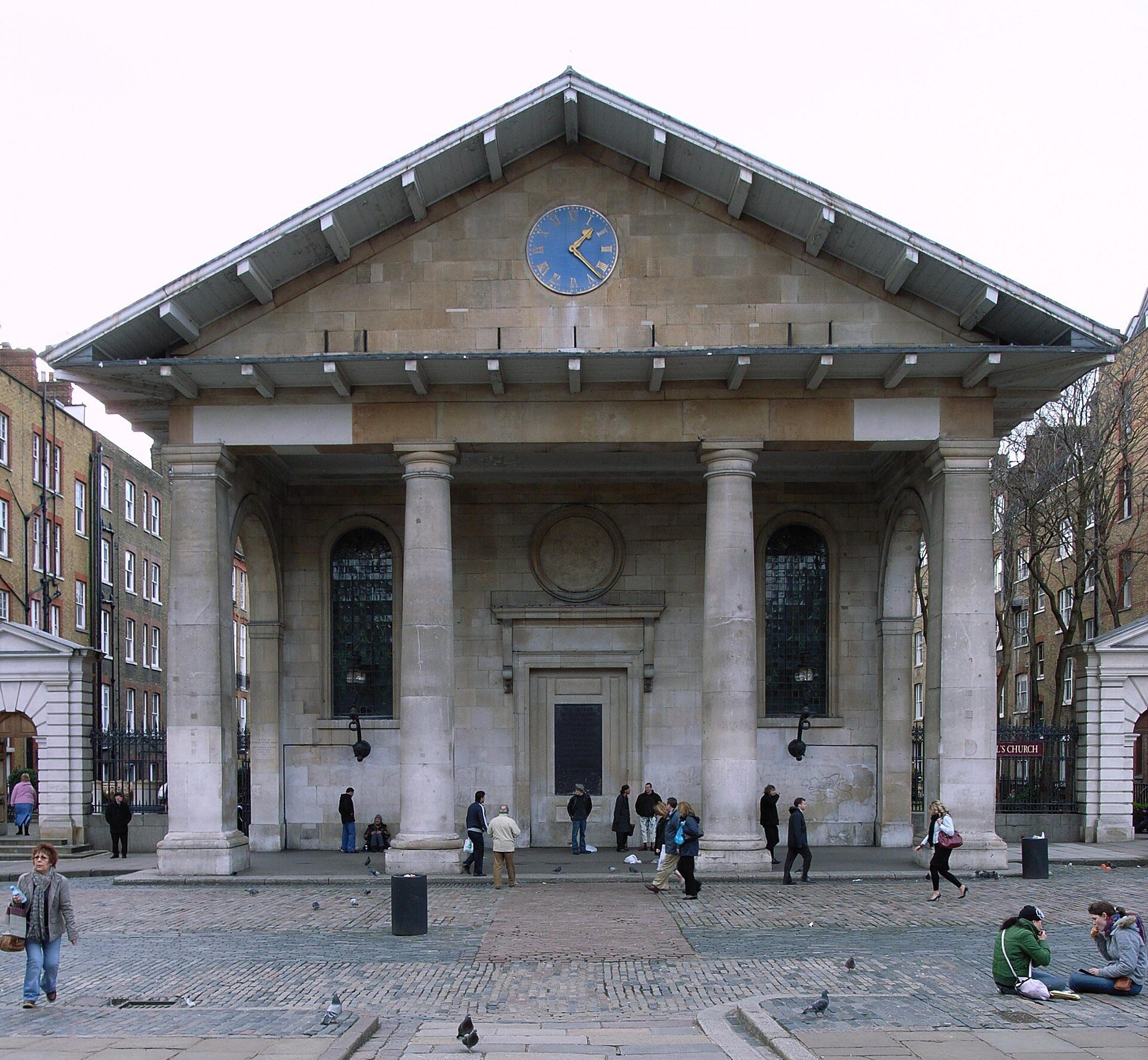
The church forms part of the classical composition of Covent Garden Piazza. Its east end faces the square and carries a substantial portico, a roofed entrance porch supported by columns or piers, beneath a strongly projecting pediment, the triangular gable above a classical facade. Two columns and two piers support the structure. Six or seven steps originally rose to the portico, but the increasing level of the piazza reduced the visible steps to two by 1823 and none by 1887.
Three doorways originally stood behind the portico. The central one survives as a false door because the wall behind it contains the altar. The two side doorways were blocked during the nineteenth century when the chancel floor was raised. The portico-facing elevation is not the principal entrance. That function belongs to the plainer west front, which has a pediment but no portico.
Facades and Gateways
The east facade is faced in stone, while the remaining sides retain red brick with stone details. The building appears to have begun with brick and stucco, making the present stone surface a later treatment. Two elaborate gateways once stood beside the portico and gave access to the churchyard. They were removed and later replaced with gateways in the Tuscan style.
The archways beside the church were originally built from stuccoed brick. Stone replicas were installed during the 1789 works, and Clutton’s restoration between 1878 and 1882 substantially widened and raised them. Historical plans and views show several small roof structures, some apparently containing bells. The roof is now bare, while two bells remain visible in recesses high on the west facade. Clutton also removed the bell turret above the western pediment.
Interior and Furnishings
Classical Interior
The interior is a single undivided space without piers or columns. Its eastern third was originally separated as a chancel by a one-step change in floor level, and Butterfield raised that area further in 1871 and 1872. The design follows Vitruvius’s description of an Etruscan or Tuscan temple. The Tuscan order is the simplest classical order, using plain columns and limited ornament, while Vitruvius was the ancient Roman architectural writer whose account influenced later classical design. The church has consequently been described as a strict Tuscan interpretation and as an almost archaeological exercise.
The roof was originally covered with tiles and was changed to slate during the 1789 renovation. Dormer windows added in the 1640s were removed at the same time. The church was built without galleries, but galleries were soon installed on three sides. Hardwick incorporated them into his rebuilding, and the western gallery survives.
Surviving Furnishings and Memorials
Grinling Gibbons’s pulpit remains in the church after surviving the fire of 1795. Gibbons was a prominent seventeenth-century English wood-carver known for intricate carved work. The interior also contains a baptismal font and memorial tablets. A statue showing the conversion of Saint Paul was carved by Bruce Denny and unveiled by Judi Dench.
Churchyard
The churchyard survives as a graveyard garden surrounding the building. Its burial ground contains, or formerly contained, the graves of artists, craftsmen, clergy, and theatre figures, including Samuel Butler, Grinling Gibbons, Thomas Murray, Sir Peter Lely, Thomas Girtin, Thomas Arne, and Sir Henry Herbert. These burials form part of the church’s continuing connection with the artistic and theatrical life of Covent Garden.