Santa Maria al Giglio: A Marian Church in Montevarchi, Italy
Site at a Glance
- Rating
- 4.4
- Popularity
- Very Low
- Country
- Italy
- Primary era
- Early Modern
- Eras represented
- Early Modern
- Civilizations
- Grand Duchy of Tuscany
- Site type
- Religious
- Remains
- Church
On this page13 sections
History
Santa Maria al Giglio is a Catholic church in Montevarchi, Italy, built from the late sixteenth century and developed during the seventeenth century around devotion to the Madonna del Giglio. Its origins lie in a rural area outside Montevarchi’s walls, where a roadside tabernacle stood beside a bridge over the stream then called the Ricasoli, now known as the Borro del Giglio.
The shrine and the reported apparition
In the sixteenth century, the locality took its name from the lilies cultivated there. The land around the bridge belonged to the Confraternity of Santa Maria del Latte, a lay religious association devoted to charitable, devotional, or funerary purposes. Its small shrine, known as the Madonna del Ponte, contained a fresco of the Virgin Mary breastfeeding the infant Jesus.
On 29 August 1585, witnesses claimed that the Virgin appeared at the shrine wearing white. Other miraculous signs were subsequently associated with the event, and devotees began arriving from Montevarchi and more distant places in search of relief from illness and misfortune. The canons of the Collegiate Church of San Lorenzo, the confraternity’s officers, and Montevarchi’s civic authorities appointed representatives to supervise the offerings and consider a church for the image.
Bishop Francesco Cattani da Diacceto of Fiesole initially withheld permission. He required an episcopal investigation to determine whether the growing devotion arose from superstition or genuine religious belief, while the image remained at the original shrine and the offerings were safeguarded. An episcopal tribunal began hearing testimony on 27 May 1589. Some evidence appeared false or unconvincing, and the bishop first archived the case. Montevarchi’s authorities continued to seek a decision through Giovanni Battista Bazzanti and an appeal to the Florentine government.
Construction and early administration
On 4 July 1589, Bishop Diacceto authorized a new church beside the bridge, on land granted by the Confraternity of Santa Maria del Latte. The building was planned to measure 30 braccia by 15 and to include a bell tower, bell, altar, and other necessary fittings. The entire tabernacle and its image of Mary, by then known as the Madonna del Giglio, were to be transferred into the new church.
The Opera della Madonna del Giglio was established to build and administer the church. It had six members, including two canons of the Collegiate Church and four lay representatives of civic society, the confraternity, and the Monte Pio. Its first members were Lorenzo Menchi, Bernardino Turchi, Giovanni Cianferoni, Piero Lapini, Gregorio Barzanti, and Francesco Carmignoli. The Opera’s earliest administrative and financial books have been lost, so the exact beginning of construction is unknown, although work probably started in 1589.
Construction proceeded gradually. The choir had risen above the roof by 28 April 1604, while two chapels and the sacristy were still unfinished in 1616. The facade also remained incomplete in 1621. The dome was completed in 1613. The church initially functioned as an oratory, and its foundation required Mass to be celebrated every day so that devotion would not remain temporary or superficial. Because it had no resident priest, clergy from Montevarchi served there, especially priests from the Collegiate Church, the Capuchin convent of San Lorenzo, and the Franciscan convent of San Ludovico. A chaplain was formally appointed on 13 March 1606.
In 1606, Bartolommeo Lapini proposed giving the church to the Servites, or Order of the Servants of Mary, a Catholic religious order particularly associated with devotion to the Virgin Mary. Montevarchi’s authorities approved the plan in 1608 and reported that funds had been found for twelve friars, but the convent was apparently never established because episcopal authorization was not obtained. In 1639, chaplain Antonio Cuffi offered his entire estate in return for a lifelong priory. The Opera accepted the arrangement, and Bishop Lorenzo della Robbia created the title of prior and appointed Cuffi as the first prior on 31 January of that year.
Parish development and later history
The Opera della Madonna del Giglio was suppressed on 21 March 1785, and its liquidation ended on 5 August 1786. Bishop Ranieri Mancini then separated the church from the parish of the Collegiate Church. A decree dated 16 December 1786 established the parish and priory of the Giglio, dedicated to the Nativity of Mary. The church remains a Catholic institution within the Diocese of Fiesole, with its religious identity rooted in the cult of the Madonna del Giglio and the transfer of the Madonna del Ponte image from its original roadside shrine.
The parish historically included several affiliated oratories. Santa Maria di Renacciolo was founded in 1689 and deconsecrated in the second half of the nineteenth century. Santa Umiliana de’ Cerchi was erected in 1848, San Giuseppe was consecrated in 1871, and the Oratory of the Calasanzian Sisters was consecrated in 1930. The Oratory of the Gruccia was built in 1948 for a parish that was never established.
Lay religious associations also shaped parish life. These included the Confraternity of Charity, active from 1785 to 1792; the Confraternity of the Blessed Sacrament, founded in 1792 and still active; the Madonna del Carmine association, active from 1819 to 1896; and the Sacred Heart association, founded in 1866. Other groups included the association of the Forty Hours, the associations of the Immaculate Conception, Saint Joseph, and the Most Holy Rosary, Eucharistic Adorers, Catholic Action, the Ladies of Charity, and the Third Order Franciscans. The Confraternity of the Blessed Sacrament continued to assist at funerals and processions. On Holy Thursday, twelve members enact the Apostles during the Washing of the Feet.
Shelling on 16 July 1944 destroyed or removed the burials and funerary remains in the loggia. The original organ, which had been moved behind the altar in 1933, was also destroyed. The present organ was made in 1960.
Remains
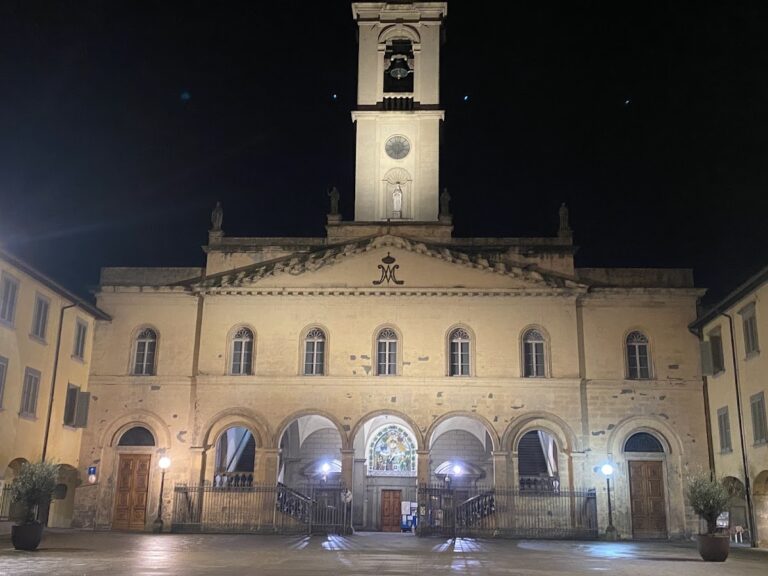
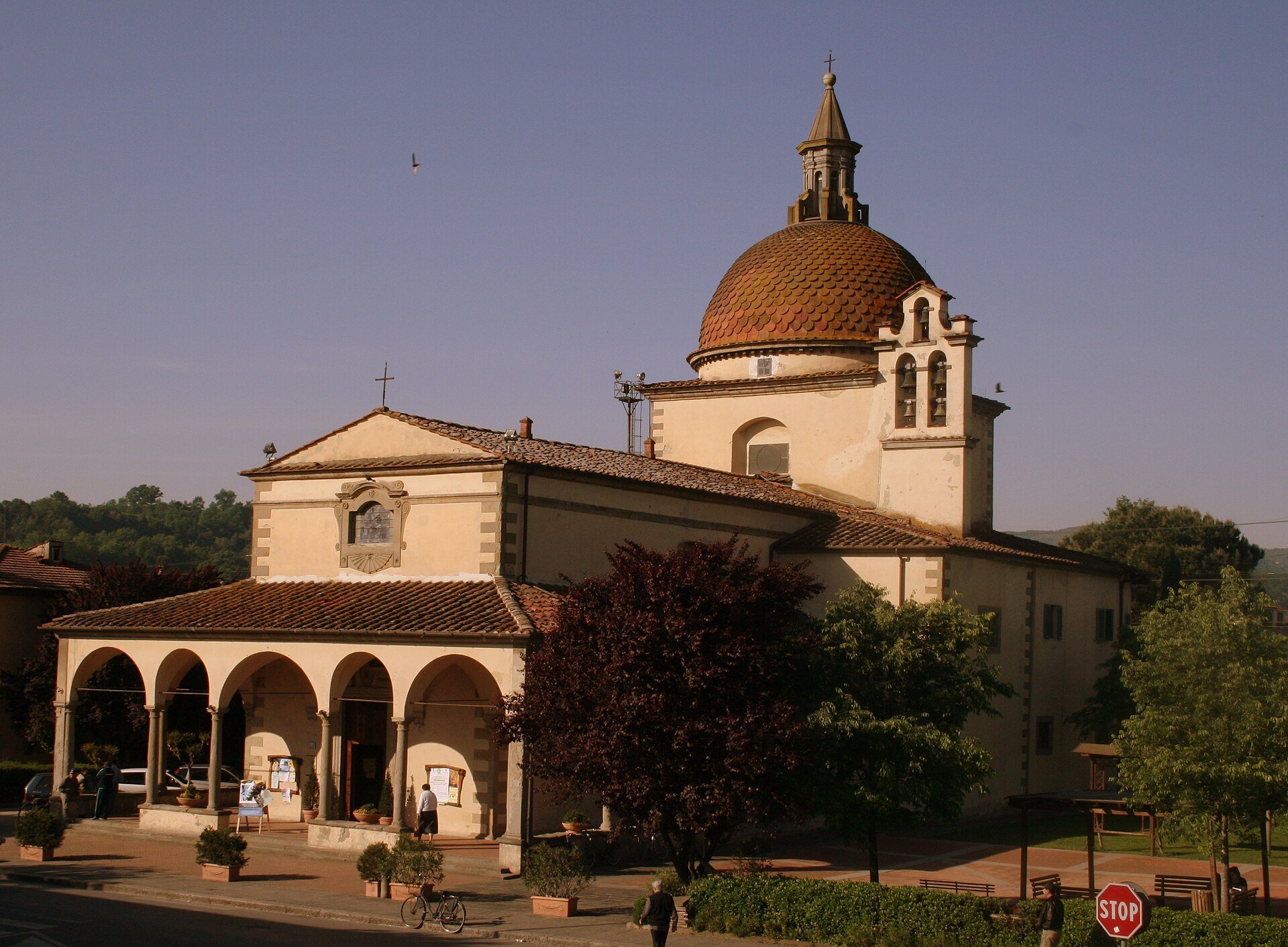
Santa Maria al Giglio has a single nave measuring 23 metres in length and 8 metres in width. A later choir and two side chapels give the building a Latin-cross plan without a transept. The nave has a trussed ceiling and terracotta floor, while the church is enclosed by a later loggia of fifteen round arches resting on gray Tuscan sandstone columns. The entrance faces north-east, and the surviving fabric brings together the original oratory, its seventeenth-century dome, later chapels, and the shrine image above the high altar.
Church exterior and structural elements
Entrance and loggia
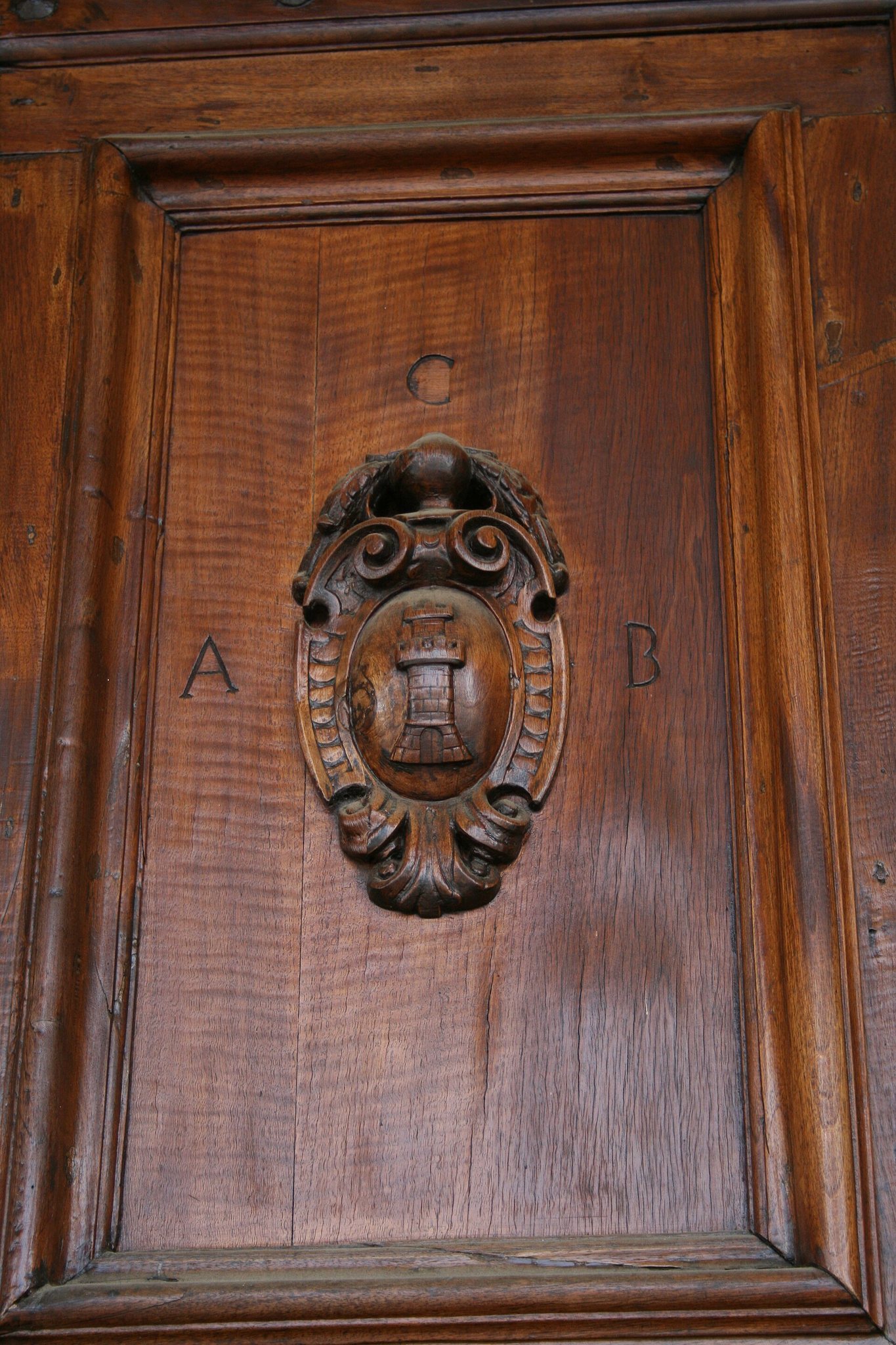
The original wooden double doors survive at the entrance. Two smaller doors were later cut into them when an interior vestibule was added. The leaves bear two matching coats of arms showing a tower and the initials “A.B.C.”, whose identity and meaning remain unknown. Beside the portal is a seventeenth-century stone alms box, now walled up. Its inscription, “Alms for the building,” records that the church was financed entirely through offerings from the faithful.
The surrounding loggia sheltered burials and funerary inscriptions from the weather. Its former beaten-earth surface was replaced by the present terracotta pavement in 1942. The loggia’s construction also blocked the church’s four original lateral windows, whose outlines remain visible from inside. Daylight now enters through the decorated facade window, four choir windows, two chapel windows, and eight openings in the lantern, the raised windowed structure above the dome.
Choir and dome
The choir is a cubic structure beyond the high altar. It rises above the roof and supports the dome, with a cornice on the exterior and an interior gallery carried by corbels. Stone was used for its construction rather than brick, and the stonework was assigned in 1605 to Piero di Gropina and Domenico di Certignano.
The dome is formed from brick scales. Bernardino Quadri measured it and calculated the required materials in 1604, while the Florentine architect Matteo Nigetti received the design and supervision of the work in 1607. Four iron chains were built into the structure. The dome was finished in 1613, when Tommaso da Firenze designed its octagonal lantern.
Bell-gable
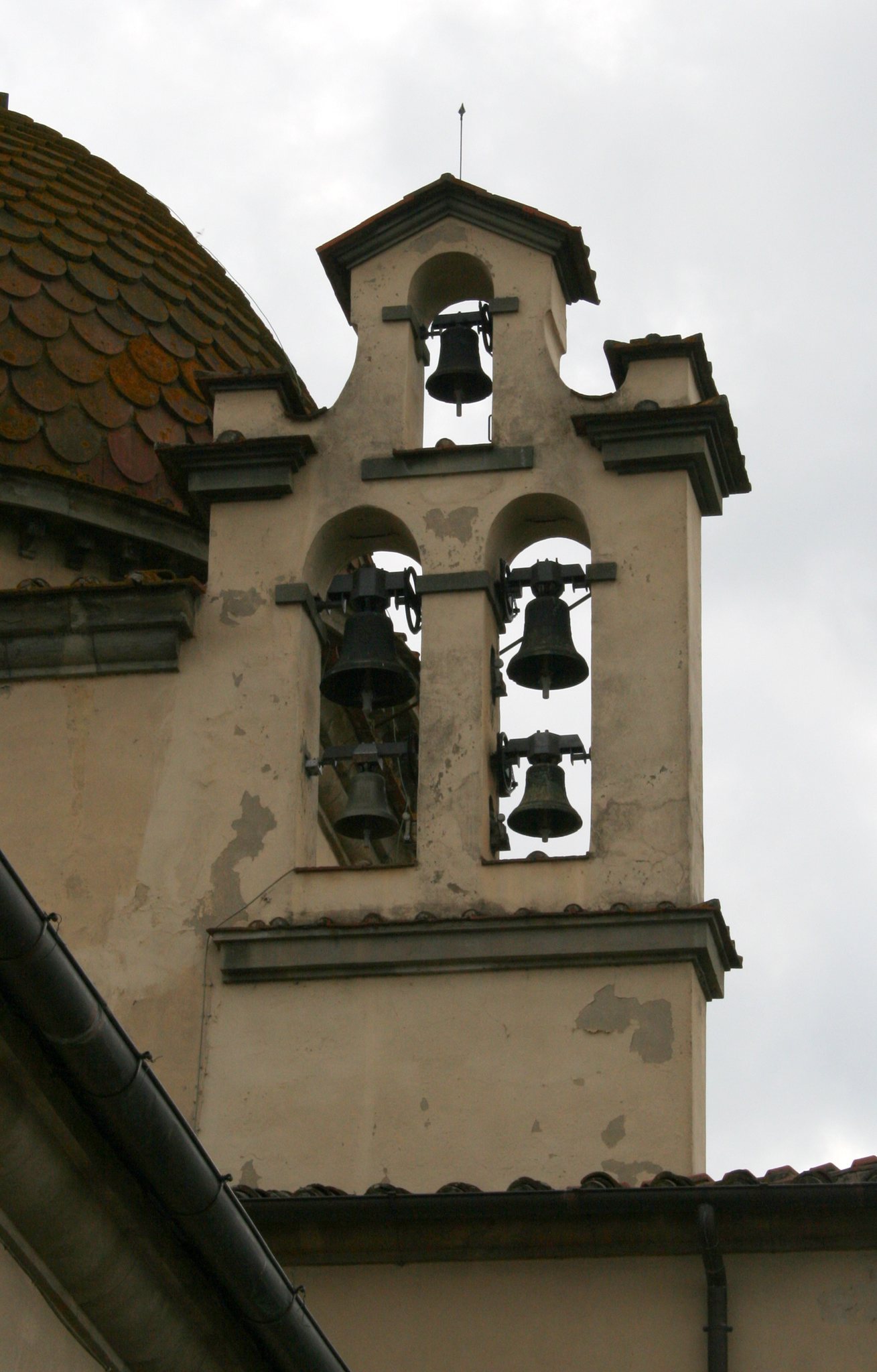
A small bell-gable stands on the right side of the church. This compact bell tower consists of openings formed in a wall rather than a separate enclosed tower, with three arches arranged in a triangular composition. It is first recorded in 1613 and originally held three bells. A fourth and largest bell was installed in 1930 after being cast by the Bastanzanetti firm of Arezzo and donated by Marchesa Elisa Alli Maccarani in memory of her son Gastone Brilli-Peri. A fifth bell was added in autumn 2006 to commemorate the beatification of Maria Teresa Scrilli, with the reason engraved on the bell.
Interior chapels and devotional features
Nave, choir, and chapels
A round-headed arch of pietra serena, a gray sandstone widely used in Tuscan architecture, separates the nave from the choir. The arch is decorated with pilasters and panels. Two simpler masonry arches open onto the side chapels. The Chapel of the Most Holy Crucifix lies to the left of the altar and measures 5.30 by 6 metres. Its cross vault was financed by Giuliano Mini and his son Leonardo, whose partially preserved dedicatory inscription identifies them as the chapel’s patrons.
The Chapel of the Nativity, also called the Chapel of Saint Anne, lies to the right and matches the Crucifix chapel in form and dimensions. It gives access to the sacristy. Above its door is a seventeenth-century oil painting attributed to Michelangelo Vestrucci, showing the Nativity of Mary and several male figures, probably patrons of the work or chapel. The altar now carries a modern statue of Saint Joseph. The Crucifix chapel’s altar likewise bears a modern statue, depicting the Sacred Heart of Jesus.
Paintings and the Madonna del Giglio
Above the rectory door is another seventeenth-century oil painting attributed to Michelangelo Vestrucci. It depicts the Crucifix with Saint Jerome, Saint Julian, Saint Francis, and Saint Leonard of Vandoeuvre. Above the high altar, the Madonna del Ponte fresco is attributed to Luberto da Montevarchi, a local painter associated with the Peruginesque tradition. The image was detached from the original roadside tabernacle and installed in the church after the building was completed.
The transferred fresco is enclosed by two cylindrical columns on square piers, crowned by Corinthian capitals and supporting an entablature. The frame measures 1.88 by 2.55 metres. Because the frame was larger than the painting, the surrounding spaces were filled in 1604 with a painted canvas of the Resurrection. That addition was later covered by cherubim, angels crowning Mary, Saint Michael the Archangel, a holy bishop, Saint Clare, and Saint Roch. The canvas was removed in 1933, when Giovanni Bassan enlarged the fresco with draperies, flying angels, a floor, Saint John the Baptist on the left of the throne, and Saint Peter on the right.
Altar, relic, and organ
The high altar originally stood beneath the central arch and was preceded by a stone balustrade. In 1933 it was moved beneath the Madonna’s tabernacle, and Marchesa Elisa Alli Maccarani donated the ciborium for the new arrangement. Beneath the altar, a gilded wooden and glass reliquary, a container for a sacred relic, holds the bones of a martyr named Saint Honorius. The saint is unidentified in hagiographical records, and the body was transferred from the catacombs of Rome. It was already in the church by 1672, accompanied by an authentication document from the Vatican curia dated 3 May 1664.
The first organ dated from 1802 and stood on a choir loft above the entrance. The loft was dismantled in 1933, and the instrument was moved behind the altar before its destruction in the 1944 bombardment. The present organ dates from 1960 and was made by the Mascioni firm. It has two keyboards, a pedalboard, and twenty-three stops.