Cape Coast Castle: A Fortified Commercial and Slave-Trading Complex in Ghana
Site at a Glance
- Rating
- 4.5
- Popularity
- Medium
- Country
- Ghana
- Primary era
- Early Modern
- External website
- Open
- Eras represented
- Early Modern
- Civilizations
- English
- Site type
- Military
- Remains
- Fort
On this page14 sections
History
Cape Coast Castle is a fortified commercial complex in Cape Coast, Ghana, begun by Portuguese traders in 1555 on the former Gold Coast of West Africa. The first establishment was a feitoria, an overseas trading post combining commerce and administration, and was known as Cabo Corso, meaning “Short Cape.” The site later became a Swedish, Danish, Dutch, and English possession and developed into a major center of the Atlantic gold trade and the forced transportation of enslaved Africans.
Portuguese and Swedish beginnings
In 1650, King Bredewa of Efutu, the coastal polity that controlled the locality, authorized the Swedish Africa Company to establish a trading post at Cabo Corso. Hendrik Caerloff, formerly an official of the Dutch West India Company, obtained the permission and directed the construction of the first Swedish fortification. A timber lodge followed in 1653 and was named Carolusborg, or Carlsborg, after King Charles X Gustav of Sweden.
The early settlement supported trade in timber and gold. Gold dust was a major reason for European commercial expansion along the coast, and the post connected European merchants with local African markets. In return for gold, mahogany, and other local goods, European traders brought clothing, blankets, spices, sugar, silk, and other imported commodities.
Competing European powers
Control of Carolusborg changed repeatedly during the late 1650s and early 1660s. Caerloff returned to Europe in 1655, leaving Johann Philipp von Krusenstjerna in charge. In 1657, Caerloff came back with Danish backing, captured Swedish possessions, and took Krusenstjerna prisoner. Samuel Smit later transferred the Danish possessions to the Dutch, although the king of Efutu prevented the Dutch from immediately taking possession. English forces captured the fort in 1664.
The Dutch regarded Carolusborg as a threat to their commercial position and organized an unsuccessful siege in 1652. After the English takeover, the fort was strengthened substantially. When Admiral Michiel de Ruyter considered recapturing it in 1665, he judged it too strong to conquer. The Danes had established Fort Frederiksborg a few hundred metres to the east in 1661, while the Dutch captured the English headquarters at Kormantsin and rebuilt it as Fort Amsterdam. Cape Coast then became the headquarters, or capital, of the English possessions on the Gold Coast.
English administration and the Atlantic slave trade
The English Royal African Company expanded Cape Coast Castle from the 1670s. The company was an English chartered trading corporation that held a legal monopoly over much English commerce on the West African coast from 1672 until Parliament ended that privilege in 1750. The African Company Act of that year transferred the castle and its employees to the Company of Merchants Trading to Africa, supported by a parliamentary subsidy for the slave-trading industry.
During the eighteenth century, Cape Coast Castle became a principal holding and export center for enslaved Africans. People awaiting shipment across the Atlantic were confined in the castle’s dungeons before being loaded onto vessels bound especially for the Caribbean and the Americas. The castle represented the final stage before the Atlantic crossing and became associated with the phrase “gate of no return.” The Atlantic slave trade was the forced transportation of enslaved Africans by European and American merchants across the ocean, particularly to plantation colonies in the Caribbean and the Americas.
The Royal African Company distinguished between “shipping slaves,” who were held in chains for export, and “castle slaves,” also called Arda slaves, who lived and worked for the company at the castle. Overcrowding affected the holding facilities in the early eighteenth century. Food supplies could become inadequate, and in June 1683 a shortage of locally available corn threatened prisoners with starvation. In 1757, during the Seven Years’ War, a global conflict fought mainly between 1756 and 1763 by European powers and their overseas colonies, a French naval squadron heavily damaged the castle and nearly captured it. Failing walls and leaking roofs then led to major reconstruction.
Executions and nineteenth-century administration
Cape Coast Castle was also the setting for executions connected with piracy. In 1689, the pirate Duncan Mackintosh and several members of his crew were hanged there. In 1722, fifty-four men from the crew of the pirate Bartholomew Roberts were condemned at the castle. Fifty-two were hanged, while two were reprieved.
George Maclean served as president of the Committee of Merchants at Cape Coast Castle from 1830 to 1844. At that time, the committee’s president administered the British Gold Coast rather than a governor. Maclean helped suppress slave trading along approximately 300 kilometres of the West African coast, negotiated peace with the Ashanti through the Treaty of 1831, developed a judicial system, and promoted commercial activity. His support for the ownership of enslaved people near the castle damaged his reputation. He was later demoted to judicial assessor but retained because of his local knowledge and commercial experience.
Maclean and his wife, the poet Letitia Landon, are buried in the castle courtyard. Landon died of heart failure within two months of returning to Cape Coast with Maclean. Governor William Winniett also worked to end the slave trade between 1846 and 1850 and died at the fortress.
Restoration and heritage
The British Public Works Department restored the castle in the 1920s. After Ghana became independent in 1957, Cape Coast Castle came under the Ghana Museums and Monuments Board. It was used successively for police training, local administration, a secondary school, and the Board’s offices. In the early 1990s, the Ghanaian government restored the castle with support from the United Nations Development Programme and the United States Agency for International Development, with technical assistance from the Smithsonian Institution and other nongovernmental organizations.
Cape Coast Castle forms part of the UNESCO World Heritage property “Forts and Castles, Volta, Greater Accra, Central and Western Regions,” inscribed in 1979 under criterion (vi). Its recognized value rests on its testimony to the Atlantic gold and slave trades. The castle now serves as a place of commemoration and historical education.
Remains
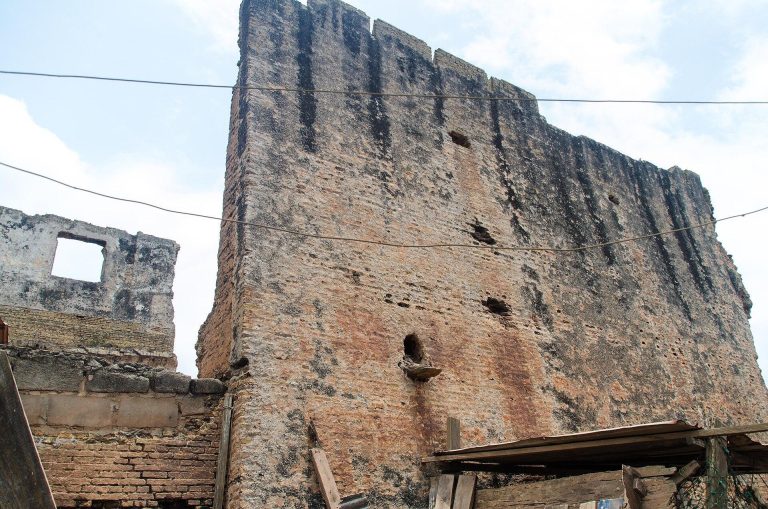
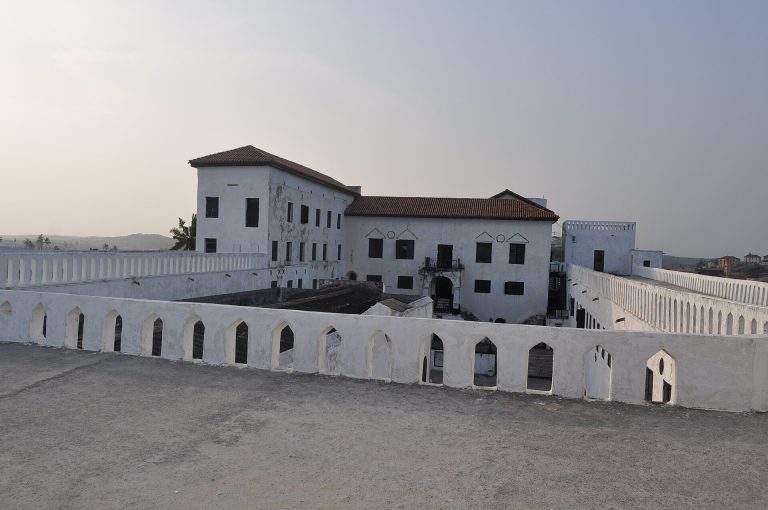
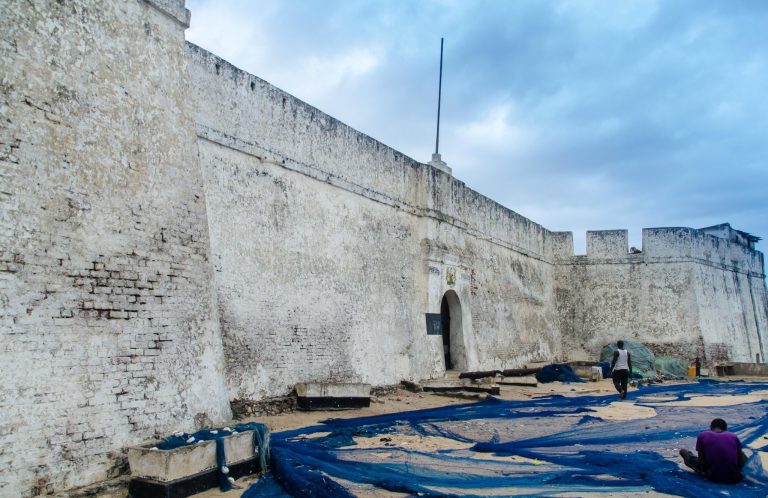
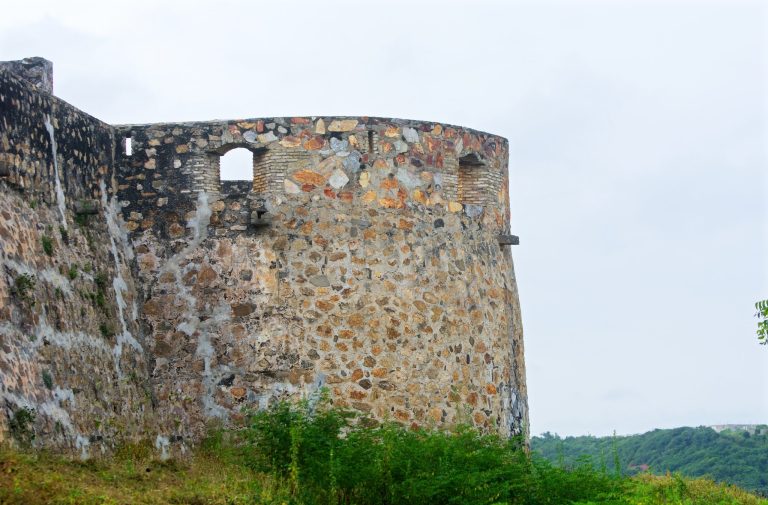
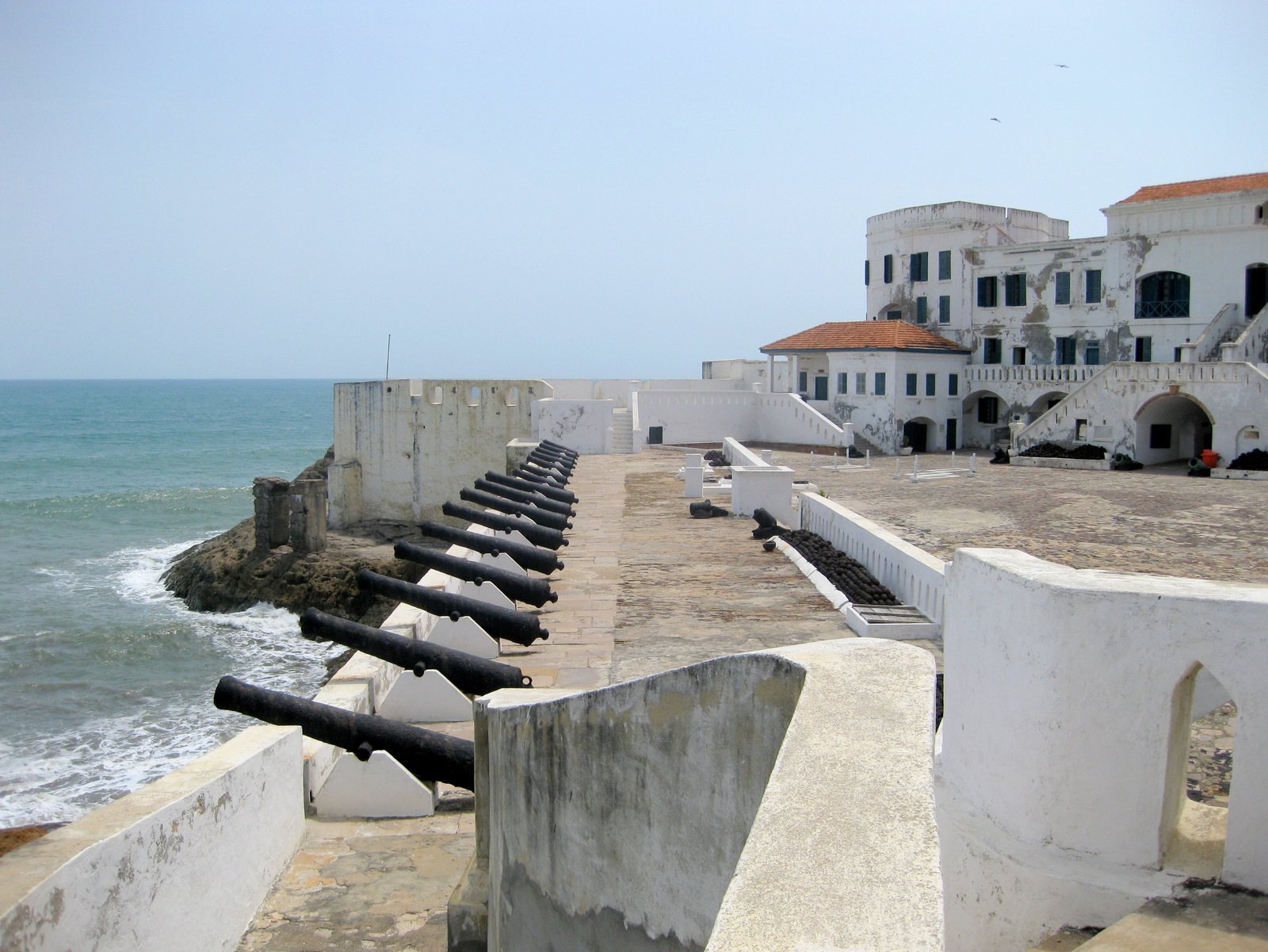
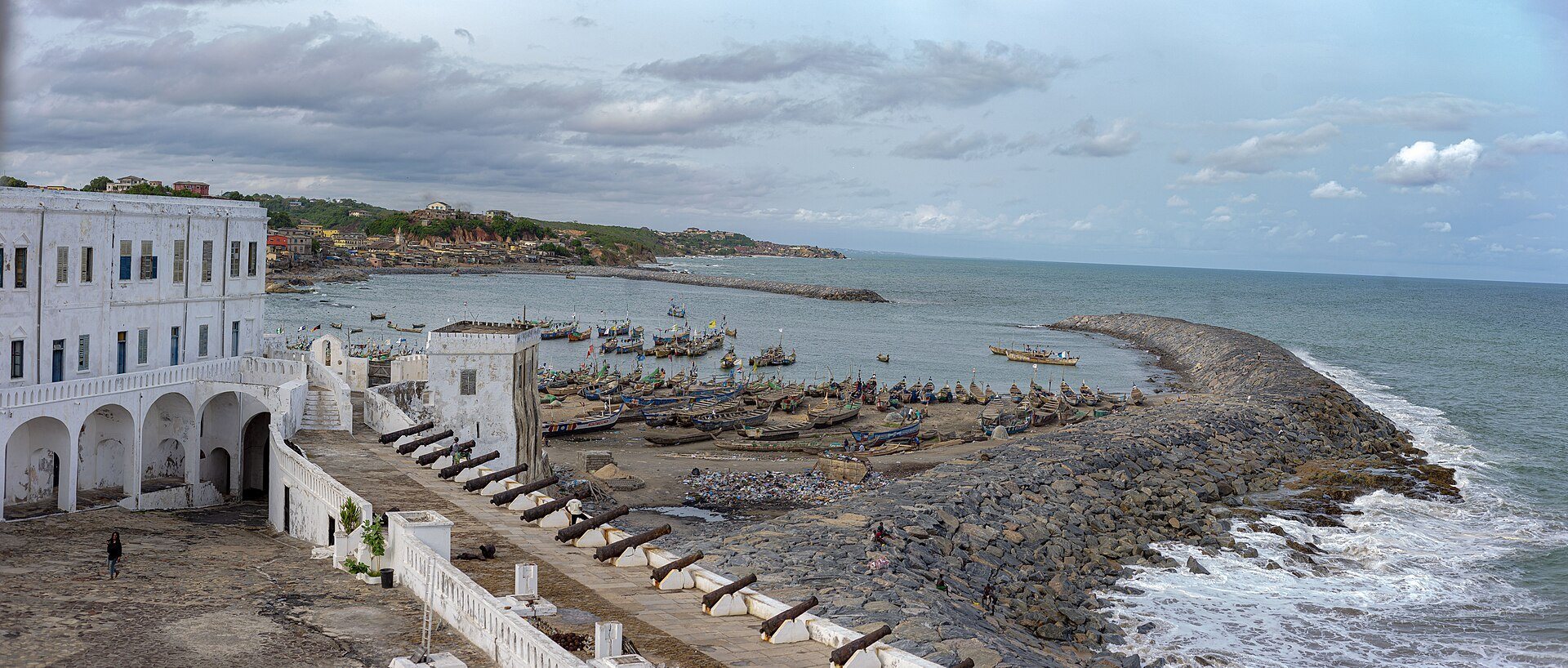
Cape Coast Castle survives as a large fortified commercial complex built mainly of brick over and around earlier timber construction. Its organized spaces include defensive walls, bastions, a sea gate, towers, a parade ground, European residential quarters, administrative areas, governors’ apartments, and underground vaulted dungeons. The castle’s physical arrangement places the former holding cells beneath the upper living and administrative spaces, preserving a stark architectural division between confinement below and European occupation above.
Fortifications and upper complex
Seventeenth-century defenses
The first lodge was wooden, but the fort was subsequently rebuilt and enlarged in more durable masonry. The seventeenth-century fortification was described as a strong regular fort with four bulwarks, projecting defensive structures that allowed fire along adjoining walls, seventy guns, and accommodation for approximately 250 men. The complex combined military protection with the storage, administration, and exchange functions of a major coastal trading post.
Later bastions and towers
A large western spur ending in a tower was constructed in 1762. In 1773, a high building was added along the northern curtain, the fortified wall joining the main defensive points, and the remaining seventeenth-century fortifications were demolished during the work. These changes reshaped the upper outline of the castle as its defenses and internal accommodation were adapted.
Greenhill Point, the eastern bastion, was replaced by two new bastions with a sea gate between them. To the south, two bastions known as Grassle’s Bastions replaced an earlier round tower as the principal defensive works. The former military tower was extended by two storeys in the 1790s and converted into governors’ apartments. The castle therefore preserves defensive structures alongside spaces altered for senior residential use.
Courtyard and underground dungeons
Parade ground and burials
The large open courtyard contains the parade ground and the graves of George Maclean and Letitia Landon. The courtyard also covers the underground spaces cut into the rock for the confinement of enslaved people, making it both an administrative and military surface above a system of subterranean holding rooms.
Enslaved people’s dungeons
The principal underground dungeon was cut into the rock beneath the parade ground. Its vaulted cellars were divided into several rooms and could hold approximately 1,000 people. The precise construction date is uncertain, but it is estimated to have been around 1682. The cells lay beneath the European living quarters and elevated administrative areas, while later dungeons were created beneath Grassle’s Bastions.
The early eighteenth-century holding facilities were overcrowded, and the shackles used on enslaved prisoners were considered excessively painful. In January 1682, eight chain slaves were allocated nine chests of corn per day, although the available supplies varied with local prices and the castle’s budget. The surviving dungeons, their vaulted construction, and their position beneath the upper rooms preserve the material setting in which captives were held before shipment across the Atlantic.
Digital record
In 2015, a terrestrial laser-scanning project documented the castle and produced a three-dimensional digital record. The record was intended to support research, education, restoration, and conservation of the surviving complex.