Montebenedetto Charterhouse: A Carthusian Monastery in Italy
Site at a Glance
- Rating
- 4.6
- Popularity
- Low
- Country
- Italy
- Primary era
- Medieval
- External website
- Open
- Eras represented
- Medieval
- Civilizations
- Holy Roman Empire
- Site type
- Religious
- Remains
- Monastery
On this page8 sections
History
Montebenedetto Charterhouse is a former Catholic Carthusian monastery in Italy, in the comune of Villar Focchiardo in Val di Susa. Founded around 1200 by the community of Losa Charterhouse, it developed as a secluded mountain monastery shaped by the Carthusian ideal of solitary contemplation in individual cells alongside communal worship.
From Losa to Montebenedetto
The community originated at Losa in Gravere, where a charterhouse was established between 1189 and 1191. The location proved unsuitable, and the monks moved to Montebenedetto in 1197 or 1198 after receiving land from Tommaso of Moriana, Count of Savoy. A foundation date of 1200 is also associated with the new settlement.
In June 1200, Henry, Viscount of Baratonia, Palmerio di Reano, and Boso Carbonello granted the Losa Carthusians an alpine territory above Villar Focchiardo. The land lay between the Salbasino area, Tollo Reposatore, and Alpe di Moschiglione, and the charterhouse recognized the three noblemen as its founders. Tommaso confirmed the community’s donations and privileges at Montebenedetto in 1202. The Bertrand family, which held substantial influence in the Susa valley, also endowed the monastery.
The early buildings were modest, while the monks struggled to establish the secluded environment, or Carthusian “desert,” required by their way of life. The community expanded its holdings by acquiring the Orsiera valley before 1205 and the lower estate of Banda in that year. Banda was more accessible and closer to productive valley-floor land, so it became the community’s main economic center. Its facilities included a grange, a farm establishment used for agricultural production and estate management, an infirmary, and a guest house.
Privileges and Medieval Development
Montebenedetto received a broad range of economic and legal privileges during the thirteenth century. Boniface of Montferrat made an offering to the Carthusians in 1202, and Tommaso granted them fishing rights along the Gravio stream in 1216. Raimond-Berenger V of Provence allowed the monks to transport salt for domestic and agricultural use without tolls or taxes. The lords of Piossasco granted pasture and transit rights in 1226, renewing them in 1258.
Amadeus IV confirmed his father’s provisions in 1233 and 1250, while Guigues VII of Viennois renewed earlier protection and transit rights in 1243. Beatrix, Countess of Vienne and Albon, ordered local officials to protect the charterhouse in 1268, and Amadeus V issued a similar order in 1290. In 1281, William VII of Montferrat granted pasture rights and exemptions from tolls. Relations with the Bertrand feudal family fluctuated during the fourteenth century.
Flood, Relocation, and Later Use
During the fifteenth century, pressure increased to move the community down into the valley. In 1473, a catastrophic flood of the Gravio destroyed almost all of the upper monastery, while a landslide carried the lower house about 50 metres farther downstream. The small church was the only major part of the upper complex left standing.
By 1498, the monks had moved to the expanded charterhouse at Banda, and Montebenedetto became a monastic grange used as a farmstead. The Banda community moved to Avigliana in 1598. In 1630, Charles Emmanuel I, Duke of Savoy, ordered the Avigliana buildings destroyed for defensive reasons. The monks then temporarily reoccupied buildings at Montebenedetto and Banda, before receiving the Charterhouse of Collegno in 1642.
Restoration and Present Administration
The creation of Orsiera-Rocciavre Natural Park led to restoration and consolidation work at Montebenedetto beginning in 1987, with particular attention given to the monastic church. The main campaign was completed in 2000, followed by the recovery of surrounding structures. A small permanent exhibition on the Carthusian order and monasticism was established inside the church. The complex is owned by the Piedmont Region and managed by the Alpi Cozie Park. It belongs to the Carthusian Province of Lombardy, the order’s administrative division for monasteries in parts of northern Italy and neighboring Alpine regions.
Remains
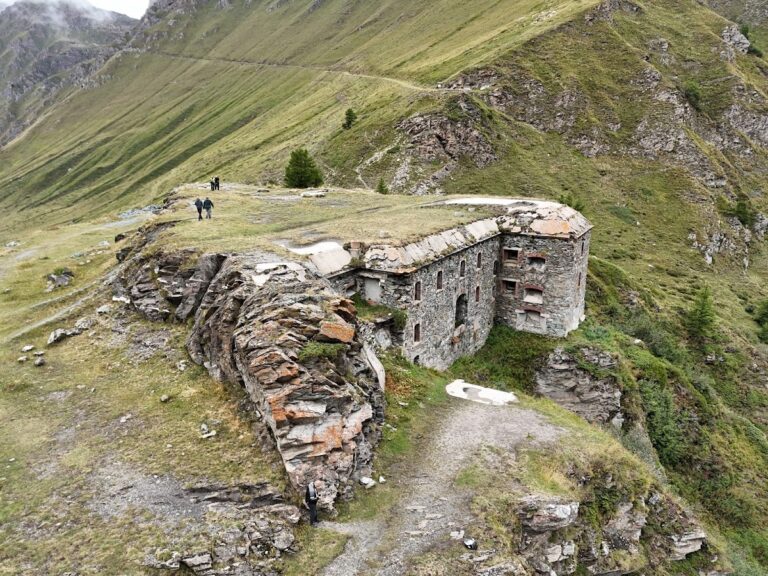
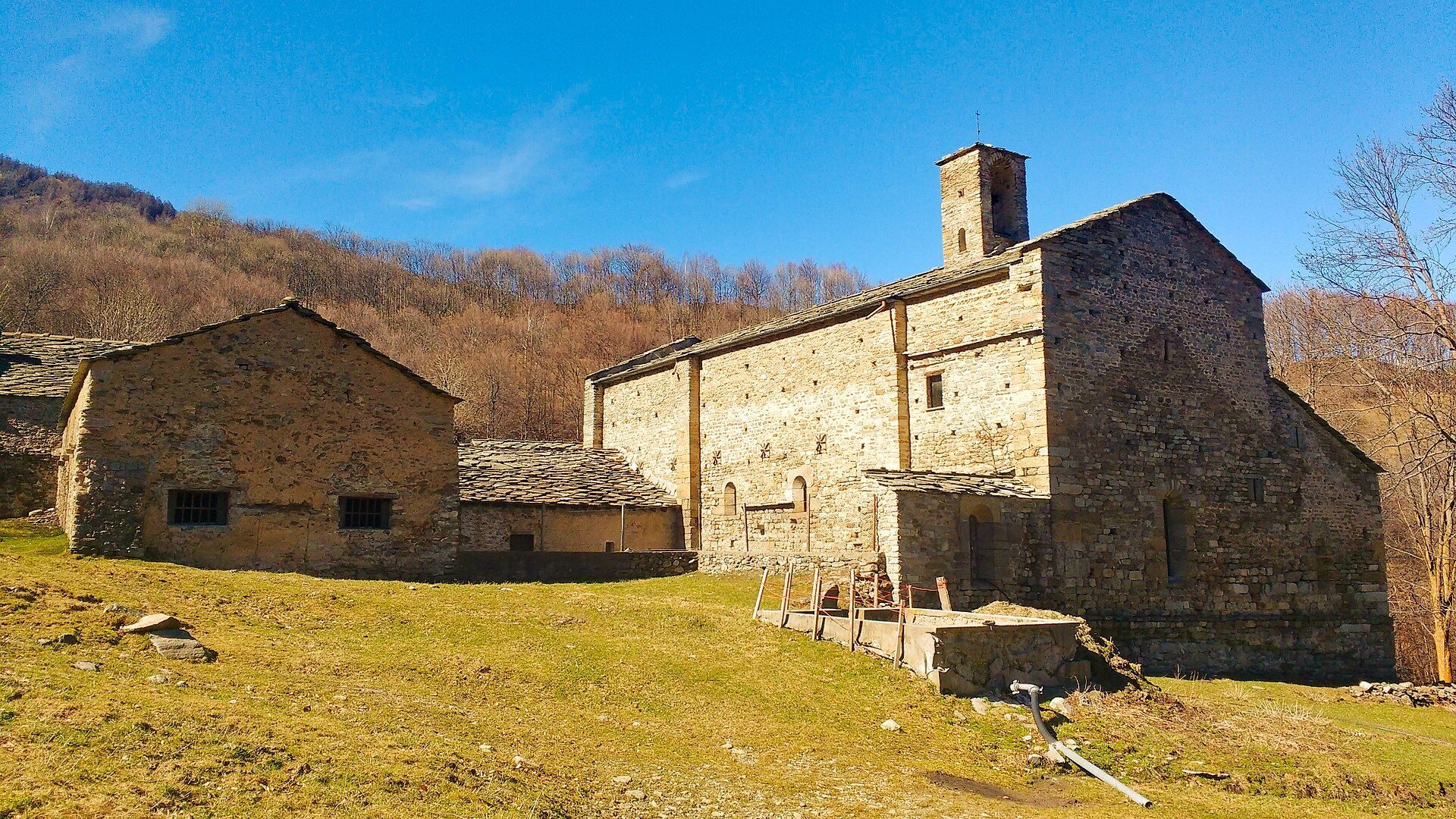
Montebenedetto stands at approximately 1,120 to 1,150 metres above sea level, in a woodland clearing beside the Fontane river. Its arrangement followed the traditional Carthusian division between the Casa Alta, the upper section containing the religious heart of the monastery, and the Casa Bassa, the lower section where religious members primarily performed manual work. The lower Banda estate, acquired in 1205 at a more accessible elevation, formed part of the monastery’s economic and practical organization through its grange, infirmary, and guest house.
Romanesque Church
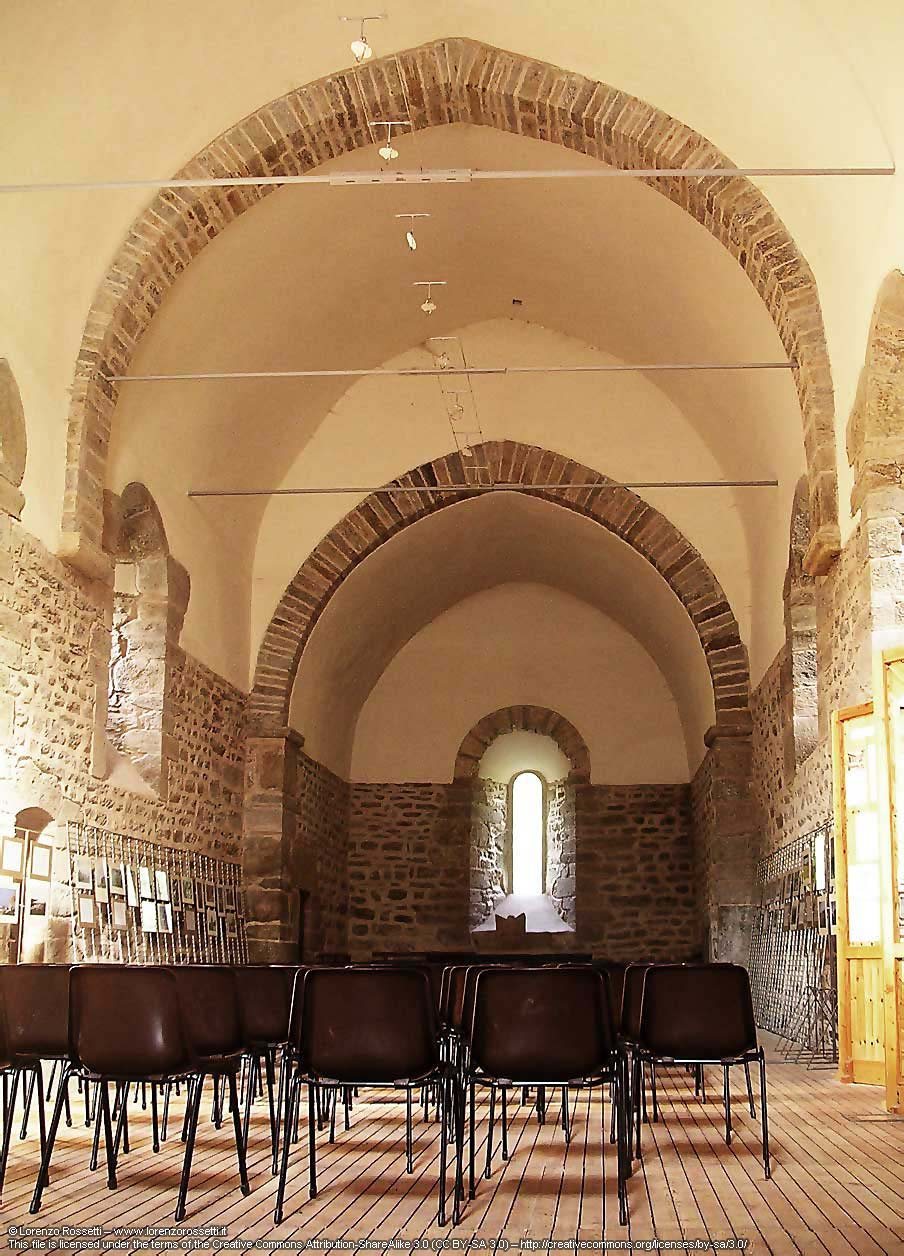
The former Carthusian church is the best-preserved part of the complex. Built in the thirteenth century in the Romanesque tradition, it has the massive masonry, rounded-arch forms, and compact character associated with that medieval style. The flood of 1473 left the small church standing while destroying most of the Casa Alta. Its original floor survives, and a wooden floor installed in 1990 protects it. Restoration and consolidation focused especially on the church, which now also contains a small exhibition on Carthusian life.
Monastic Buildings and Recovery
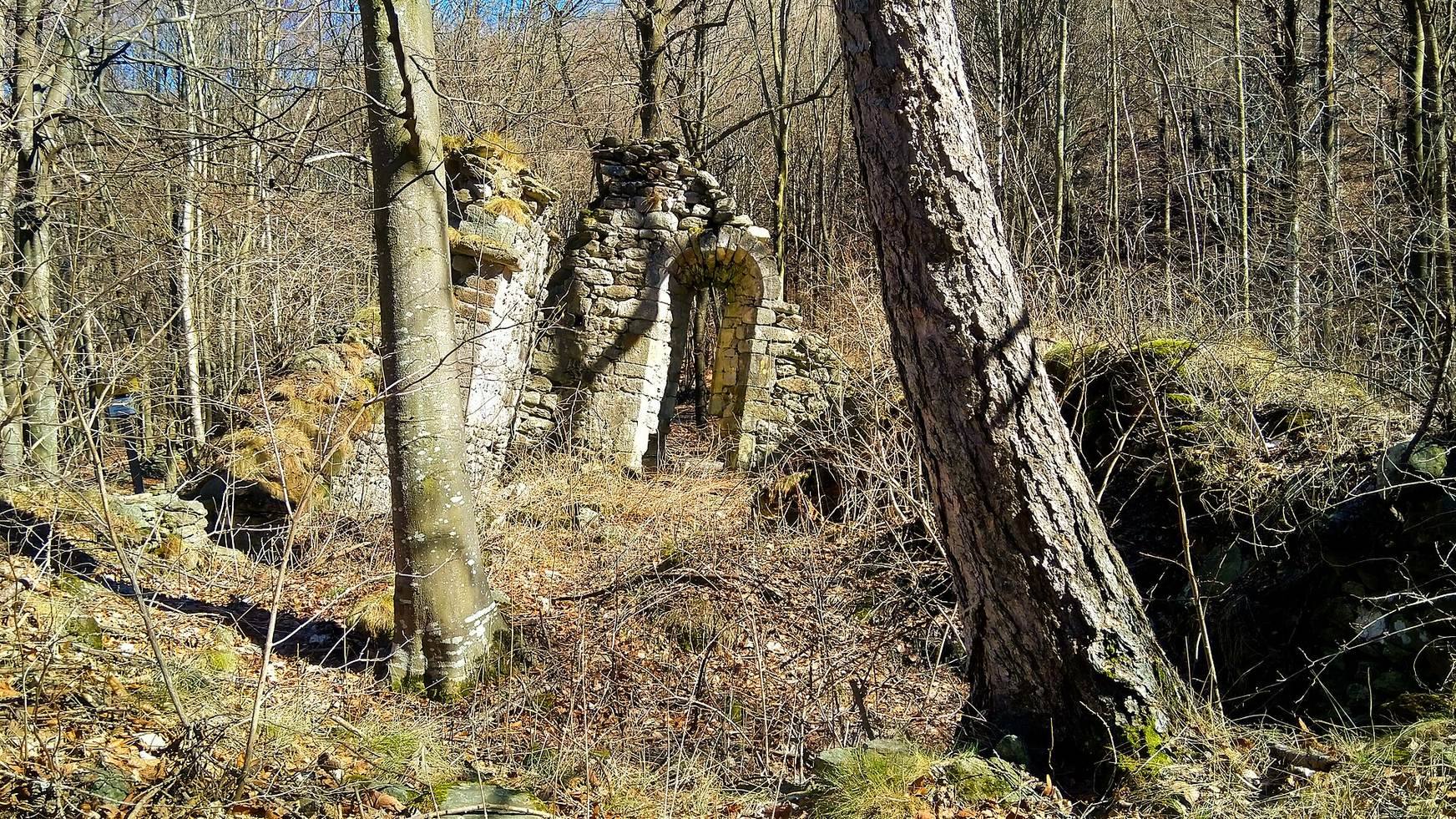
The great and small cloisters, the monks’ cells, and the buildings used by the lay brothers were damaged by the flood or fell into ruin after the monastery was abandoned. Lay brothers were members of the Carthusian community who generally undertook manual and administrative work. The surrounding structures were recovered after the restoration campaign completed in 2000, leaving the church and the remaining monastic fabric as the principal physical evidence of Montebenedetto’s former organization.